Unleashed Tyrese? A Profile of Tyrese Campbell

So, Tyrese Campbell, eh? A divisive figure among many Stoke fans, so lets get the the bottom of it once and for all.

Is he actually any good? Well, long story short, yes.

But let’s look into the long story a little bit deeper. What is he good at? Where is he best used? Will he be my best friend? All this and more (maybe) answered below.

Who?

Let’s start off with an overall picture of the type of attacker Campbell is. Using the radar plot from our Player Stats Hub, we can build an insight into what style we’re looking for in the player.

From this, I draw three major conclusions.

Firstly, Campbell is an excellent creative force, in the top 10% of expected assists (xA – a measure of how likely a pass is to result in a goal) per 90, the top 10% for crosses per 90, alongside being in the top 25% for key passes (passes putting a player in a clear goalscoring situation), passes into the area, and deep completions (passes to the zone <20m from the opponent’s goal).

Secondly, he’s on an incredible finishing run, despite getting lower-value chances than almost 3/4 of forwards in the league, he scores above his xG by 0.07 per 90, in the top 25%. More on this later.

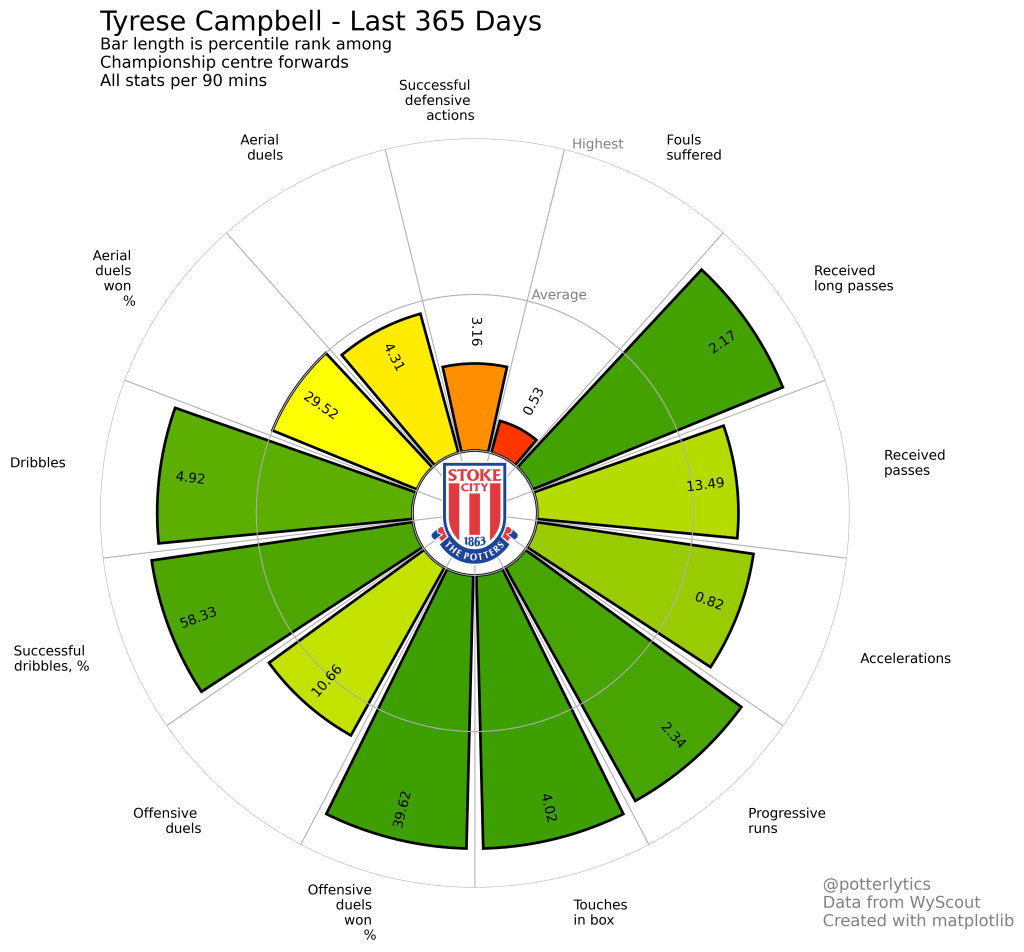
Finally, it’s clear he’s a very strong ball carrier, above 75th percentile in progressive runs (definition here), dribbles, dribble success rate, touches in the box, and offensive duels. Campbell is a strong forward who wins his duels and carries the ball incredibly well, taking on defenders and progressing play towards goal.

Surprisingly for many, he’s actually about average at winning aerial duels too. Take that, sarcastic cheer-ers.

He’s clearly a very well-rounded forward, but let’s dig a bit into each of these aspects, starting with his finishing.

The Boy’s On Fire

It’s actually incredibly rare for players to overperform their xG over long periods of time, so the stats above for Tyrese’s finishing are a little suspicious at first glance. Is he just on a hot streak? Well, weirdly, no.

Campbell has outperformed his xG in every season as a footballer besides his first 5 games at Stoke, played exclusively as a substitute in Paul Lambert’s doomed side.

Below we have a plot of Campbell’s cumulative goals and xG over his whole league career on the left, and a plot of his cumulative xG overperformance (i.e. his goals minus xG) over the same period of games. It’s clear he’s an oddly consistent performer.

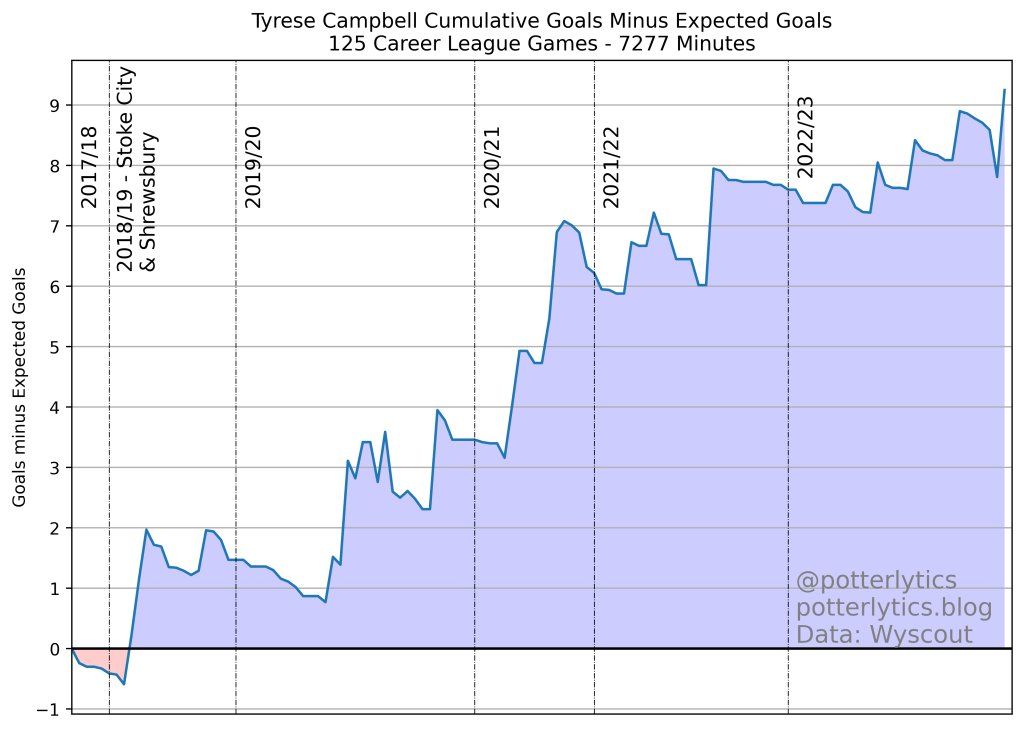
Why though? If this is such an oddity, why is he such a consistent finisher? Well it could be that this is only a sample of just over 7000 minutes – just over 80 full games, but I think there’s some more to this that we can use to explain Campbell’s quality.

If You Have To Ask, You’re Streets Behind

One thing that shows up clearly in Campbell’s goalscoring is his preference for two zones either side of the D, just within the box.

Looking at his last 75 shots we can see a clear penchant for scoring from these two areas.
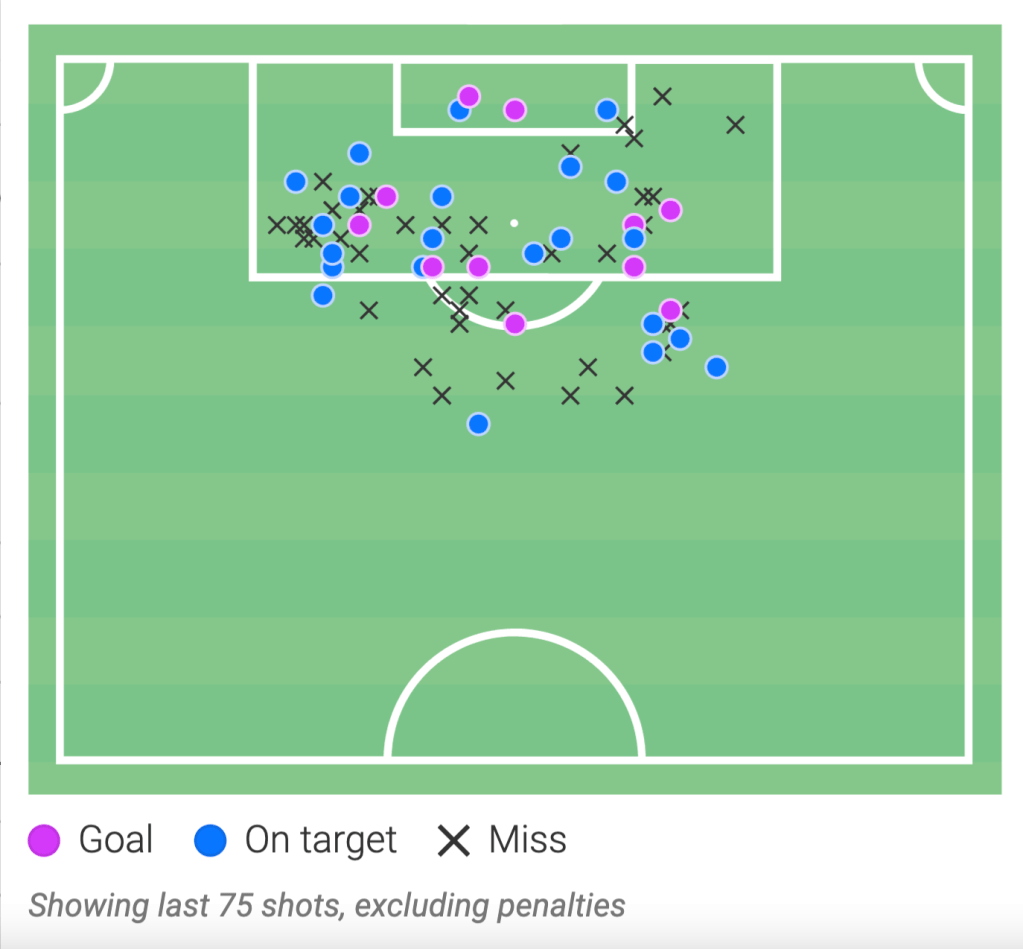
Image: WyScout

Due to this area obviously looking like a phone (right?), and definitely not due to me forcibly trying to hammer in the word ‘Ty’ to something, I’ve decided to coin this the ‘Ty-phone‘ zone. It sounds kind of like Typhoon too, which is a cool word. It’s verbal wildfire. I’m so sorry.

The ‘Ty-phone zone

Campbell’s quality turns these lower-value, lower-xG chances into goals at a disproportionate rate because of his specific skill in curling the ball to the far post.

We can delve into a few examples to see this in action.

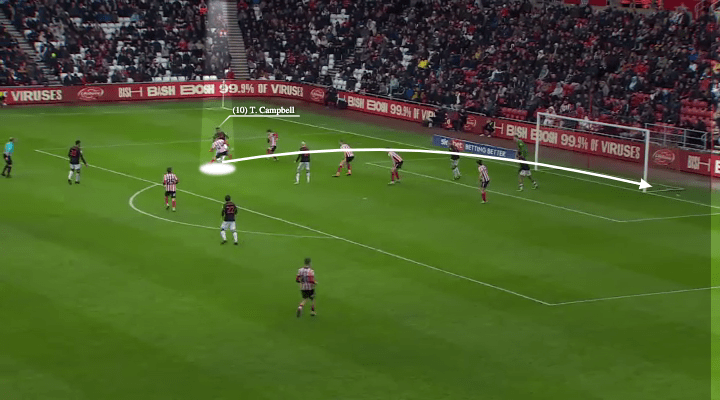
First off, let’s look at his 2nd, and Stoke’s 3rd, away at Sunderland.

Click each image to zoom in.
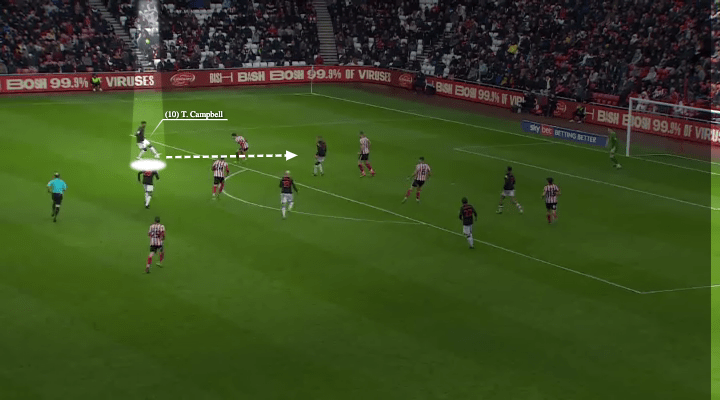
Campbell gets the ball on the edge of the area to the left, drives at the back line, and attempts a shot.

It comes back on his right foot, and he curls it to the far corner through a crowd of defenders. This had 0.06 xG according to Infogol.

We saw a similar goal from the other side last season at home to Birmingham.

Click each image to zoom in.

Campbell takes it on the right outside the box and immediately drives at the defenders.

From there he cuts inside past a Birmingham defender and and whips it into the far corner.

Again, Infogol has this as a 0.06 xG chance for the average player.

Finally, we go back to the lockdown season vs. eventual promotion-winners Brentford.

Click each image to zoom in

Tyrese picks the ball up wide left. comes inside on his right foot, beating two defenders, and whips it again into the far corner.

Infogol has this chance at a tiny 0.04 xG.

So we have 3 very similar finishes here, and Campbell has done this on several more occasions, also adding his skill of driving the ball across the keeper, and powering it home at the near post as vs Peterborough in 2021.

But Hold Your Horses

Goals can be very deceiving, particularly when there are only 31 of them, so is there a different way we can quantify Campbell’s finishing skill? The answer, predictably, is ‘kind of but not entirely’.

Whereas normal expected goals (xG) refers to the probability of a player scoring a given chance at the point of a shot being taken, Post-Shot xG (PSxG), refers to the probability of a shot being scored after it has been taken.

This includes features such as the power of the shot, where it is headed in the goal, swerve and trajectory, and players unsighting the goalkeeper.

As such, one way to infer the quality of a player’s shooting is to compare the PSxG with the xG, to see how much a player’s shots improve the quality of chances they get.

Now, as a point of order, this is by no means a definitive measure of finishing quality. As with all statistics, this is just one, very imperfect measure by which we can gain some insight into what might be happening.

As an example, a shot near the top corner that just goes wide will receive 0 PSxG, whereas a slow dribbling scuff that goes straight into the keeper’s arms will receive a PSxG of above 0.

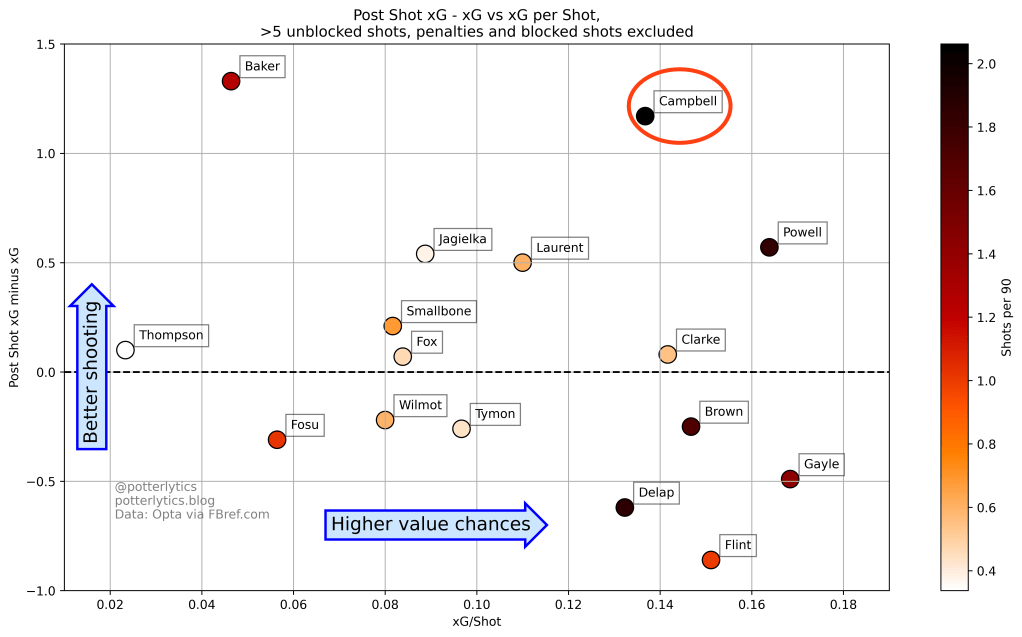
But, as an indicator, we can still use it to gain some insight, and as such we have the two plots below, showing Stoke players’ PSxG overperformance (i.e. the PSxG minus xG) vs the average quality of their chances (xG/shot).

Click each plot to zoom in
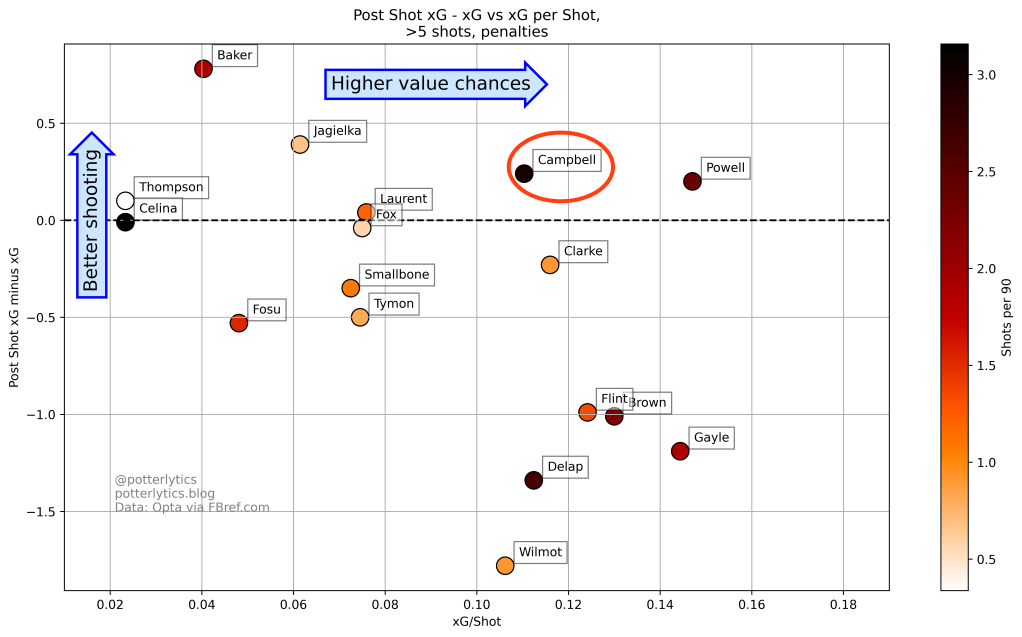
What we see here is another insight into Campbell’s quality of shot.

In the left hand plot, including all shots, we see that he’s added around 0.25xG to his chances.

In the right hand plot, we have discounted blocked shots, as these are typically ascribed a value of 0PSxG, whether struck into good areas or not.

In this case Campbell stands out alongside long-shot expert Lewis Baker. He has added over 1.1xG to his chances via his shooting skill this season, another indication that he has quality in striking the ball.

Tyrese, The Creator

Well, I think we’ve built up a solid idea of his finishing, so what about that glorious vat of creativity we saw in the radar? Well, let’s expand it a little and take a closer look.
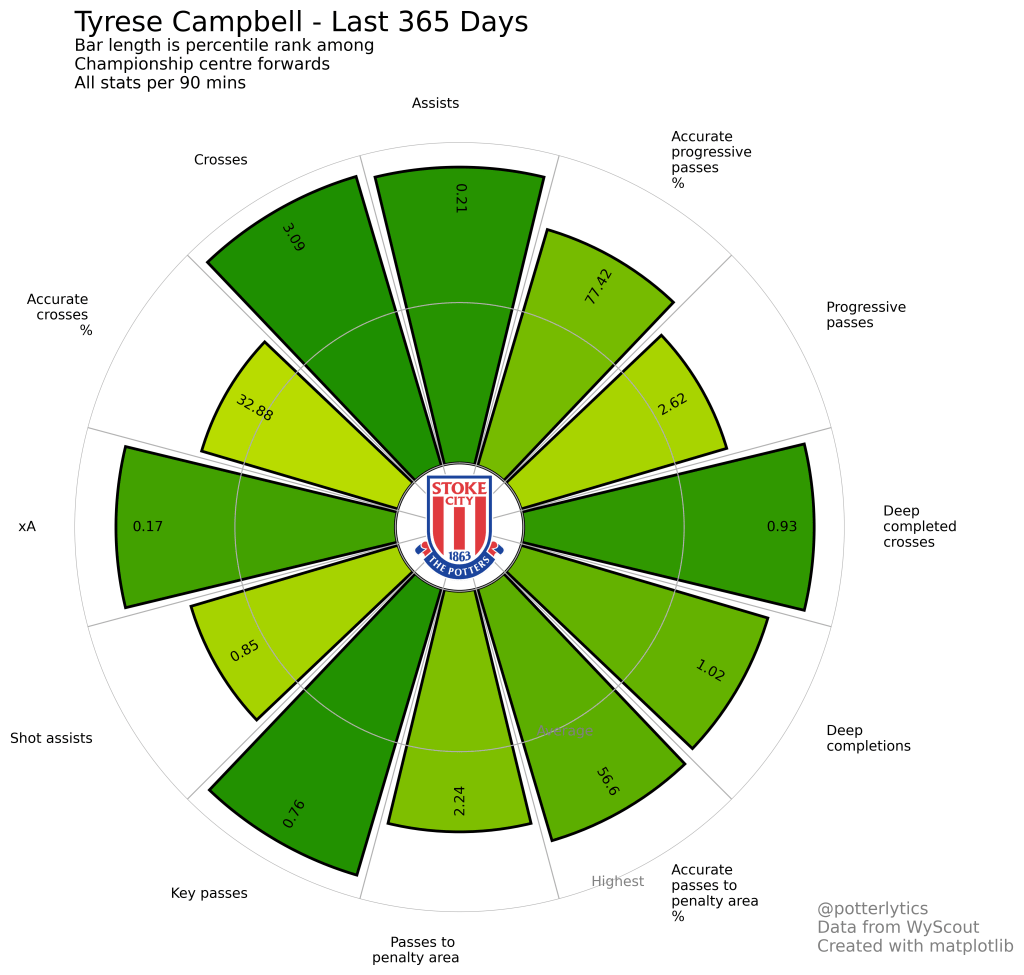
Well, you’ll be glad to hear that Campbell is one of the most creative players in the league in his position.

Particularly impressive are the deep completions, xA and key passes, all signs of a quality creative player.

He progresses the ball exceptionally well, and the number of shot assists that are key passes is a good measure of this quality.

Let’s take a look at how Tyrese likes to get his assists, and I promise I won’t make up a new name thing for it this time.

Campbell is in the top 15% of crossers even compared with AM/Wingers, and carries the ball into the area more than 89% of forwards in the league (FBref).

He also attempts in the top 11% of take-ons among forwards, so we can tell that he likes to take players on, alongside getting lots of crosses in.

It’s also obvious from his heatmap below (for Campbell’s whole senior career) that he has a preference for running wide, with lots of touches wide of the box. Alongside that, we see those touches inside the corners of the box, in that Ty-Phone area again.

Image: Wyscout

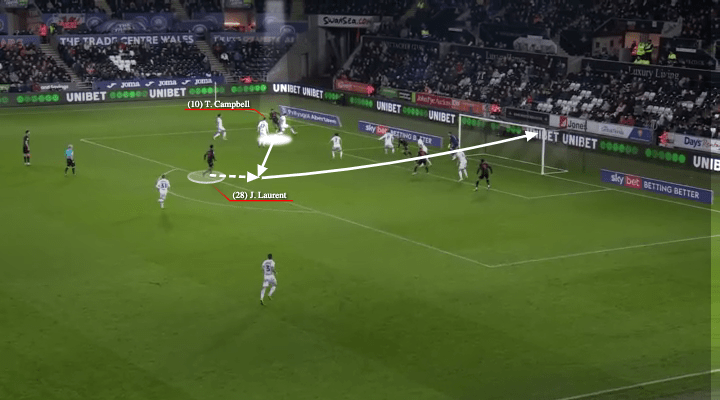
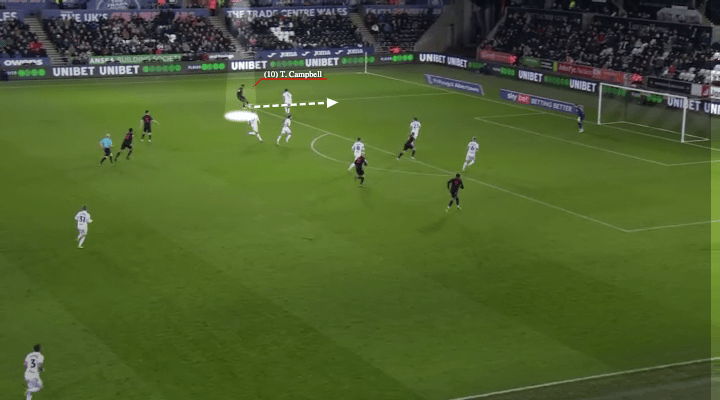
We can see lots of this in action in his last assist, vs Swansea.

Tyrese gets the ball in a similar position to the goals explained above, where he scores in the Ty-phone.

Again, he drives at the defence, but this time he runs on the outside, beating a defender to cut the ball back to Laurent, who fires it into the top corner.

Click each image to zoom in
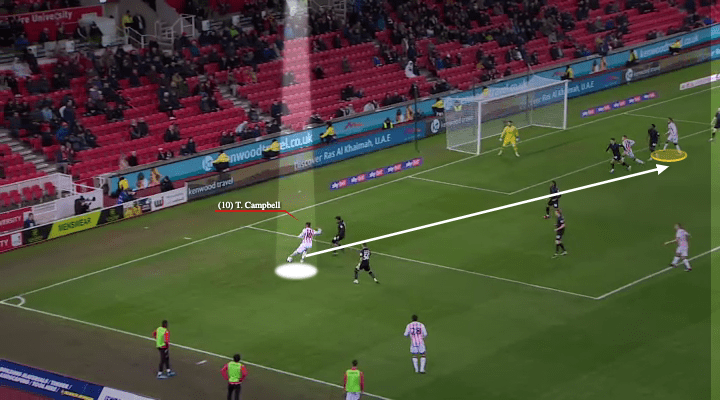
The same happened in the game against Huddersfield in January.

Campbell gets the ball on the edge of the box, again beats a defender and cuts it back into a dangerous area.

Brown gets two bites at it and then scores.
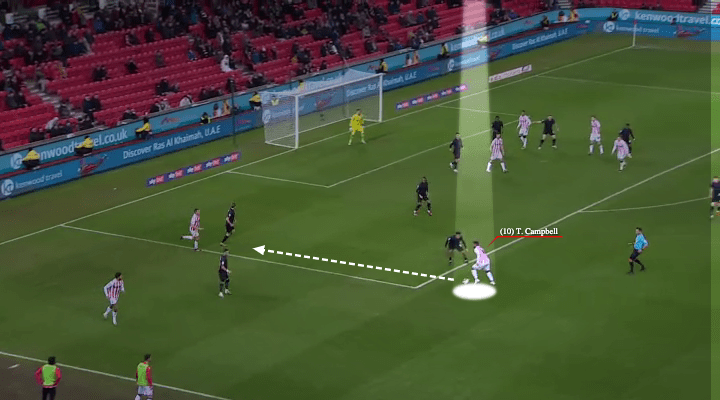
The cut-back from a take-on into wide areas is something Campbell is really bringing into his game this season.

Most importantly, many of these passes, cutbacks and crosses are not just high-volume, but also of a high-quality, leading to Campbell’s high expected assist numbers.

The skill Campbell has when attacking the box with the ball is rare at this level, and his output reflects that.

Spreading His Wings?

Now what about positioning? Campbell is a player who is often touted as ‘better from the wing’ by fans, and there’s no doubt that his skill-set in carrying the ball from deeper, and attacking the box from the half-spaces is fantastic.

That being said, does he have to play wide to play well? The answer is probably no.

Positions in modern football are a difficult concept to easily tie down. As a brief example, playing Gayle as a central striker and Brown as a central striker gives you two very different things. One will push higher on the back line and one will drop deeper.

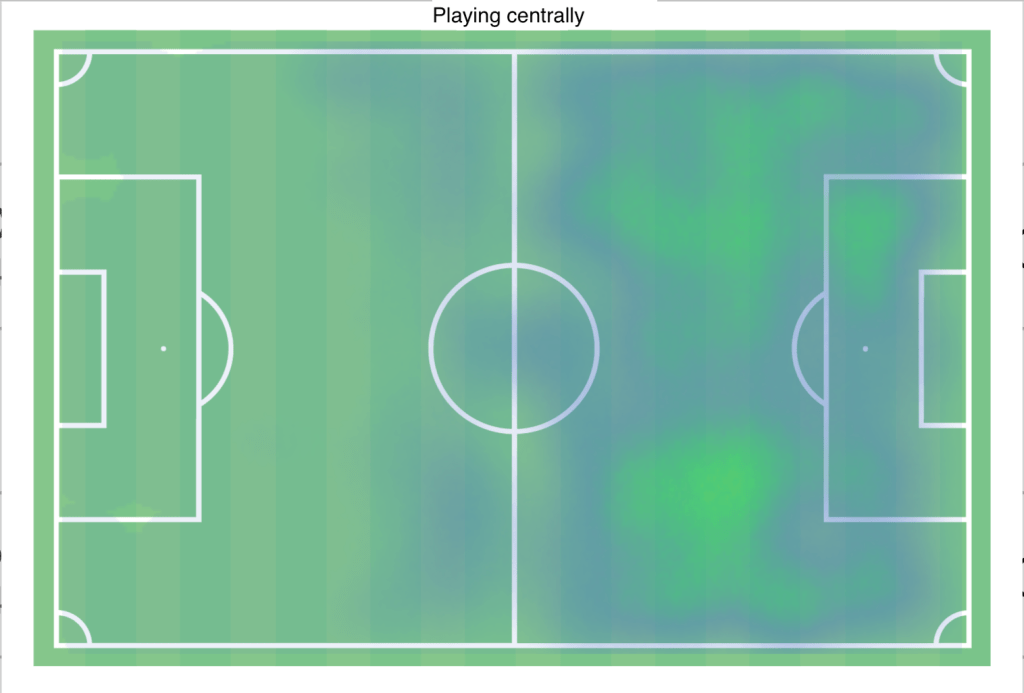
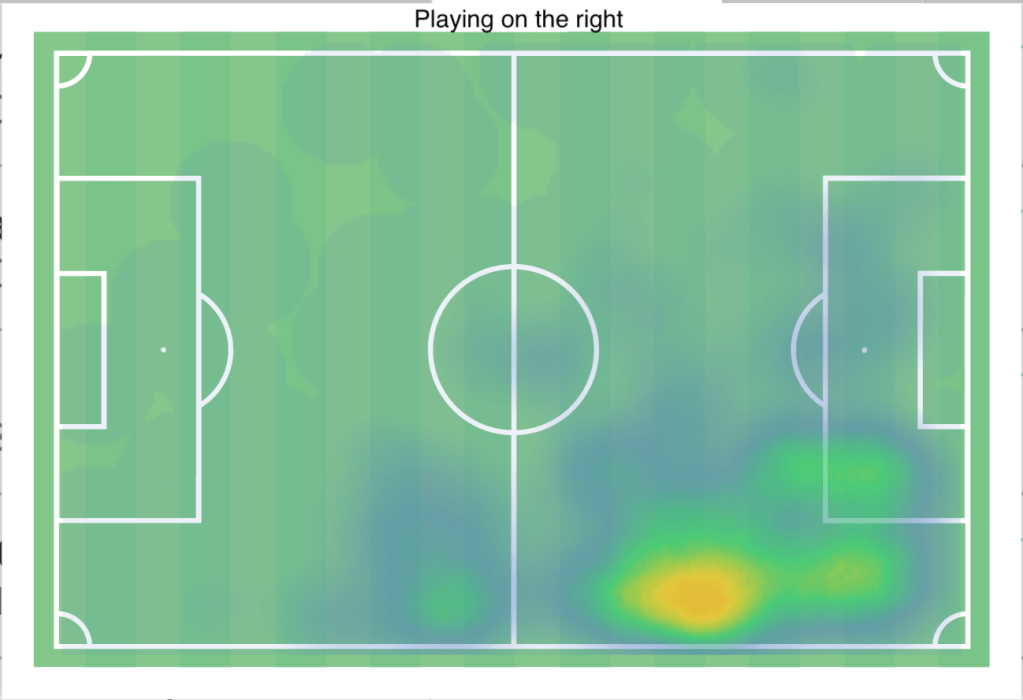
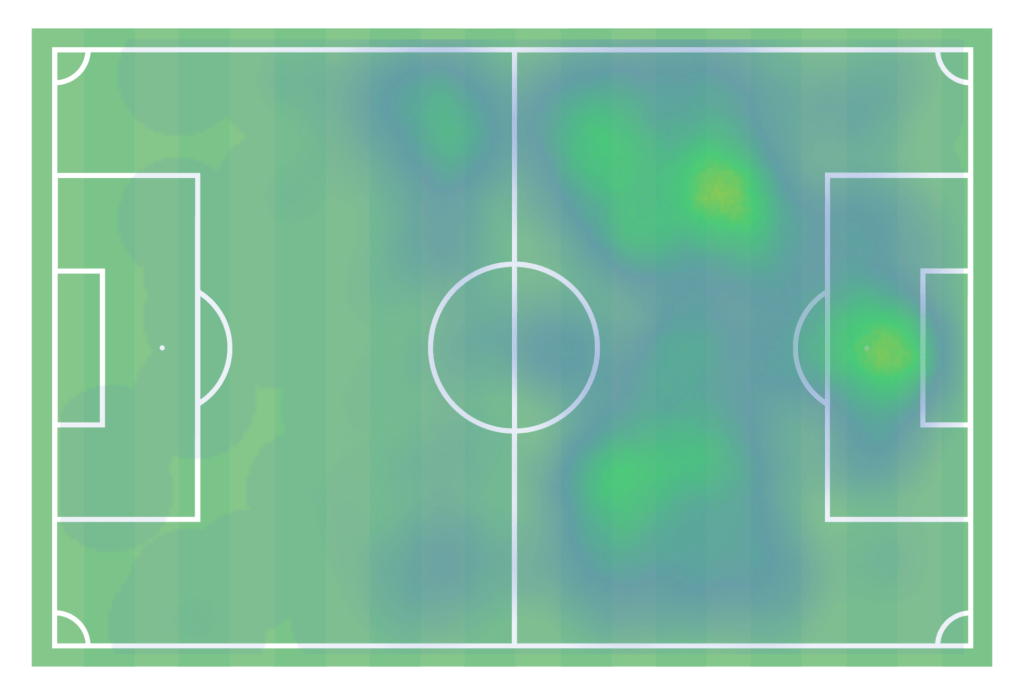
What we do see is that no matter which ‘set position’ across the front line Campbell starts in, he still tends to get touches of the ball in deeper and wider positions, where he’s clearly dangerous.

We can see that in his heat maps below, each showing Campbell’s senior career touches when starting wide left, centrally, and wide right.

Click each image to zoom in

Simple ‘formations’ as we know them are not completely useless, but this is a good example where they are not fully describing the game in front of us.

As a central striker in Michael O’Neill’s 352, Campbell would still drop into many of the same positions he would occupy as a wide man in Alex Neil’s 433.

In terms of numbers, his output is still good in all positions too, although there is an increase when he starts wide, which I will explain further.

The table below shows his output per 90 minutes in each position in his league career so far.

Metric\PositionWide LeftCentralWide Right
Minutes91141802013
Goals0.490.340.45
Assists0.300.110.22
xG0.280.290.23
xA0.180.090.13
Dribbles/success rate %6.72 / 61.8%3.57 / 51.8%6.08 / 55.9%
Crosses/accuracy %5.73 / 29.3%1.79 / 25.3%3.00 / 34.3%
Passes to penalty area/accuracy %3.75 / 44.7%1.53 / 47.9%2.86 / 54.7%
Data: Wyscout

You may look at that and immediately conclude that Campbell is better playing wide, but remember many of these numbers will be due to the change in play style and not necessarily indicative of a player who is ‘better’ in one position than another.

As a striker, Campbell will be much more focused on running in behind and creating space for others, for example, which does not show up in his own numbers.

What we can say is that Campbell is great at dropping deep and driving at defences.

BUT….

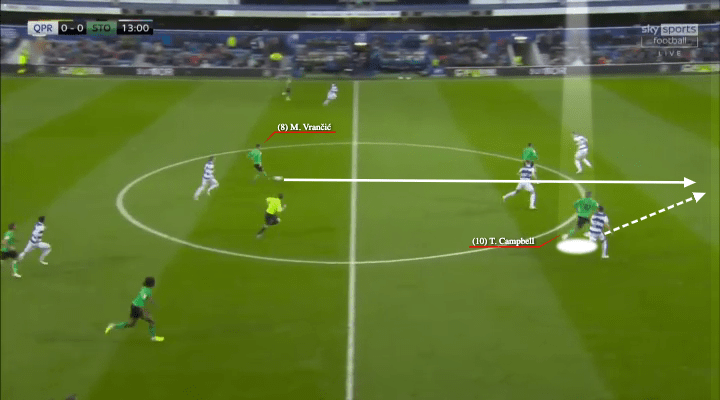
As alluded to above, there’s another side to his play too. Let’s look at one of his goals from last season, away at QPR.

Click each image to zoom in
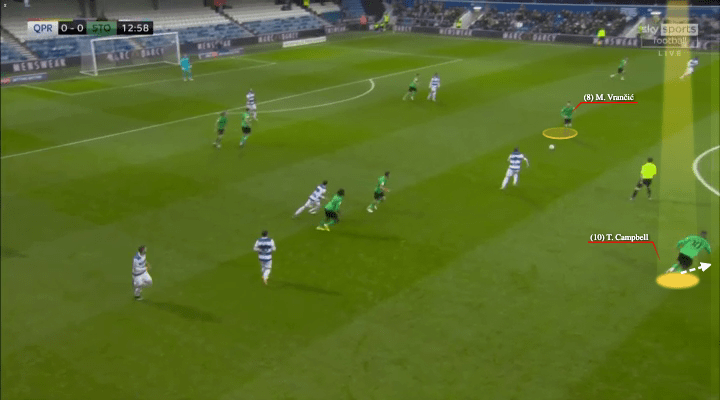
As Vrancic gets the ball, Tyrese immediately sprints forwards.

He breaks quickly through the dropping defence, into a huge open space to slot home from the edge of the box 1v1.

We saw a similar goal from Campbell against Preston this season too.

Click each image to zoom in
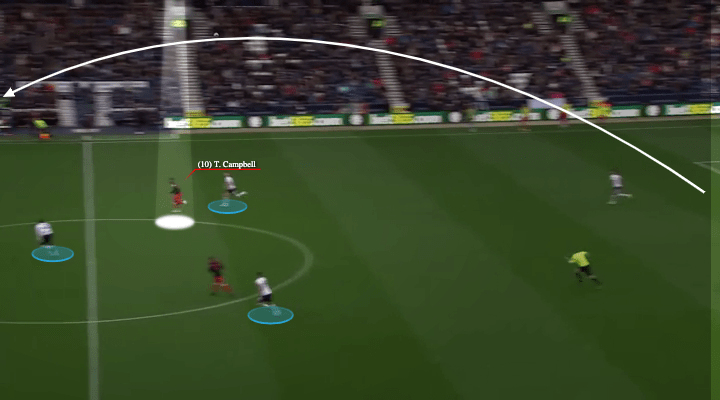
Baker receives the ball on the edge of Stoke’s box, and immediately plays it high and long for Campbell.

With a 10 yard deficit to make up, Campbell gets the ball before the Preston defender, cuts into his Ty-phone Zone and finishes in his trademark style.

So although Campbell’s skill running at defences & progressing the ball is clear, he’s also a huge threat in behind with his pace and particularly his 1vs1 finishing skill.

Conclusions?

So, what have we learned? Well, we’ve learned that I have some kind of obsession with Tyrese Campbell and/or numbers.

We’ve also learned that the numbers are very promising for his career, he’s a quality finisher of chances and has a skill level for progressing the ball that is rare among peers in this league.

He can play wide or central, but whichever you choose, you’d be silly not to try to get him involved in play as much as possible.

Thanks to any and all readers, and please feel free to comment and follow on Twitter at @potterlytics.

Should you wish to donate to help with the running costs of the site, and the data subscriptions we use, please feel free to visit our donations page here. Any and all help is very much appreciated!

George
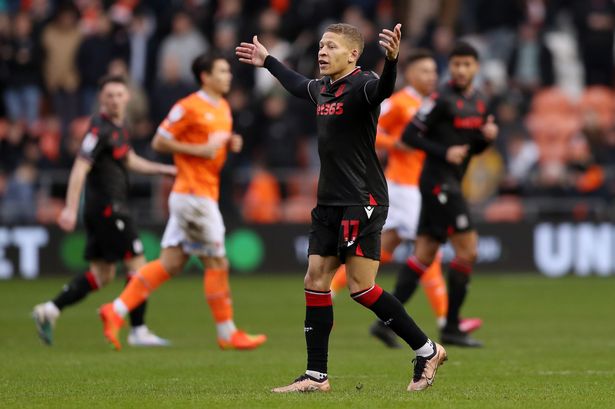
Bringing Balance To The (Strike) Force

Now that the transfer window’s excitement and fun has died down, we find Stoke City having added no strikers and lost one loanee in Liam Delap, shifted off to Preston.

This leaves the remaining trio of Jacob Brown, Tyrese Campbell and Dwight Gayle.

The fanbase has been, to say the least, divided over the roles each of the 3 should be playing, and so I thought it would be useful to give some added context through the lens of stats and a little bit of tactical analysis.

I’ll focus on style, strengths and weaknesses, and try not to swerve too much into critique, although I’m not perfect!

If there are any metrics you’re unsure of or haven’t heard of before, please feel free to visit WyScout’s Glossary for a full definition.

Strikers?

Central to our discussion is the role each striker plays, and one initial marker of this can be where each player takes their touches on the pitch, shown by the heat maps below.

Remember the colour of these maps is relative to the player, not to each other. So an area of 10 touches for one player could have the same colour as an area of 100 touches for another, more active on-ball player.

Jacob Brown’s heatmap in the 22/23 Championship season – Image: WyScout

First off, Jacob Brown’s heatmap shows a few interesting things. This is selected through WyScout’s filters to exclude games where Brown played at wing back.

We see a lot of touches on the right hand channel, which is reasonable as he’s been favoured on this side of a front two in a 352, and rarely on the right in a 433.

We also see very few touches in the central areas outside the box, but a hotspot in the space between the 6 yard box and the edge of the penalty area.

As an initial assessment, this tells us that Brown gets into the box readily, and appears to rarely contribute to creation outside the area. When we look into deeper analysis, this is what we should check.

Dwight Gayle’s heatmap in the 22/23 Championship season – Image: WyScout

Second up, we see Dwight Gayle’s map. Lots of his touches are around the penalty area, where he’s been played as a central striker.

However, we also see that Gayle is much more active outside the box. Lots of link-up between midfield and attack, particularly off the left, where he’s linked with Tymon.

This means we’re probably looking for some creative stats alongside his shooting in our analysis.

Tyrese Campbell’s heatmap in the 22/23 Championship season – Image: WyScout

Finally, with Tyrese Campbell’s heatmap, we see a much more interesting plot.

This only includes games where Campbell has played as a striker, and we see that he’s a much more nomadic player than Brown or Gayle.

He appears to love attacking the box from the right half space, and dropping off the front line to receive in the deeper half spaces.

All this gives us a baseline from which to build some insights into each of our strikers.

Shooooooooooot

Let’s start with somewhere we see great variety in our strikers: the finishing.

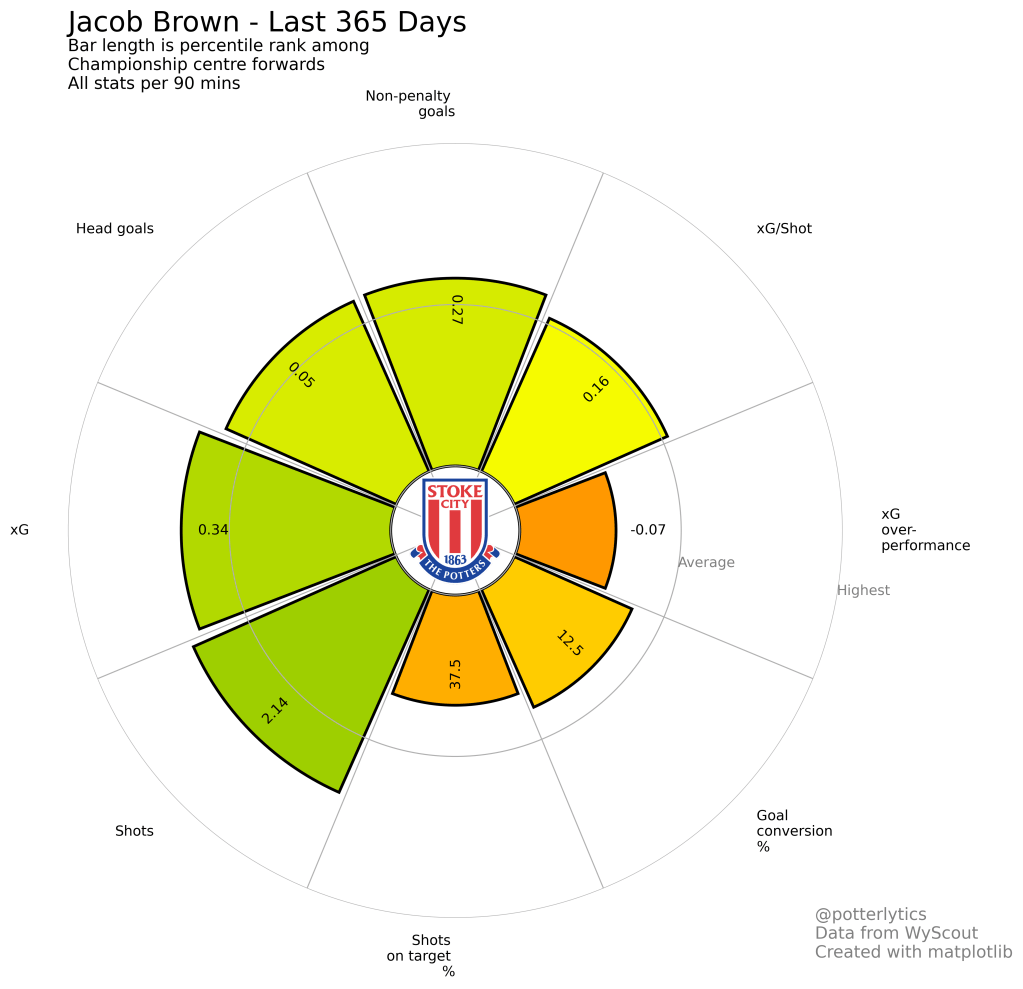
Beginning again with Brown, with the least exciting data of the 3. We have a radar plot, where the length of each bar is the rank among EFL Championship strikers, in the past calendar year.

Brown’s chart is probably unsurprising here, he gets an above average number of chances, scores a good amount of goals, but underperforms his xG (i.e. scores fewer goals than expected given his chances) by about a goal every 14 games.

Interestingly, xG underperformance is a stat that generally tend to regress to the mean over long periods of time. This means that players in general, including some of those we think of as the best ‘finishers’ of all time, tend to score a number of goals relatively close to their xG over the course of a career. For further reading on this I highly recommend this article from James Tippett and his book: ‘The Expected Goals Philosophy’.

But xG is still an interesting indicator, and what we often see is that players who are at a higher quality get into positions to get more xG than lower quality players.

Brown seems to be a strong box presence, who can get into positions well to generate a fairly high quantity of xG through the course of games.

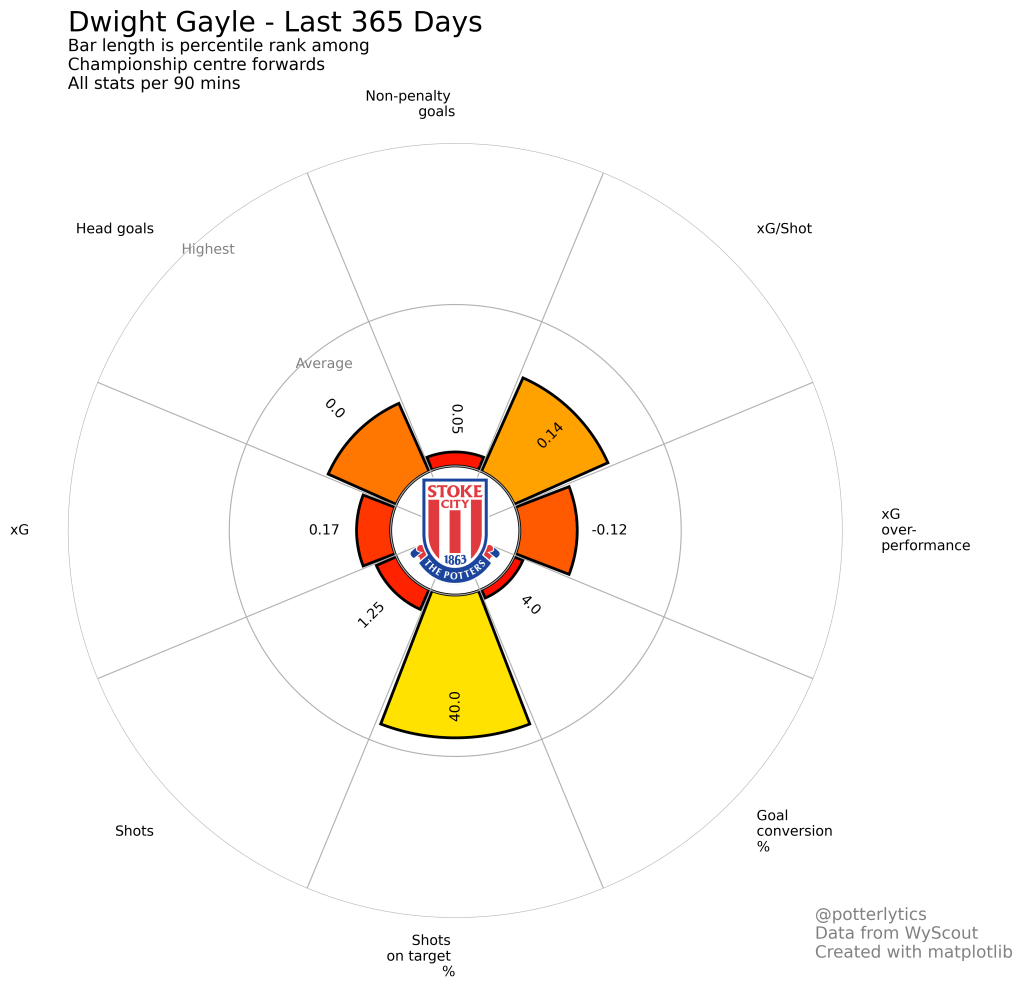
Gayle’s chart, however, is very revealing.

The xG underperformance, as above, is not necessarily in itself the worst thing possible, but the fact Gayle has a very low number of shots is a poor indicator, and particularly worrying are his general xG stats.

As mentioned, high-quality forward players tend to be getting into positions where they find lots of xG, but Gayle seems to have lost that completely.

A lack of xG overall, and a well below average xG/shot shows that Gayle is not only getting few chances, but that the chances he does get are of relatively poor quality.

This fits well with the fact his heatmap showed lots of touches outside the box, but he seems to have lost a lot of in-box presence since his prolific 18/19 season.

Gayle appears to have changed his style quite considerably from that time, but we can tell that he’s no longer a nippy, clinical, movement-based goalscorer.

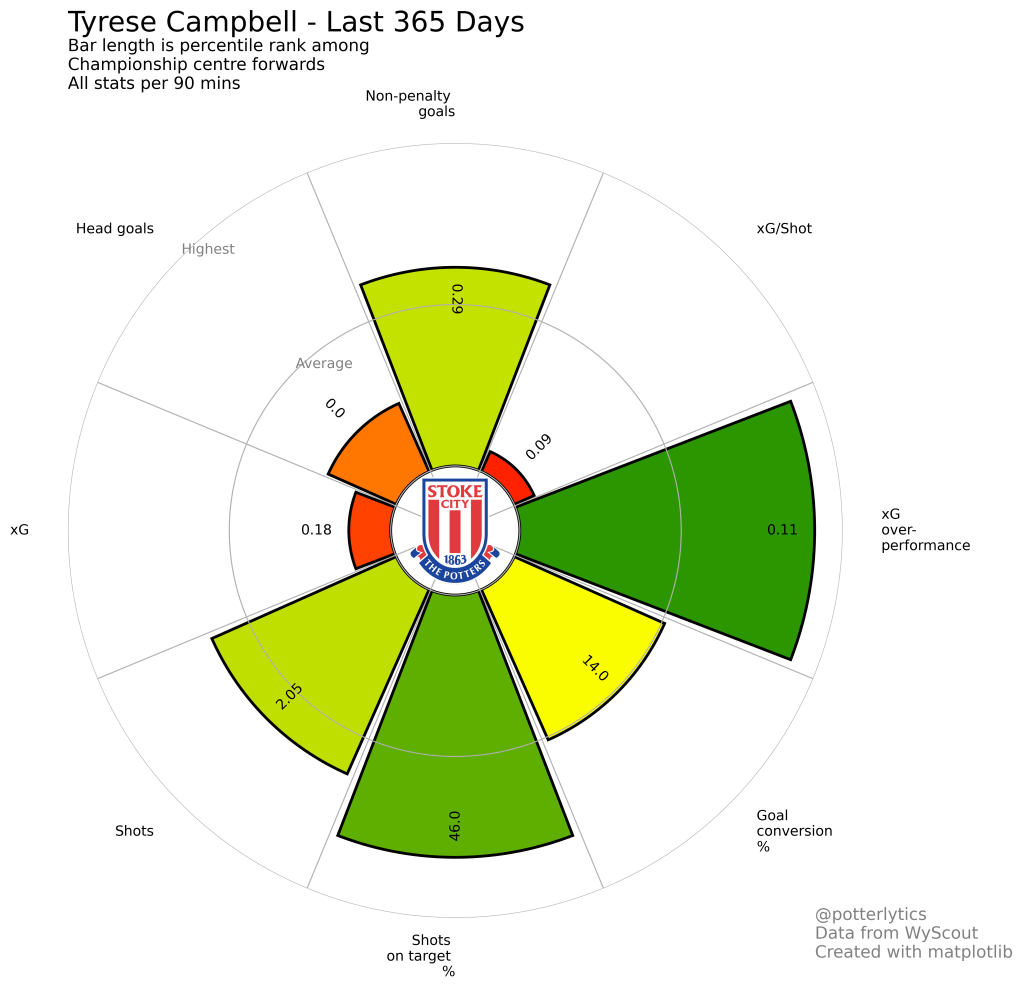
Now we come to, in my opinion, the most interesting and nuanced plot of the 3 forwards. Tyrese Campbell.

Looking at the xG and xG per shot, we see that Campbell is actually alongside Gayle in terms of raw numbers and percentile ranks. But I think this is a case where the eye test can help us out.

Campbell’s shot map helps with this.

We see that he takes a lot of shots from towards the edge of the box, and particularly coming in from those half spaces we mentioned before.

Campbell’s xG is very low, but he takes an above-average number of shots, leading to the very low xG/shot values.

Alongside these stats, video analysis, and his very high xG over-performance, we find that Campbell is almost a specialist at finishing certain types of tough chances. As we said before, xG is rarely a stat people outperform over long periods, but Campbell has now done so for several seasons.

Although he takes low-value shots, he takes a high volume of them, and crucially, gets an exceptionally high percentage of them on the target. We also see some large variation across models for Campbell’s xG particularly. This is explained nicely in our blog post about xG in general, please feel free to check it out here!

Let’s hope this means the xG over-performance can continue!

The Creator?

But we’re looking at roles here, and we need to take into account more than just where forwards take touches and how they finish and get chances.

This time we’ll look at the creative influence of our forwards through a similar radar of metrics.

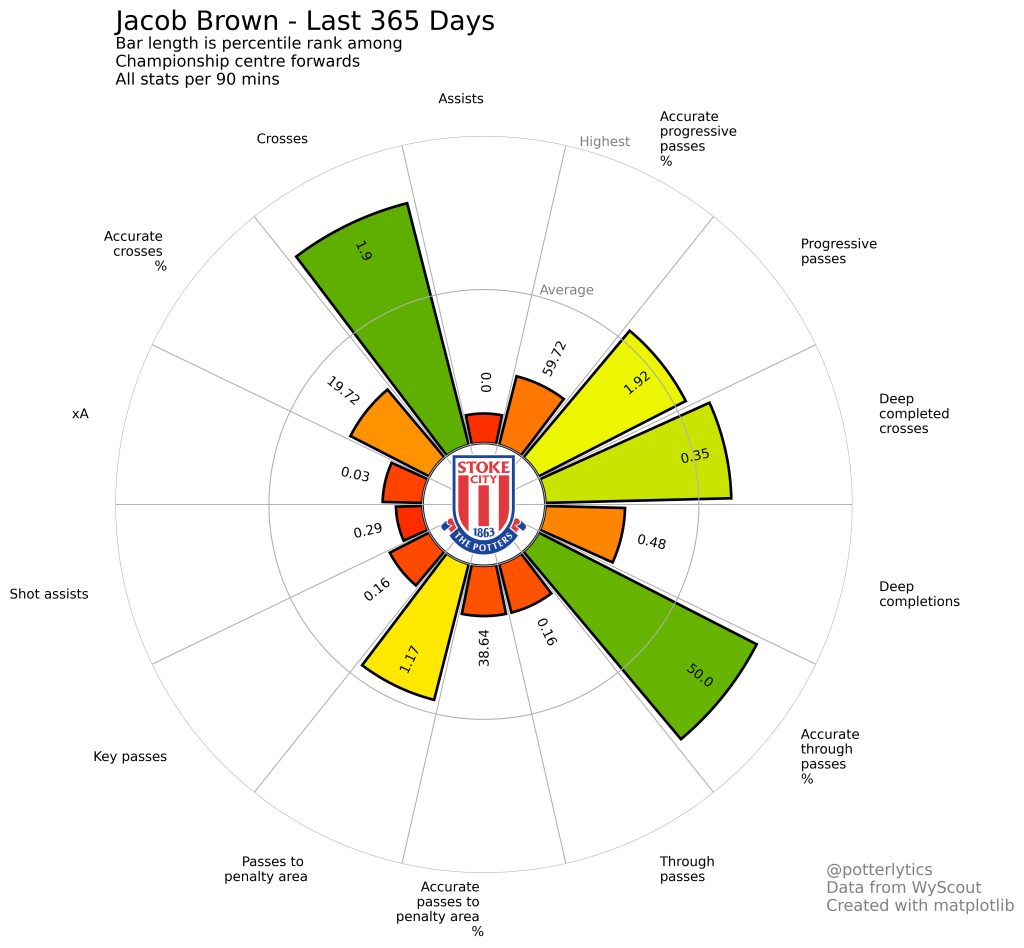
Again, we’ll start with Brown.

Unsurprising metrics to most Stoke fans, I’d imagine. Brown isn’t much of a creative force. He does progress the ball well for an out-and-out 9, and his running into the channels means he does put a high volume of crosses into the box.

As Brown tends to be found in the box when Stoke are high up the pitch, he doesn’t provide much in the way of key passes or xA for other players, preferring to be on the end of the move rather than creating from it.

Looking into Gayle’s creative stats is much more interesting however, as we now see the big shift in Gayle’s style of play.

The increase in touches deeper in his heatmap further contextualises this radar, where Gayle produces above-average numbers of progressive passes (passes that move the ball significantly closer to the opposition goal), shot assists, key passes, and through passes, alongside high expected assists (xA) numbers.

We further solidify the view that Gayle is losing his movement and on-the-shoulder-poacher instincts, and transferring instead to playing as a deeper linking forward.

However, with Tyrese Campbell we see a very efficient creative force.

Very high xA numbers, very high key passing numbers, and very high crossing numbers show the story of a player who is very keen to get the ball into dangerous areas for his teammates.

This also fits well with the heatmap we saw before. Campbell is a player who, whether off the right in a 433 or up front in a 352, drops into those half spaces outside the box, and sets up chances for others.

Particularly interesting here is that Campbell has a very high xA for a slightly lower number of shot assists, and a small difference between xA and assists. This indicates that his passes/crosses to teammates are putting them into areas where they are highly-likely to score.

You Got The Style

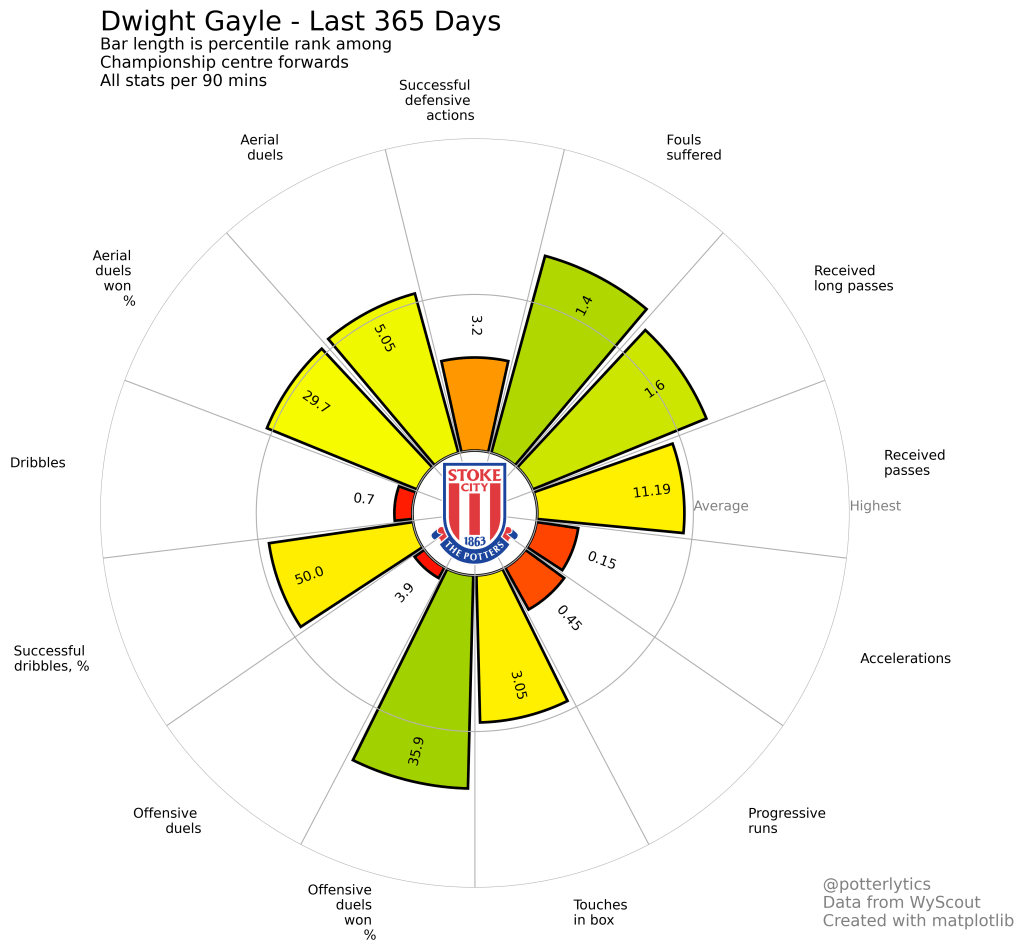
Finally, we can look at similar radars of some metrics that indicate a little more of the player’s style as a forward.

As ever, we start with the lovely Halifax-born Scot, Jacob Brown.

Here is where we can really pinpoint some markers of Brown’s identity as a forward player.

Unsurprising to any Stoke fan is his very high number of successful defensive actions, denoting his ability as a pressing forward, the first line of the defence.

He’s also a well-above-average player in the air, winning 36% of aerial duels, and competing in over 10 per 90 mins, more than >75% of the league’s forwards.

The markers of a combative forward continue as he undertakes a high number of offensive duels, and suffers a high number of fouls.

As we mentioned before, he’s also predominantly a box striker, with a very high number of touches in the box.

Most interestingly, though, are the two markers we don’t perhaps expect of Brown. He is in fact a strong dribbler, largely through running channels, and is successful in more than half of his attempts to take-on his man.

The interesting stats don’t stop there (I know, I’m biased) though, as we look into the same metrics for Dwight Gayle.

We see further evidence of Gayle’s changes, particularly that he very rarely accelerates, and very rarely dribbles.

Alongside his lack of offensive or defensive duels, and his low progressive running numbers, Gayle appears to be trying to take up the Stephen Ireland-esque role of being a player to bounce the ball off and play it into good areas, but not really one who can do a whole lot of moving or progressing when he’s on the ball.

Clearly again, a huge shift since the days of his all-action off-the-shoulder poaching.

Finally, looking at the stats for Tyrese Campbell shows the picture of an attacker who loves being on the ball.

Few aerial duels and few defensive actions are expected of him, but even then he is surprisingly (to some) about average at winning aerial duels.

He’s also incredibly good at winning duels generally in attacking positions, and clearly he has a fantastic penchant for dribbling and making progressive runs.

Also exciting is the fact he gets a huge number of touches in the box, despite playing largely outside the area as we saw in his heatmap. A player who can pick it up deep, progress it forward with solid dribbling, and get into the box to create, alongside winning offensive duels and scoring well above xG consistently is gold dust.

Conclusions? Please?

I know what you’re thinking, and yes we’re nearly done, don’t worry.

The conclusions I, personally, draw from these stats are as follows, but remember stats and analyses are only part of the picture, and even with the whole picture a lot of the inferences and conclusions can be debated!

These are vast, sweeping conclusions from only some points of data, albeit backed up with video analysis, but please take these with a pinch of salt.

Jacob Brown: A strong, combative player who is good in the air and positive at moving into positions to get chances. Largely a box presence and doesn’t contribute much creatively, but his pressing and dribbling are traits that make him a good, solid number 9.

Dwight Gayle: Appears to have completely changed his style of play since his WBA days. He drops off and seems to have lost the quick movement and acceleration needed to get into good positions in the box. His finishing has been poor, but more worryingly he isn’t getting the chances in the first place. He does, however, create for the team. High xA numbers and lots of through balls are an indicator of a high-quality creative player.

Tyrese Campbell: xG over performance is incredible, if a little strange (and possibly model-dependent). He consistently gets his shots on target despite them being worse chances on average than most strikers in the league, and his movement and dribbling numbers are very high. Surprisingly strong in defensive duels too, but his major traits are in his creativity. High xA, crossing, key passing, shot assists, and passes into the area make him a formidable deeper-lying forward/wide player.

It appears to be a fairly balanced strike force, but I’m sure many would argue for the inclusion of another to help out, perhaps some would even think Delap going back wasn’t a good decision.

I hope this helps provide context for the strikers we have, and please feel free to comment your opinions or share the article!

Thanks to any and all readers, and please feel free to comment and follow on Twitter at @potterlytics.

Should you wish to donate to help with the running costs of the site, and the data subscriptions we use, please feel free to visit our donations page here. Any and all help is very much appreciated!

George