Excited Stress — My View On the Schumacher – Pèlach Transition

The Stoke City Era Continues

Well, what the hell has just happened?

It wouldn’t be a heavy week of Stoke news without everyone having a taketm, and I wouldn’t be a content creator (am I that? ew), if I didn’t do my best to add my own to the pile of dirge that has come out since 9.05am on Monday morning.

I’m writing this prior to the game against Hull, so be aware that the stats and data below don’t include that game. (I’m writing this after the Hull game, a lot of the data basically maps perfectly onto what happened in the 3-1 loss, but more on that in the coming days)

So, without further ado, here’s my measured response to the latest Stoke City hiring-and-firing saga.

St-even I Didn’t Expect That

It was one hell of a bombshell from Jon Walters, and it appeared that a large bulk of the fanbase neither expected, nor particularly agreed with, the sacking.

I have to admit, my own reaction was initially of confusion, disappointment, and more than a hint of frustration at the timing and justification for Schumacher’s removal as Head Coach.

But, aside from speculation of Walters’ and Schumacher’s relationship, which I’m absolutely not going to be a part of, is there any performance-related justification? Let’s take a brief look at the data to find out.

Rolling mean xG per game from previous 7 games since Alex Neil’s sacking in 2023. Blue shaded regions indicate Stoke are creating more than their opponents on average, and red shaded regions indicate the opposite. xG from fbref.com via Opta

Nothing too worrying to look at, on the face of it. After a poor period between the loss at home to Birmingham and the win away at Preston, performances seemed to settle down into what would probably be considered par for the course with Stoke’s squad.

Aside from an absolutely mad performance away in Swansea and a poor effort at Norwich, Stoke actually ended last season in fantastic form, with 5 wins and 3 draws from the last 10 games.

Two very positive performances this season vs Coventry and Plymouth bookended a lacklustre game away at Watford, and a tough loss at home to West Brom in which Koumas twice hit the post when 1v1 with the goalkeeper.

To my view, watching Stoke’s games this season, the key word has been ‘moments’. Setting aside Oxford for the moment, although I do think it followed a similar pattern to many of the other games until the goal, the other 4 league games have been settled largely by one or two key moments either in Stoke’s favour (Baker & Manhoef’s goals) or against them (Koumas misses vs WBA & Johansson’s poor keeping vs Watford).

Erm, well, actually, I think you’ll find’ I hear you say in a nasally voice, pushing your glasses up the bridge of your nose. Yes, don’t worry, I’m not going to pretend everything was simply down to luck, even if I do think the performances were around on-par for what you’d expect with our squad.

Some Kind Of Pun About Schumacher Not Settling Tactically Yet This Season

I’m focusing on league fixtures from this season, but just as a word on the cup games, I think they’ve followed a similar pattern, and I think in particular the Plymouth game was a mirror of Middlesbrough away, with the halves flipped.

But returning to the league, there have been 2 noticeable issues – in my opinion – in how Stoke have performed in their 5 games so far.

As always, this is massively caveated by there only being 5 games, and particularly by huge rotation in the squad with the transfer window only having closed the day prior to the 4th league fixture. I’ll explain later in the piece whether I feel these are issues large enough to justify a sacking, but I bet you can guess my views.

Goals, Yet Again.

The obvious one to start. Stoke have only scored 3 league goals in 5 games. The benefit of Schumacher’s open style, although not quite fully let loose yet, is that freedom in the final 3rd allows your best players to solve their own problems, and generate chances with their individual quality.

But in only 2 games have generated more than 1 expected goals, the 2-1 loss to WBA and the 1-0 win at Home Park. It’s clear from the underlying numbers, and the eye test, that Stoke aren’t a top 6 side right now, but where exactly are they stacking up?

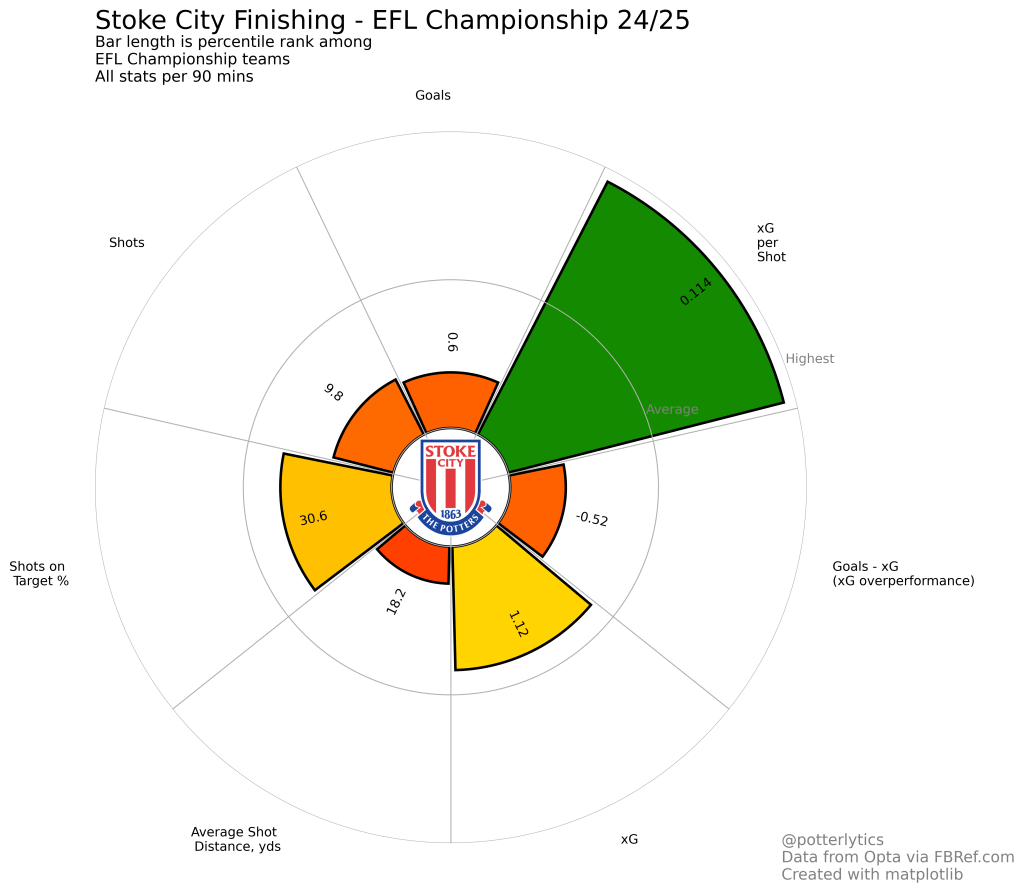
Above we see some ranking radars from their games so far in the league. Again, only 5 games, please take this with a huge bucket of salt.

Glaringly obvious in the right hand plot is the fact Stoke are generating chances at the level of a mid-table side, but doing so from very few shots. This leads to the 2nd highest average chance quality in the league, and the 3rd lowest average distance from goal.

This leads to our 2 major issues in Stoke’s chance creation so far: finishing, and volume.

Firstly, looking into their finishing, Stoke have been underperforming their xG by a huge 0.5xG per game, indicating that the ‘average’ side would have scored 2.5 more goals than Stoke at this point in the season. The bulk of the contributions to this are from chances like those missed against WBA, and often in 1v1 situations.

One might expect that with a young forward line, particularly in Lewis Koumas, who has missed some big opportunities in his exciting start to life at Stoke, this will improve as the season goes on, and the quality of chances Stoke have been able to create is a good sign for the potential of their new forward line.

Secondly, and more of an issue in my opinion, is the volume of chances. 60% of Stoke’s xG has come in the Plymouth and WBA matches, and they’ve created the 5th lowest number of shots in the league.

This doesn’t appear to simply be due to not finding the space to shoot in good positions, although Stoke have had more shots blocked than all but one other team this season in the Championship. The left hand radar above shows that Stoke aren’t managing to get the ball into those dangerous positions (i.e. the final 3rd and the penalty area) at the rate of other sides in the league.

Most glaringly, across all 5 games, Stoke have completed just 2 crosses into the penalty area from open play, both on the opening day of the season against Coventry.
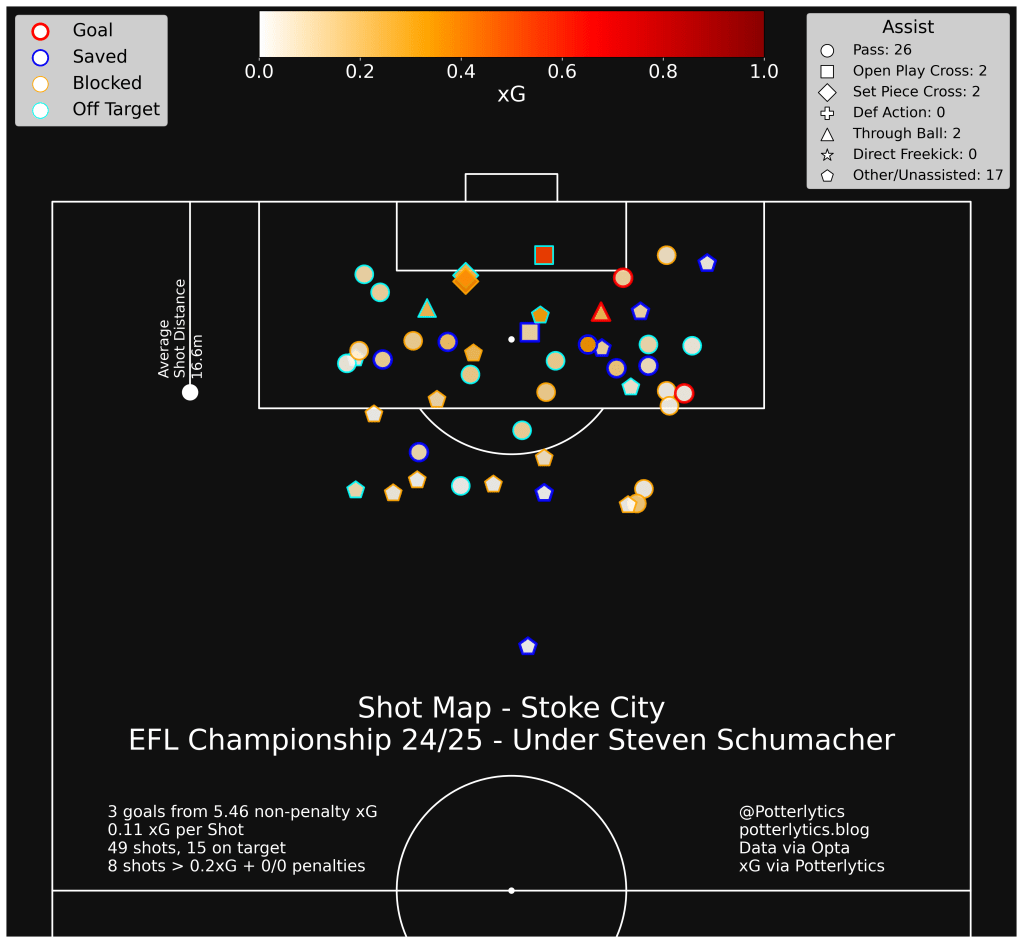
We can see from the above shot map that while stoke have created some high-value chances, they’re pretty sparse in the most dangerous areas, i.e. centrally and ahead of the penalty spot.

The freedom for the front line, alongside their undoubted quality, has led to Stoke creating good chances from the times they do get into good areas (hence the high xG per xA, i.e creating high value chances from each average pass).

This indicates to me that the issue has been much more in getting through an opposition press when the game isn’t so open as it was against WBA and Plymouth, but also that there is one hell of a front line there in terms of chance creation when it does get the ball.

Very Mid (Am I Doing Gen-Z Words Right?)

From my view this season, another issue has been in Stoke’s ability to win the ball back outside of their main pressing/out-of-possession plan.

The main plan appeared to be a compact and narrow mid block, as shown by this (blurry, sorry) still from the West Brom game, which resulted in Maja’s goal.
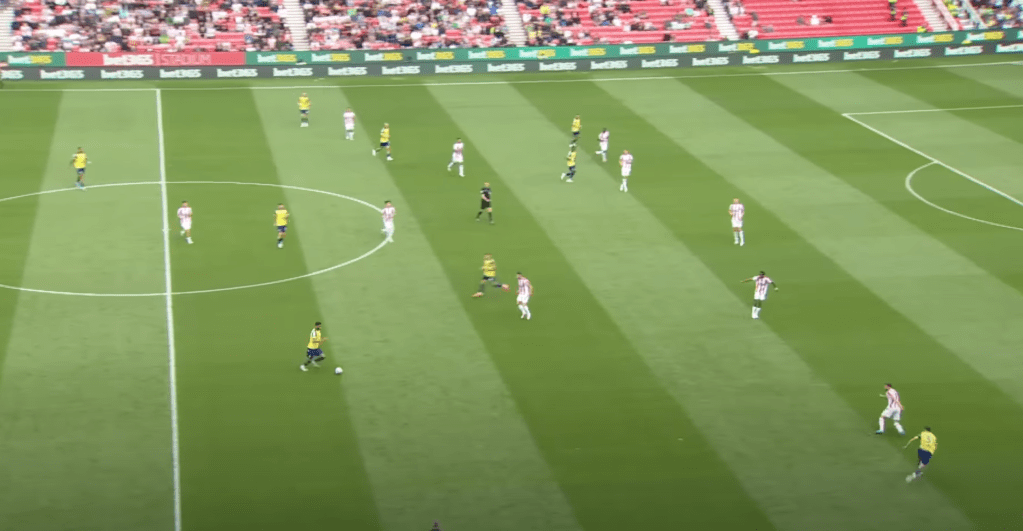
Aside from Lynden Gooch deep on the left hand side of Stoke’s shape, the set-up is essentially how they’ve looked to defend off the ball in every game so far, Plymouth’s double-10/single-pivot aside.

A very narrow back 4, and a compact midfield 3 in front, with the wide players coming inside to make it difficult to play through central areas.

You might wonder why Gooch is dropping into left wing back here, and my read of this is that after a few incursions on the left hand side in the first 30 minutes, Gooch was worried enough to drop in and try to cover the space that winger Fellows was attacking
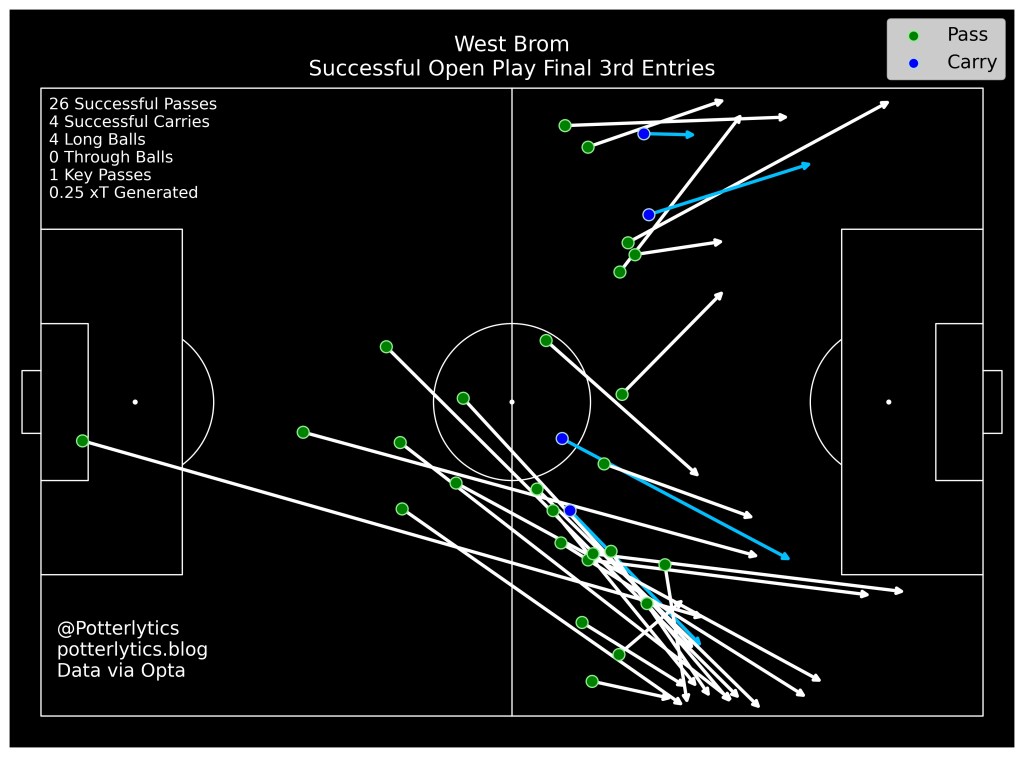
As an aside, it didn’t work…

But whilst this shape is a good way to protect the centre of the pitch, and Stoke defended their box pretty well when opponents tried to attack the wide areas (possibly Watford aside), something Stoke haven’t managed to do this season is find an out-of-possession plan that wins the ball back when they’re losing.

Particularly in that compact midfield shape of the 4-2-3-1, where the trigger is to push opponents wide and remain combative in the middle, Stoke have struggled to stop the gaps when they have to open up and try to win it back.

Often games have seen midfielders doing their Joe Allen impressions (sorry for the drive-by, Joe) and pressing the ball alone or out of shape, leaving huge spaces for opponents to exploit.

We can see this below in the defensive actions of Stoke’s midfielders from the first half and the second half of games.
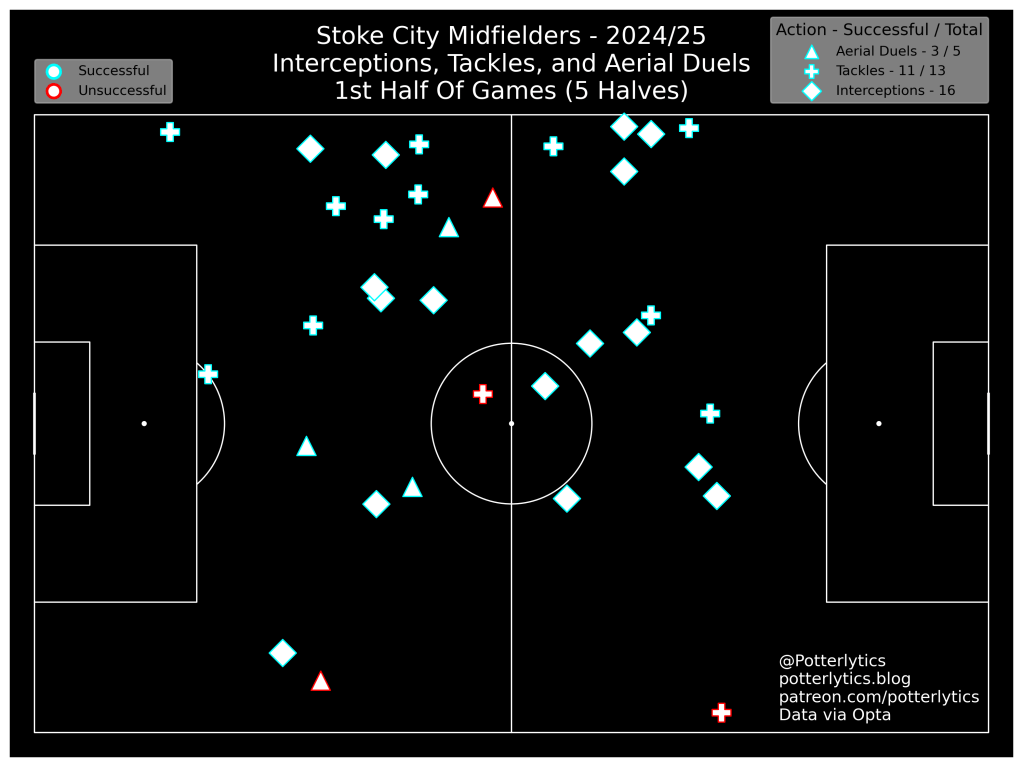
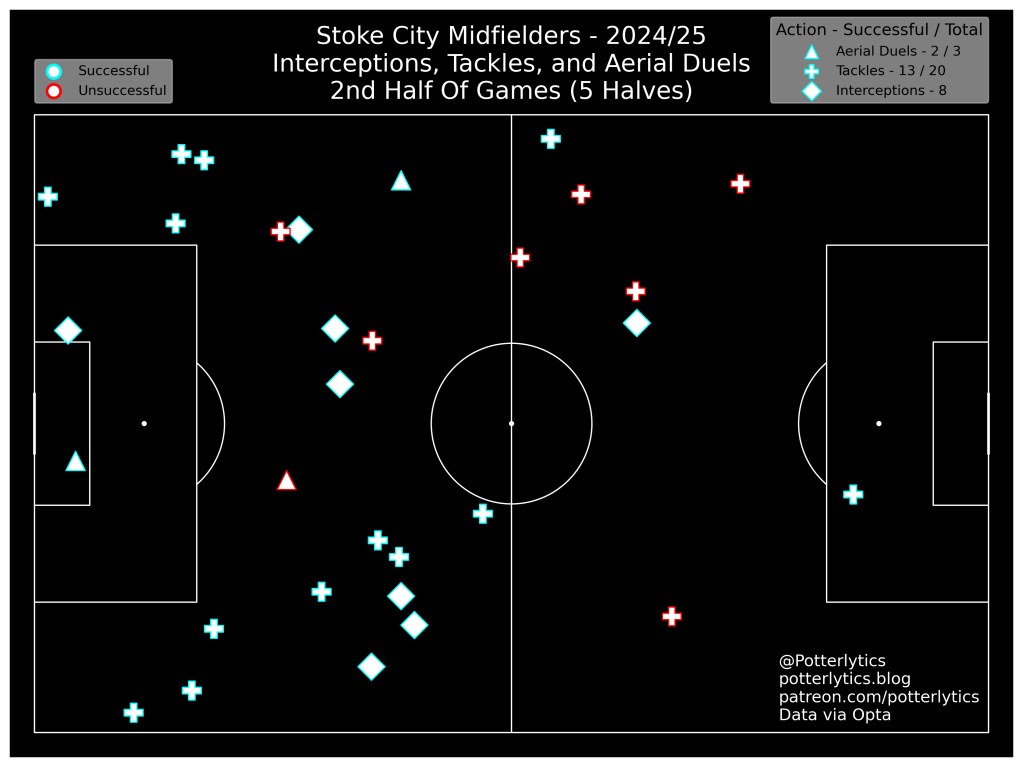
The obvious caveat of Stoke defending more in the second half when in the lead are alleviated by the fact Stoke have only actually been in the lead for 20 minutes this season, and in 3 of their 5 games have been behind for either the entire second half or more than 43 minutes of it, whilst they were level in 33 and 35 minutes of the other 2 games respectively.

But what we do see here is that Stoke’s midfielders tended to do two things between the first and second half:

Firstly: Their central midfielders made double the number of interceptions in the first half compared to the second, and their success rate in tackles went from 85% in the first half to 65% in the second, despite making more attempts to tackle their opponents.

Secondly: Although the number of defensive actions was fairly consistent (34 to 31), the number of those actions taking place in the opponents half dropped from 42% to 26% from the first to second half. On top of that, only 3 of those defensive actions in the opponent’s half were successful.

Combining this data with the footage (contextless data is always dangerous, remember!), you see that this is pointing towards exactly the worry above.

Stoke’s midfielders are being stretched as they search for the ball and press out of shape, so we end up with fewer defensive actions in the opposition’s half as they’re played around/through. We also end up a massive decrease in success rates in those actions as more players press on their own, and end up overloaded due to the lack of shape.

Was It Worth It? My Own Daft Conclusions

So the question becomes, after 1800 words of nonsense, was that enough to sack Schumacher, just 9 months in?

In a word, for me, no.

It’s clear this was Jon Walters’ decision, and he’s been keen to put his name to it, emphasising that these are the key decisions that he’s here to make as Sporting Director. ‘Brave’, ‘ballsy’, and many other words have been used to describe this hell of a call from the Stoke fans’ hero.

The issues I described were certainly noticeable in Stoke’s games so far, and not even the most optimistic fan can say they were entirely happy with the performances, but it felt there were signs of improvement, as Schumacher stated in his statement to the LMA: ‘It was clear that my vision of selecting young, hungry and energetic players to represent this great club was beginning to come to fruition’.

So what the hell is going on? I’ve kept you too long already, but let’s consider, briefly, the changes we’re seeing at Stoke, and what they might represent in terms of the long-term plans for the club.

Plus Ça Change

From my point of view, there’s a distinct lack of change on a larger scale with this particular week of excitement, despite constant rallying calls of ‘we’re doing things differently this time’ from the club.

We were (we being me and a set of other nerds who are too excited by ‘the likes of Brentford’) keen to see Stoke shift their manager-led structure into something which better lends itself to longevity and continuity in the modern game. But what Stoke appear to have done is misunderstand the benefits of that, instead simply shifting that power from one person to another, and still refusing to have a club-wide process.

The huge swings in playing style of the first 4 years in the Championship, from cautious controlled possession under Rowett, to blood-and-thunder verticality under Jones, to patient, wide build up under O’Neill, and finally to even more direct, tactically strict play under Neil, were joined by big swings in the backrooms too.

‘Strong and stable’

I can’t escape the feeling that it’s a club without much, if any, identity. Don’t get me wrong, I don’t mean the kind of identity in terms of ‘lump it long and get on the end of it’, but in terms of the processes the club wants to follow, the ethos of how it wants to move forward, and a long-term plan that involves development in all sections of the club; men, women, academy and community.

That doesn’t appear to be happening here at Stoke, or at least, those things seem to change completely at least once a season.

The transition away from a club who gave complete and emperor-like power to a manager, to a club with a Head Coach, focused on coaching and tactical work on the pitch, was something that felt like a positive move, and it certainly is an upgrade on the previous structure.

But Stoke are still a club who relies on a unicorn at the top of the club. Jon Walters may not be the manager of Stoke City, but he is taking up the vast majority of the role that previous bosses have been given, and he has already begun reshaping the club in his image.

I am a huge fan of Jon Walters, and I loved him as a Stoke player, but he is not coming into a club that has a well-defined structure that needs to evolve or tweak its running behind the scenes. He’s a brand new Sporting Director, with very little experience, being given the keys to the entire club and near-unlimited power to set the direction on his own.

This is not expanding on what was done before, this is another revolution in a club that has been ravaged by them for almost a decade now.

I hope beyond hope that this works, but I come back to an excellent article by Tim Keech on alignment within football clubs, and I worry that we still haven’t got this right.

The key focus here is that all segments of the club are aligned, and in alphabetical order. Whilst I’m keen to see Walters’ ideas about the club succeed, there is both a chance that they don’t, and he moves on, or that they do, and he moves on. Either way, he’s not here forever, barring some incredible set of circumstances à la Groundhog Day.

Most importantly, when he does move on, I don’t believe that Stoke have a consistent set of principles that bind everyone from board level downwards, and that will remain beyond his tenure.

My gut instinct, from both this week’s saga and the past 6 years of promised change, is that this is a club and board who are searching to find the ‘right’ or ‘best’ way to run the club, and expect that at some point they’ll find the ‘best’ person to do so, and this will all finally click together.

Whilst it might, particularly with Stoke’s hefty wage budget (even with P&S rules), there are long term issues in having to have a complete revolution whenever one person moves on. Not only that, but not having the commitment to a process through the club, and the obsession with being generically ‘good’, means it’s far too easy to conclude that a set of principles have now failed, and should be discarded for a complete root-and-branch reform, as we’ve seen so many times since 2018.

As Tim says, it is an easy fix. The difference between allowing one person to be emperor of the club, and developing a club-wide plan and process for everyone to get behind isn’t a million miles in reality, especially with the stability of having the owners Stoke have.

For us to have come down, melted our way through so many club structures, club philosophies, and processes, and still only have finished 14th and below, is the worst kind of achievement.

For my pessimistic side, it can feel inevitable that this may end as every other revolution has ended, first with a sacked Head Coach and a new style of play, then with a sacked Sporting Director and promises of a ‘new approach’ and ‘lessons learned’.

But just how many lessons is it possible to learn? How many individual people do we give complete control of the club’s footballing direction before we find success? What even is success for this club, because apparently mid table after 5 games isn’t good enough? If we even do find it, what happens when the right people leave? Do the dice roll again?

I hope beyond hope that Pèlach is given time, and that whoever follows him into the Head Coach role, or Walters into the Sporting Director role, are personnel who can provide a continuity to the club.

As a famous Alan once said:

“I evolve, but I don’t revolve

Thanks to any and all readers, and please feel free to comment and follow on Twitter at @potterlytics. If you want to hear myself and Lucas Yeomans discussing each Stoke game alongside some exciting interviews, head over to the Cold Wet Tuesday Night Podcast at BBC Sounds.

Should you wish to donate to help with the running costs of the site, and the data subscriptions we use, please feel free to visit our donations page here or subscribe to the Patreon linked above. Any and all help is very much appreciated!

George

A Torrent of Laurent – Profiling Josh Laurent

It’s very difficult to pick out just one player who has been a top performer in Stoke City’s last couple of months.

Wilmot, Tuanzebe, Campbell, Hoever, Sterling, Smallbone, and Pearson have all excelled, but unfortunately, with Potterlytics being somewhat of a one-man-band, I’m just looking to profile one player this week.

Whilst the above players have all been very positive in obvious ways, it struck me that there is a little less clarity around recent revelation, Josh Laurent.

It’s clear to all that he’s had some excellent performances in recent months, as part of a midfield that seems to be clicking together better than any other since the days of Whelan, N’Zonzi and Bojan.

So let’s take a dive into the murky waters of something new even to me: the profile of a “Number 8”.

Winning Ways

First off, before quantifying the specifics of a player’s skill, we can look into how a team performs with and without a player.

As a warning, this is an incredibly dodgy statistic to take as gospel, as team performance can rely heavily on other aspects, such as fixture difficulty, tactical shifts, other injuries/suspensions, among other things.

For example, a player who comes on mostly as a substitute for a team that loses a lot of games will likely have a much higher xG difference improvement.

This is because the team is losing when the player comes on, is more likely to attack, and therefore the xG difference is not necessarily correlated with the player themselves.

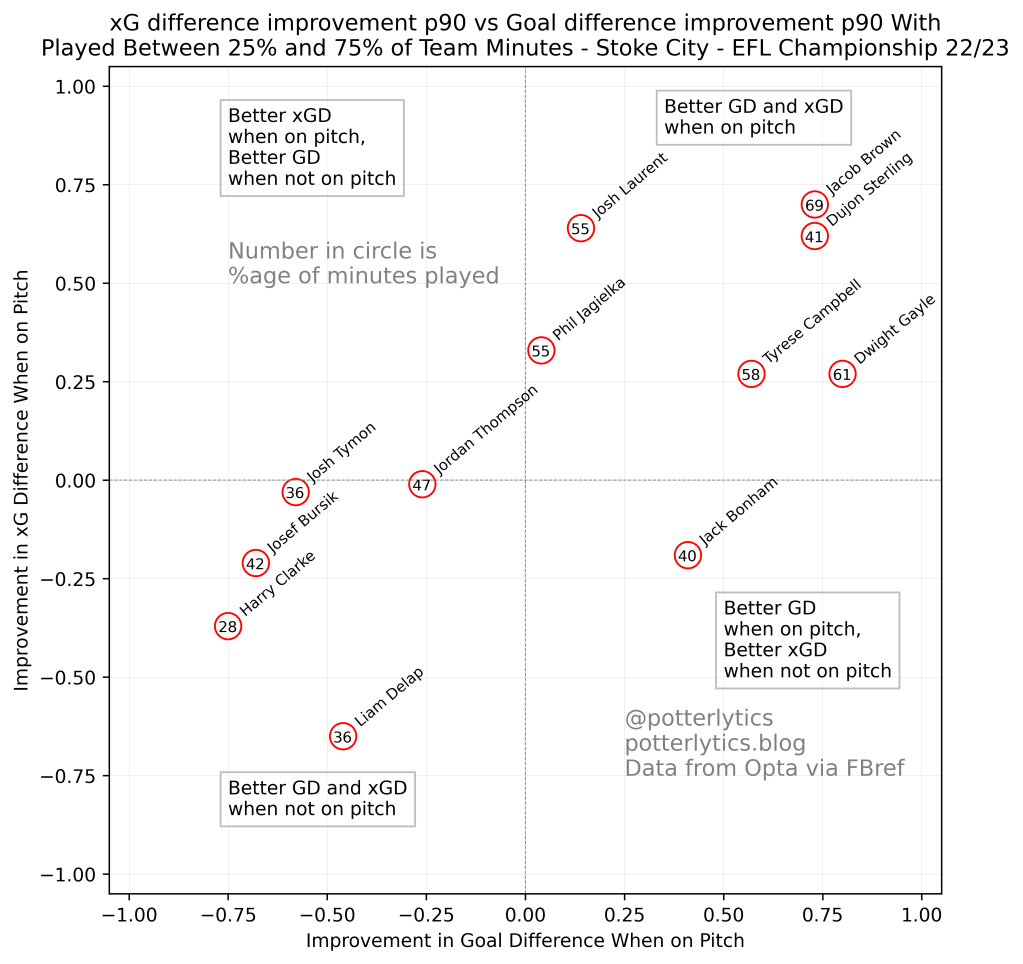
That said, we can still get a measure of the effect Laurent has had on the team by comparing both the goal difference and the xG difference for Stoke when he’s on and off the pitch.

(for an explanation of Expected Goals (xG), check out our previous post here)

This plot compares the improvement in expected goal difference and the improvement in goal difference when a player is on the pitch. Again, please take this with a *huge* pinch of salt, as many factors can skew this data!

Because Josh Laurent has played a similar number of games during Stoke’s good and bad runs (15 games prior to the 4-0 Reading victory and 13 after) and about half of the team’s total minutes, we can take a bit more confidence from the plot above for his datapoint, but only when put in context with the stats in the rest of this post.

We can see in the plot that in games where Laurent plays, Stoke’s goal difference per 90 minutes improves by 0.14, and their xG difference per 90 minutes is 0.64 higher.

So in basic terms, when Josh Laurent has been playing, Stoke’s expected goal difference per 90 has been 0.64xG higher than when he hasn’t been playing.

Let’s can take a look into games he’s started to make sure that we’re not just selectively picking stats!

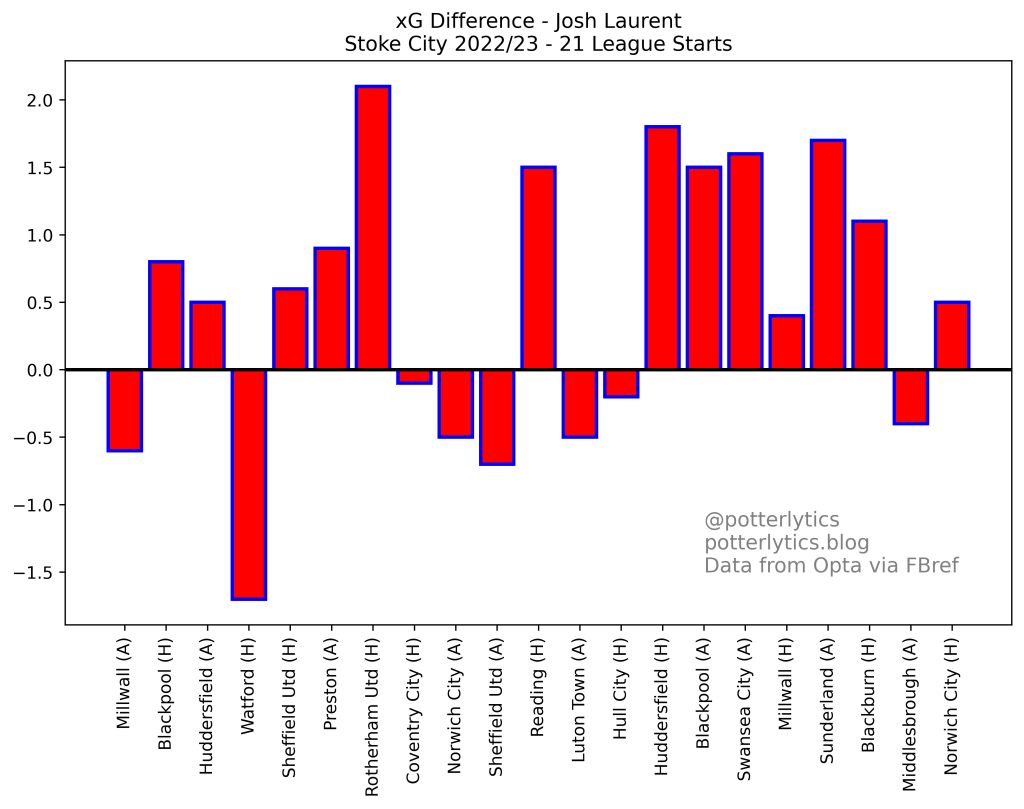
xG difference in the 21 league games Josh Laurent has started in 2022/23.

Here we get a picture that helps decrease the dodgy-ness of the stats above. The majority of games Laurent starts in see Stoke’s xG for exceeding their xG against.

Among these, we find some of Stoke’s most positive performances this season. The recent run of form, the Sheffield Utd, Blackpool, Rotherham games at home, and the Preston away match.

Looking into those games where xG against is higher than xG for, we find the opening day fixture against Millwall, the battering at home to Watford, tight games against Middlesbrough, Coventry, Luton and Hull, and losses to quality sides in Norwich and Sheffield United away.

But all this is academic unless we can figure out how, or even whether, Laurent’s skillset is improving the side. So just what is he good at?

The rest are real stats, I promise…

Well first off, as usual, we’ll take a look at the trusty radar plot to see if there are any stand-out stats among other Championship midfielders.

Josh Laurent’s radar in the 2022/23 Championship season compared with other league central midfielders.

First off, I see 3 major areas where Laurent is particularly strong; his progression while carrying the ball (and passing, although this is less pronounced), his activeness in duels and interceptions, and his willingness to get forward and shoot.

Let’s go through each of these and see what more we can find out.

Keep Calm and Carry, Laurent

The most exciting of the skills we see Laurent show is his quality and willingness to carry the ball forward.

In our radar (and in games) we see evidence that Laurent regularly drives forward with the ball at his feet, as he’s in the top 10% of progressive runners in his position.

We also see evidence that these runs are attempts to break the opposition lines, with Laurent also in the top 15% of dribble attempts, and the top 10% of accelerations.

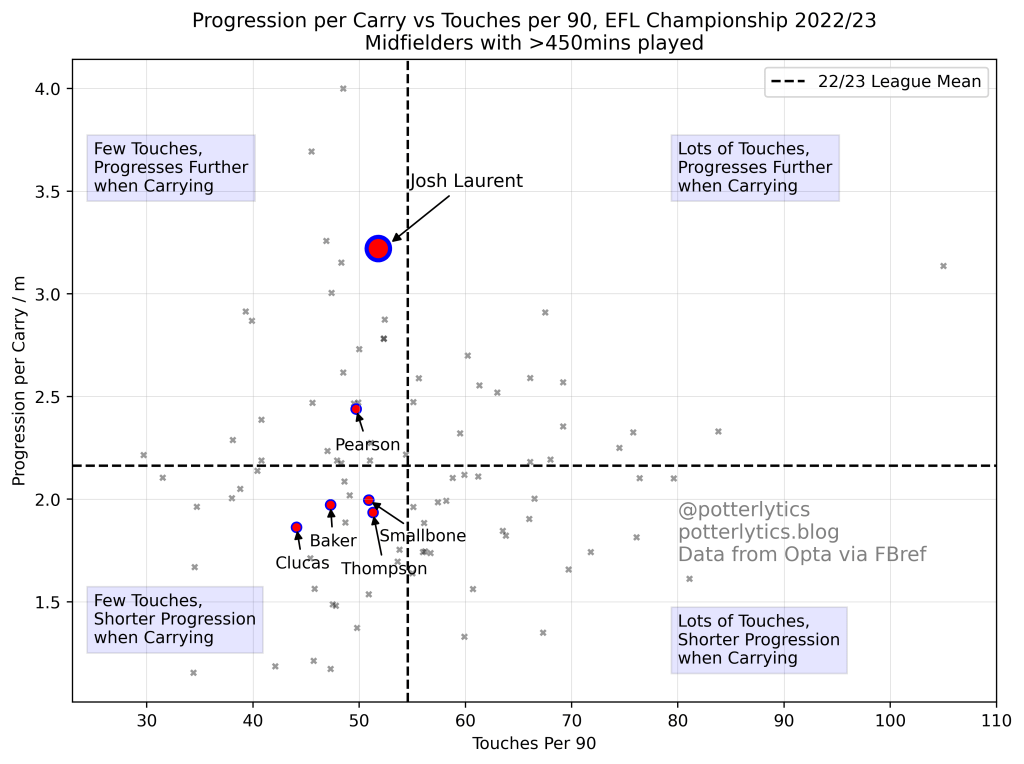
Delving a bit deeper and comparing him with other midfielders in the league, we can find that according to Opta, Laurent is one of only 7 players (of midfielders with >450mins) who progresses the ball more than 3m per carry on average.

Laurent carries the ball almost 1m per carry further than any other Stoke midfielder on average. The crazy guy off way in the top right is Swansea’s Matt Grimes.

Here we see that while Laurent has a similar number of touches to other Stoke midfielders, he tends to progress the ball much further towards the opposition goal than his teammates.

In fact only 3 league midfielders progress the ball more per carry than Laurent; Juninho Bacuna (Birmingham), James McAtee (Sheffield Utd), and Ismaël Koné (Watford).

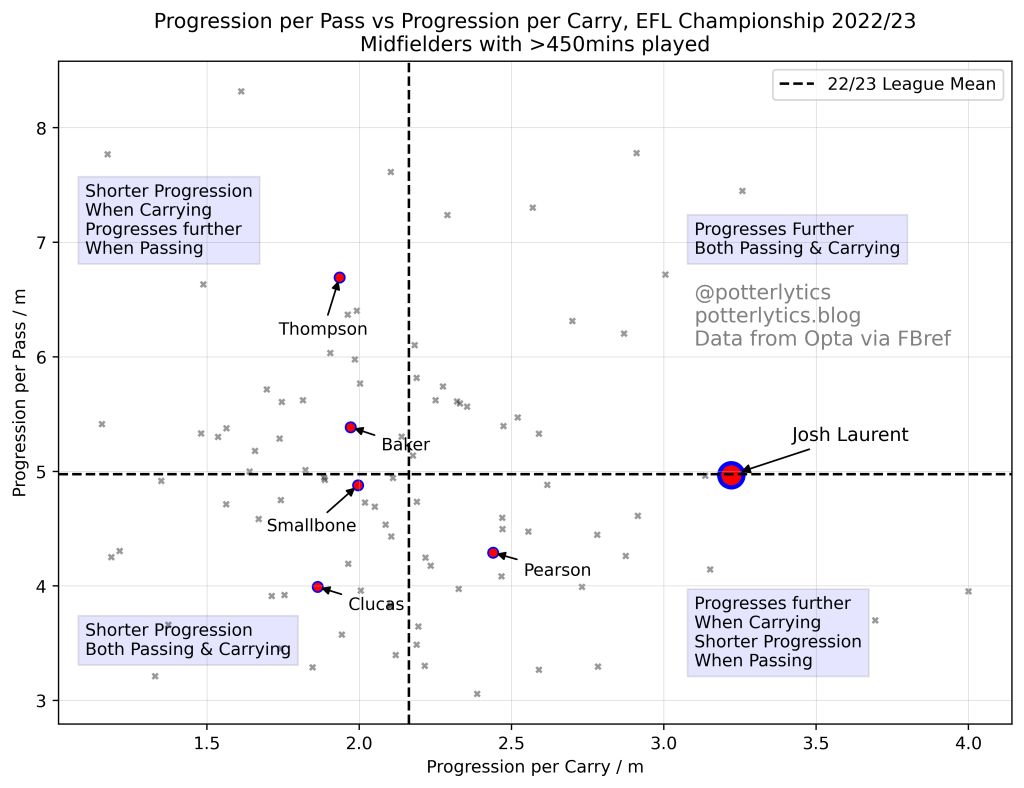
This role as a progressive carrier is something not shared by other Stoke midfielders, and as such, Stoke add another string to their progression bow when Laurent plays. As we see below, Stoke have players who are progressive in their passing in the midfield, but no other real ball carriers.

Baker and Thompson are keen progressers of the ball in passing, but Laurent stands out as a progressive ball carrier.

It’s all well and good showing graphs, but where do we see this in action for Stoke during games?

Well, let’s have a look at 3 different examples of Laurent’s carrying and dribbling ability.

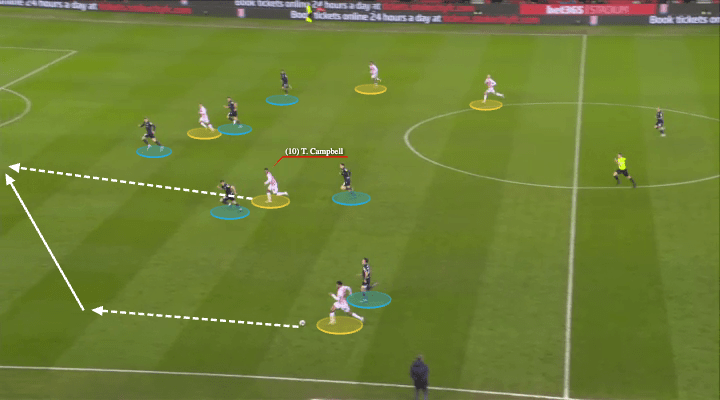
First off, let’s look at a moment about 60 minutes into the Stoke vs Blackburn game a few weeks ago.

Click each image to zoom in.
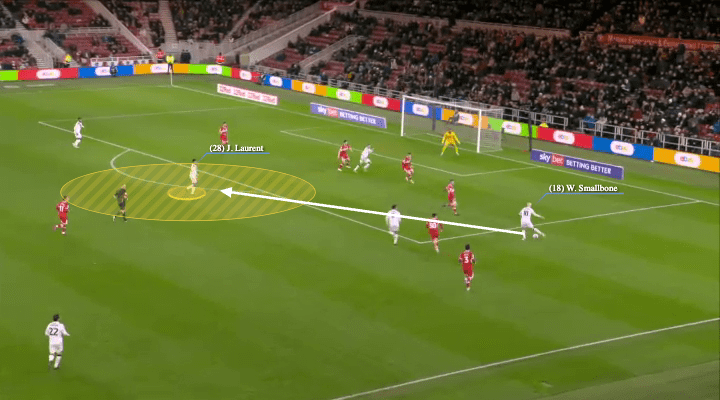
Bonham rolls the ball out after a Blackburn attack into Laurent’s feet, about halfway in his own half. He immediately powers forwards into the space available to him.
The run continues and at the halfway line, Laurent is pressured by a Blackburn player. He accelerates again to push past his opponent and drive down the line into more space.

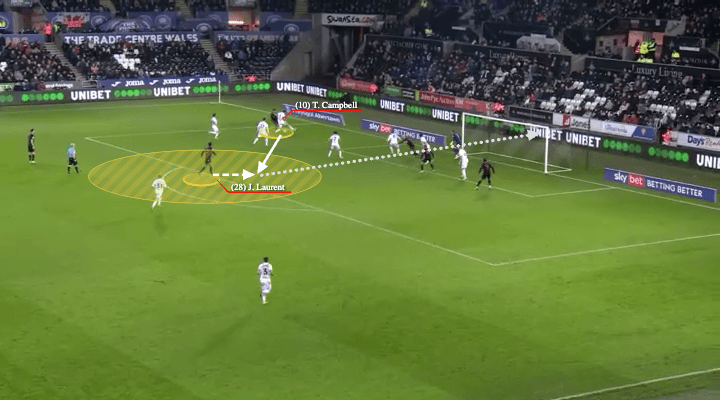
As his teammates push forward with him into the space created by the quick transition, Laurent plays a through ball into Tyrese Campbell, who can now cut it back into space for Brown or Smallbone to attack.

On this occasion, Smallbone blasts a golden chance over the bar, but a 0.46xG chance (Infogol.com) was created here thanks to Laurent carrying the ball from halfway in his own half, through one line of press, and playing an incisive pass into the box.

Whilst you may see this and sarcastically say ‘wow, he’s run into masses of space, great’, I’d argue that a player with the speed and skill to complete this move is something Stoke have not had in their ranks for many seasons.

This exact move is something Alex Neil’s Stoke team have been specifically targeting in the past 2 or 3 months, Laurent drags the team up the pitch and takes maximum advantage of a transition, where the opposition’s defensive structure is more loose and the lines are easier to break.

This is despite the transition taking place inside Stoke’s penalty area.

Looking at another move in the same game, we see a clearer view of both Laurent’s power and his quality in possession in the following move.

Click each image to zoom in.

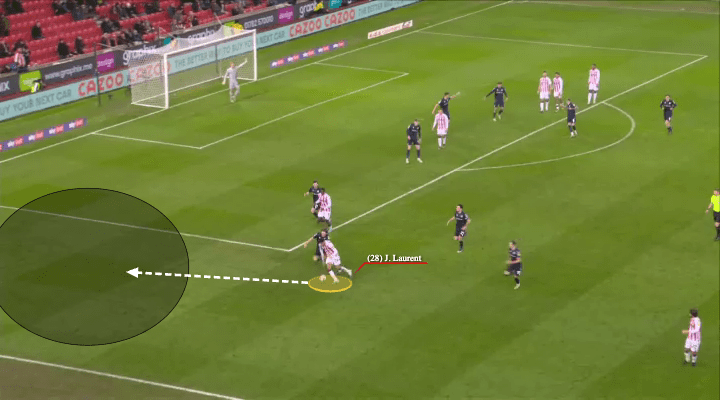
Laurent recovers the ball on the edge of the area with his back to goal and under pressure. There is a possible pass back to Pearson if he can hold the ball, but nothing much on.

Laurent takes on look over his shoulder to check for the space, and trusts his ability to move the ball into the marked area wide of the box, despite close attention from the Blackburn player.

Again, he switches tempo and accelerates away into the space.

Click each image to zoom in.

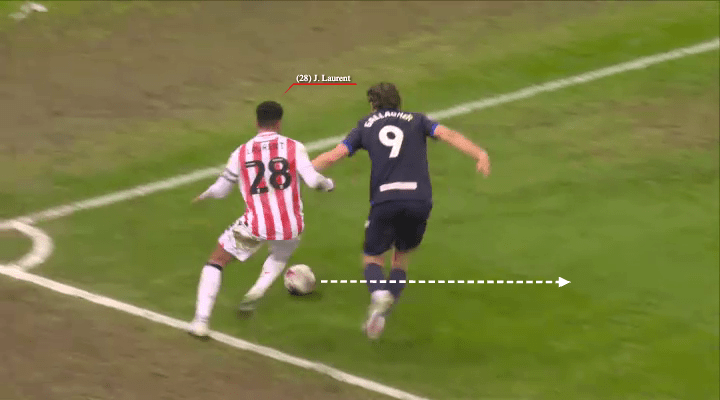
He ends up in where Blackburn might want him, pressured by Gallagher and facing the corner.

But again, he doesn’t hold up the ball and try to wait for a backwards pass, he trusts his ability and accelerates to the right, putting the ball through Gallagher’s legs and towards the box.

As another Blackburn players comes in for the ball, Laurent accelerates forward and wins the duel (something we will be talking about later), and ends up facing up the left hand edge of the box with the ball at his feet.

Click each image to zoom in.

A third Blackburn player pressures Laurent, but again he trusts himself to beat the defender, does so, and continues moving into the box.

In this position, he’s now broken the midfield line of the low block, gone from facing away from the goal on the edge of the box to facing the goal near the corner of the 6 yard box, and he has runners moving into the box to pass to.

The ball is played across to Smallbone and drops back for Campbell to finish.

Finally, we have a very brief moment against Sunderland away, which perfectly encapsulates the improvement in Stoke’s midfield 3 in the recent spell of games on the ball.

Image: Wyscout

A fairly innocuous situation for Sunderland. Jagielka has played the ball forwards to Laurent, who is pressured by the middle player in the Sunderland mid-line.

Previous iterations of this midfield might have taken a touch and played back to a centre back, or possibly the goalkeeper, but Laurent does something that has been noticeably missing from many games in the past 5 or 6 years.

Click each image to zoom in.

As the ball comes into Laurent, from one frame to the next, he moves his body side-on to the ball as he sees the pressing Sunderland player over his left shoulder.

This simple move opens up the space behind the midfield line, shown by the yellow arc, and with this one touch Stoke are immediately through the second line of Sunderland press and able to attack the back line.

He turns into space and plays a simple pass off to Smallbone, who is now directly able to attack the Sunderland defence, thanks to this one piece of quality.

This is another weapon in Stoke’s arsenal as they play in this new style, forcing ‘artificial transitions’ by breaking lines with quick changes of tempo.

Just Joshing

Alongside this, we’ve seen a vast improvement in Stoke’s pressing unit going forward, and the midfield duo of Pearson and Laurent play crucial roles in this, as combative midfielders with the athleticism and quality to win a 1 v 1 duel.

Stoke have moved away from a side who focus on low-tempo build-up to force the ball wide and progress calmly up the pitch under Michael O’Neill, to a side who are trying to force transitions and utilise pace and athleticism to break onto a disjointed defence.

The first of these types of transition, directly from winning the ball back, has been due to the new pressing unit, so let’s look into how Laurent helps this along.

I have previously focused on the work of the front 3 (and often Will Smallbone as a pseudo-10) in forcing the opposition’s defence to play longer into forward players from wide areas in their own 3rd. This is important work, but only half the story.

The second half of the story comes from the players behind the front 3 or 4 players, who mark man-to-man in order to step in and win 50/50 duels when the opposition try to play past, over, or through Stoke’s initial press.

Let’s go back to an early game in our current run, with some analysis previously done on this site, in the away win to Swansea.

Click each image to zoom in.

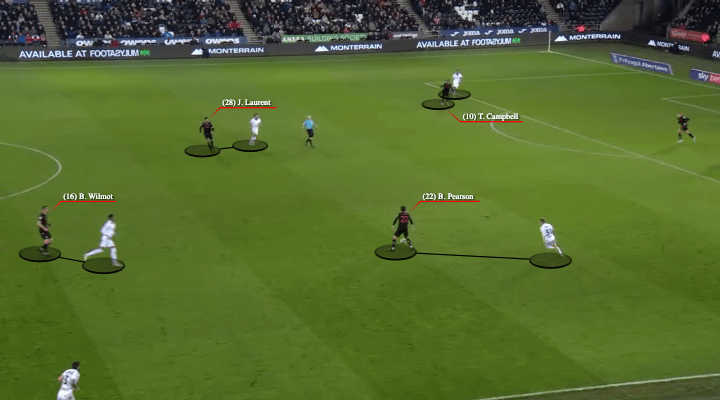
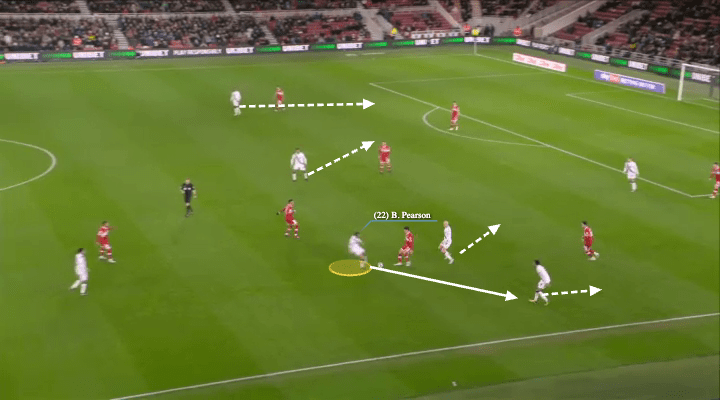
In the first image, Stoke’s front 4 have forced Swansea into a position whereby all passing lanes are cut off, and they therefore play it long.

At which point, Ben Pearson is waiting to collect the loose ball, or challenge the Swansea player, and as the camera pans out, we see that both Laurent and centre back Wilmot had also been closely marking 1 v 1 to do exactly the same should the ball come to the player they’re marking.

This is a very brave way of pressing, and Stoke’s confidence in their ability to win these man-to-man duels appears to have coincided with the return of Laurent from injury, and the signing of Ben Pearson.

This sparked the move to 4-3-3 and the new pressing shape, alongside the new build-up phase that I touched on in our recent article after the Blackburn win (The Revolution Was Televised – Alex Neil’s 4-3-3 vs Blackburn).

All of this is only possible with (particularly in midfield) players who are combative, strong off the ball, and comfortable in possession. The perfect Laurent descriptor.

Let’s heading back to Sunderland away for an example of Laurent himself doing this work.

Click each image to zoom in.

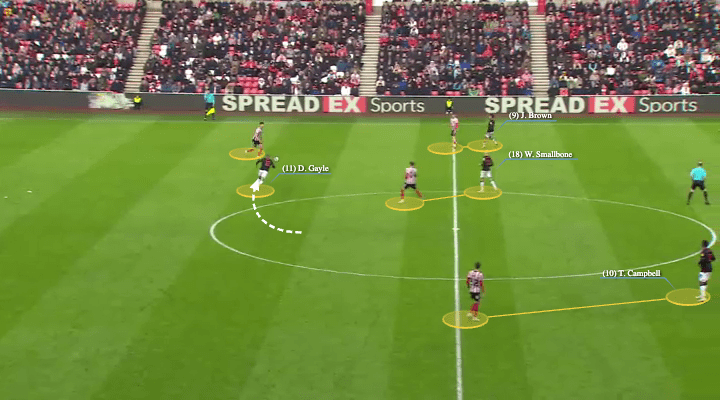
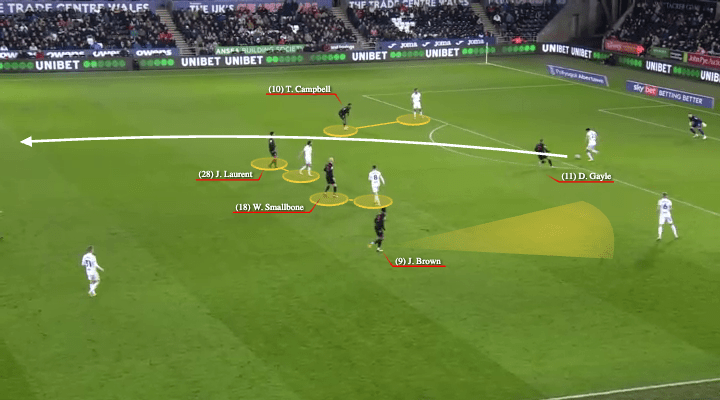
The left-most image shows the initial line of press. Gayle curves his pressing run to mark out the passing lane across the back, and Brown, Campbell and Smallbone sit on other players 1 to 1.

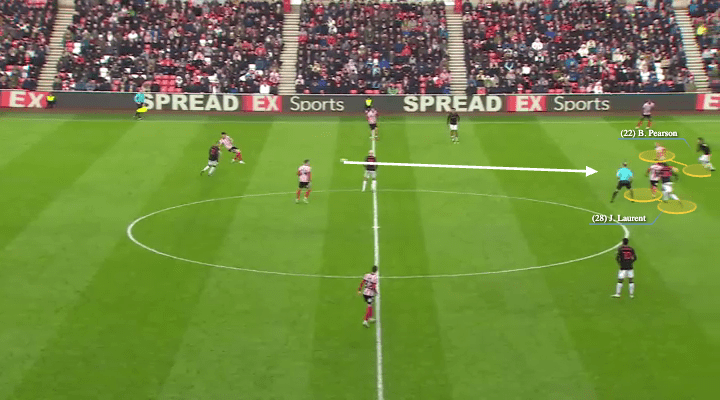
The defender is forced to play a pass through the initial press, where guess who is waiting?

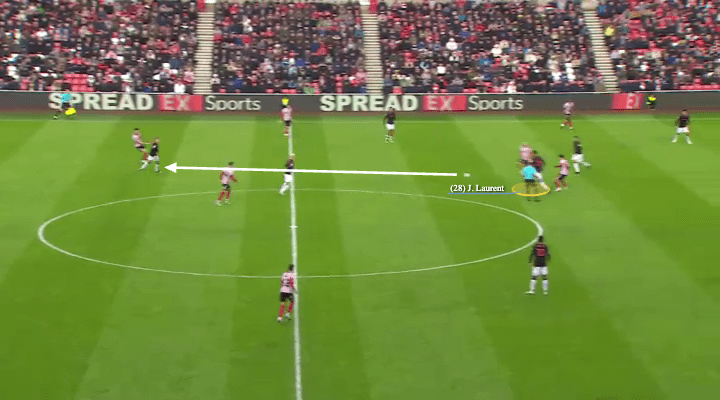
That’s right, it’s Laurent and Pearson, marking tightly man-to-man and waiting to nip in.

As the ball comes in, Laurent accelerates past the Sunderland midfielder and intercepts the ball, laying it off to Gayle and starting an attack.

This willingness to tempt and force players into pressing traps relies not only on Laurent’s athleticism, but also his ability to spot when to step in and when to commit to the ball. High risk, but high reward.

Bosh, Laurent

I mentioned above that one area Stoke have been targeting is enforcing transitions in the front 2/3 of the pitch, in order to attack disjointed and unset defences, both through turnovers of play, and through rapid changes in tempo to break lines.

One key part of this is that Stoke manage to get players into the forward areas when they do move the ball forward, and in recent games Laurent has excelled at this.

We see this shift in style below in the plot of cumulative xG and cumulative goals. (For info about what xG is, check out our Stoke City xG Explainer here: xG – A Stoke City Explainer!)

This chart only includes games Laurent started.

Since the Blackpool game at home, and the start of Stoke’s improvement in results, we can see that Laurent’s xG has been shifting significantly upwards, with an increase in cumulative xG in every game since Huddersfield at Home.

The same is true of his shooting, as below.

This chart only includes games Laurent started.

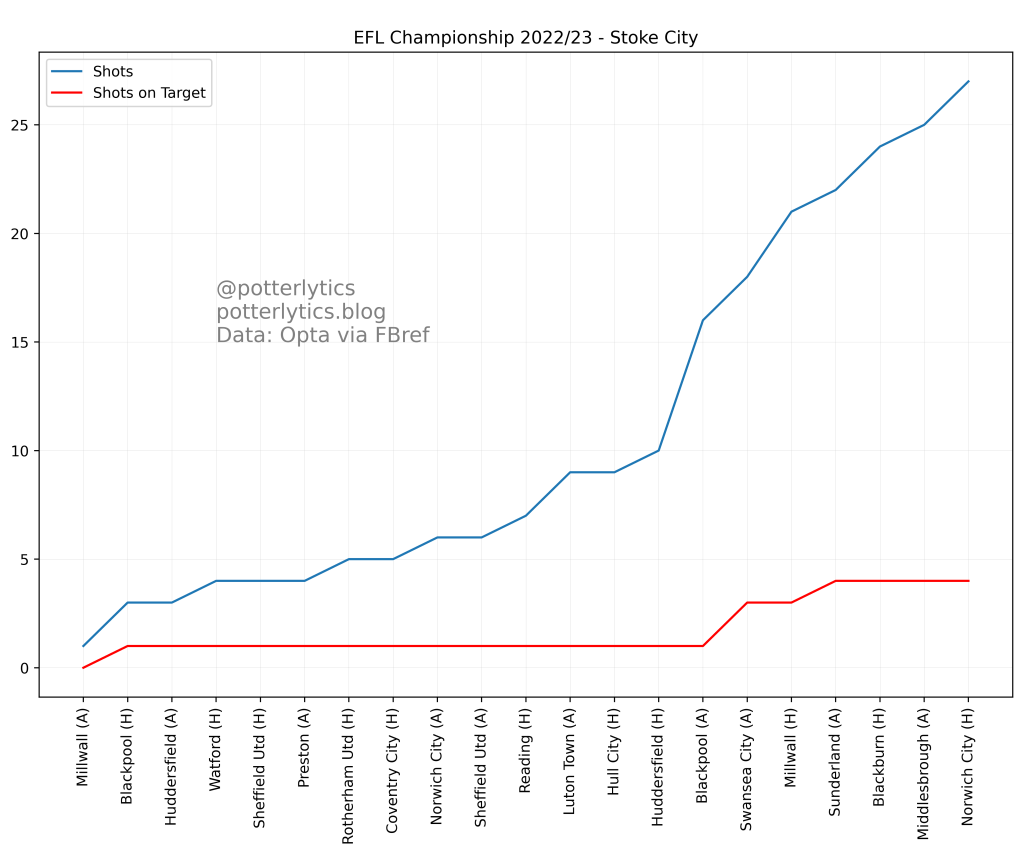
This time the increase is similarly obvious, up until Blackpool away, Laurent had taken 10 shots in 14 games, with 0 goals and 0.3 xG. In the subsequent 7 games, he’s taken 17 shots, and scored 3 goals from 1.9 xG.

This quality has been linking in perfectly with the other areas we’ve delved into, so let’s look at 2 examples of the new style working together to create chances for Stoke.

First off, in the recent away draw to Middlesbrough, we join with the opposition building up from the left back position.

Click each image to zoom in.

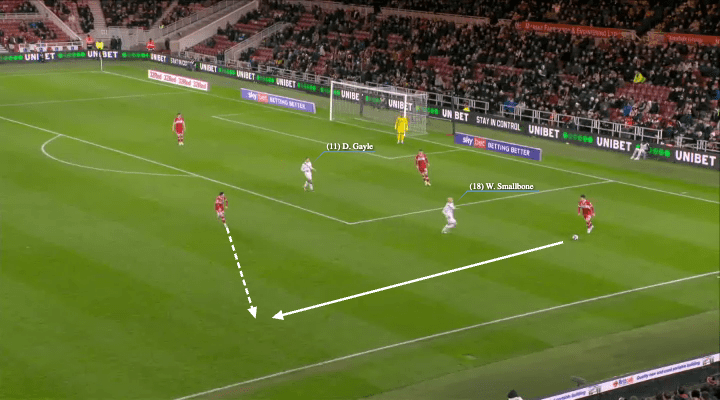
As Stoke press up the pitch, we again see the man-to-man marking behind Gayle, and Middlesbrough play well through the line. The midfielder pushes forwards, but runs into a good challenge from Pearson, who moves across.

Click each image to zoom in.

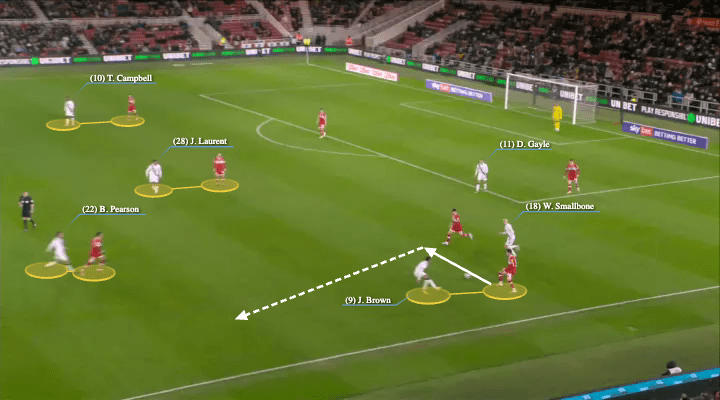
At this point, Brown can now break forward, and he lays the ball to Smallbone on the right hand side of the box.

As Brown and Gayle move into the box to push the defensive line back, Laurent sits on the edge in the yellow space. His shot is blocked, but the space comes from that second aspect of transition play we’ve talked about these past few weeks.

1- Man to man behind the first line of press

2- Win your 1-to-1 duels when the opponent is forced to move/pass into risky areas.

3- Break forward quickly with pace, 1 on 1 skill, and lots of bodies.

Laurent’s increased tactical emphasis on supporting the attack has meant he can be involved in all 3 of these phases, and on top of that he’s now turned into a goal threat after step 3.

Finally, we can see the ‘perfect’ combination of this play in Laurent’s first goal against Swansea. Let’s take a bit more time to go in depth in this one.

Click each image to zoom in.

Swansea have the ball just in front of their box. Stoke are as usual playing their man-to-man pressing line, with Campbell and Brown ready to press should the ball go to the wider centre backs, and Gayle watching the passing line backwards.

The ball goes back to the central centre back, who is faced with no real passing options. The goalkeeper is very close by, the wide right centre back is marked by Campbell, the midfielders are man-marked by Laurent and Smallbone, and Gayle cleverly bends his pressing run to block the lane to the left.

He plays a pass through the lines towards the Swansea forwards, who are around the halfway line.

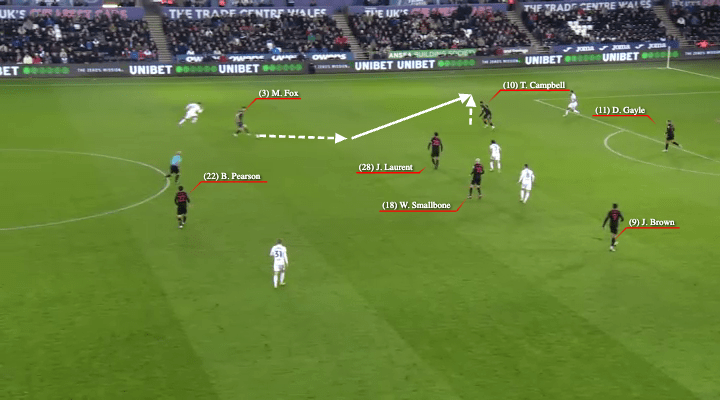
Click each image to zoom in.

Unfortunately for Swansea, Morgan Fox is waiting on the man the pass is aimed for, and nips in front to grab the ball. He plays it wide to Potterlytics favourite, Tyrese Campbell, and Stoke players pile into the box. Steps 1, 2 and 3 are working perfectly.

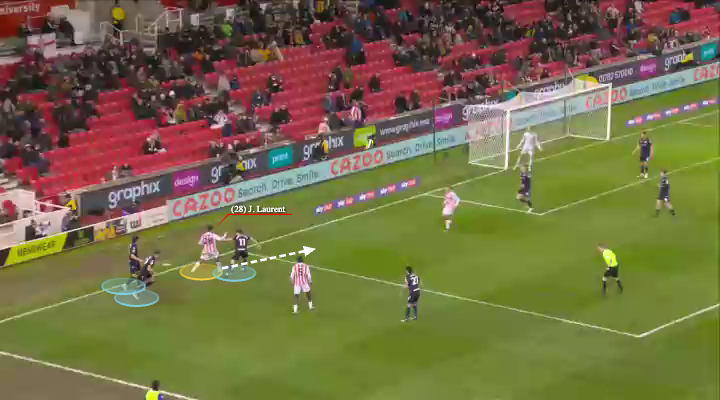
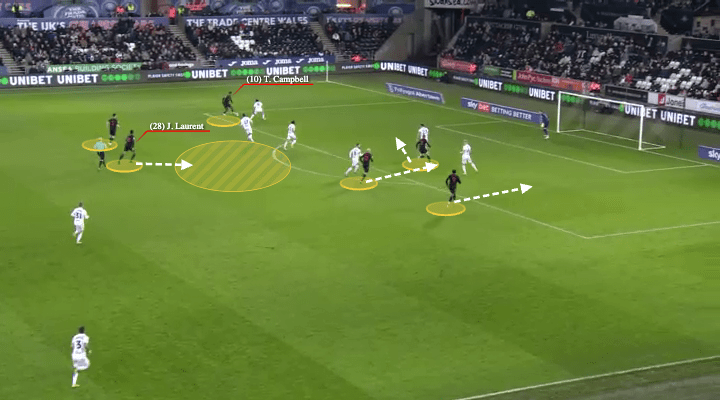
Except for one. Josh Laurent sees the area marked in yellow that is unoccupied, and again sits on the edge of the box while Campbell works the defender to get the cross in.

Images: Wyscout

As Campbell moves towards the byline, Laurent hangs in this space waiting for the ball. As Stoke piled so many others (Brown, Smallbone, Gayle) into the box, and Campbell’s quality means that 3 players try to stop the cross, Laurent is left completely free.

When he gets the ball, well, we all remember what that grey dotted line looked like in video form, don’t we.

I’ve Run Out of Subtitle Wordplay But He’s Good at Creating Too

The final area I want to look at is something that wasn’t actually so prevalent on his radar, but I believe is something we’re starting to see a lot more in Laurent’s game since this recent run of form begun.

We can see evidence of this improvement again in cumulative graphs of both his Key Passes (A pass that immediately creates a clear goal scoring opportunity for a teammate), and Expected Assists (xA, the probability of a pass becoming an assist based on historical data).

Click each image to zoom in.

Again, since that fateful Blackpool game, Laurent has become a much more important creative force, with quality passing and clear ability to pick out teammates in good positions.

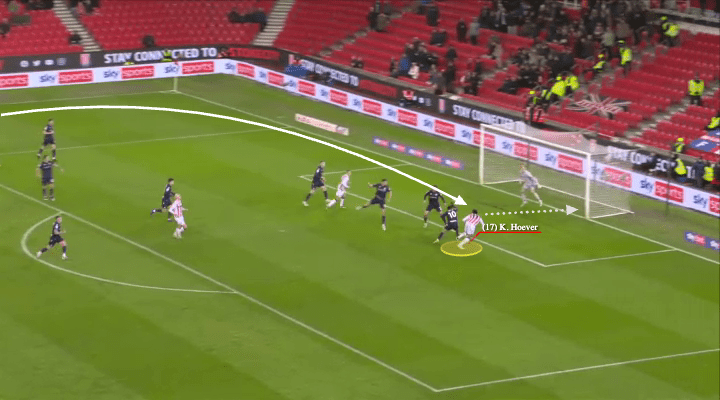
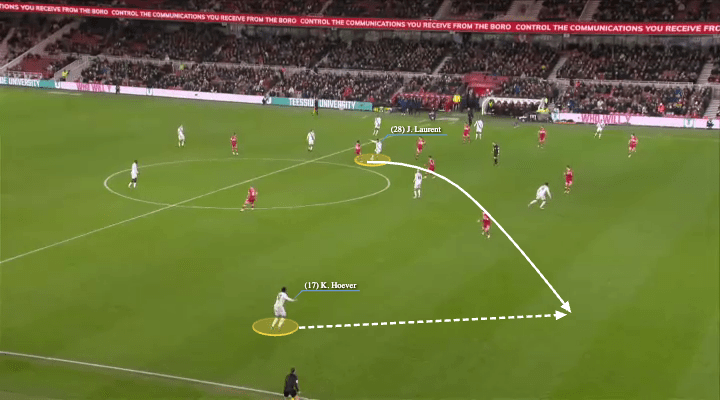
Two such examples of this are for two of right-back-turned-poacher Ki-Jana Hoever’s goals a few weeks ago.

Click each image to zoom in.

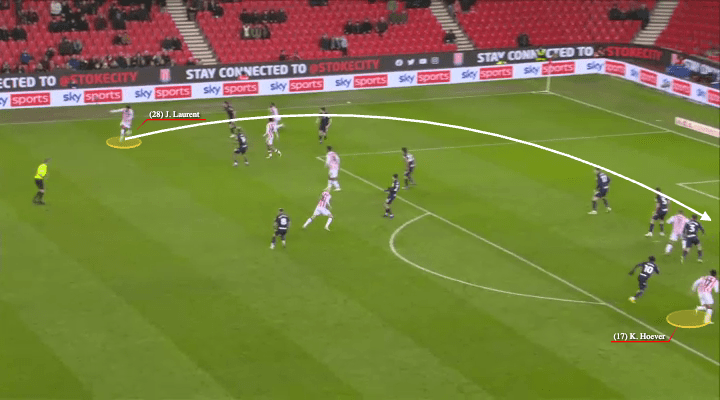
First, at home to Blackburn, Laurent picks the ball up on the wide life, about 25 yards from the byline, and whips a powerful, dipping cross to the far post for Hoever to head home.

Click each image to zoom in.

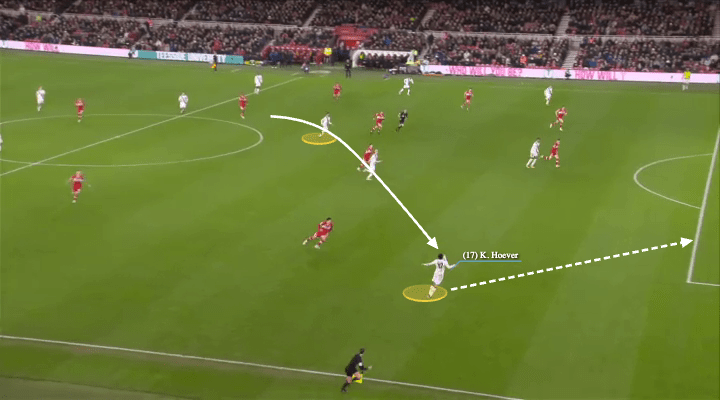
Secondly, away to Middlesbrough, Laurent clips a first time pass over the head of the outside centre back, into the path of Hoever, who has a clear run on goal to finish.

Although it’s been a bit of an injury-hit season, it really does seem like Laurent is turning into a very well-rounded midfielder, and certainly one that fits perfectly into the style of play Alex Neil has been implementing in the past few months.

So there we have it. Summarised in just over 3500 words. A light morning read*.

*I’m so sorry.

Josh Laurent has been a huge boost to Stoke since his return from injury in January, and we can see above just how his strengths in carrying the ball, being active in winning duels and anticipating interceptions, getting into shooting positions to support the attack, and even his passing and crossing help Stoke to implement this aggressive transitional system of Alex Neil’s.

Long live this lovely Laurent revoLution.

Thanks to any and all readers, and please feel free to comment and follow on Twitter at @potterlytics.

Should you wish to donate to help with the running costs of the site, and the data subscriptions we use, please feel free to visit our donations page here. Any and all help is very much appreciated!

George