

So, Tyrese Campbell, eh? A divisive figure among many Stoke fans, so lets get the the bottom of it once and for all.
Is he actually any good? Well, long story short, yes.
But let’s look into the long story a little bit deeper. What is he good at? Where is he best used? Will he be my best friend? All this and more (maybe) answered below.
Who?
Let’s start off with an overall picture of the type of attacker Campbell is. Using the radar plot from our Player Stats Hub, we can build an insight into what style we’re looking for in the player.

From this, I draw three major conclusions.
Firstly, Campbell is an excellent creative force, in the top 10% of expected assists (xA – a measure of how likely a pass is to result in a goal) per 90, the top 10% for crosses per 90, alongside being in the top 25% for key passes (passes putting a player in a clear goalscoring situation), passes into the area, and deep completions (passes to the zone <20m from the opponent’s goal).
Secondly, he’s on an incredible finishing run, despite getting lower-value chances than almost 3/4 of forwards in the league, he scores above his xG by 0.07 per 90, in the top 25%. More on this later.
Finally, it’s clear he’s a very strong ball carrier, above 75th percentile in progressive runs (definition here), dribbles, dribble success rate, touches in the box, and offensive duels. Campbell is a strong forward who wins his duels and carries the ball incredibly well, taking on defenders and progressing play towards goal.
Surprisingly for many, he’s actually about average at winning aerial duels too. Take that, sarcastic cheer-ers.
He’s clearly a very well-rounded forward, but let’s dig a bit into each of these aspects, starting with his finishing.
The Boy’s On Fire
It’s actually incredibly rare for players to overperform their xG over long periods of time, so the stats above for Tyrese’s finishing are a little suspicious at first glance. Is he just on a hot streak? Well, weirdly, no.
Campbell has outperformed his xG in every season as a footballer besides his first 5 games at Stoke, played exclusively as a substitute in Paul Lambert’s doomed side.
Below we have a plot of Campbell’s cumulative goals and xG over his whole league career on the left, and a plot of his cumulative xG overperformance (i.e. his goals minus xG) over the same period of games. It’s clear he’s an oddly consistent performer.

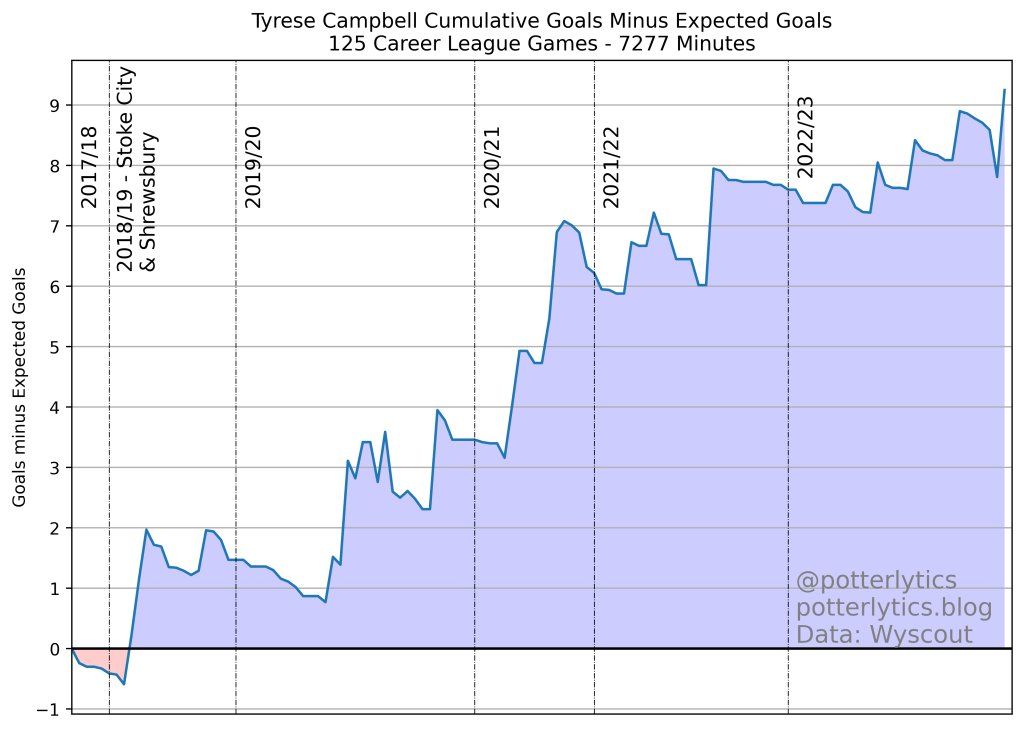
Why though? If this is such an oddity, why is he such a consistent finisher? Well it could be that this is only a sample of just over 7000 minutes – just over 80 full games, but I think there’s some more to this that we can use to explain Campbell’s quality.
If You Have To Ask, You’re Streets Behind
One thing that shows up clearly in Campbell’s goalscoring is his preference for two zones either side of the D, just within the box.
Looking at his last 75 shots we can see a clear penchant for scoring from these two areas.
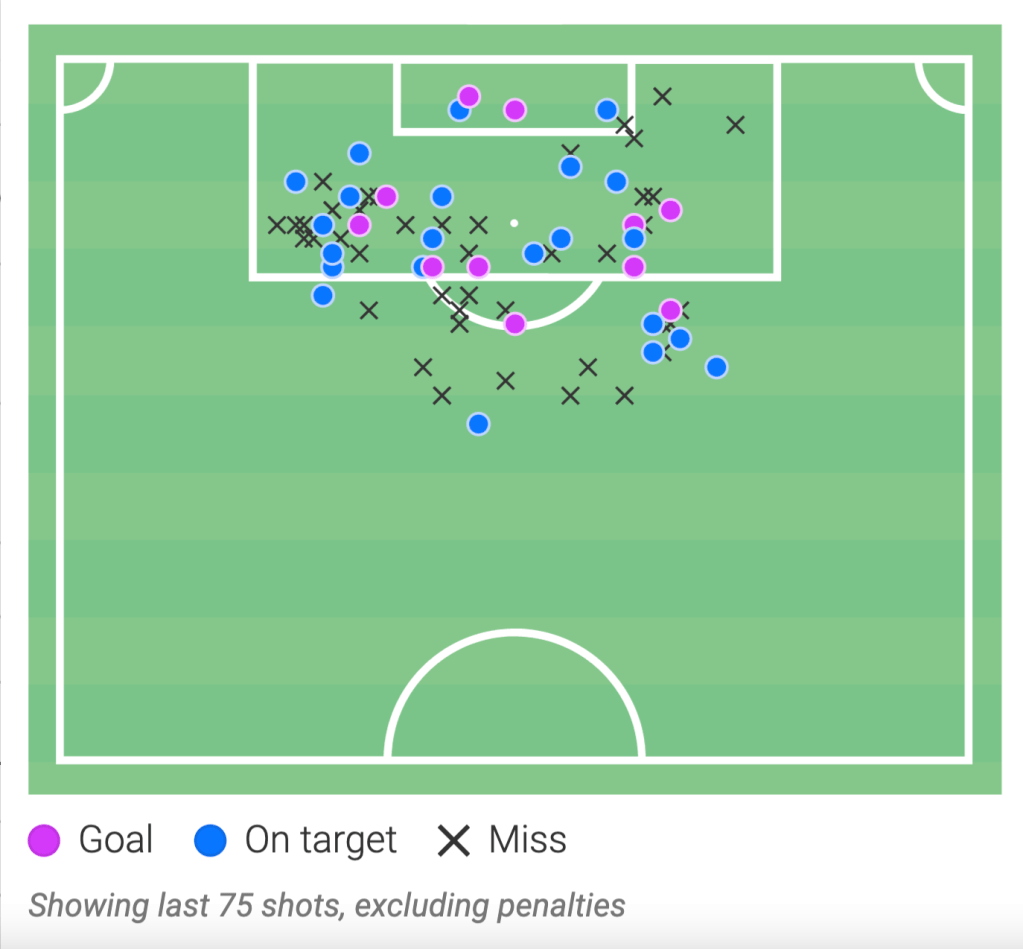
Due to this area obviously looking like a phone (right?), and definitely not due to me forcibly trying to hammer in the word ‘Ty’ to something, I’ve decided to coin this the ‘Ty-phone‘ zone. It sounds kind of like Typhoon too, which is a cool word. It’s verbal wildfire. I’m so sorry.

Campbell’s quality turns these lower-value, lower-xG chances into goals at a disproportionate rate because of his specific skill in curling the ball to the far post.
We can delve into a few examples to see this in action.
First off, let’s look at his 2nd, and Stoke’s 3rd, away at Sunderland.
Click each image to zoom in.
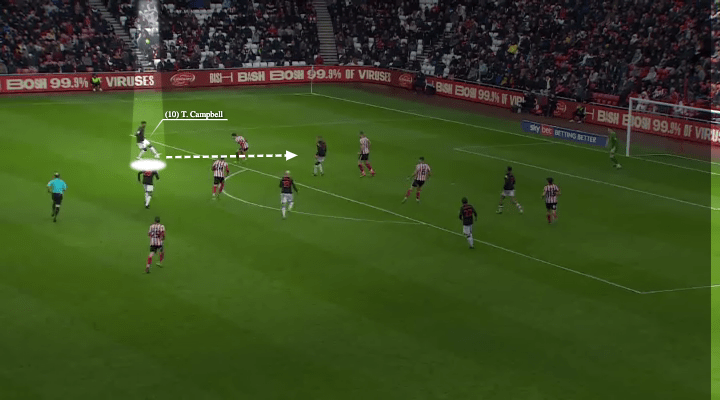
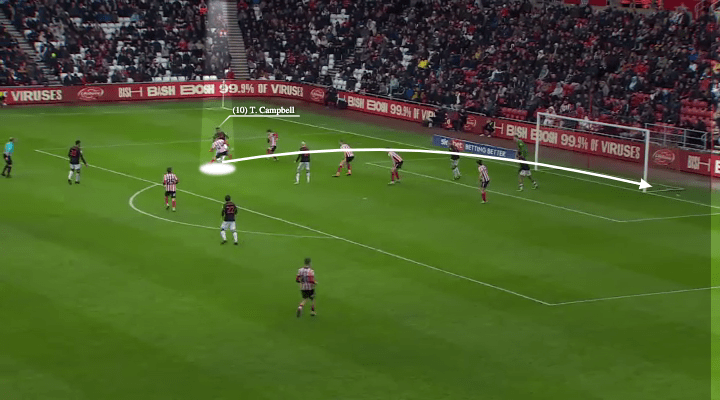
Campbell gets the ball on the edge of the area to the left, drives at the back line, and attempts a shot.
It comes back on his right foot, and he curls it to the far corner through a crowd of defenders. This had 0.06 xG according to Infogol.
We saw a similar goal from the other side last season at home to Birmingham.
Click each image to zoom in.


Campbell takes it on the right outside the box and immediately drives at the defenders.
From there he cuts inside past a Birmingham defender and and whips it into the far corner.
Again, Infogol has this as a 0.06 xG chance for the average player.
Finally, we go back to the lockdown season vs. eventual promotion-winners Brentford.
Click each image to zoom in


Tyrese picks the ball up wide left. comes inside on his right foot, beating two defenders, and whips it again into the far corner.
Infogol has this chance at a tiny 0.04 xG.
So we have 3 very similar finishes here, and Campbell has done this on several more occasions, also adding his skill of driving the ball across the keeper, and powering it home at the near post as vs Peterborough in 2021.
But Hold Your Horses
Goals can be very deceiving, particularly when there are only 31 of them, so is there a different way we can quantify Campbell’s finishing skill? The answer, predictably, is ‘kind of but not entirely’.
Whereas normal expected goals (xG) refers to the probability of a player scoring a given chance at the point of a shot being taken, Post-Shot xG (PSxG), refers to the probability of a shot being scored after it has been taken.
This includes features such as the power of the shot, where it is headed in the goal, swerve and trajectory, and players unsighting the goalkeeper.
As such, one way to infer the quality of a player’s shooting is to compare the PSxG with the xG, to see how much a player’s shots improve the quality of chances they get.
Now, as a point of order, this is by no means a definitive measure of finishing quality. As with all statistics, this is just one, very imperfect measure by which we can gain some insight into what might be happening.
As an example, a shot near the top corner that just goes wide will receive 0 PSxG, whereas a slow dribbling scuff that goes straight into the keeper’s arms will receive a PSxG of above 0.
But, as an indicator, we can still use it to gain some insight, and as such we have the two plots below, showing Stoke players’ PSxG overperformance (i.e. the PSxG minus xG) vs the average quality of their chances (xG/shot).
Click each plot to zoom in
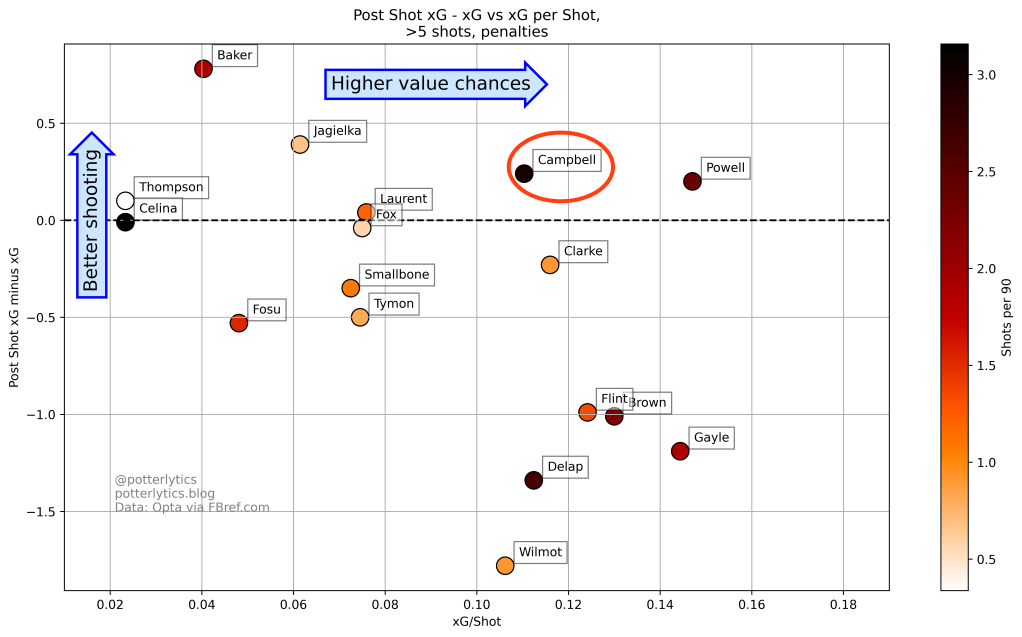
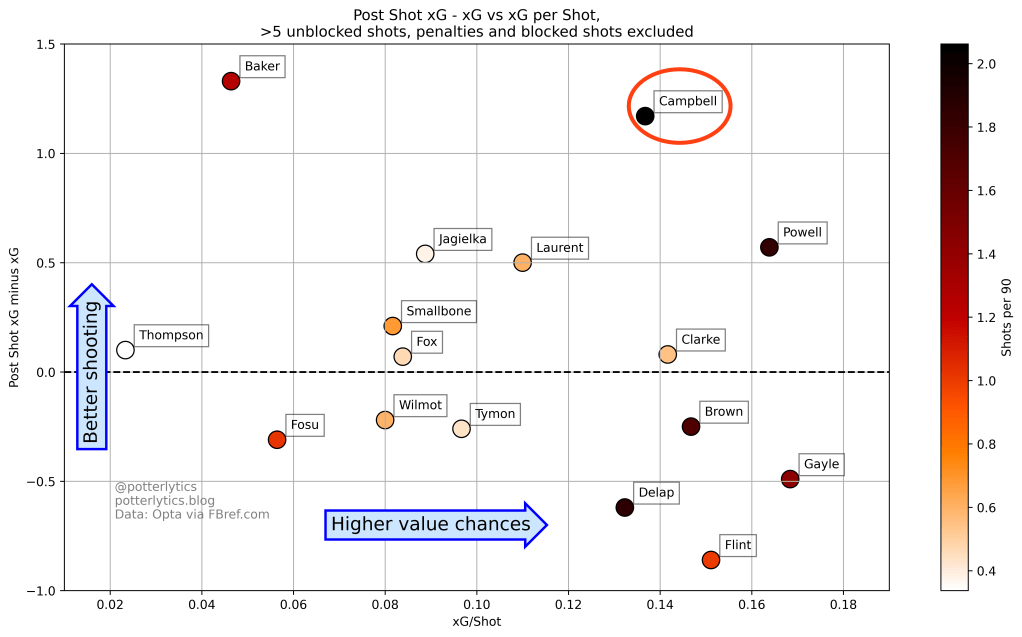
What we see here is another insight into Campbell’s quality of shot.
In the left hand plot, including all shots, we see that he’s added around 0.25xG to his chances.
In the right hand plot, we have discounted blocked shots, as these are typically ascribed a value of 0PSxG, whether struck into good areas or not.
In this case Campbell stands out alongside long-shot expert Lewis Baker. He has added over 1.1xG to his chances via his shooting skill this season, another indication that he has quality in striking the ball.
Tyrese, The Creator
Well, I think we’ve built up a solid idea of his finishing, so what about that glorious vat of creativity we saw in the radar? Well, let’s expand it a little and take a closer look.
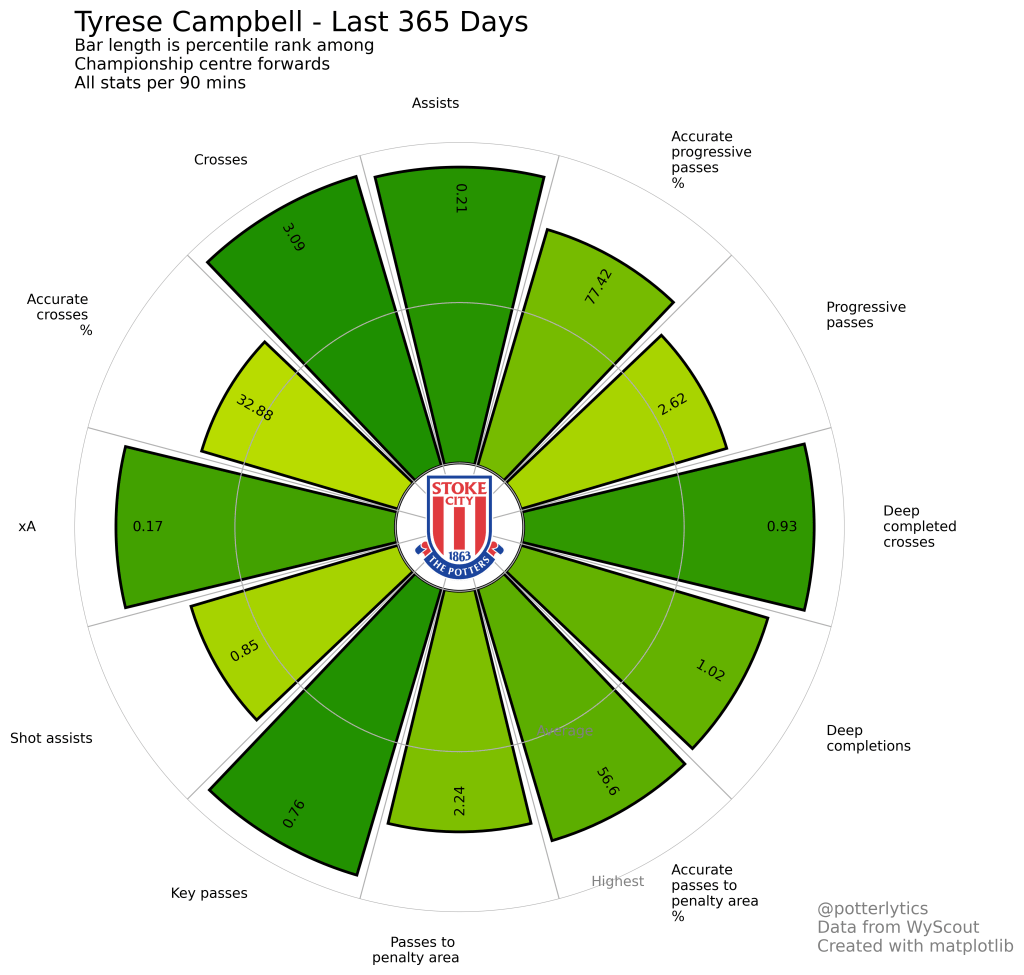
Well, you’ll be glad to hear that Campbell is one of the most creative players in the league in his position.
Particularly impressive are the deep completions, xA and key passes, all signs of a quality creative player.
He progresses the ball exceptionally well, and the number of shot assists that are key passes is a good measure of this quality.
Let’s take a look at how Tyrese likes to get his assists, and I promise I won’t make up a new name thing for it this time.
Campbell is in the top 15% of crossers even compared with AM/Wingers, and carries the ball into the area more than 89% of forwards in the league (FBref).
He also attempts in the top 11% of take-ons among forwards, so we can tell that he likes to take players on, alongside getting lots of crosses in.
It’s also obvious from his heatmap below (for Campbell’s whole senior career) that he has a preference for running wide, with lots of touches wide of the box. Alongside that, we see those touches inside the corners of the box, in that Ty-Phone area again.

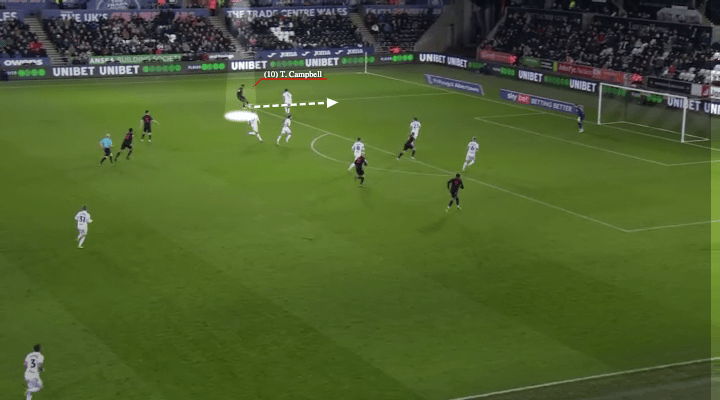
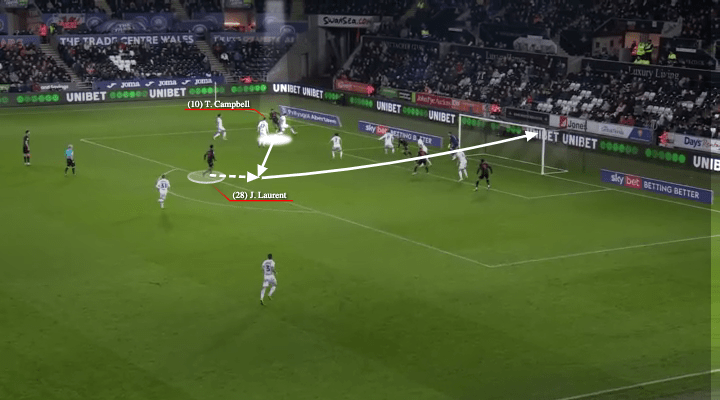
We can see lots of this in action in his last assist, vs Swansea.
Tyrese gets the ball in a similar position to the goals explained above, where he scores in the Ty-phone.
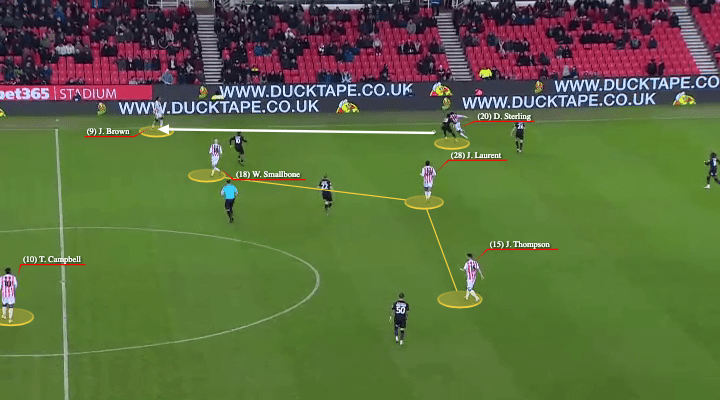
Again, he drives at the defence, but this time he runs on the outside, beating a defender to cut the ball back to Laurent, who fires it into the top corner.
Click each image to zoom in
The same happened in the game against Huddersfield in January.
Campbell gets the ball on the edge of the box, again beats a defender and cuts it back into a dangerous area.
Brown gets two bites at it and then scores.
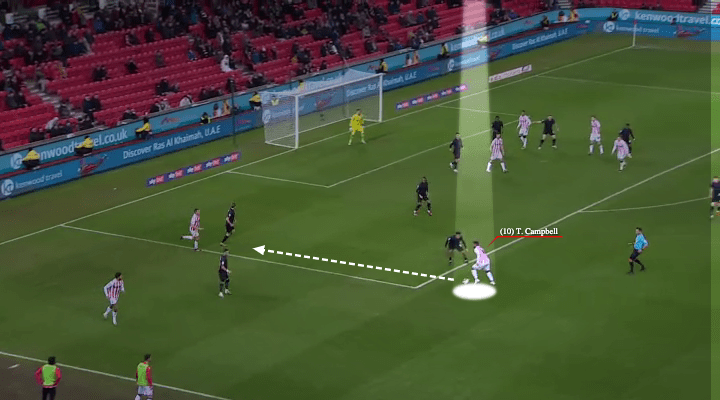
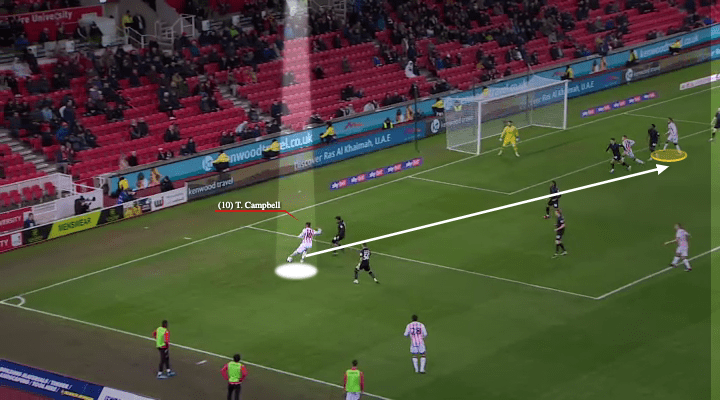
The cut-back from a take-on into wide areas is something Campbell is really bringing into his game this season.
Most importantly, many of these passes, cutbacks and crosses are not just high-volume, but also of a high-quality, leading to Campbell’s high expected assist numbers.
The skill Campbell has when attacking the box with the ball is rare at this level, and his output reflects that.
Spreading His Wings?
Now what about positioning? Campbell is a player who is often touted as ‘better from the wing’ by fans, and there’s no doubt that his skill-set in carrying the ball from deeper, and attacking the box from the half-spaces is fantastic.
That being said, does he have to play wide to play well? The answer is probably no.
Positions in modern football are a difficult concept to easily tie down. As a brief example, playing Gayle as a central striker and Brown as a central striker gives you two very different things. One will push higher on the back line and one will drop deeper.
What we do see is that no matter which ‘set position’ across the front line Campbell starts in, he still tends to get touches of the ball in deeper and wider positions, where he’s clearly dangerous.
We can see that in his heat maps below, each showing Campbell’s senior career touches when starting wide left, centrally, and wide right.
Click each image to zoom in

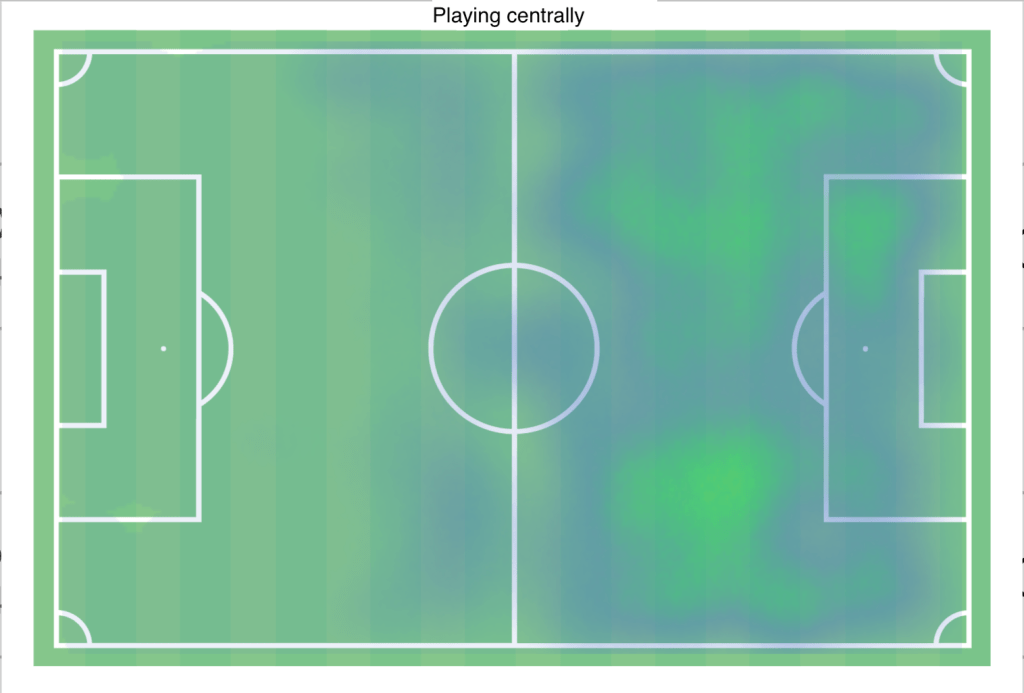
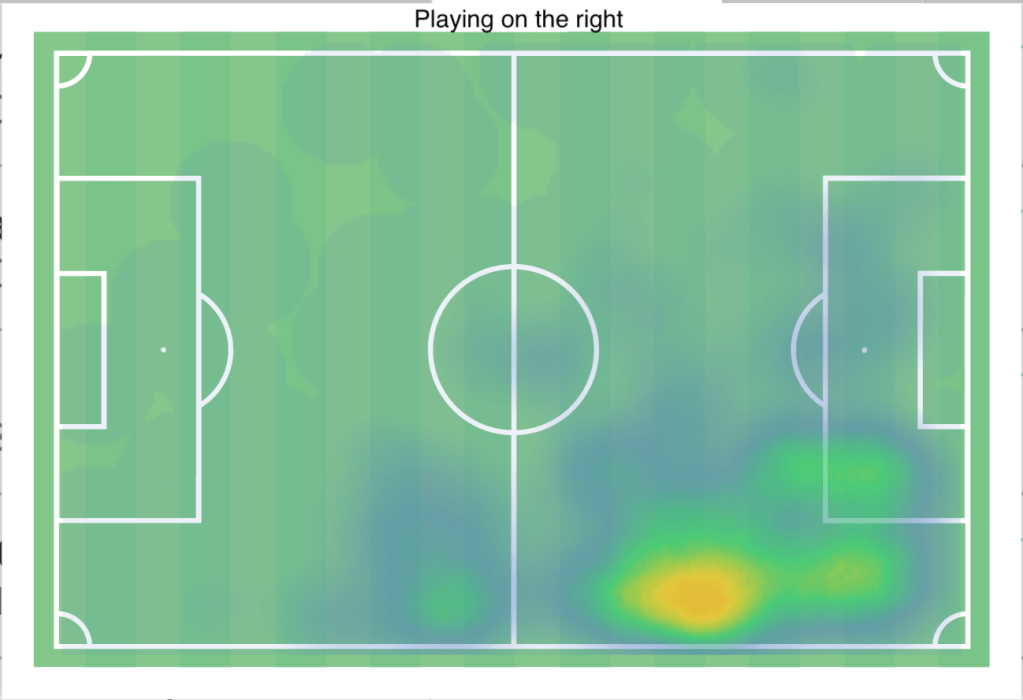
Simple ‘formations’ as we know them are not completely useless, but this is a good example where they are not fully describing the game in front of us.
As a central striker in Michael O’Neill’s 352, Campbell would still drop into many of the same positions he would occupy as a wide man in Alex Neil’s 433.
In terms of numbers, his output is still good in all positions too, although there is an increase when he starts wide, which I will explain further.
The table below shows his output per 90 minutes in each position in his league career so far.
| Metric\Position | Wide Left | Central | Wide Right |
|---|---|---|---|
| Minutes | 911 | 4180 | 2013 |
| Goals | 0.49 | 0.34 | 0.45 |
| Assists | 0.30 | 0.11 | 0.22 |
| xG | 0.28 | 0.29 | 0.23 |
| xA | 0.18 | 0.09 | 0.13 |
| Dribbles/success rate % | 6.72 / 61.8% | 3.57 / 51.8% | 6.08 / 55.9% |
| Crosses/accuracy % | 5.73 / 29.3% | 1.79 / 25.3% | 3.00 / 34.3% |
| Passes to penalty area/accuracy % | 3.75 / 44.7% | 1.53 / 47.9% | 2.86 / 54.7% |
You may look at that and immediately conclude that Campbell is better playing wide, but remember many of these numbers will be due to the change in play style and not necessarily indicative of a player who is ‘better’ in one position than another.
As a striker, Campbell will be much more focused on running in behind and creating space for others, for example, which does not show up in his own numbers.
What we can say is that Campbell is great at dropping deep and driving at defences.
BUT….
As alluded to above, there’s another side to his play too. Let’s look at one of his goals from last season, away at QPR.
Click each image to zoom in

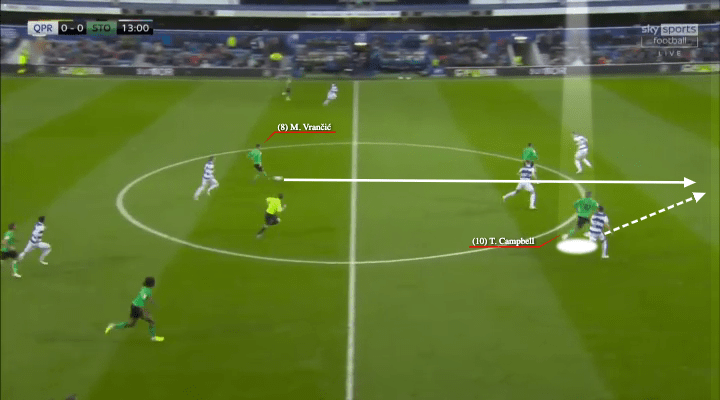
As Vrancic gets the ball, Tyrese immediately sprints forwards.
He breaks quickly through the dropping defence, into a huge open space to slot home from the edge of the box 1v1.
We saw a similar goal from Campbell against Preston this season too.
Click each image to zoom in
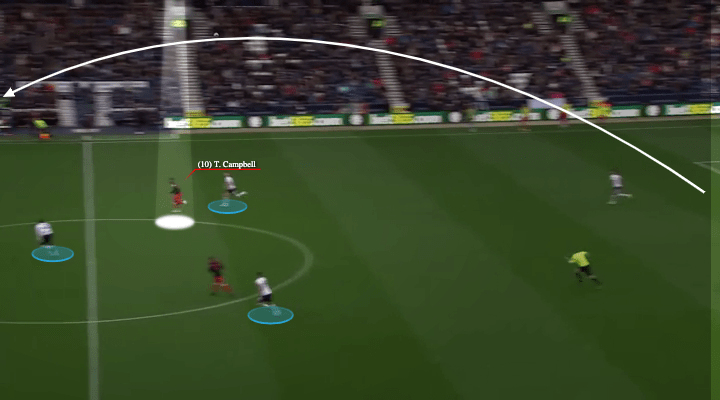


Baker receives the ball on the edge of Stoke’s box, and immediately plays it high and long for Campbell.
With a 10 yard deficit to make up, Campbell gets the ball before the Preston defender, cuts into his Ty-phone Zone and finishes in his trademark style.
So although Campbell’s skill running at defences & progressing the ball is clear, he’s also a huge threat in behind with his pace and particularly his 1vs1 finishing skill.
Conclusions?
So, what have we learned? Well, we’ve learned that I have some kind of obsession with Tyrese Campbell and/or numbers.
We’ve also learned that the numbers are very promising for his career, he’s a quality finisher of chances and has a skill level for progressing the ball that is rare among peers in this league.
He can play wide or central, but whichever you choose, you’d be silly not to try to get him involved in play as much as possible.
Thanks to any and all readers, and please feel free to comment and follow on Twitter at @potterlytics.
Should you wish to donate to help with the running costs of the site, and the data subscriptions we use, please feel free to visit our donations page here. Any and all help is very much appreciated!
George

















 Potterlytics