The Brief Rise and Rapid Fall of Alex Neil – What Happened?

So, there we have it. A 1-0 loss to bottom-of-the-table Sheffield Wednesday the final nail in Alex Neil’s 16 month tenure at Stoke City, and we’re in the market for a manager for the 5th time since relegation.

If you would like a reminder, please do go back and check out the xG article from last year.

After a shaky start, Neil looked to have turned things around with an incredible run of 12 games or so from February to April 2023. 21 points from a possible 36, including huge wins over Sunderland and Coventry, gave fans hope that things may finally be coming together.

The run was everything Neil had promised. Front-foot, aggressive football, intelligent high pressing, creativity and directness in attack, and most of all: fun. It was something we hadn’t seen since the COVID-hit end to the 19/20 season, and we didn’t even get to experience that in person.
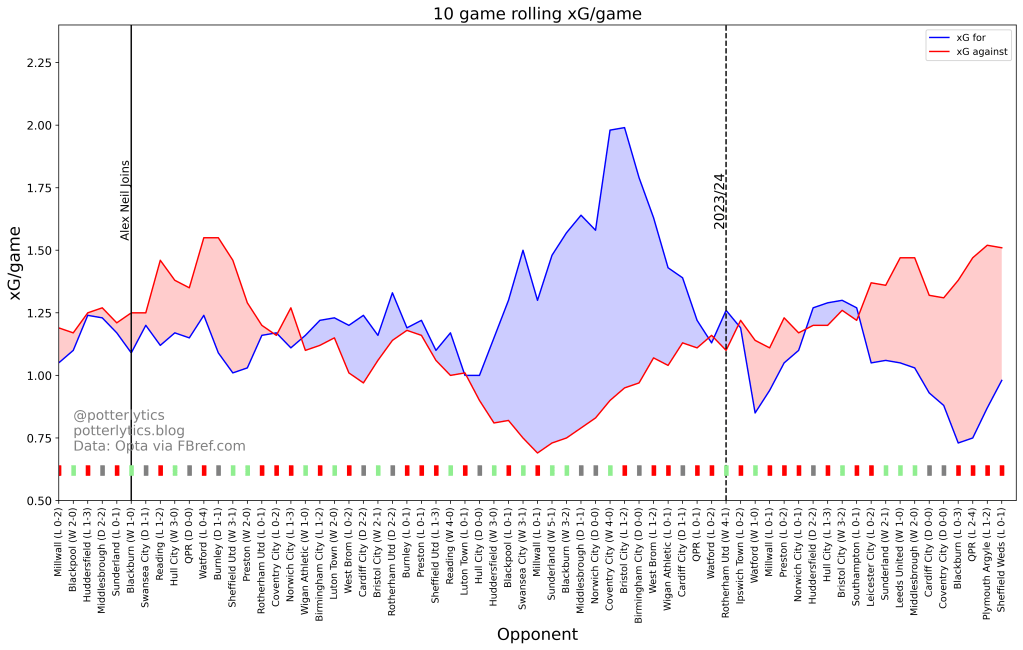
Those beautiful days of blue shading are long gone. Data: Opta via FBref.com

But the good times had to end, and wow, did they come to a brake-slamming emergency stop. A run of 2 points and just 3 goals from 7 games finished off the 22/23 season as the threadbare squad which could rarely rotate struggled to cope with fatigue. Worse still, a back injury to Player of the Season Ben Wilmot compounded the issue in breaking down a deep block.

This was all fairly reasonable in the minds of most, myself included. It was clear that Neil’s plan (at least as it showed itself in March) was a positive one, and one that had given lots of fans a big reason to buy in to a wave of optimism finally surrounding the club. Yes, the run had petered out with a whimper, but there was now a huge chance in the summer for Neil to bring in his own squad almost from scratch. This was a chance that very few managers get, to mould almost the entire club exactly as he wants it.

This was his chance to show us what he wants his team to be…

*Curb Your Enthusiasm Credits Theme*

The season started full of promise. A 4-1 victory over an admittedly poor Rotherham side was a shot in the arm for the fanbase. The new side consisted of 5 debutants and 2 returning loanees, but it was like they’d been playing together for years.

But very quickly there were worrying signs, and a week later Stoke were taken apart in a 2-0 defeat to Ipswich. The ‘all-action’ pressing approach that led to the halcyon run of Feb-April was clearly something that needed more time to develop among these new players. Ipswich were able to bait the press with ease, and play through Stoke as if they weren’t on the same pitch.

The aptitude of this pressing unit has become a very big issue in the opening 10 games of the season for Stoke, alongside a penchant for allowing attackers to turn in their own box and take a shot. Aside from a battling (and tactically strong) 1-0 win at home to Watford, Stoke were unable to add to their victories column until Gameweek 9, when a late strike from 18 year old Nathan Lowe sealed 3 points away at Bristol City in a very tight, and probably very lucky.

Prior to that game, Stoke were in 20th place, the same position they find themselves 12 games later having removed Neil from office.

Among these starting few games were the seeds of Neil’s destruction, shown best with the following similar goals conceded by Stoke through that period.
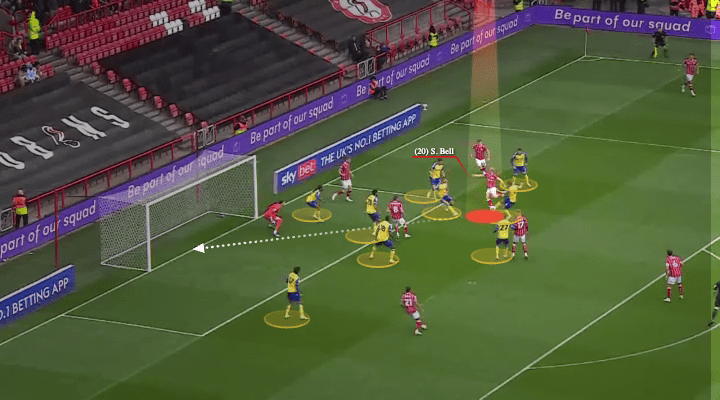

In each of the 4 situations above, the opponent highlighted was able to bring the ball down and get a shot away (all 4 resulted in goals) inside the Stoke area, within the width of the 6 yard box. In each of these cases, stoke had a minimum of 5 players in within 6 yards of the ball as the goalscorer received it.

‘Same old Stoke’, right? Well, yes. And this issue seemed to combine with a run of poor injuries to change Neil’s view on how Stoke needed to add points to their tally in the following weeks.

The ‘Good’ Run

A defensively-strong performance against Southampton saw Stoke go down 1-0 to a glorious free kick, despite a stonewall penalty claim being waved away for the Potters. The blueprint was set, as Stoke looked to pack the midfield and create a scrappy game whereby they might release counterattacks from second balls and hope to defeat other teams in small moments (remember this phrase).

Ignoring the Leicester game, with the many injuries and the embarrassing surrender with 2 banks of 4 stood on their own 6 yard box, Stoke stuck with this ‘crowd them out’ mentality in the midfield throughout the next 10 games, and here began the ‘good run’ which convinced many that the tide was turning.

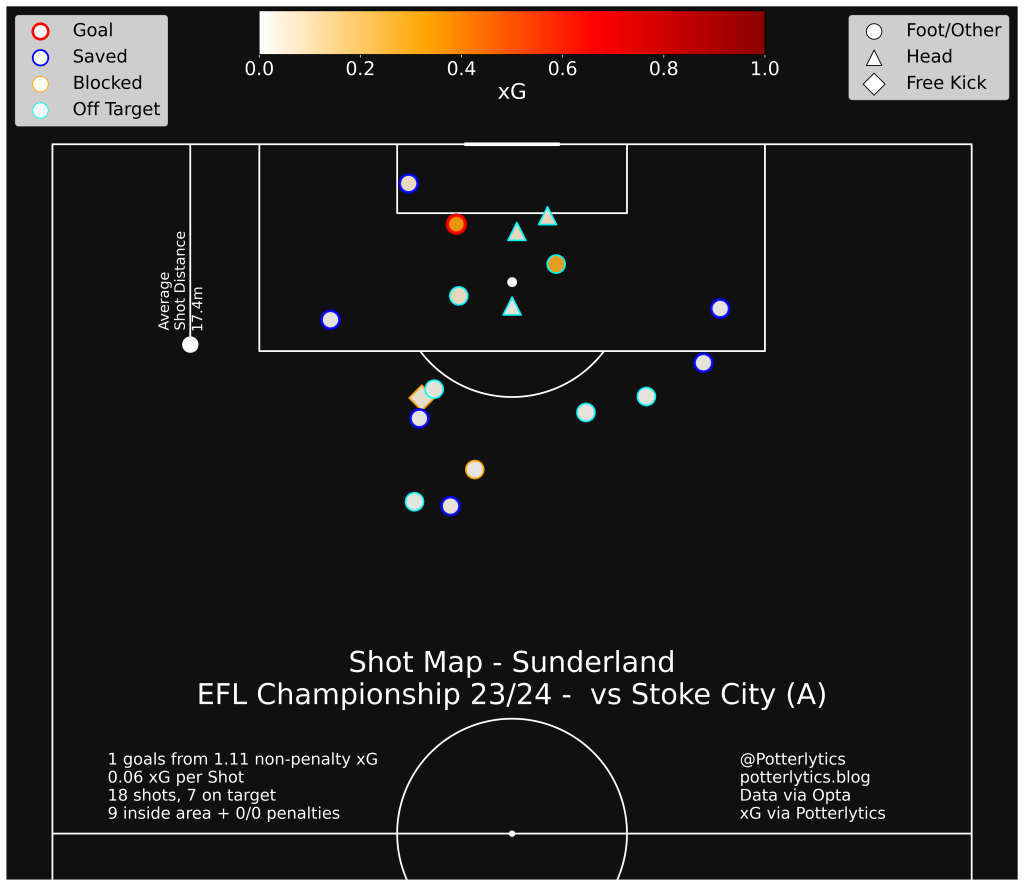
The 2-1 win at Sunderland was a nervy affair, in which neither team particularly dominated, and neither team particularly deserved to win.

Despite scoring 2 goals, Stoke’s attacking woes continued in the underlying numbers, and from the start of October to the end of November, they amassed only 6.5 xG from 9 games. In only one of those 9 did they achieve above 1 xG in a game, the 2nd dominant performance of the season away at Middlesbrough.

In the same period, despite conceding only 11 goals (4 of those in the final game of November vs QPR), Stoke’s opponents managed to create 13.4 xG, over double Stoke’s tally. It became clear that even though they had managed to pull together 3 wins from 5 unbeaten matches in this time, there was no sustainability to this run of form, unlike the highs of March.

The Middlesborough game was a rare joy. A match in which the press worked perfectly, Stoke’s build up was positive and sharp, and the 2-0 victory was well deserved. Leeds at home brought a rare return to the battling victories of old against higher-level opponents, with players throwing their bodies on the line, and a fantastically jammy set piece own goal bringing home the points. But even this joyous win and genuinely battling performance relied on Leeds missing big chances and a penalty.

The strength of battling to save points in those 5 unbeaten matches was marked by a scrappy midfield, a lack of creative freedom, and a consistent lack of bodies willing to run ahead of the ball from midfield or in wide areas. The build-up became slower, more laboured, and consistently longer into forward players. At time of writing, Stoke have attempted more long balls than any other team in the league.

Stoke’s build-up radar. They attempt more long passes p90 than anyone else in the league, and despite having more possession than average, almost 1/3 of their touches are in the attacking 3rd, well above average for the league.

This longer build up was also true of Stoke last season, and reflected the will of Alex Neil to create overloads in the wider areas, which could be hit quickly, either by switches from defence, diagonal passes over the top of fullbacks, or line-breaking passes from centre halves. If all else failed, Jacob Brown (or this season, Mehdi Léris) made a good option for a flick on into a crowded area of the near side midfielder, the full back, and the striker, all ready to win the second ball.

This season, however, the passes into those overloaded areas have been slower to come, less varied, longer, and generally with fewer bodies around the ball.

See the difference between the Rotherham game at home, and the Sheffield Wednesday game from Saturday below.
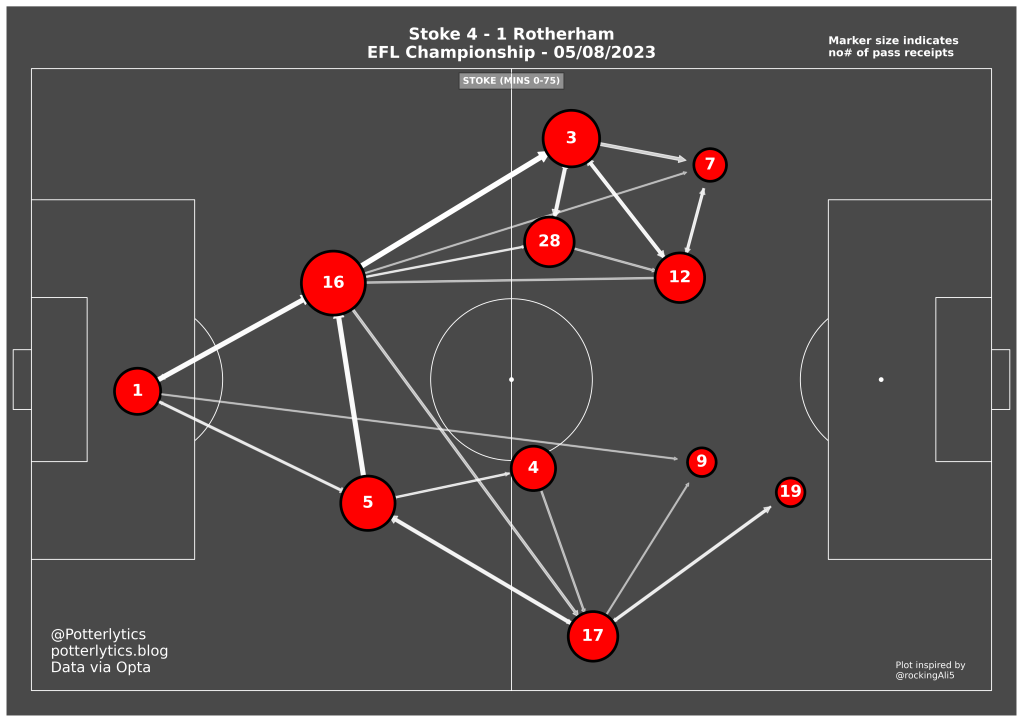
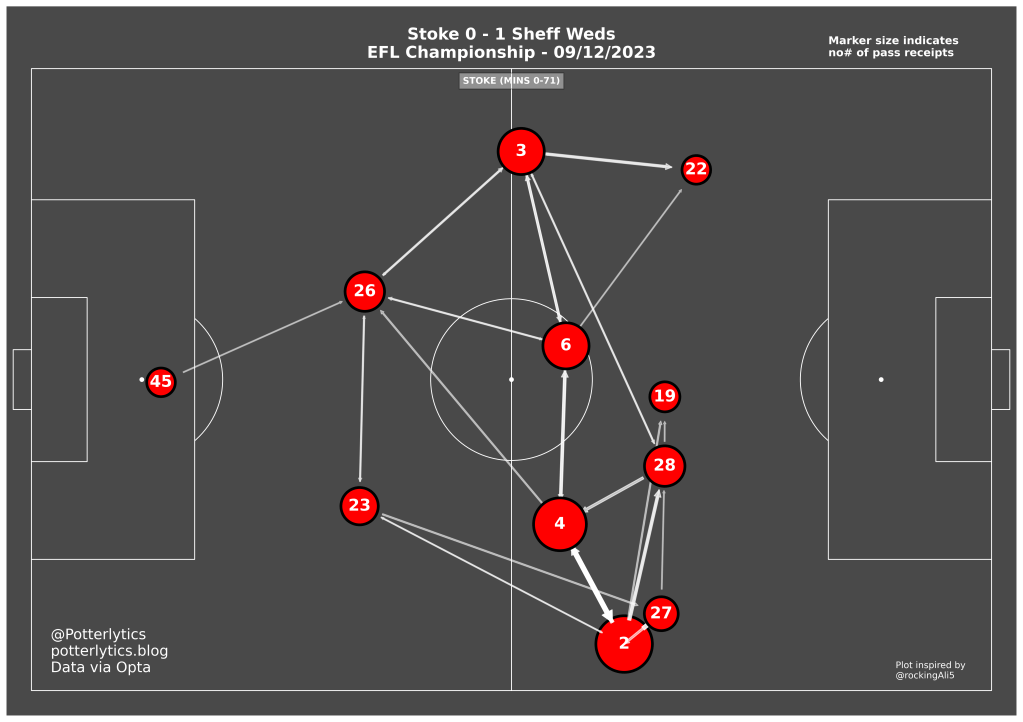
Against Rotherham we see two clear areas, left and right, where players often interlinked to provide overloads. On the left wing we have Stevens pushed high into the opposition half, with Laurent, Johnson and Vidigal connected closely to support progression of the ball. On the right wing, we see Hoever further forward, with Pearson supporting from slightly further away, and Brown/Mmaee pushed higher to run in behind.

The small arrow to Brown from Travers indicated those longer passes as an emergency outlet. Note that in this game both centre backs played a range of progressive passes into midfield and full backs (Wilmot to Hoever in particular was a huge progression route for Stoke).

Against Sheffield Wednesday we see much less cohesion. Both centre backs contributed less to the build up, and more passes went straight down the line to full backs. Gooch and Léris were in similar average positions, and Bae Junho was almost entirely on his own, relying on straight balls down the line from Stevens.

In fact, throughout the season, midfielders have been receiving the ball in deeper and deeper areas as the games have passed.

Positions of received passes by centre midfielders. The thick white line indicates the median height at which passes were received.

On average, players in central midfield are receiving the ball ~6 yards deeper in the last 10 games than the first 10. The biggest issue here for me is not necessarily that they’re involved in build-up in deeper areas, that can be fine, but that they’re much less involved in higher areas of the pitch.

Last season we regularly saw Smallbone, Laurent, and Baker pop up in higher areas of the pitch to help create and finish off chances. These last 10 games we’ve not seen nearly as much of that. On the plot, this shows up as the squares around the half spaces near the box, which are much less bright in the second image.

Alongside this, centre midfielders added less xT (I know, I’m sorry, it’s a measure of how useful possession is, but for the purposes of this it basically means their average pass didn’t move the ball as close to the goal as it did before) in their passes in the last 10 games.

The end points of successful passes made by Stoke City centre backs. The thick white line indicates the median height at which passes were received.

The same is seen in the passes made by our centre backs. In the second plot, we see that fewer passes make it into half spaces across the halfway line, and far fewer make it into the central areas just inside Stoke’s half. The indication here is that Stoke’s build-up is much less likely to break the initial line of the opposition press by playing into the midfield than it was early in the season.

All this supports the thesis of Neil struggling to fix the defensive issues of the early season, and as such he tried to step away from his centre backs playing into more risky areas, instead preferring to allow centre midfielders to drop deeper than the opposition press, and hoping the real creativity would come from quick breaks or high regains.

‘Front-Foot, Aggressive Football’?

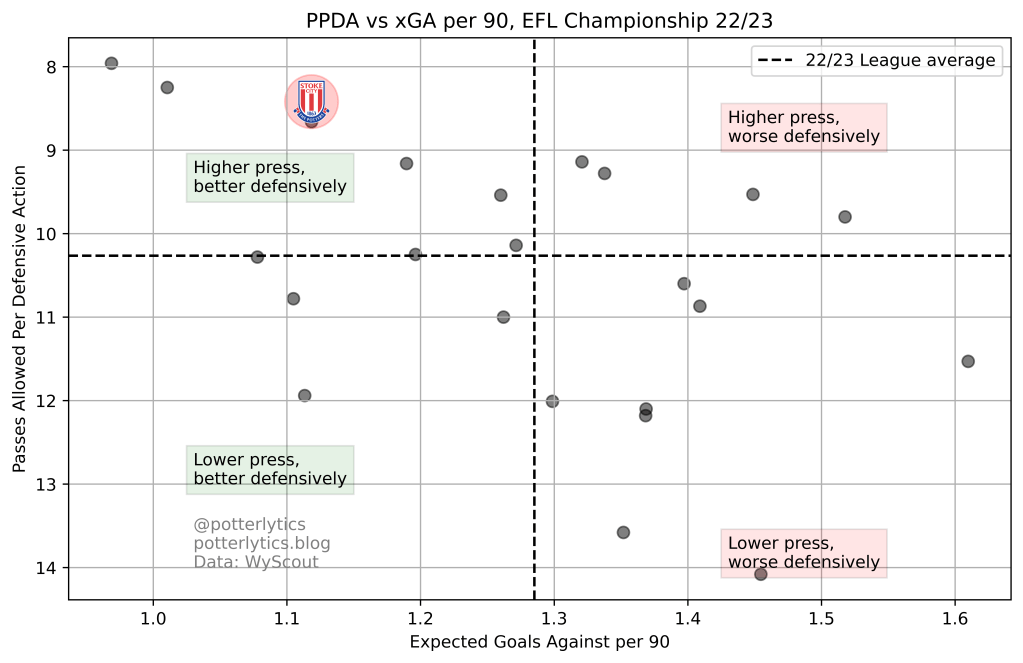
Stoke’s high press has actually been pretty good this season, and they’re still one of the most aggressive pressers in the league. Stoke’s PPDA (how many passes they allow the opponent to make before making a tackle/interception etc) of 8.98 is the lowest (i.e. the most aggressive press) in the league. They make the 5th most attacking 3rd tackles of any side, and have the highest duels, tackles and interceptions per minute of opponent possession.

We can see this in the two radars below.
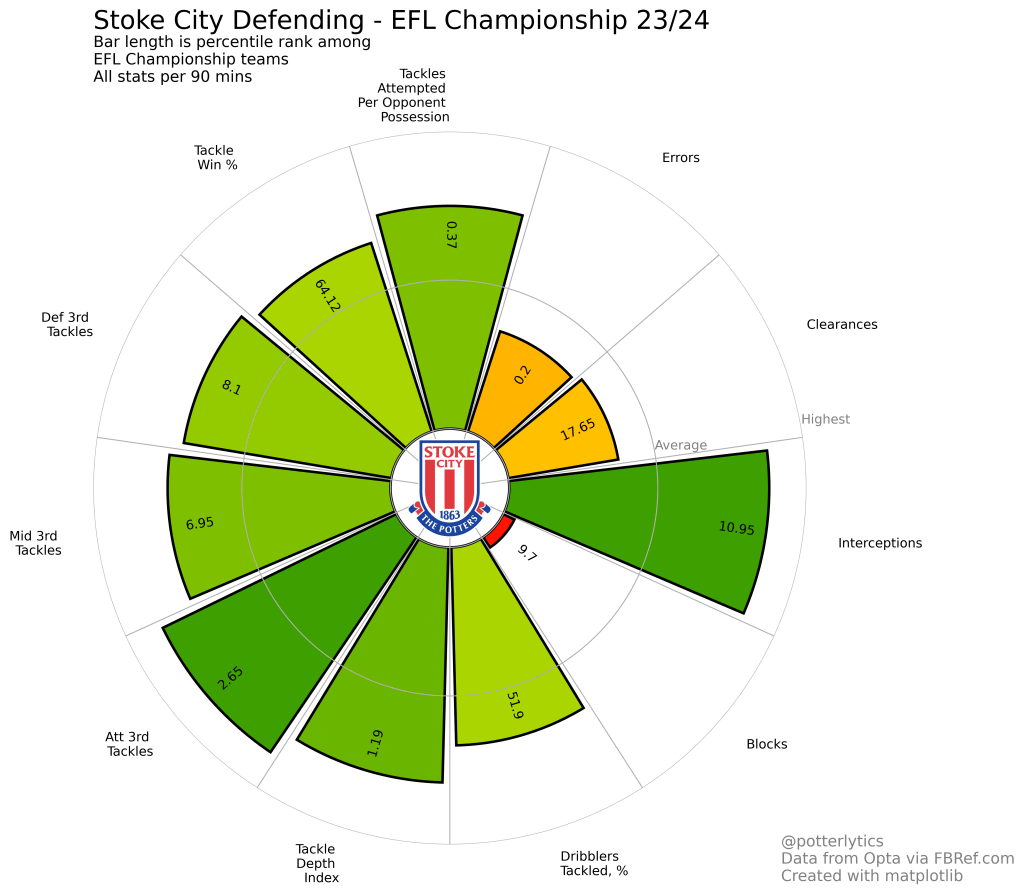
In the left-hand radar, we see that Stoke make lots of tackles and interceptions, lots of tackles high up the pitch, and a larger-than-average portion of their tackles are high up the pitch.

Similarly, in the right-hand radar, we see that opponents playing against Stoke have few touches in the attacking 3rd, a very low pass completion, and a lower-than-average attacking 3rd touch ratio (number of touches in attacking third/total number of touches).

Stoke are still good at pressing, although their numbers have fallen a little in the last few weeks.

Despite this, Stoke have yet to score a goal from a high turnover all season. From 124 of these occurrences (2nd only to Leeds), 28 have ended in a shot, the 5th highest number in the league. The lack of a true goalscoring threat from this key part of Alex Neil’s ethos has further compounded the attacking woes, and couldn’t cover up the defensive errors as well as they had earlier in the season.

The creativity they do have comes often from throwing the ball into the box and hoping to pick up the resulting pinball. They put far more crosses than average into the box, and pass the ball into the area more than average too. But from this relatively high ‘expected assist’ value (how likely a pass is to result in a goal from 0-1) comes a very low conversion into xG. The xG per xA section of the radar shows that Stoke are among the poorest at the league in turning balls into good areas into high value chances.

There are two possible issues that can cause this, and I think Stoke fall foul of both, but more likely the overriding issue is the latter of the following problems.

Firstly, your shooting players could be poor at getting into those good positions, or poor at turning good passes and crosses into shots. Secondly, but more pertinent for Stoke in my opinion, you can be putting a high volume of low-value balls into the box, inflating your expected assists value but converting very few of these deliveries into good chances. This is supported by the high number of crosses and passes into the box, and an xA value that, despite being above average, is still lower in league rank than the volume of balls into the box.

Crosses are a pretty low-efficiency way of scoring goals, and that becomes even more inefficient when you don’t have lots of bodies in the box as in Stoke’s last 10 games. Compare this to the high value chances created by cut backs in March’s run, and we see a huge difference in the efficiency of Stoke’s attacks.

‘The Malaise Is Deep’

Thanks to John Percy for that turn of phrase. It really does describe the club perfectly.

Although Neil can point to several games where Stoke were on the wrong end of little mistakes, his classic line of ‘we just need to be on top in those moments’ still rings in the ears of every Stoke fan who could stand the post-match press conferences after a loss.

But at some point, you have to look into why so many of these games have been decided by small moments. The Championship is a very scrappy league, with games often decided by tiny margins, but the issue with Alex Neil’s 23/24 Stoke side is that they forced games to be this way in the last 10 weeks or so.

It’s seen perfectly in the Sheffield Wednesday game. Yes, Stoke should’ve scored a (very dubious) penalty. Mmaee and Junho Bae probably should’ve scored big chances too, but Sheffield Wednesday were given a chance to win with Stoke’s lack of control on the ball and unwillingness to play through the lines.

The scrappy nature of the match, enforced by a lack of confidence on the ball, a lack of sharpness in passing, and a midfield 3 tasked with battling their way through the game, was the reason that moment existed for the opposition.

Even the games in which Neil appeared to make attacking changes, namely vs QPR and Plymouth in which a front 4 of Vidigal, Mmaee, Campbell and Junho started, appeared more out of desperation to stop the attacking rot than a true plan.

The front 4 did create more chances against these two defensively weak opponents, despite often appearing to be left to their own devices in terms of how to break down the opposition. But even this relatively conservative attempt to let some technical players do some attacking immediately led the return of defensive woes, with the team conceding 4 (from > 2 xG) to a QPR side that had only scored 12 goals all season by that point.

And So It Begins… Again… Again…

And here you find us again, returning to the managerial market, like an addict trying to find that one hit of dopamine that will make everything great again.

I’ve been clear in my views before about the model of the club, and it will be very interesting to see if the de-facto ‘long term dudes’, in Ricky Martin and Jared Dublin, will survive contact with the next manager who walks through the door. Martin made it clear in the summer that the aim was for Stoke to build with a core ethos of ‘high tempo, aggressive, front-foot football’ in the mould of February to April’s run of form. It was even more clear that there was very little consideration that Alex Neil might not be able to deliver that.

Given the previous willingness of the owners to allow a manager to tear up the foundations of the club as soon as they are announced, any new boss may be likely to have a veto on pretty much anyone in the club. It may depend how much of Ricky Martin’s spiel has been bought into by John Coates, but the dice gets rolled again, and maybe this time we’ll get lucky…

My last post on here ended with a genuine ‘Bravo, Alex’ after the Watford win.

This one will end with a slightly more sarcastic line.

Bravo, John.

xG per game, 20 game rolling average, since Summer 2017.

Thanks to any and all readers, and please feel free to comment and follow on Twitter at @potterlytics.

Should you wish to donate to help with the running costs of the site, and the data subscriptions we use, please feel free to visit our donations page here. Any and all help is very much appreciated!

George

Anatomy of a 10-game Revolution (Part 1) – Stoke’s New Blueprint

Part 1 – Sustainability and off-the-ball principles

‘Oh great, another tactics piece that goes on way too long’ I hear them cry.

‘Here he goes, getting carried away again’ the haters say.

Well they’re damn right, strap yourselves in for another lengthy profile of the new-look Potters of February 2023 to March 2023 (and beyond?).

Edit – This piece has turned out to be a lot longer than I imagined, so it’s now split into two parts! This is part 1, looking at sustainability and off-the-ball work. Part 2, looking at build-up and chance creation, is available at this like when you’re finished with Part 1! Anatomy of a 10-game Revolution (Part 2) – The On-Ball Boogaloo

An Unexpected Turnaround

It’s a month and 2 days (providing I release this when I intend to) since Stoke fans serenaded the team with chants of ‘you’re not fit to wear the shirt’ after a last minute loss at home to Preston.

Just 2 league games later, Stoke were thrashing Reading 4-0, and despite a few lulls, there have been increasingly positive signs ever since. This has culminated in a run of form that has seen Stoke take 11 points from a very difficult 5 games, scoring 13 and conceding just 4.

Now on these small timescales, many teams can go on these runs of form due to variance (in effect, luck), in finishing outcomes, goalkeeping outcomes, refereeing decisions, or other unsustainable factors.

Interestingly (and excitingly) for Stoke, though, the recent form actually seems to be reflected in the underlying numbers. Let’s take a look at the 10 game rolling average xG per game (taking the average of the last 10 games expected goals, see our explainer article: xG – A Stoke City Explainer!).

We see that Stoke have been consistently improving their rolling xG since the Hull City home game, and have had an average expected goal difference p90 of above +0.5 since the Blackpool away game.

Whilst the quality of these performances may not last forever, it’s heartening to see that the results are backed up by the underlying numbers. This is a big tick next to the sustainability box, and although there are some factors that could shift the balance, such as shifting opposition attitudes towards Stoke, transfers and the return of loan players, and injuries, here at Potterlytics I like to take the positive slant on things.

So what exactly is this newly-revolutionised Stoke side doing differently? What is the blueprint?

Well, let’s combine all we’ve seen over the past 10 or so games together to build a tactical profile.

A Brave New World – Off The Ball

The first big shift we’ve seen is the way Stoke work off the ball. They’ve been relatively high-pressing all season, but in recent weeks this has been taken into overdrive, and the well-oiled pressing machine has even managed to stifle high-flying Middlesbrough in their own back yard.

Indeed, looking at the Passes per Defensive Action or PPDA (the average number of passes a team makes before Stoke perform a defensive action, e.g. a tackle or interception), Stoke are one of the most intense pressers in the league.

Remember, a lower PPDA indicates a more intense press.

I’ve waxed lyrical already about the quality and efficiency of Stoke’s new pressing unit since the 3-1 victory away at Swansea, but it wouldn’t be a real profile without explaining again how the main press has been working.

So what is the quintessential Stoke City high press? Take a look at the animation below, and let’s go through the plan step-by-step.

A hypothetical realisation of Stoke City’s main pressing plan of the past 10 games.
Click the lines with dots on in the bottom right to slow the footage.

There are 4 main steps in the most basic realisation of the plan.

In our theoretical scenario, the opponent is playing a relatively simple 433, with one full back pushing high, and the other dropping inside to help with build-up. This is similar to what we saw from Sunderland. The opposition keeper has the ball, and from here, we see our 4 steps as follows:

1 – The central striker (number 11, usually Gayle, although in his absence this role has gone to Jacob Brown and Nick Powell) makes a curved pressing run towards the ball. The curving of the run cuts off one passing lane for the player in possession, forcing the ball into a specific area, starting the trap. The pass can only go one way, as behind the front 3 all players are closely man-marking.

2 – As the ball gets passed out to the wide to the right, Stoke’s wide left player (in our case, Tyrese Campbell, number 10) triggers his press and closes down the ball aggressively. This forces the opposition centre back (5) to either try to carry the ball past Campbell, or play long. The central striker (11) drops to cover the passing lanes across the box and back to the keeper.

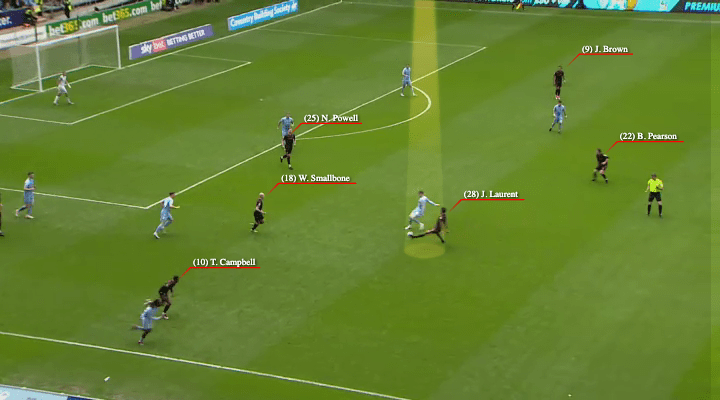
3 – The centre back (5) plays the ball long to the front line, where Stoke’s aggressive man-to-man press is waiting. Josh Laurent (28) steps in front of the waiting opponent and nicks the ball back.

4 – Laurent (28) pushes forward and plays the ball wide to Campbell (10) and Stoke’s midfield and forward line bomb forward to take advantage of the transition.

This shift has made great use of the athleticism and combative nature of the players Stoke have available. The additions of Ben Pearson, Axel Tuanzebe, and Ki-Jana Hoever, and the return to the side of Dijon Sterling and Josh Laurent have given Stoke a side that loves to be active in forcing the opposition to give up the ball.

Even in games where the opposition have clear strengths in attack, such as the game vs Coventry, we saw Stoke trust 40-year-old Phil Jagielka and Ben Wilmot to mark Gyökeres and Godden man-to-man, two strikers who are by no means easy to pocket. Again, bravery is the word of the day!

It’s all well and good looking at it on a tactics board, but how does this work in reality? Players aren’t always going to lump it long straight away, and they may be able to bypass one of those pressing moves if they’re good enough.

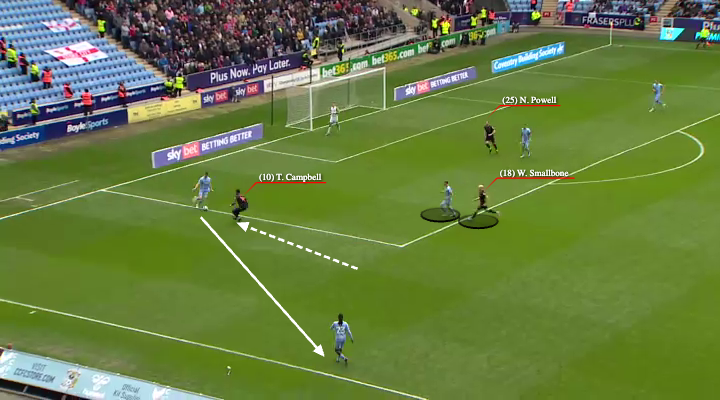
Let’s see some examples of how the press evolves in real games. First up, about 10 minutes into the Coventry away game, and Coventry have a goal kick. As the ball comes back to the keeper we see the press in action.

Click each image to zoom in

In the first frame we see our familiar setup. Powell, playing as the central striker in this game, is blocking the passing lane to the central player, Smallbone is marking the deeper midfielder, and the wide players are sat off the back line, ready for their press to be triggered when the ball comes to their side.

Sure enough, the keeper plays it to the right hand centre back, and Campbell presses the Coventry player as soon as the ball moves out.

Under significant pressure, the opponent plays the ball down the line to the right back, who has dropped deep to provide support.

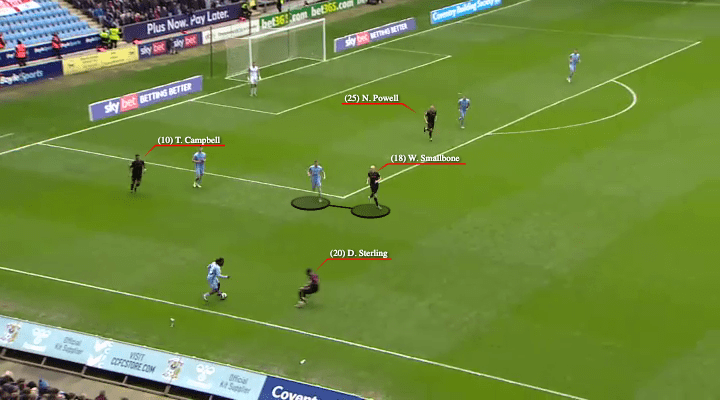
Click each image to zoom in

As the ball comes out to the right back, Stoke’s left back, Dijon Sterling, bombs forward to continue the press and forces the Coventry player to play the ball inside to a supporting midfielder.

The trap has worked. As the ball comes into the centre of midfield, we see both Josh Laurent and Ben Pearson man-marking the Coventry players. Laurent snaps into the tackle and wins the ball back.

This isn’t necessarily the same in all games, however, and we see a slightly different setup in this shorter clip from the Norwich home game.

A reminder that in this game, Stoke started with a front 3 of Campbell, Brown and Hoever.

Click each image to zoom in.

In this first clip, we see Stoke set up relatively similarly to previous games, but this time Smallbone presses the ball, leaving his man-marking position. As he does this, Brown moves across to cover and pass back across.

As Smallbone curves his pressing run, there is no pass available back across.

Norwich in this game were tactically very interesting, and were in fact told by the manager to go long much more often than they usually do. As evidence, in this game Norwich attempted only 242 passes at a completion rate of 64%, compared with their average this season of 456 passes per game (82.9% completion). They had only 37% possession compared with their average of 57%, and played 18.2% of their passes long, compared with a season average of 10.9%.

As such, we see the Norwich centre back attempt to bypass Stoke’s press by launching it long into the wide player on the left. Again, Stoke’s man-to-man press is waiting for exactly this, and right-back Sterling launches in aggressively to intercept the ball.

So we see that there can be a slight change in specifics of the press, in this case Will Smallbone pressing forward alongside Brown in more of a 4-4-2 high block. We’ve also seen specific responses to opposition styles, such as Campbell dropping off and marking man-to-man to stop Blackburn’s inverted right back from overloading the centre of the pitch.

But even in these changes, the philosophy of Stoke’s press is the same:

  • Allow the opponent to play the ball into an area with curved pressing runs.
  • Press aggressively to force the opponent to make riskier passes through the press, towards their forward line.
  • Where strong, combative players are marking man-to-man, ready to win what might usually be 50/50 duels, but are now in their favour due to their skillsets.

It’s Only the Championship

Most impressive though, is the quality of opposition Stoke have been managing to successfully implement these brave principles against.

Looking at Championship form over the last 10 games, Stoke have beaten the 3rd and 6th most in-form teams (Coventry and Blackburn), and produced excellent performances, arguably deserving to beat the 1st and 9th most in-form teams in Middlesbrough and Norwich.

Most impressive, as those of you with Freeview may know, is possibly Stoke’s performance at home to high-flying Brighton in the FA Cup.

A 1-0 loss marred what was an exceptionally brave pressing performance against one of the most press resistant sides in the country, with Stoke following the principles outlined above.

Let’s take a look at a couple of examples.

Click each image to zoom in.

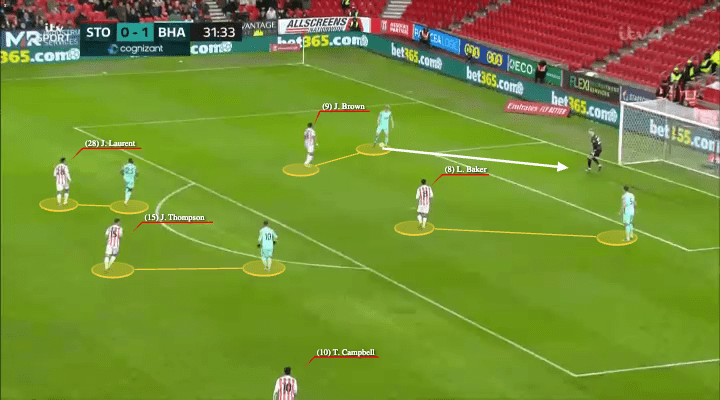
From a goal kick, Brighton play the ball short to a centre back, and we see that Stoke are set in a similar 4-4-2 high press to the Norwich game.

In this game, Ben Pearson, Will Smallbone, and Dwight Gayle were replaced by Thompson, Baker and Tymon respectively. You might expect Stoke to therefore change tact to alleviate the possible lack of cohesion, especially against an incredibly press-resistant team. But no, Stoke stick to the principles outlined above.

Brown presses the keeper with a curved run to block the passing lane back to the centre back. Baker pushes out to the player who then gets the ball off the keeper, aggressively pushing to force Brighton into riskier, line-breaking passes.

Click each image to zoom in

Trying to play out quickly and break the press, the Brighton centre back scuffs his pass, into the feet of the waiting Tyrese Campbell.

Now, as the ball turns over to Stoke’s hands, you can see one major benefit of the high press. Suddenly, Stoke have a 4v4 in the opposition box, against a disorganised defence.

Even more fun, in the last frame as Campbell gets the ball, we see centre back Axel Tuanzebe pushed 20 yards into the opposition half to track a player man-to-man who was dropping off to receive the ball.

You Can’t High Press All of The People All of The Time

But, sometimes good teams get through! So what do Stoke do when the pressure is on and they have to sit a bit deeper? Let’s take a look at an example or two to garner the back-up plan if the press doesn’t work, or if Stoke are holding onto a late lead and under pressure.

We start off in the 1-1 against Middlesbrough, as the opposition have the ball 35 yards from goal.

Image: Wyscout

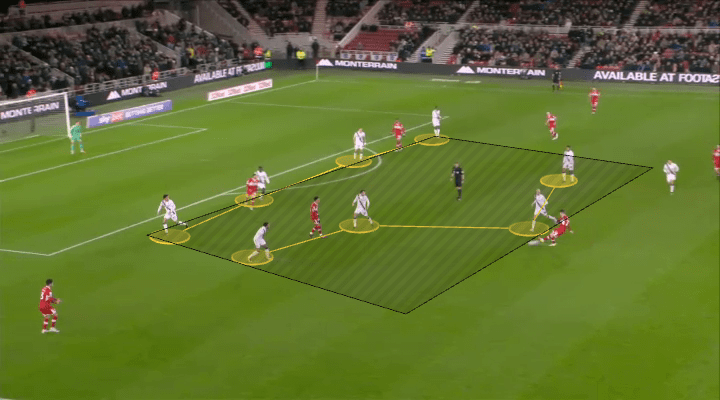
Se see that in this game, Stoke set into a pseudo-4-4-1-1 low block, with Brown dropping into a wide right role deep, as Gayle and Campbell stay forward on the break. Note that the ball is always under some pressure from a player.

But, most importantly, we see a principle that we’re very familiar with at Stoke off the ball. The area covered by Stoke defensive players is compact, narrow, and defending the centre of the pitch first and foremost.

When the ball pushes wide, thanks to Stoke’s narrow block, they can then contract space by pressing the ball more aggressively, using the touchline as a blocker and keeping the ball away from goal.

In this position, the right or left hand side of Stoke’s team can double up on the wingers to stifle the attack.

Similar positions are seen in this image from the 5-1 victory at Sunderland.

Image: Wyscout

This time, the ball is wide left of the Sunderland attack. We notice that Ki-Jana Hoever has pressed the ball aggressively, and as such, Ben Pearson has dropped into the right back position, Smallbone has dropped into defensive midfield, and Brown has dropped centrally into Smallbone’s initial role.

This cohesion is an incredibly important factor in Stoke’s consistency in defensive work.

The narrow, compact pseudo-4-4-1-1 remains, and the ball is still always under pressure by at least one defending player.

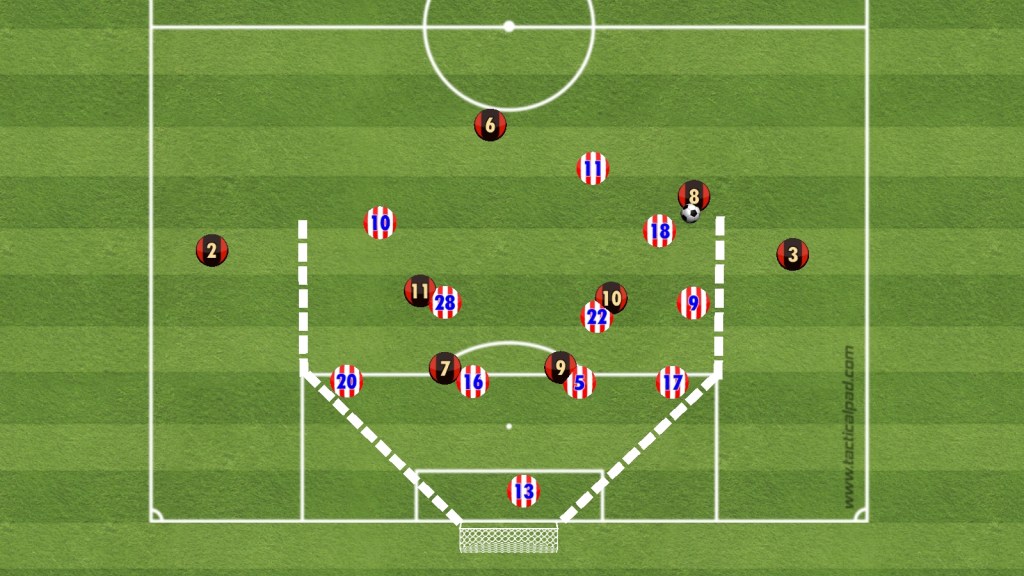
Stoke block out the central areas just on the edge of the box, and again force the ball wide into areas easier to defend, and away from high-value chance areas centrally. This is an expansion of the work Sean Dyche described in his fantastic Coaches Voice interview (see here: https://www.youtube.com/watch?v=o3YY7PY-IH0&t=399s) in protecting the zone of maximum opportunity, a v-shape from the goal to the corners of the box, and then lines parallel to the touchlines extending out from the corners of the box towards the half-way line.

In this (crude, sorry) scenario, Stoke’s opponent has the ball outside the box, and while Smallbone presses the ball aggressively, the unit behind him sits protecting the area between the dotted lines. These lines show the zone of maximum opportunity, in the most dangerous areas for chances to occur.

So, there we have it! The basic principles of Stoke’s off the ball work, and hopefully some signs that the current performances could continue for quite a while yet.

Next up on Potterlytics, I’ll be delving into the work on the ball in build-up and chance creation. Follow this link to take a look. https://potterlytics.blog/2023/04/07/anatomy-of-a-10-game-revolution-part-2-the-on-ball-boogaloo/

Thanks to any and all readers, and please feel free to comment and follow on Twitter at @potterlytics.

Should you wish to donate to help with the running costs of the site, and the data subscriptions we use, please feel free to visit our donations page here. Any and all help is very much appreciated!

George

xG – A Stoke City Explainer!

You see it everywhere in football nowadays, it’s even grown to the point where Sky Sports show it on their post-match stats.

We now appear to be at a point where not only is eXpected Goals (xG) assumed to be common knowledge, it’s also something that its assumed everyone fully understands. But for a lot of people, xG is just a term that suddenly appeared and isn’t necessarily well-understood.

Considering this, I thought a good way to start off the blog here at Potterlytics would be to go through a little xPlainer (I’m sorry) of expected goals, told through the lens of Tyrese Campbell and two beautiful Stoke City goals from recent seasons.

The Basics

So let’s start by looking at the basic concept behind xG.

Football is a very low scoring game, with a high proportion of randomness to the results. It’s much easier for a lower-quality team to eek out a win through a bit of luck in football than in, say, basketball, where games finish with much higher scores.

This means that in football, the final score is generally a poor metric by which to measure the quality of a team’s performance, or to understand the major themes within a match.

As an example, you could say ‘well Stoke had 14 shots and Preston only had 3’ to show that Stoke were the better side, but on further inspection it could be the case that Stoke tried 14 Charlie Adam-esque shots from the halfway line in the last 10 minutes, and Preston had 3 shots from 5 yards out. This is the point where we’d say ‘they had the better chances’.

The best way to consider xG is that it gives you a number that quantifies just how good a chance is. Taking into account historical data, namely thousands of shots from previous seasons, an xG model tells you just how often the average player can be expected to score from a given chance.

There is no such thing as a perfect metric for the quality of a performance, but xG helps at least compare the quality of chances created.

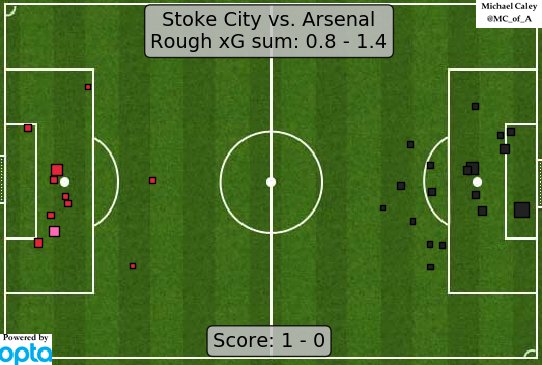
#Ambition’: An xG map of Stoke’s 1-0 win over Arsenal in August 2017, thanks to a Jese goal assisted by Berahino. Larger squares indicate a higher xG chance, and a higher probability of scoring. The pink square is the goal. Credit: Michael Caley, @MC_of_A

‘How can you score 0.47 goals? What a load of ****’

xG values are usually quoted in terms of the probability of a goal being scored from zero to one. 0 xG would indicate that it’s impossible to score the chance, and 1 xG would indicate that it’s impossible to miss.

If a chance has an xG of 0.47 from a given model, that means that in that model’s historical data, a goal was scored from this type of chance 47% of the time, i.e. for every 100 of these chances, there were 47 goals.

Interestingly, it’s usually the case that xG is much lower than you’d expect, for lots of chances. xG can never be 1, as even a half-yard tap in is missed very occasionally. Let’s give a few examples and then take a look at a very fun Stoke City goal.

‘How’s he missed that?’

Take, for example, a penalty. Before you read on, think carefully and have a guess at how often you’d expect an average penalty taker to score. 90% of the time? Surprisingly it’s not that high! A penalty is in fact (using Wyscout models) 0.76xG, meaning only 76% of penalties are scored.

Extra points if you assumed lower than 0.76 because of Stoke’s record.

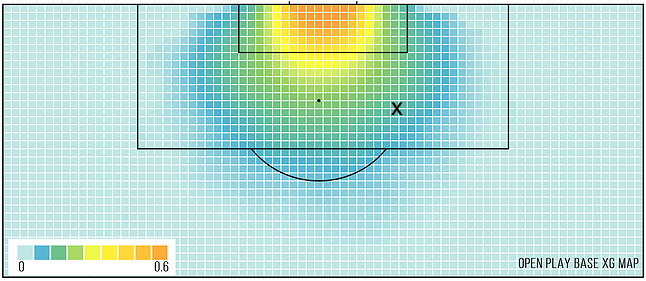
We can take a look below at the xG model that takes into account only the location of the shot, to see what kind of values we can expect:

An xG map showing the probability of scoring from various locations on the pitch. This model takes into account only the location of the chance. Credit: https://www.datofutbol.cl/xg-model/

Now better models will take into account much more than just the location of the shot. Let’s use Tyrese Campbell’s goal vs Preston, from 22/23, as an example:

Unleash Tyrese

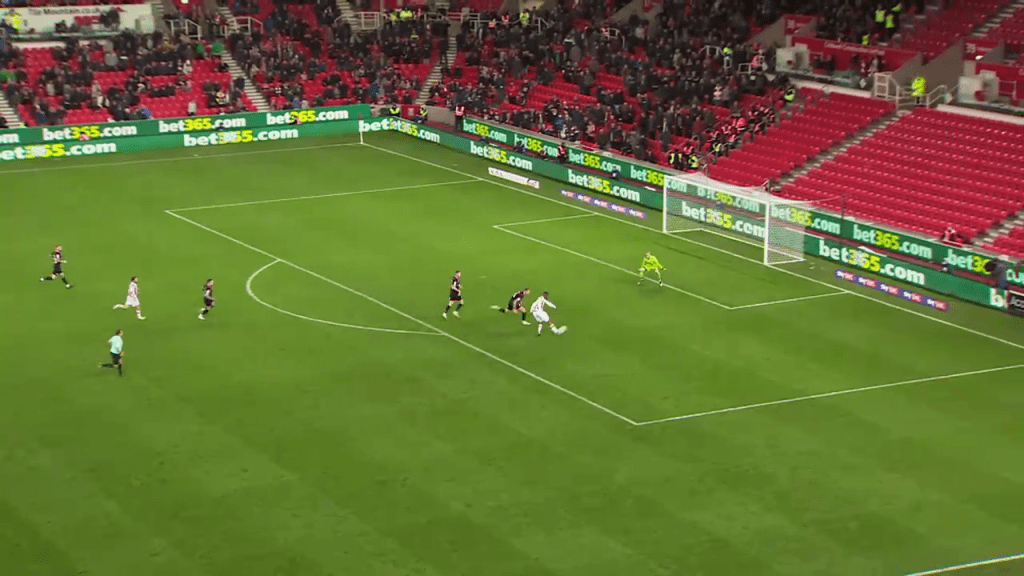
In the 2-0 away win at Preston North End, Tyrese Campbell scored the second goal with a placed shot from just inside the box. On our map above, the location is marked with an ‘x’. We see that this gives us an xG value of around 0.15, meaning a shot from this location is scored about 15% of the time according to the model.

If we look at Infogol’s model value, we see that they assign a probability of 0.12 xG to this chance.

Wyscout on the other hand, assign it a value of 0.07 xG, and FBref.com go even lower to 0.03 xG.

Where’s that difference coming from?

Well, aside from models using different datasets, which will include slightly different shots, and models themselves learning from the data differently, the major difference here is what information is included when we define a type of shot.

‘This man’s magic’ – Campbell has very little space and a lot to do to score this chance. Image from Wyscout

Looking at our first model from the map above, we see that in Campbell’s shot, he’s about 14 yards out, to the right of the goal, and that’s all the information our model has! From this, we can say only that a shot from this area results in a goal about 15% of the time.

Now, better and more rounded models can add in more info. For example, the 3 other models take into account information such as angle to the goal, how the shot was assisted (e.g. cross or through ball), and the body part with which it was taken (strong/weak foot or header).

In addition to this, many of the models will include even more infortmation. Opta data (used by FBref.com, and many professional football teams/leagues) takes into account the positioning of defenders, the status of the goalkeeper (is he set or in motion?), and the height at which the shot is struck.

We can see very simply how this affects the xG value. Our FBref value of 0.03 xG was much lower than the others, due to the pressure Campbell is under. Two defenders directly in front of him, and a set goalkeeper waiting for the shot.

Left: A 0.15xG chance, Right: A 0.03xG chance

The Return of the Messiah

Now we can further see this difference by comparing the Preston goal with Campbell’s first goal after his injury layoff, vs Peterborough in November 2021. He receives the ball from a pass by a teammate, and takes a shot from a similar position.

Similar position, same outcome. Campbell finishes well on his weaker foot past the keeper.
xG = 0.25. Image: Wyscout

However, this time, there are two obvious differences.

Firstly, Campbell takes the shot with his weak foot, slightly decreasing the chance of scoring. More importantly, however, he has a clear view to goal, with only some pressure to his left, from a defender he has just dribbled past.

The combination of these extra differences for two chances in a similar position increases the FBref xG from 0.03 xG to 0.25 xG.

Hopefully this provides a nice intro and explainer for those who are interested in Stoke, and didn’t previously understand what xG was used for and how it was developed. Any and all comments are appreciated!

This is the first of many posts on this blog, and the aim is to contribute between once a fortnight and once a week some form of longer piece here. Alongside that, we have regular brief threads on Twitter at @potterlytics.

Should you wish to donate to help with the running costs of the site, and the data subscriptions we use, please feel free to visit our donations page here. Any and all help is very much appreciated!

George