
Well, it’s time for a break.
As many of you will have seen before clicking this, I’m putting the Potterlytics name, and social media, into an indeterminate-length hibernation as I move into a new and incredibly exciting role in football.
This blog and social media account was set up to help me document my silly little foray into football data and analysis. Having loved the work of ExpectedKilns back in the Nathan Jones days, I saw an opening in the link between my day job in astronomy and in the data that underpins football analysis.
Just over 2 years later, and I’ve had incredible opportunities I never could have dreamed of.
From writing in the Sentinel as a guest columnist, co-commentating on the very same radio station I used to listen to games on throughout my childhood, to working with an incredible club of people at Liverpool Feds, I’ve loved every second of it.
I could not be more grateful to the individuals that have helped me on the way, whether through opportunities they’ve given me, or through helping me develop and learn as I ventured into a sport in which I’d only ever been an outsider.
People like Pete Smith, Lucas Yeomans, Angela Smith, Matt Sandoz, Leanne Duffy and everyone involved with Liverpool Feds, among many others I’ll try to list on Twitter, have made my journey infinitely more enjoyable and helped me develop far more than I could have alone.
And the same is true of you, the reader/listener/consumer of content. I’ve loved the debates, comments, shares and the odd argument I’ve had with you all. It’s been a pleasure to produce these daft bits of content, and I’m delighted to have had even one person read it, never mind the number I’ve had over the years.
Stoke City may be a bit of a dumpster fire right now, but away from all that there’s a club backed by a city with good people, who just want to see their club succeed, and boy, do I hope they get that.
So if you’ll indulge me, I’d like to have one little randomised ramble through the last few years, with some views on Stoke’s current plight, the relegation run-in, and probably a load of other miscellaneous rubbish.
Let’s start off with the positives before my customary rant, eh?
Mark Robins & The Normal Football Team
As last Saturday’s fantastic win lives brightly in the memory, it’s become more and more clear that the best XI Stoke City can pick, when all are fit, has some excellent footballers in amongst a solid spine.
Having a Ben Pearson figure – for all the faults I have with him as a player – next to Wouter Burger has released the Dutch maestro to be more aggressive, more influential, and less knackered as he can cover ground when it makes sense, rather than all the time for everyone else.
But, the most important of all the improvements, the most basic but crucial idea he’s brought into the team, is that sitting deep isn’t a good way for this squad to defend.

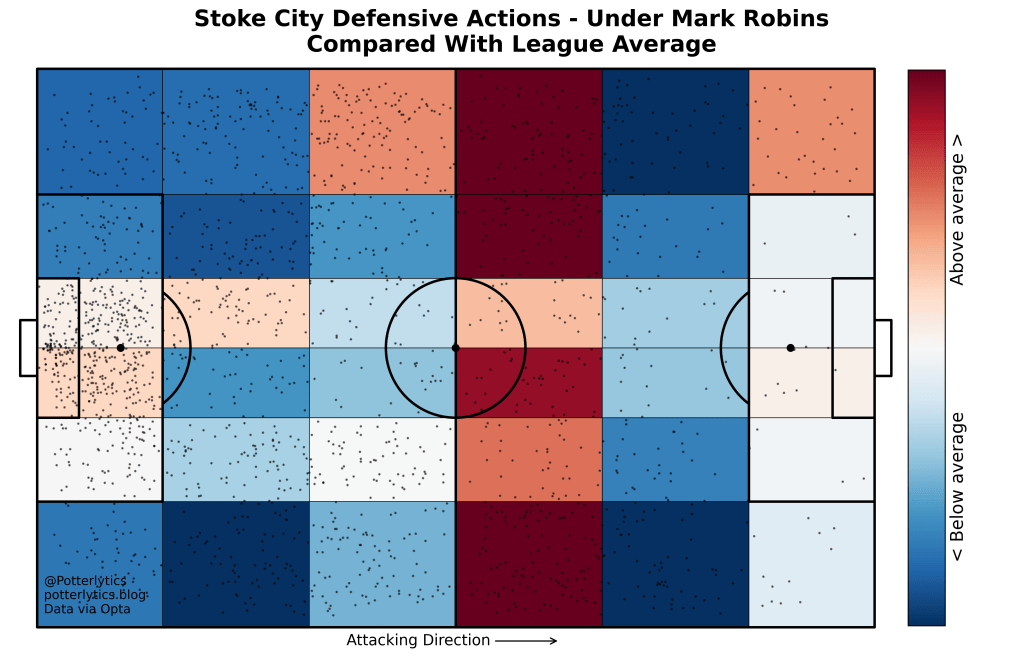
As you can see above, Stoke’s defensive actions in deeper areas of the pitch have drastically reduced under Mark Robins, compared with Narcís Pèlach’s side.
Interestingly, the front line of the press seems to be similar, with a significant number of defensive actions taking place just inside the opponent’s half under both bosses. This was the factor that led to, among other things, Pèlach’s Stoke side some of the highest values in attacking half tackles and interceptions.
But much more clearly-visible is the obvious decrease in how often Stoke’s defensive actions take place in their own penalty area.
To be clear, they’re not world-beaters, just about level with the league average for penalty area defensive actions under Robins, but under Pèlach they were forced into the highest number of defensive actions in their own box in the league, by some distance.

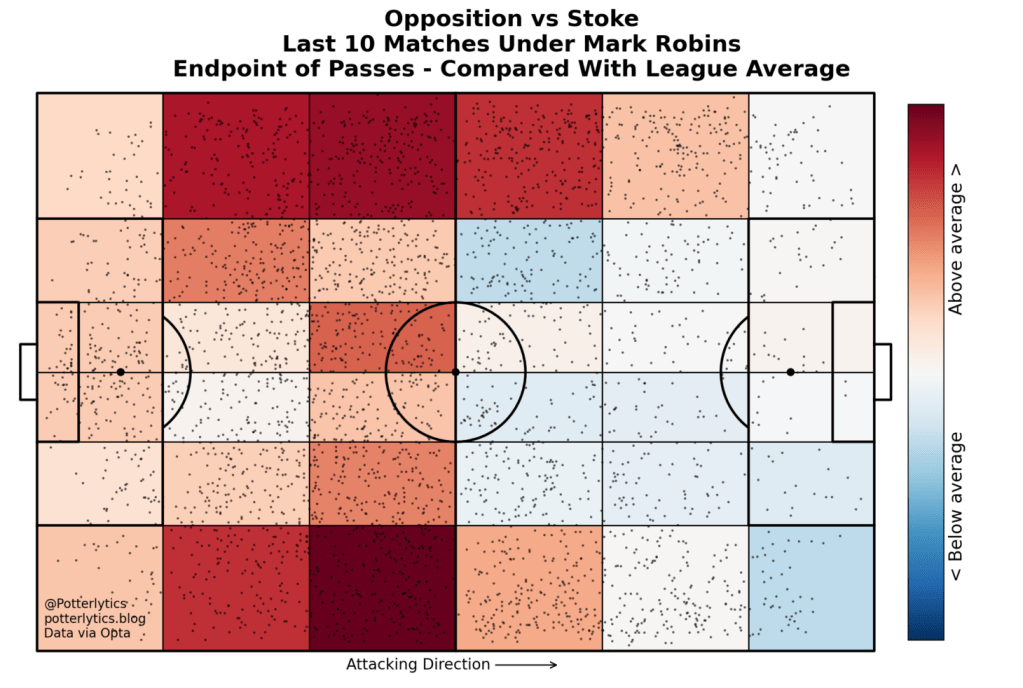
It’s also visible, albeit slightly less obviously, in the plots above. Stoke have conceded a lot of passes in the former Coventry boss’s reign, but far more of them are ending in the wide areas of the opposition half. i.e. Teams are much more likely to be playing in front of Stoke’s press, than in Stoke’s half.
Pèlach’s pressing plan was okay higher up the pitch, as seen by the way the ball is forced wide on the left-hand plot, but it was the sacrifice of space when defending deeper that led to those days of conceding 20+ shots and 2+ xG per game.
Now, crucially, far fewer passes are ending in dangerous areas inside and around Stoke’s penalty area, when compared with the previous head coach’s reign.
It’s far from perfect, Stoke still sit back and lose momentum often in games (see the 2nd half of Millwall away), but it’s a huge improvement, brought on largely by a willingness to affect the game higher up the pitch when out of possession.
The Effect Of Affecting The Game
This becomes even more clear when you look at the change in opposition shots from NP to MR.
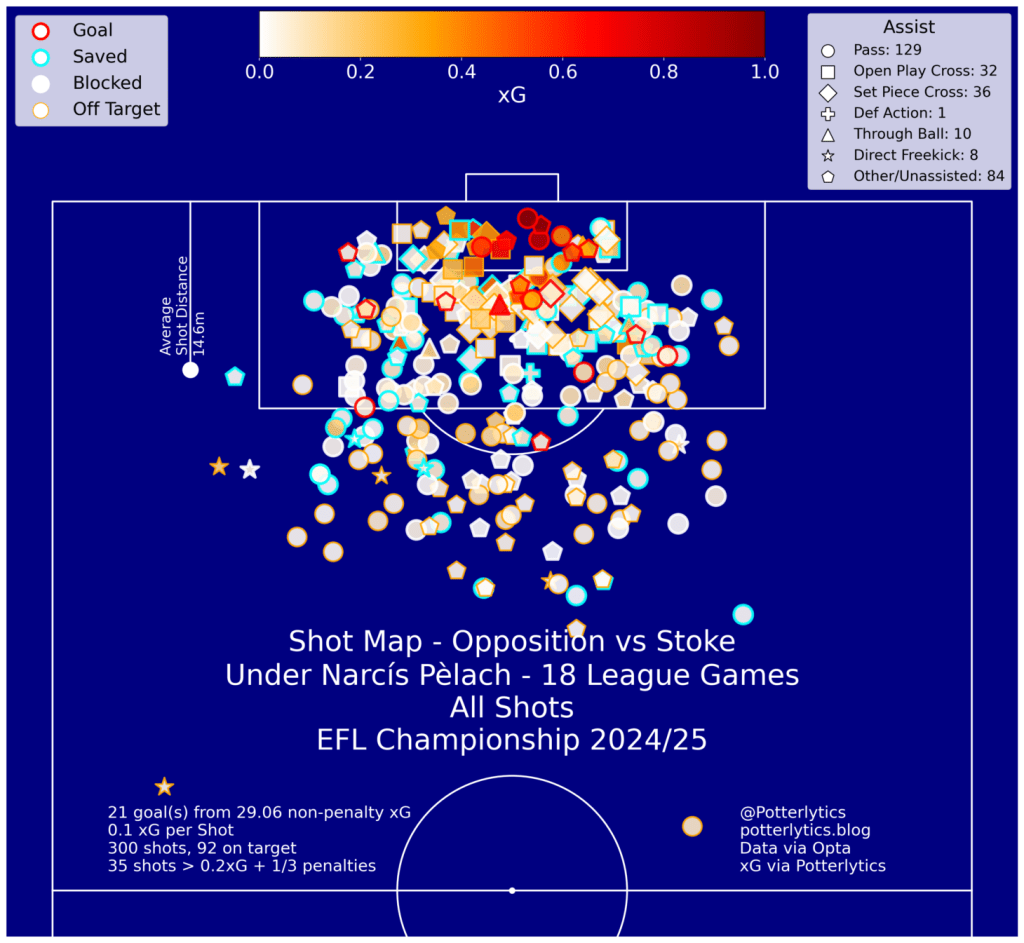

There’s a slight discrepancy in the number of games each manager/head coach has had, but I’ll put some normalised stats below to make up for that.
Key in these plots is the number of shots within a 12 yard radius of the goal, which you can essentially see by the ‘density’ of shots in that area.
Even with the eye test, it’s pretty clear that Stoke have improved in this, and if we delve into the data it becomes almost ridiculous. (All of the following don’t include penalties)
In Mark Robins’ time as manager, he’s reduced the number of shots Stoke concede per game from 16.7 to 12.1. The xG conceded per game has reduced from 1.61 to 1.09. The number of ‘big chances’ (I’ve defined this as chances with >0.2xG) conceded per game has gone down from 1.94 to 1.26.
So, despite the number of non-penalty goals conceded per game very slightly increasing under Robins, from 1.17 to 1.2, it’s clear that the underlying processes for Stoke have significantly improved. And with this, as have their chances of winning points consistently.
Remember, it’s still possible to create loads of chances, barely concede any chances, and lose a game. But what these number do show, is that Stoke have a much higher chance of consistently picking up points with these improved defensive performances.
Finally, Some Blue For The Red And Whites
All of this, including an improvement in attacking output, (definitely there, although largely influenced by the penalty vs PNE and the Gallagher open net vs Coventry) has led to Stoke’s rolling xG plot looking much nicer.
In fact, if you take the rolling average over 10 games of xG created minus xG conceded, that number is now positive for the first time since Steven Schumacher was in charge.
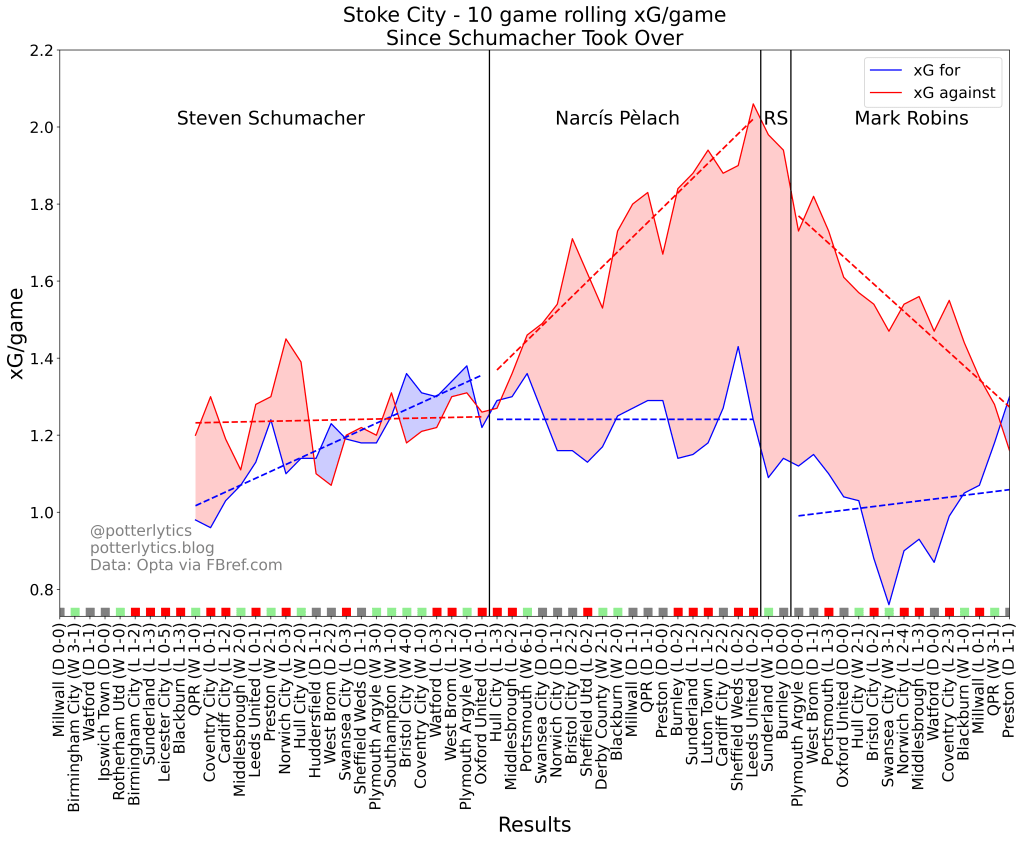
This also shows through in the improvement in Stoke’s expected points.
Simulating all shots in Stoke games 100,000 times, we can build up a probability distribution of how many points Stoke are likely to get. Essentially, each simulation, we count how many points Stoke would have if the simulated number of goals were scored/conceded.
Comparing the whole season to just the season up to Pèlach’s sacking, we can see how much that’s improved.
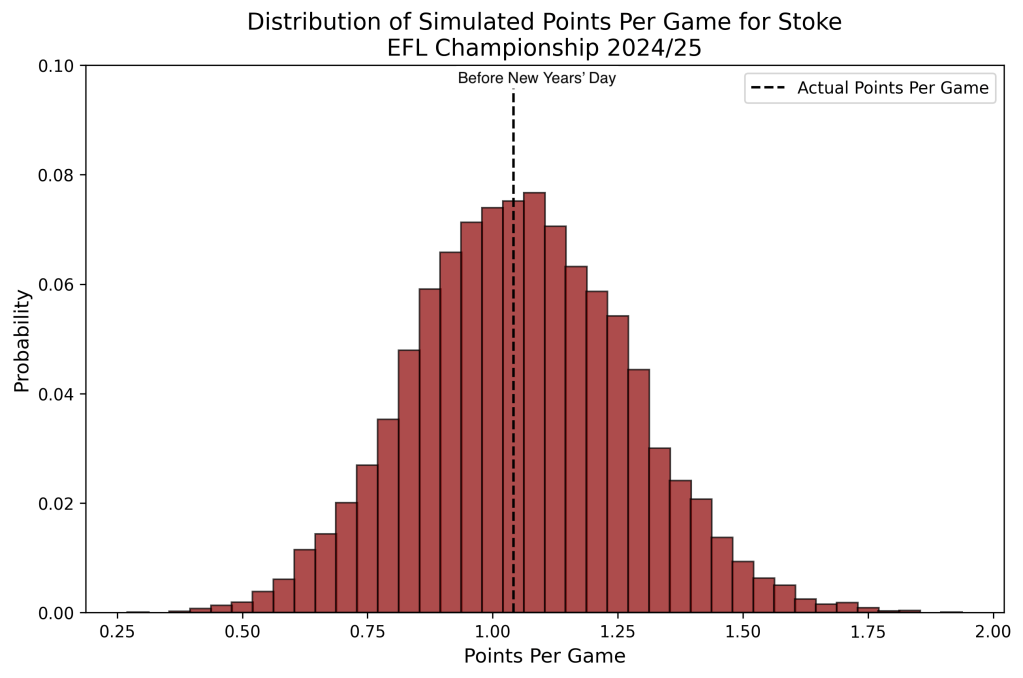

As shown above, in Robins’ 15 games, he’s improved the peak of the distribution (i.e. the most likely number of points Stoke would have per game) by around 0.1 points per game.


When comparing this to the rest of the division, it looks like improvement is still visible.
Stoke have jumped over QPR, Oxford and Portsmouth (albeit not by much), as a result of that improvement in simulated points per game.
That said, had they remained at ~1.1 simulated PPG, they’d currently be the 3rd worst team in the league by that measure, so the improvement was very much necessary, thanks to improvements from Portsmouth, QPR and Cardiff.
Potter-mystics?
That title pun doesn’t really work, but the last bits of info move us on nicely to my view of the relegation battle between now and May, and the key optimism and pessimism we can look for with Stoke.
I think the improvements of teams around Stoke is very much the major reason to be less optimistic as we move towards this last few matches. Of the 4 teams with fewer points than Stoke currently, only Cardiff and Plymouth have a lower simulated points per game than Stoke.
Whether the next point is an optimistic or pessimistic fact depends on your own nature, but Stoke have still to play 3 of those 4 teams in the remaining 6 games, with Luton and Cardiff as the next 2 fixtures at time of writing.
It’s very clear that those two games in particular are huge for the season, and the club, and with both sides having taken points off Stoke this season in the Pèlach era, the improvements we’ve seen recently need to be backed up with performances and results in these games.
| Date | Team (Venue) | Previous Result (xGF – xGA) |
| 8/4/2025 | Luton Town (Home) | 2-1 Loss (1.3 – 2.1) |
| 12/4/2025 | Cardiff City (Away) | 2-2 Draw (1.8 – 1.8) |
| 18/4/2025 | Sheffield Wednesday (Home) | 2-0 Loss (2.1p – 1.5) |
| 21/4/2025 | Leeds United (Home) | 2-0 Loss (0.3 – 2.2) |
| 25/4/2025 | Sheffield United (Home) | 2-0 Loss (0.5 – 1.3) |
| 3/5/2025 | Derby County (Away) | 2-1 Win (2.2p – 0.6) |
As I mentioned above, football is a massively high variance sport, where a near-perfect performance and set of underlying numbers can lead to 0 points, and barely touching the ball all game can give you 3.
Well, that variance is usually likely to decrease over lots of games. Stoke have 6 games remaining, which leaves very little room for bad luck.
Including, in that, the unbelievably impressive Leeds away, and a promotion-chasing Sheffield United at home as two of the other remaining fixtures, within 5 days of one another, and it’s no wonder fans bums are very much in the midst of squeaking.
Personally, and feel free to tag me in this when it doesn’t happen, because I won’t see it, I think Stoke have enough to stay up. In recent times, the fantastic Ben Rowley likened Stoke to a pressure cooker that lets off steam at the right time, and I think that’s what we’ll see.
I think recent improvements, and the overall level of the squad in its more balanced state, mean that Stoke have the edge over the sides around them in this relegation run in. Vibes and momentum are huge, and I still believe there will be a win over Luton to give the club both of those.
Oh God, Another Long-Term Club Rant
But when this dust settles, and if Stoke celebrate their safety for a 2nd season in a row (I still remember worrying about it in Feb 2023 too!), there’ll be more hardship ahead in the transfer window.
As has been long-discussed, Stoke’s last 2 transfer windows of big spending, financed in equal measure by both the Souttar sale for £15m in January 2023 and by the club forgetting that it’s a rolling reporting window for the 2nd time since relegation, have led to a very empty pot of gold for the upcoming summer.
With no more loopholes in Covid and stadium/training ground sales, we’re once again at a point where the club has to look at its transfer policies of recent years, and pay the price for its love of wasteful spending and lack of efficiency in the market.
Having spent significant amounts in the last 2 seasons, ‘covered by the Souttar transfer’ which itself covered up losses of the previous windows, the breakdown of the players who have been signed does not show a club working well behind the scenes.
Nothing encapsulates these issues more for me than the striker situation this season.
Stoke ended 2023/24 with a front 3 of Manhoef, Campbell and Bae Junho, scoring 8 in their final 3 games (2 from Campbell, 3 from Manhoef). As other forward options, they had Niall Ennis (widely understood to be a bit below the required quality), Ryan Mmaee (a big money signing who’d had an uneventful, but not awful, first season in the country), and Nathan Lowe (a youth player in need of game time).
From the 4 central strikers detailed above, let’s see what the plan was and how it ended up:
- Campbell was released on a free, and is currently the top scorer for a team that are 2nd, and would be top without their 2-point deduction.
- Ennis made 9 appearances before being loaned out to Blackpool in January, having signed a 2 and a half year contract for a ~£500k transfer fee a year prior.
- Mmaee was loaned out to Rapid Wien, making zero appearances due to injury, before returning to Stoke in February and making the squad again in April.
- Lowe had an incredibly successful loan spell at Walsall, scoring 18 in 30 appearances, but was then recalled in January as Stoke had no strikers available besides Ennis. Since his recall, he’s started 5 games, playing a total of 5.2 90mins.
So, in summary, Stoke went into a summer with a £3m striker in Mmaee who had played 1 season in the UK, and an in-form striker in Campbell, alongside a player who likely needed to leave in Ennis, and a player who needed a loan in Lowe.
Oh God, He’s On About Campbell Again, Stop Him
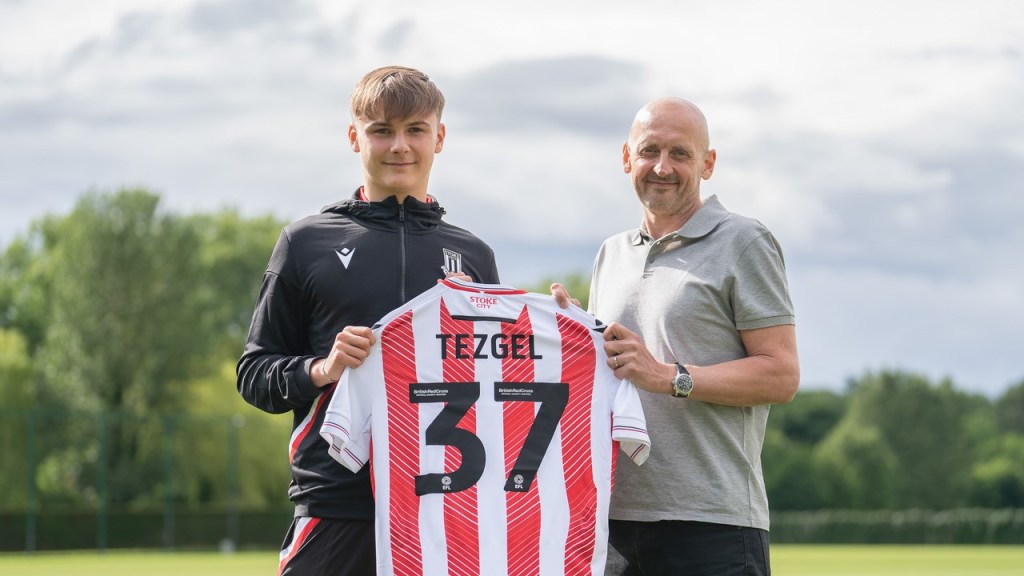
Of course, the response was to do the sane thing, and so Stoke didn’t offer a contract to Campbell, losing him on a free, and loaned out their £3m signing for a minimal fee as the head coach, who would last 1 single further game in charge of the club, wasn’t a fan. Alongside that, they started the season with youngster Emre Tezgel as their main striker, having signed a £1.5 million injury-prone forward in Sam Gallagher, who was predictably injured in pre-season.
Since that opening day, in which Tezgel impressed, he’s played 298 minutes of senior league football.
Stoke then chased Tom Cannon, as their policy of ‘if we can just get him in, we’ll have solved it’ continued. Cannon impressed with his ability to be clinical on several occasions, but all-to-often contributed very little to the game outside of taking shots, and didn’t have the ability to create outside of his confidence in taking on the shot from any angle.
He was then recalled in January, a fair possibility given how many clubs had chased him in the summer, and how well he was doing on paper for Stoke.
Back came Nathan Lowe from Walsall to cover the gaping hole in the squad (not the only one, having got rid of two mobile midfielders near to deadline day for seemingly no reason), and in came Ali Al Hamadi on loan to replace Lowe and remove any idea of him getting the game time he needs to progress and improve.
I’m being very facetious, but that example is my best effort to show how Stoke’s transfer policy has been scattergun. For so long, signings appear to have been based on ‘he seems good!’ rather than specific, planned, long-term policy with desired profiles and a cohesive idea of how we want the squad to look.
Whether hated or loved, selling Josh Laurent and loaning out Lewis Baker, then signing a completely different profile of footballer in Tatsuki Seko showed a massive lack of planning. With only Wouter Burger as a mobile, ground-covering midfielder, Stoke were overrun for the vast majority of the season until Baker was recalled and Ben Pearson (!) was brought back into the side.
Ctrl + C/Ctrl + V from the last article
With 3 ‘Heads of Recruitment’ or similar having been in place in the last 12 months, alongside 4 managers and 2 sporting directors in 2 seasons, it’s clear that Stoke need to pick a direction and stick to it. The return to a manager-led model in Mark Robins may well produce some short and medium-term success, but boy, am I worried about what happens when he leaves.
As Jon Walters continues learning about his role and the 2025/26 season looms, there are a lot of questions over the trajectory of Stoke City as a club.
Deciding that the Sporting Director role is there to set the plans and structure of the entire club is a fair departure from the shorter-term methodology that other clubs utilise it for, in which the SD is measured against a set of performance indicators based on the philosophy of the club as a whole.
I’m not sure that Stoke City have this overall philosophy at a higher level, and so the buck falls to Walters. A club legend, but one with very little experience and two massively high-risk decisions that catastrophically blew up in his face already on his CV, his future will be very interesting in this next season or two.
Stoke absolutely have to make better use of the assets they have at the club this summer, they cannot be drawn into signing shiny players who do not fit the squad, but they also can’t afford to make no signings at all.
The performance of the starting XI of the last few weeks has been important and cause for optimism, but behind that lies a lack of depth that must be addressed if the goal is to be progress.
Whether that be the sale of a valuable player to finance others, or some clever free transfers and loan moves, I want to see an intelligent window from Stoke. Not a perfect one, but one in which the risk-reward balance is much less wild than recent years.
I don’t think that promotion is likely, or should really be the aim, but progress is the aim for me. I just want to see my club and think ‘yeah, we’re on the way up here, we’re doing the right things’.
I certainly don’t want to see any complaints about PSR either, the bed we lie in is absolutely of our own making, and the rules are there for everyone else too. As a top 10 wage-bill-payer, there’s no reason for us not to perform significantly better.
But one thing’s for sure, I hope to God we don’t see another revolution, I’m not sure my heart can take it.
Thanks to any and all readers, it’s been a hell of a few years. I’ll certainly miss this blog and all our discussions online, even the heated ones!
Best wishes to all of you, and goarrrrrrrn Stoke!
George







 Potterlytics