
Part 1 – Sustainability and off-the-ball principles
‘Oh great, another tactics piece that goes on way too long’ I hear them cry.
‘Here he goes, getting carried away again’ the haters say.
Well they’re damn right, strap yourselves in for another lengthy profile of the new-look Potters of February 2023 to March 2023 (and beyond?).
Edit – This piece has turned out to be a lot longer than I imagined, so it’s now split into two parts! This is part 1, looking at sustainability and off-the-ball work. Part 2, looking at build-up and chance creation, is available at this like when you’re finished with Part 1! Anatomy of a 10-game Revolution (Part 2) – The On-Ball Boogaloo
An Unexpected Turnaround
It’s a month and 2 days (providing I release this when I intend to) since Stoke fans serenaded the team with chants of ‘you’re not fit to wear the shirt’ after a last minute loss at home to Preston.
Just 2 league games later, Stoke were thrashing Reading 4-0, and despite a few lulls, there have been increasingly positive signs ever since. This has culminated in a run of form that has seen Stoke take 11 points from a very difficult 5 games, scoring 13 and conceding just 4.
Now on these small timescales, many teams can go on these runs of form due to variance (in effect, luck), in finishing outcomes, goalkeeping outcomes, refereeing decisions, or other unsustainable factors.
Interestingly (and excitingly) for Stoke, though, the recent form actually seems to be reflected in the underlying numbers. Let’s take a look at the 10 game rolling average xG per game (taking the average of the last 10 games expected goals, see our explainer article: xG – A Stoke City Explainer!).

We see that Stoke have been consistently improving their rolling xG since the Hull City home game, and have had an average expected goal difference p90 of above +0.5 since the Blackpool away game.
Whilst the quality of these performances may not last forever, it’s heartening to see that the results are backed up by the underlying numbers. This is a big tick next to the sustainability box, and although there are some factors that could shift the balance, such as shifting opposition attitudes towards Stoke, transfers and the return of loan players, and injuries, here at Potterlytics I like to take the positive slant on things.
So what exactly is this newly-revolutionised Stoke side doing differently? What is the blueprint?
Well, let’s combine all we’ve seen over the past 10 or so games together to build a tactical profile.
A Brave New World – Off The Ball
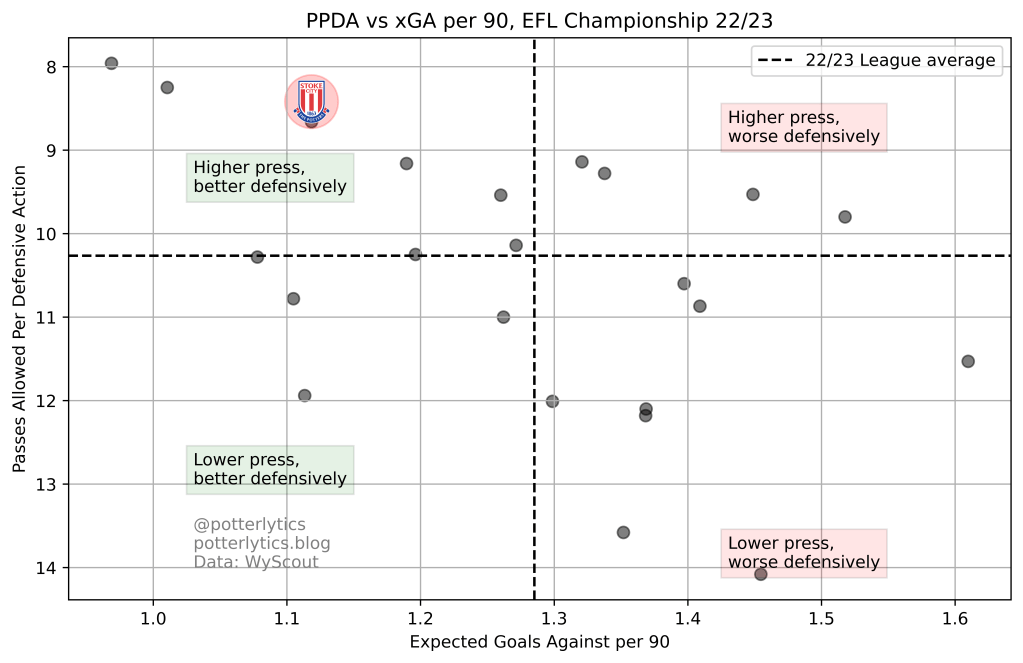
The first big shift we’ve seen is the way Stoke work off the ball. They’ve been relatively high-pressing all season, but in recent weeks this has been taken into overdrive, and the well-oiled pressing machine has even managed to stifle high-flying Middlesbrough in their own back yard.
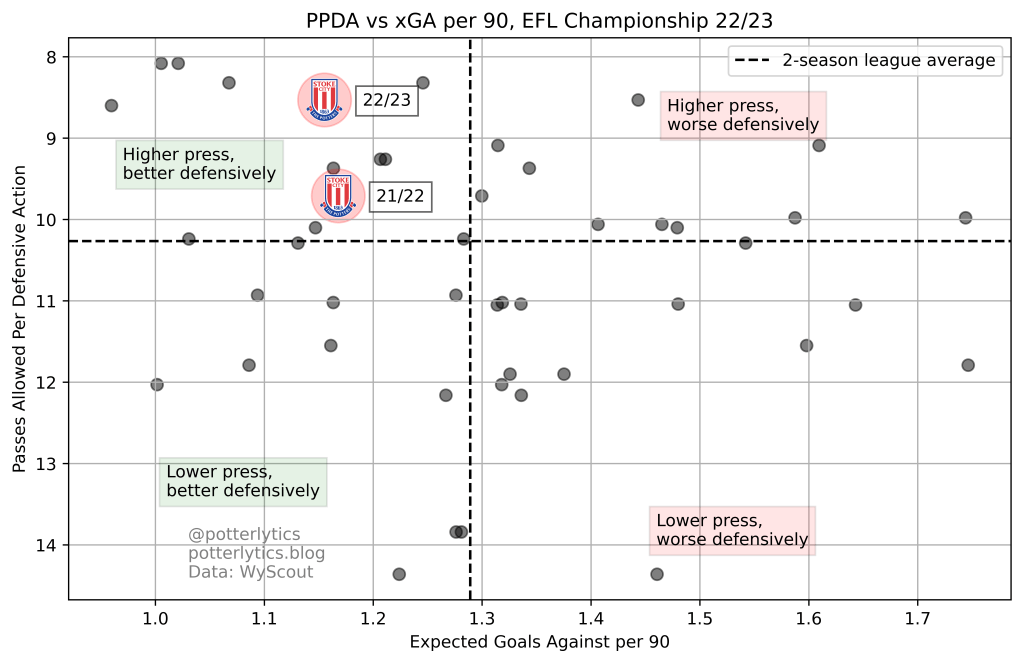
Indeed, looking at the Passes per Defensive Action or PPDA (the average number of passes a team makes before Stoke perform a defensive action, e.g. a tackle or interception), Stoke are one of the most intense pressers in the league.
I’ve waxed lyrical already about the quality and efficiency of Stoke’s new pressing unit since the 3-1 victory away at Swansea, but it wouldn’t be a real profile without explaining again how the main press has been working.
So what is the quintessential Stoke City high press? Take a look at the animation below, and let’s go through the plan step-by-step.
Click the lines with dots on in the bottom right to slow the footage.
There are 4 main steps in the most basic realisation of the plan.
In our theoretical scenario, the opponent is playing a relatively simple 433, with one full back pushing high, and the other dropping inside to help with build-up. This is similar to what we saw from Sunderland. The opposition keeper has the ball, and from here, we see our 4 steps as follows:
1 – The central striker (number 11, usually Gayle, although in his absence this role has gone to Jacob Brown and Nick Powell) makes a curved pressing run towards the ball. The curving of the run cuts off one passing lane for the player in possession, forcing the ball into a specific area, starting the trap. The pass can only go one way, as behind the front 3 all players are closely man-marking.
2 – As the ball gets passed out to the wide to the right, Stoke’s wide left player (in our case, Tyrese Campbell, number 10) triggers his press and closes down the ball aggressively. This forces the opposition centre back (5) to either try to carry the ball past Campbell, or play long. The central striker (11) drops to cover the passing lanes across the box and back to the keeper.
3 – The centre back (5) plays the ball long to the front line, where Stoke’s aggressive man-to-man press is waiting. Josh Laurent (28) steps in front of the waiting opponent and nicks the ball back.
4 – Laurent (28) pushes forward and plays the ball wide to Campbell (10) and Stoke’s midfield and forward line bomb forward to take advantage of the transition.
This shift has made great use of the athleticism and combative nature of the players Stoke have available. The additions of Ben Pearson, Axel Tuanzebe, and Ki-Jana Hoever, and the return to the side of Dijon Sterling and Josh Laurent have given Stoke a side that loves to be active in forcing the opposition to give up the ball.
Even in games where the opposition have clear strengths in attack, such as the game vs Coventry, we saw Stoke trust 40-year-old Phil Jagielka and Ben Wilmot to mark Gyökeres and Godden man-to-man, two strikers who are by no means easy to pocket. Again, bravery is the word of the day!
It’s all well and good looking at it on a tactics board, but how does this work in reality? Players aren’t always going to lump it long straight away, and they may be able to bypass one of those pressing moves if they’re good enough.
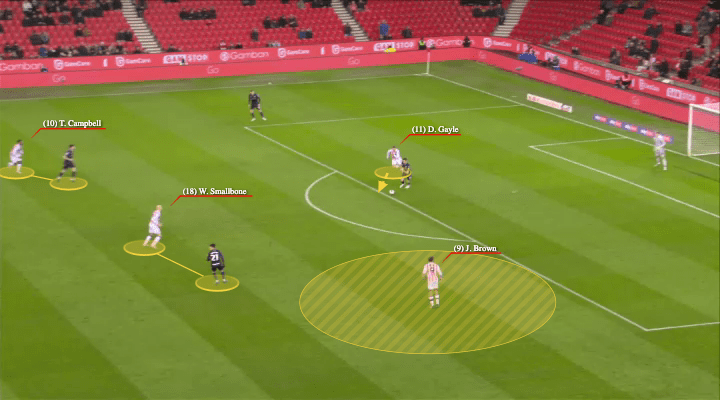
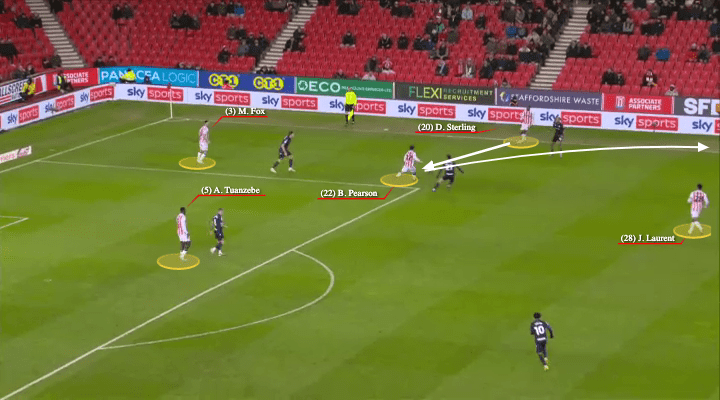
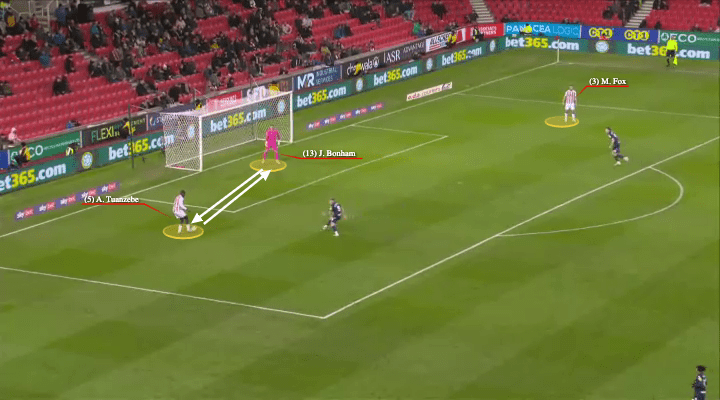
Let’s see some examples of how the press evolves in real games. First up, about 10 minutes into the Coventry away game, and Coventry have a goal kick. As the ball comes back to the keeper we see the press in action.
Click each image to zoom in

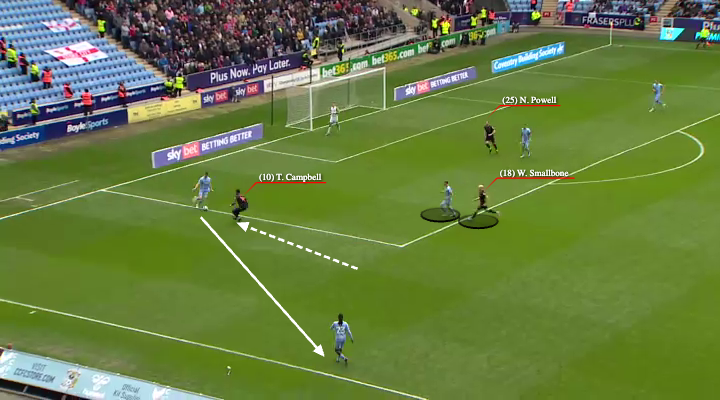
In the first frame we see our familiar setup. Powell, playing as the central striker in this game, is blocking the passing lane to the central player, Smallbone is marking the deeper midfielder, and the wide players are sat off the back line, ready for their press to be triggered when the ball comes to their side.
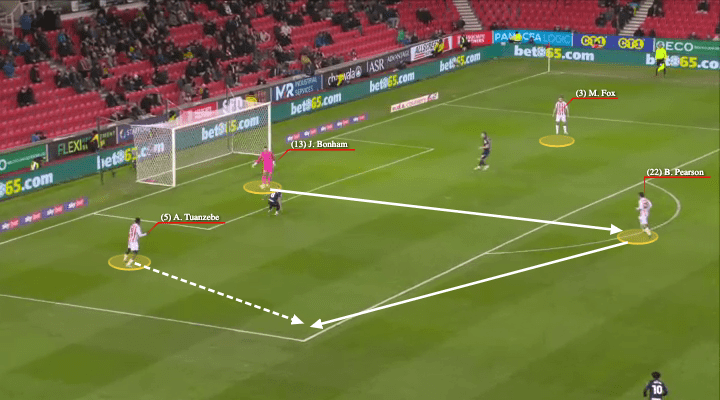
Sure enough, the keeper plays it to the right hand centre back, and Campbell presses the Coventry player as soon as the ball moves out.
Under significant pressure, the opponent plays the ball down the line to the right back, who has dropped deep to provide support.
Click each image to zoom in
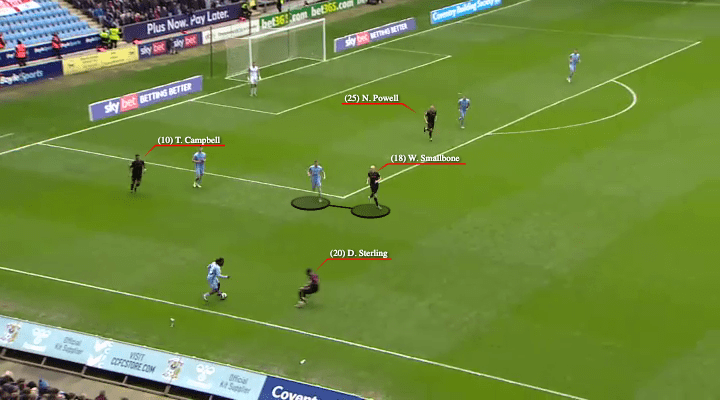
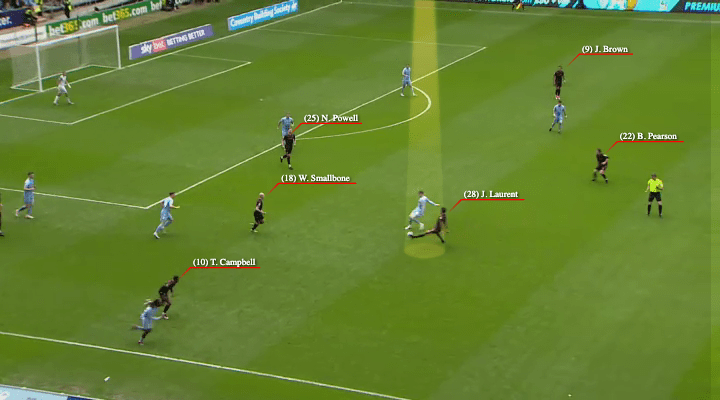
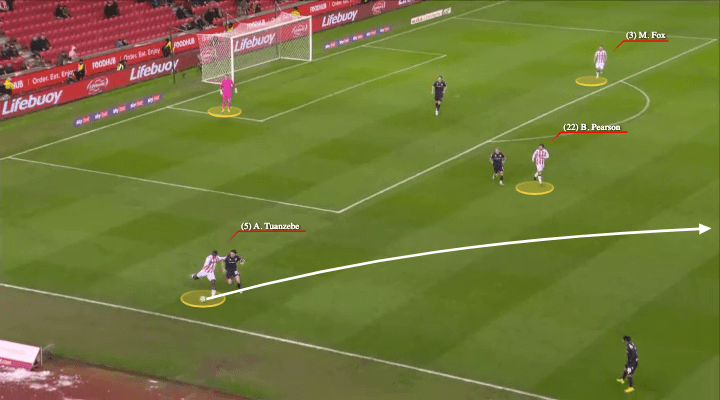
As the ball comes out to the right back, Stoke’s left back, Dijon Sterling, bombs forward to continue the press and forces the Coventry player to play the ball inside to a supporting midfielder.
The trap has worked. As the ball comes into the centre of midfield, we see both Josh Laurent and Ben Pearson man-marking the Coventry players. Laurent snaps into the tackle and wins the ball back.
This isn’t necessarily the same in all games, however, and we see a slightly different setup in this shorter clip from the Norwich home game.
A reminder that in this game, Stoke started with a front 3 of Campbell, Brown and Hoever.
Click each image to zoom in.


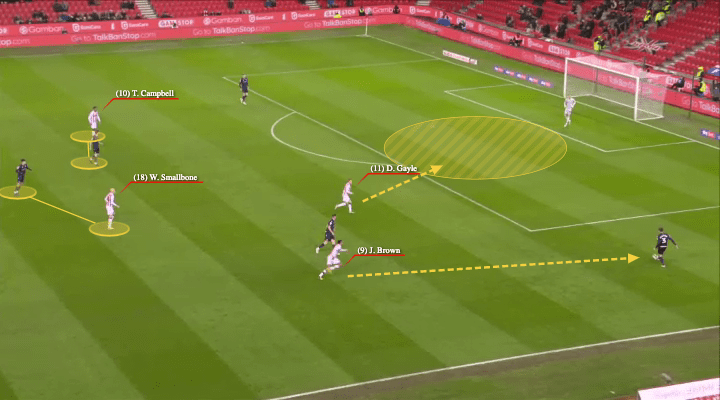
In this first clip, we see Stoke set up relatively similarly to previous games, but this time Smallbone presses the ball, leaving his man-marking position. As he does this, Brown moves across to cover and pass back across.
As Smallbone curves his pressing run, there is no pass available back across.
Norwich in this game were tactically very interesting, and were in fact told by the manager to go long much more often than they usually do. As evidence, in this game Norwich attempted only 242 passes at a completion rate of 64%, compared with their average this season of 456 passes per game (82.9% completion). They had only 37% possession compared with their average of 57%, and played 18.2% of their passes long, compared with a season average of 10.9%.
As such, we see the Norwich centre back attempt to bypass Stoke’s press by launching it long into the wide player on the left. Again, Stoke’s man-to-man press is waiting for exactly this, and right-back Sterling launches in aggressively to intercept the ball.
So we see that there can be a slight change in specifics of the press, in this case Will Smallbone pressing forward alongside Brown in more of a 4-4-2 high block. We’ve also seen specific responses to opposition styles, such as Campbell dropping off and marking man-to-man to stop Blackburn’s inverted right back from overloading the centre of the pitch.
But even in these changes, the philosophy of Stoke’s press is the same:
- Allow the opponent to play the ball into an area with curved pressing runs.
- Press aggressively to force the opponent to make riskier passes through the press, towards their forward line.
- Where strong, combative players are marking man-to-man, ready to win what might usually be 50/50 duels, but are now in their favour due to their skillsets.
It’s Only the Championship
Most impressive though, is the quality of opposition Stoke have been managing to successfully implement these brave principles against.
Looking at Championship form over the last 10 games, Stoke have beaten the 3rd and 6th most in-form teams (Coventry and Blackburn), and produced excellent performances, arguably deserving to beat the 1st and 9th most in-form teams in Middlesbrough and Norwich.
Most impressive, as those of you with Freeview may know, is possibly Stoke’s performance at home to high-flying Brighton in the FA Cup.
A 1-0 loss marred what was an exceptionally brave pressing performance against one of the most press resistant sides in the country, with Stoke following the principles outlined above.
Let’s take a look at a couple of examples.
Click each image to zoom in.
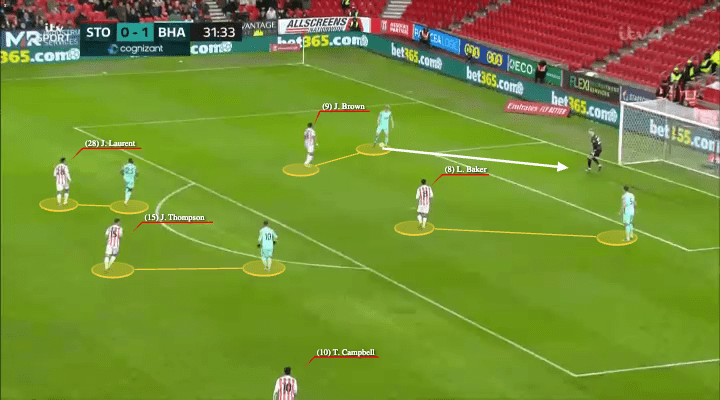

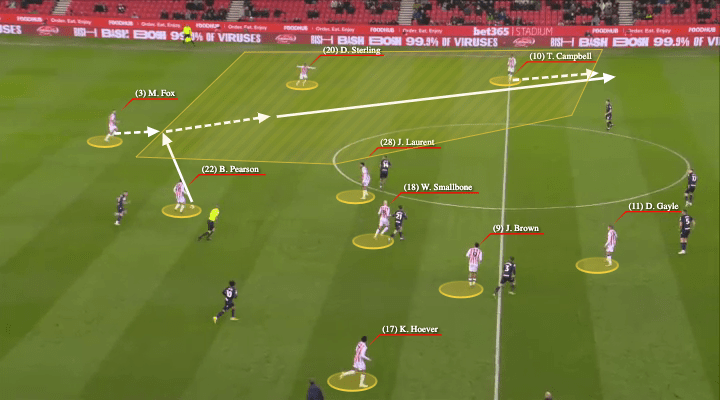
From a goal kick, Brighton play the ball short to a centre back, and we see that Stoke are set in a similar 4-4-2 high press to the Norwich game.
In this game, Ben Pearson, Will Smallbone, and Dwight Gayle were replaced by Thompson, Baker and Tymon respectively. You might expect Stoke to therefore change tact to alleviate the possible lack of cohesion, especially against an incredibly press-resistant team. But no, Stoke stick to the principles outlined above.
Brown presses the keeper with a curved run to block the passing lane back to the centre back. Baker pushes out to the player who then gets the ball off the keeper, aggressively pushing to force Brighton into riskier, line-breaking passes.
Click each image to zoom in


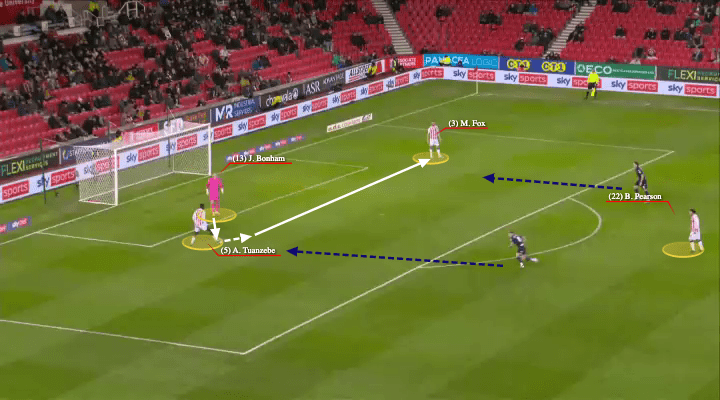
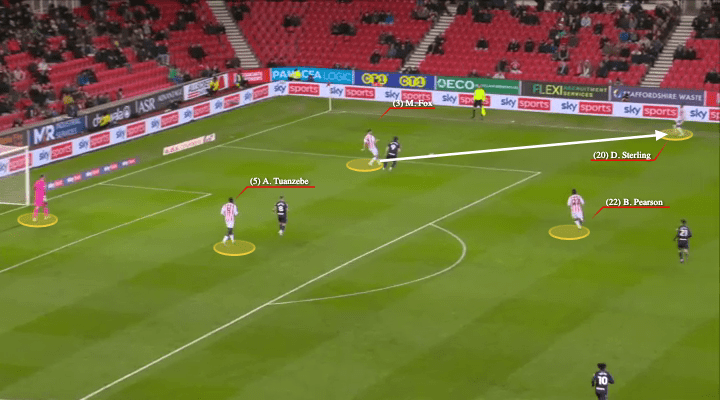
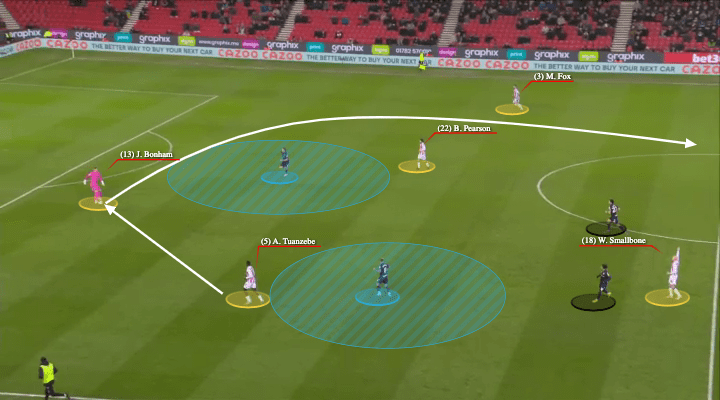
Trying to play out quickly and break the press, the Brighton centre back scuffs his pass, into the feet of the waiting Tyrese Campbell.
Now, as the ball turns over to Stoke’s hands, you can see one major benefit of the high press. Suddenly, Stoke have a 4v4 in the opposition box, against a disorganised defence.
Even more fun, in the last frame as Campbell gets the ball, we see centre back Axel Tuanzebe pushed 20 yards into the opposition half to track a player man-to-man who was dropping off to receive the ball.
You Can’t High Press All of The People All of The Time
But, sometimes good teams get through! So what do Stoke do when the pressure is on and they have to sit a bit deeper? Let’s take a look at an example or two to garner the back-up plan if the press doesn’t work, or if Stoke are holding onto a late lead and under pressure.
We start off in the 1-1 against Middlesbrough, as the opposition have the ball 35 yards from goal.
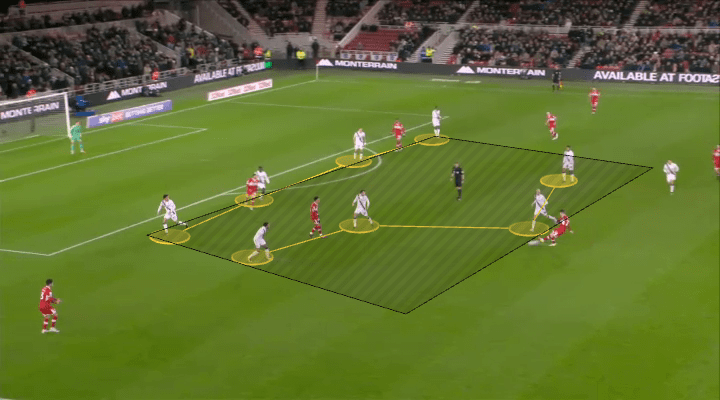
Se see that in this game, Stoke set into a pseudo-4-4-1-1 low block, with Brown dropping into a wide right role deep, as Gayle and Campbell stay forward on the break. Note that the ball is always under some pressure from a player.
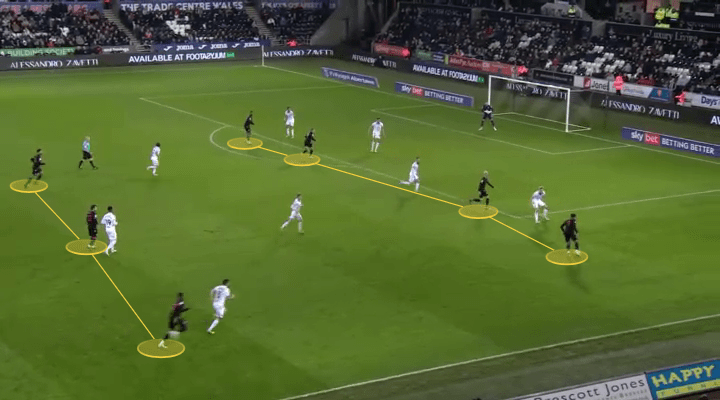
But, most importantly, we see a principle that we’re very familiar with at Stoke off the ball. The area covered by Stoke defensive players is compact, narrow, and defending the centre of the pitch first and foremost.
When the ball pushes wide, thanks to Stoke’s narrow block, they can then contract space by pressing the ball more aggressively, using the touchline as a blocker and keeping the ball away from goal.
In this position, the right or left hand side of Stoke’s team can double up on the wingers to stifle the attack.
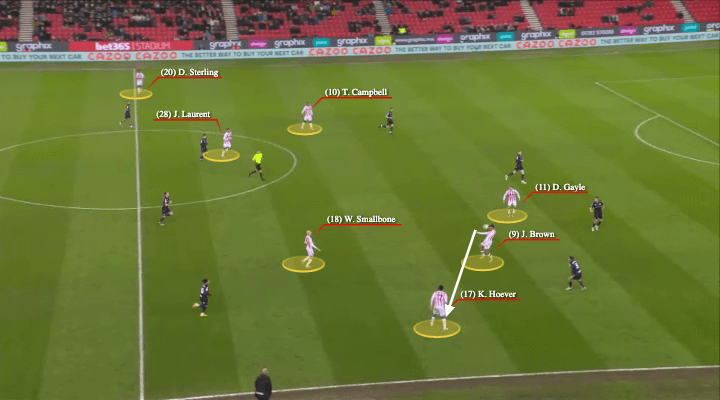
Similar positions are seen in this image from the 5-1 victory at Sunderland.

This time, the ball is wide left of the Sunderland attack. We notice that Ki-Jana Hoever has pressed the ball aggressively, and as such, Ben Pearson has dropped into the right back position, Smallbone has dropped into defensive midfield, and Brown has dropped centrally into Smallbone’s initial role.
This cohesion is an incredibly important factor in Stoke’s consistency in defensive work.
The narrow, compact pseudo-4-4-1-1 remains, and the ball is still always under pressure by at least one defending player.
Stoke block out the central areas just on the edge of the box, and again force the ball wide into areas easier to defend, and away from high-value chance areas centrally. This is an expansion of the work Sean Dyche described in his fantastic Coaches Voice interview (see here: https://www.youtube.com/watch?v=o3YY7PY-IH0&t=399s) in protecting the zone of maximum opportunity, a v-shape from the goal to the corners of the box, and then lines parallel to the touchlines extending out from the corners of the box towards the half-way line.
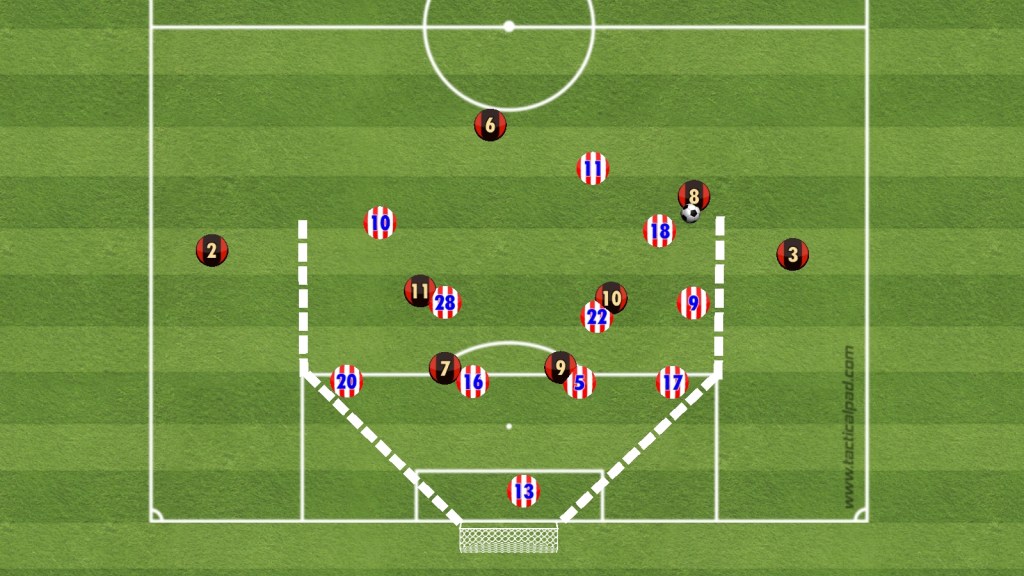
In this (crude, sorry) scenario, Stoke’s opponent has the ball outside the box, and while Smallbone presses the ball aggressively, the unit behind him sits protecting the area between the dotted lines. These lines show the zone of maximum opportunity, in the most dangerous areas for chances to occur.
So, there we have it! The basic principles of Stoke’s off the ball work, and hopefully some signs that the current performances could continue for quite a while yet.
Next up on Potterlytics, I’ll be delving into the work on the ball in build-up and chance creation. Follow this link to take a look. https://potterlytics.blog/2023/04/07/anatomy-of-a-10-game-revolution-part-2-the-on-ball-boogaloo/
Thanks to any and all readers, and please feel free to comment and follow on Twitter at @potterlytics.
Should you wish to donate to help with the running costs of the site, and the data subscriptions we use, please feel free to visit our donations page here. Any and all help is very much appreciated!
George























 Potterlytics