Lessons In Stagnation: An Unhinged Data-Driven Rant About Stoke City

Well, it just gets worse and worse, doesn’t it.

For the second season in a row it feels like a fixture against Sheffield Wednesday, after a poor run of results that followed a pretty lucky/unsustainable unbeaten run feels likely to decide a manager’s fate.

Saturday’s 2-2 draw to Cardiff, with a very late set-piece equaliser saving Stoke from a feeling of the sky falling in, wasn’t enough for fans. The boos rang out in the bet365 Stadium, and honestly, who can blame them?

No other relegated side, since Stoke first came into the Championship in 2018, has gone without a play-off campaign after dropping out of the Premier League.

It seems like the fans’ view has shifted significantly, with talk of unfair Profit & Sustainability Rules, ‘Not His Squad’, and ‘He Just Needs Time’ fading out in favour of a deeper frustration with the past 8 years of Stoke City. With no top half finishes to speak of, and another relegation battle possibly looming, there appears to be very little credit left in the bank for the club’s hierarchy.

Let’s take a look at what the data shows about Stoke’s most recent fall in performances, which unfortunately appears to have been off a rather large cliff.

Has It Been All That Bad?

In a word: yes. In more words: yes, it has been that bad.

Since Narcis Pelach took over, Stoke’s underlying numbers have plummeted to one of the worst in the division, creating more than their opposition in just 2 of his 17 games in charge.

With 16 points from 16 league games, and some big slices bad luck in some poor refereeing decisions (particularly in draws at home to Millwall and away at QPR), it was hoped that Pèlach’s recent run of form – 4 points from 7 games with no win – is somewhat of an anomaly, having only lost 1 game from 10 prior to the Burnley match.

But as a big data nerd – as I sit here and look at and play with all my silly machines as much as I like – the performances tell a different story.
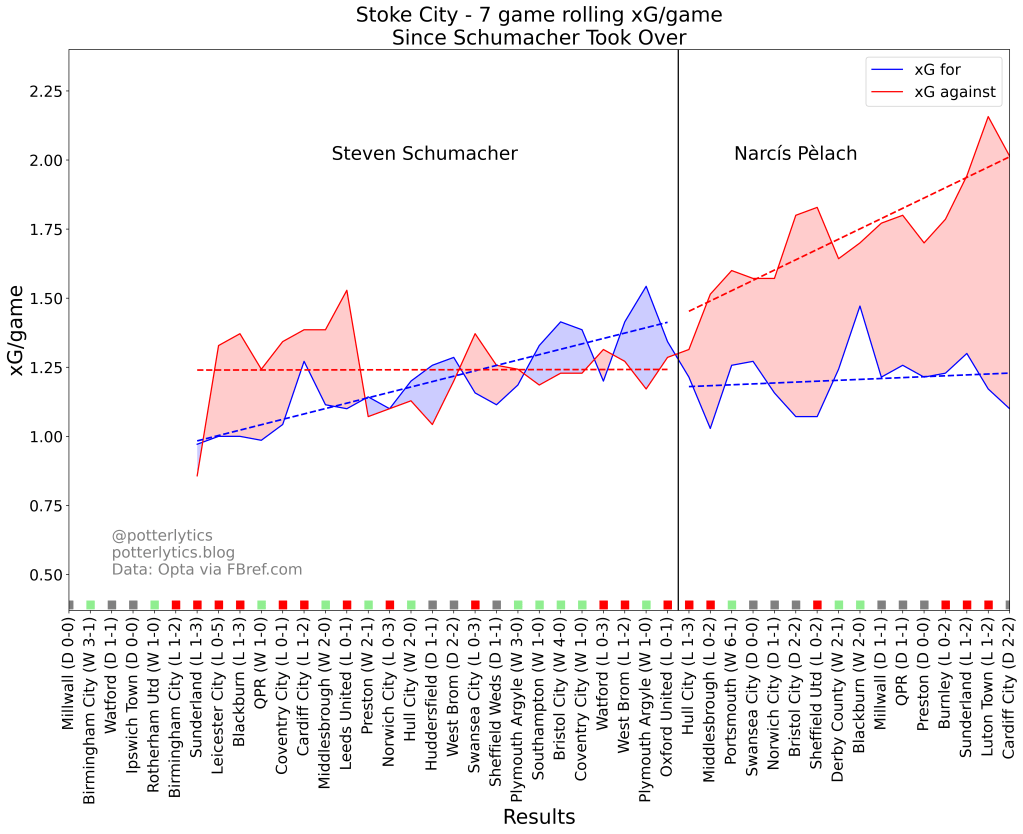
The blue line indicates Stoke’s attacking prowess, as the average xG they’ve created per game. The red line is the same average but for xG created per game by the opposition. Each point in the lines is an average of the previous 7 games. The dashed lines show trends under Schumacher and Pèlach for xG created and conceded.

Whilst Stoke’s attacking numbers under Pèlach have remained relatively stable (although certainly not impressive), their defensive numbers have been shot directly downwards into the Mariana Trench by a howitzer.

It’s interesting that even in the run of 1 loss in 10, Stoke were still putting up poor underlying numbers, and after this perfect example of the role of data as a measure of ‘sustainability’, I think this is something I’ll point to forever as a reason to use it to predict future performance, rather than relying on results.

Looking at the table, Stoke have only conceded 28 in 21 (22 in 16 under Pèlach), with 4 of those being own goals (more on that later). This disconnect is why I’m not too keen to call Pèlach and the team currently ‘unlucky’ for those poor decisions.

To quantify that defensive ‘luck’, using the chances they’ve conceded in games since Pèlach took over, we can calculate the probability that Stoke concede the number of goals they have conceded in that time.

Simulating their shots 100,000 times (own goals excluded), we find that the most likely number of goals for Stoke to concede in their 16 league games under Pèlach is 29, compared to the 18 they’ve actually conceded.

In fact, in 99,585 of the 100,000 simulations, Stoke conceded more goals than they have in real life.

For those with a willingness to debase football with technical jargon, they’re almost 3 standard deviations away from the mean prediction.
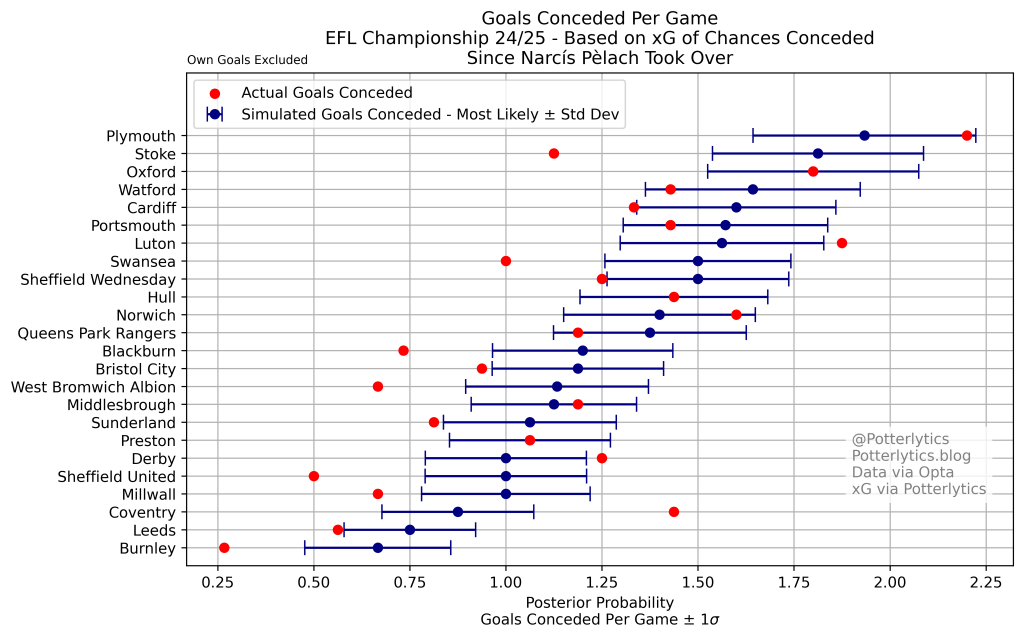
Simulating each Championship shot since Narcís Pèlach took over 100,000 times, this plot shows the most likely number of goals conceded on a per game basis for each team in a blue marker, with the error bars show 1 standard deviation either side. The red markers show the actual number of goals conceded in this time frame.

Looking at the rest of the league for comparison, only Plymouth conceded more on average in the simulations than Stoke, with the Potters about level with Oxford (who incidentally just sacked Des Buckingham) in terms of predicted goals conceded per game.

In fact, no other team is ‘luckier’ – in that no other team has a higher probability of conceding more goals than they have – than Stoke, with Sheffield United close behind.

Not Just A Brick Wall, A 10m Thick Nuclear Bunker

A huge part of that is down to Viktor Johansson, with the Swedish number 1 conceding an incredible 11 (eleven) goals fewer than expected for the shots he’s faced.

In fact, no other Championship goalkeeper has excelled by such a margin in shot-stopping since FBref started measuring Post-Shot Expected Goals.

PSxG is similar to xG, but instead of predicting how likely a chance is to be scored before the shot, it takes the trajectory of the shot after it’s taken, and predicts how likely it is to be scored based on historical data. So, for example, Peter Crouch’s volley against Manchester City had a low xG (far out, difficult chance), but a high PSxG (struck powerfully into the top corner).

A plot showing how much a goalkeeper has over-performed PSxG on the vertical axis – above zero means they concede fewer than the average goalkeeper for the shots they faced. On the horizontal axis is the total xG they’ve faced. Johansson is shown by the Stoke City badge.

As you can likely judge from the plot above, being high up means good shot-stopping, and Johansson is so far above the rest as to almost be in my previous blog post.

As Narcís Pèlach was keen to point out, the defensive shape – a very deep, very compact and narrow block – was in place not necessarily to prevent opposition shots, but to prevent them getting clear cut chances. As much as that has likely helped Johansson exceed expectations by giving him a smaller area of the goal to cover, it’s certainly a push to say it’s been ‘working’.

Defending The Space

The first of the two major tactical issues is one I’ve written about in depth before on here, so I won’t dwell on it too much, but the ultra-conservative low block, that Stoke are desperate to get back into and rely on, has started to bring the results I feared it might back in early November.

Stoke have now conceded more shots than any other team in the division, and more xG than all but one side in Plymouth Argyle. They’re not close to the defences above them either, sitting almost 5xG conceded worse than Oxford United.
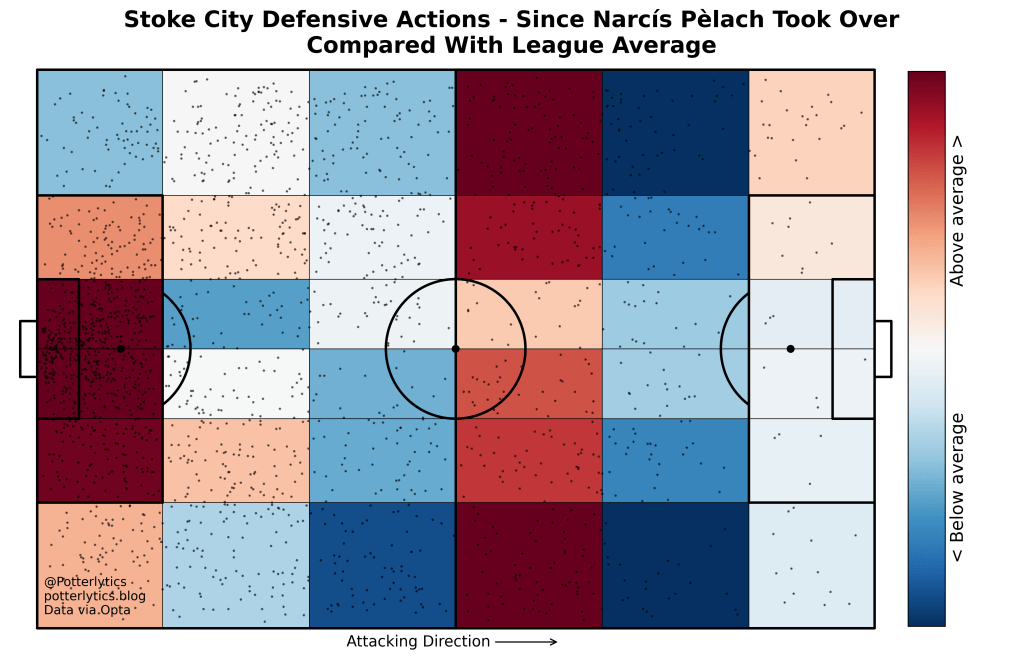
A map of the location of Stoke City’s defensive actions (tackles/interceptions etc.) with each zone coloured to indicate whether there are more or less actions per game than the league average in that zone.

Reposting the plot above, we see that Stoke look to pretty much defend 2 areas and 2 areas only.

Firstly, they sit in a mid-block, and force the ball wide in the opposition’s half – indicated by the big red strip just inside the opposition half, with the darker red areas in wide positions.

If that gets bypassed, they then sit incredibly deep in their own penalty area and essentially concede the space in front of their own box – indicated by the red penalty area and the blue/white areas outside their own box – hoping to get enough bodies between the ball and the goal to prevent a big opportunity.

The idea is clear, defend the most dangerous areas of the pitch, and don’t allow the opposition to have uncontested possession close to your goal.

But the ideas have been muddled, and as Narcís Pèlach himself put it:
 “When you go from one thing to another, sometimes you can go to the extreme. This is what we have done. Now we have to try to rebalance it a little bit to win more duels, basically.”

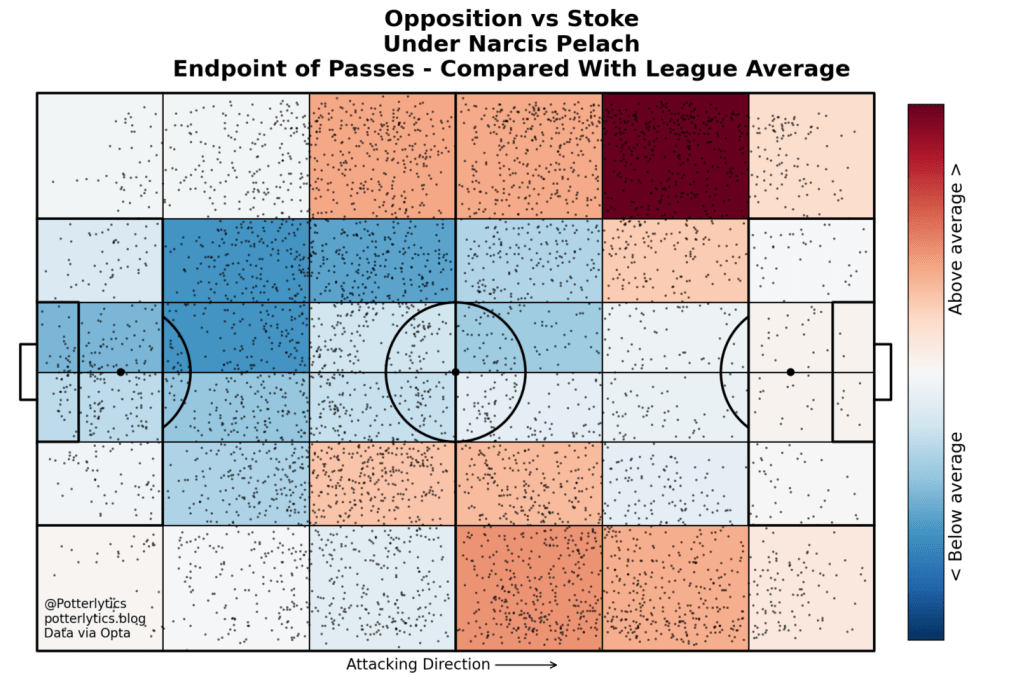
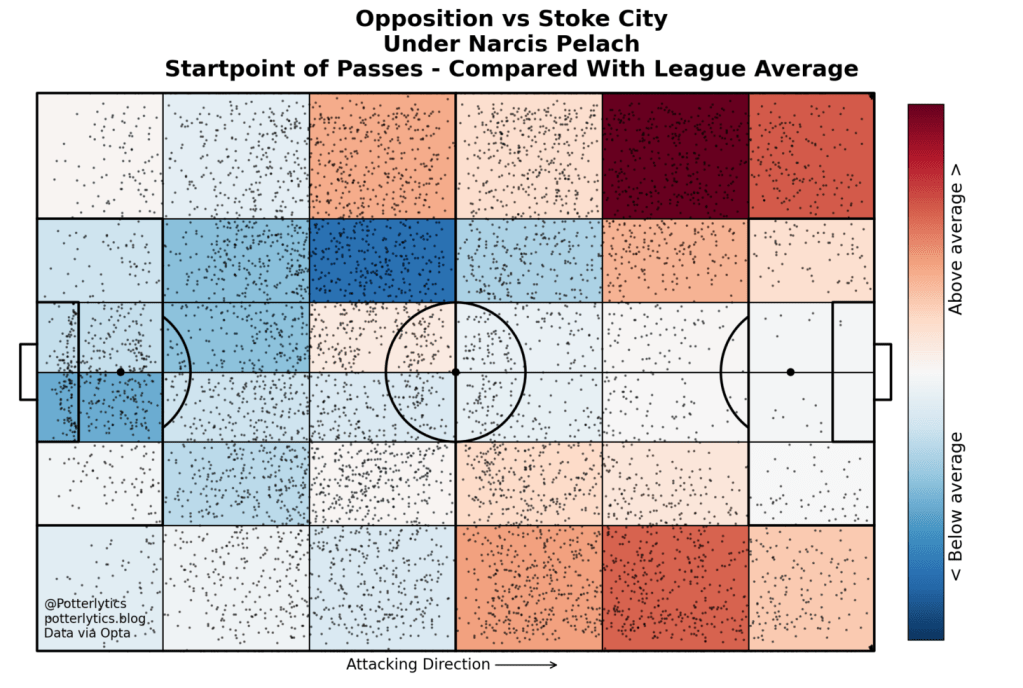
As above, looking at the passes Stoke’s opposition are making, it’s clear that the first line of the defensive press isn’t effective enough at preventing the ball getting into dangerous areas.

Opposition build-up simply plays around Stoke’s compact and narrow lines, and manages to consistently get into dangerous areas wide of the box.

Now, the plan here is for Stoke to simply pack the box full of players and prevent big chances for the opposition. But their unwillingness to press the ball on the edge to prevent crosses, alongside the unwillingness to mark a man moving between spaces in the box, has led to Stoke still conceding above the average xG per shot on average in the division according the Opta.
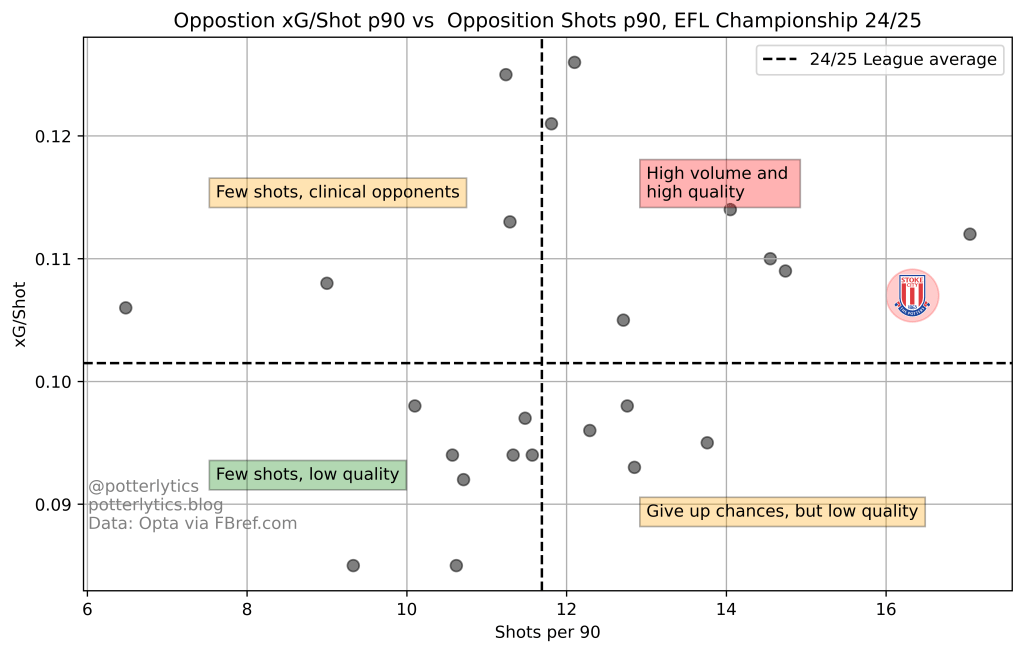
xG per shot (the average quality of chance) for opponents on the vertical axis against the number of shots per game for opponents on the horizontal axis.

As shown above, Stoke have not only conceded more shots per game than all teams bar Plymouth Argyle, but the shots they do concede are also higher value, on average, than 14 other teams in the league.

Click each image to zoom in.

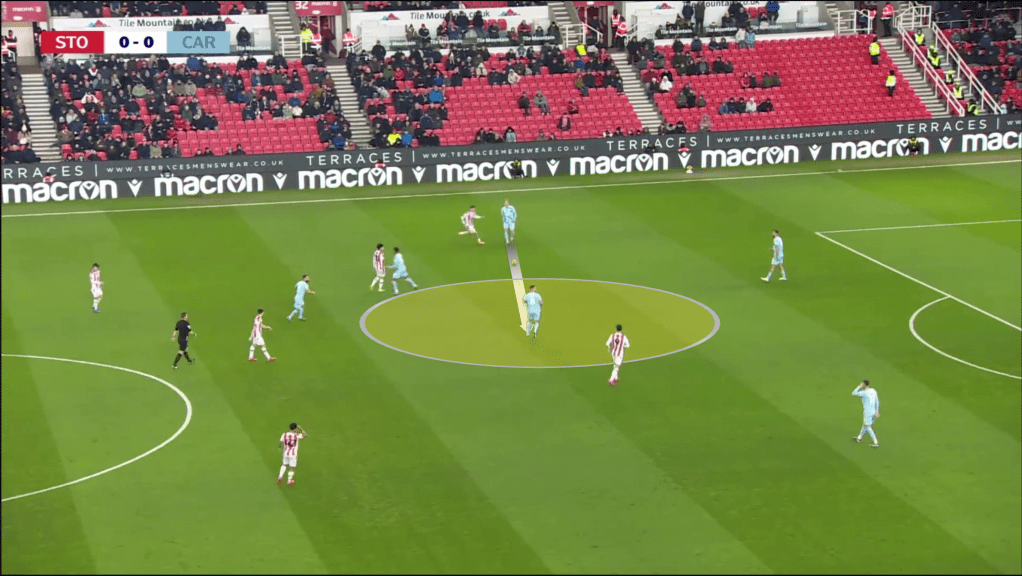
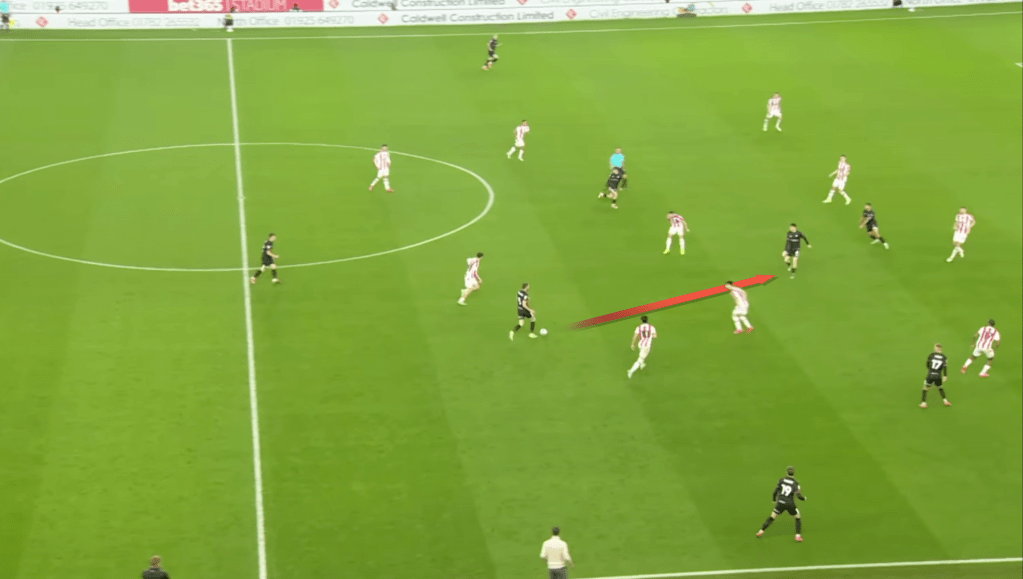
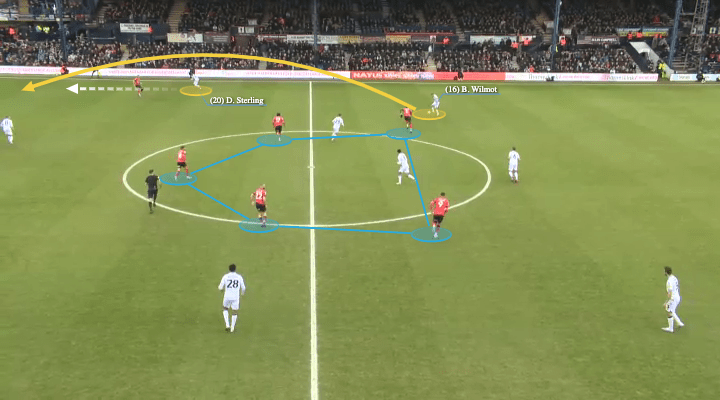
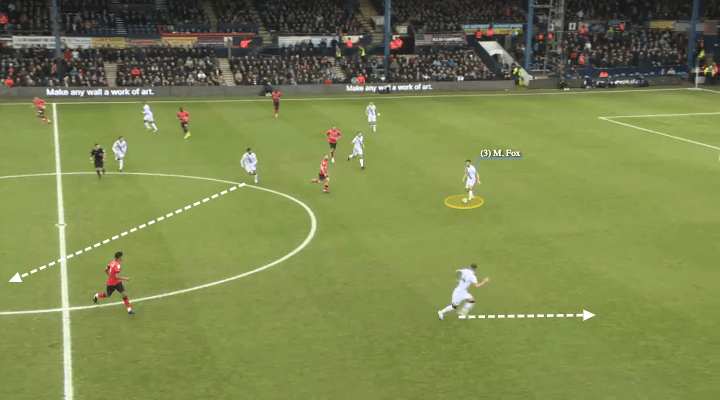
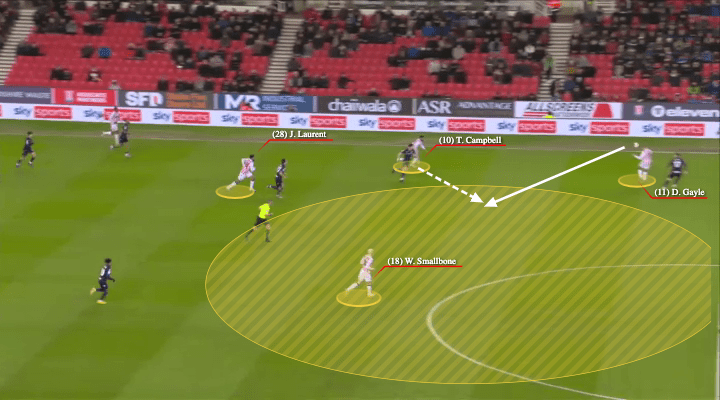
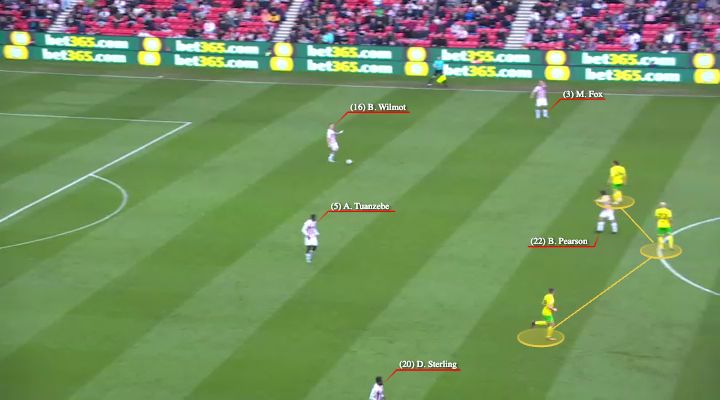
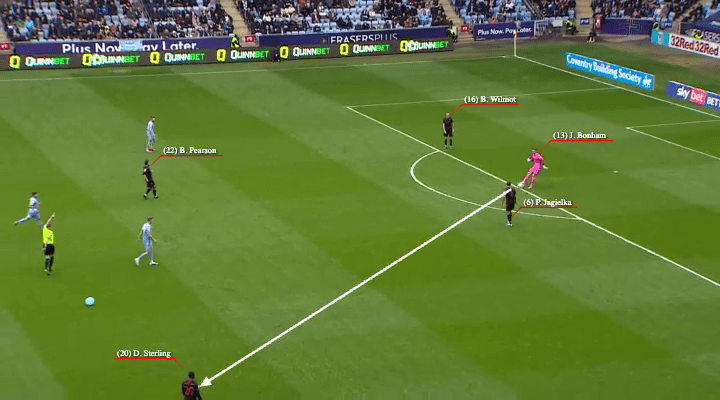
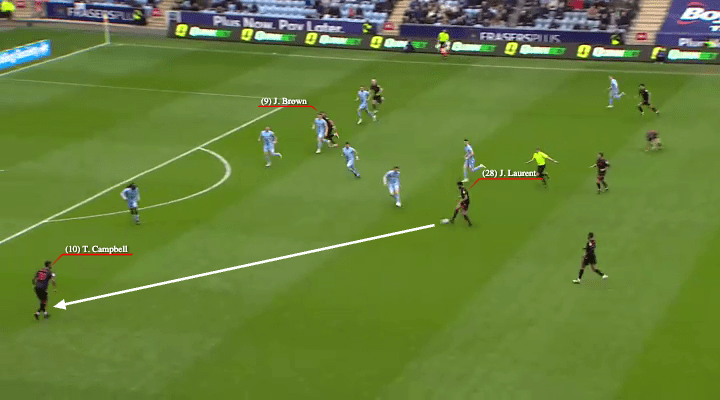
In the above images, from the first half against Cardiff, we see an example of Stoke’s defensive passivity and zonal defensive shape being far too easy to exploit.

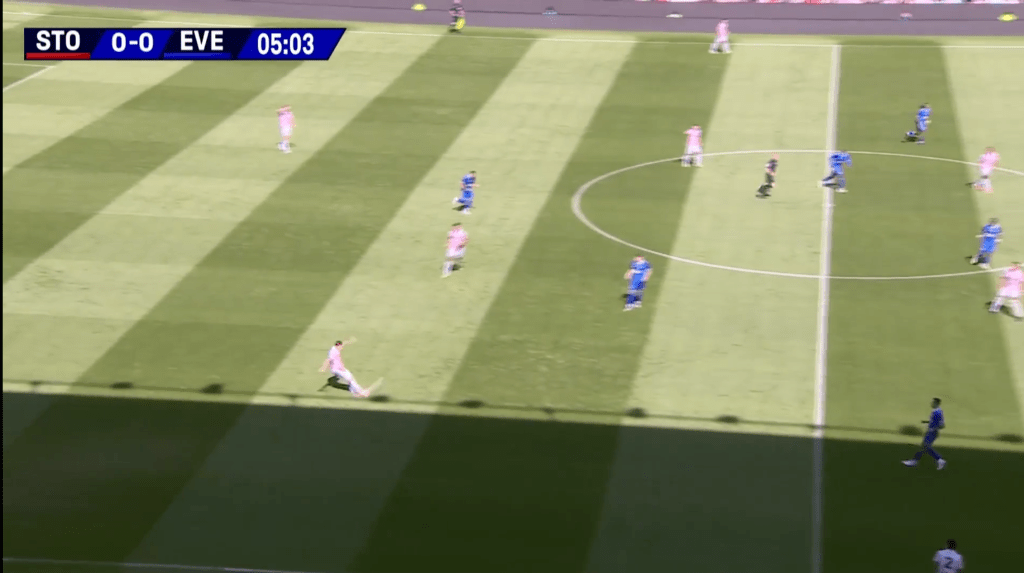
As the ball is played out to Cardiff’s right back, Stoke are sat loosely in their 4-4-2 shape, narrow and compact to prevent passes through the centre of the pitch. Koumas presses aggressively towards the player who receives the first pass, and the passer moves forward towards Junho.

But Koumas is pressing alone, and Cardiff play a simple pass into the centre of the pitch to Ralls.

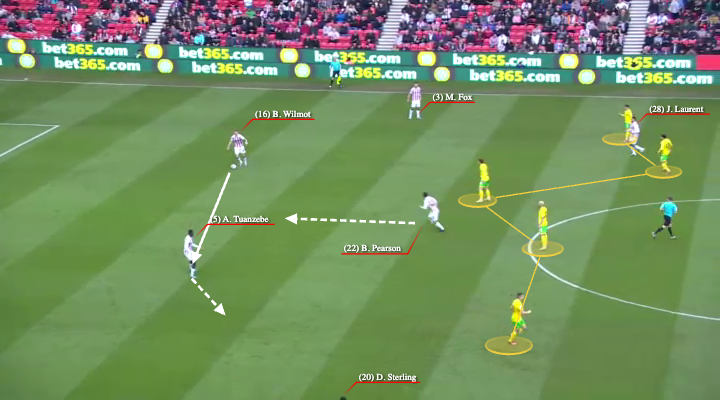
Not a problem, on its own, but because Stoke are so obsessed with keeping their shape and preventing central passes, they give Ralls complete freedom to turn on the ball and pick a pass forward.

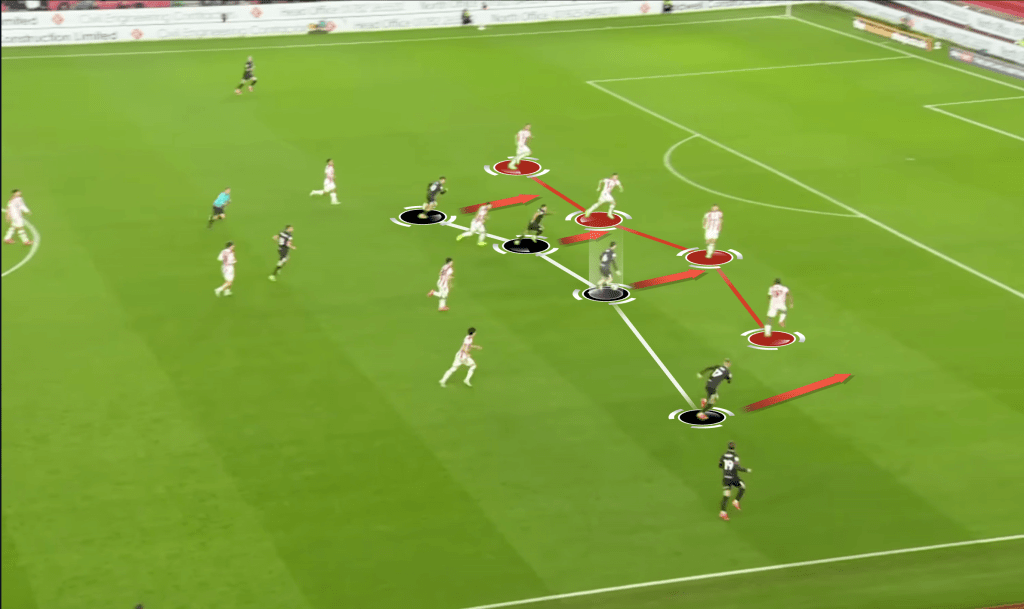
And now we see the major issue.

Click each image to zoom in.

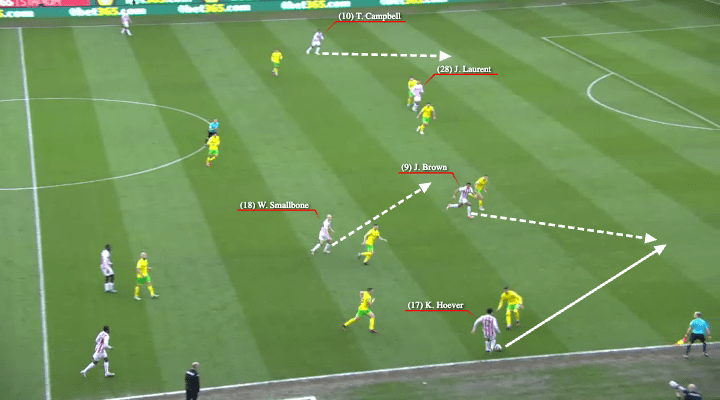
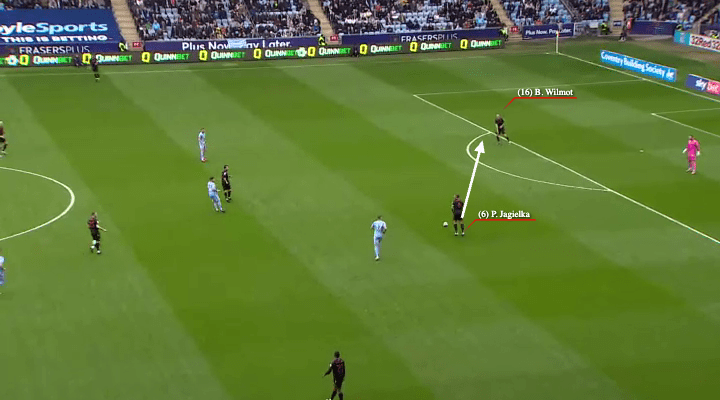
Cardiff do one thing very well in this phase of play – spreading their attacking line to fill the width of the pitch.

Stoke do many things badly, but my biggest problem comes with the lack of recognition of how to prevent attacks like this in their shape and structure.

If you’re sitting as narrow as Stoke are (look at their defence in the left image), and allowing the opposition to have the space wide, you have to be willing to press and compact the space higher up the pitch.

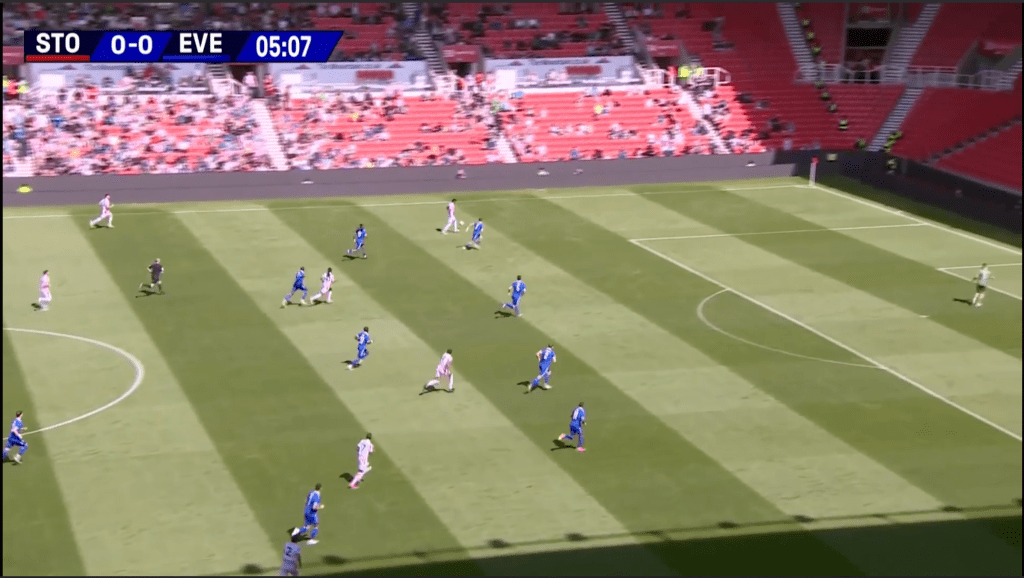
As it stands, Stoke’s forward lines (both midfield and forward lines are disjointed and leaving huge gaps in the middle 3rd in this case) are essentially training cones, with no pressure on the ball at all, allowing a relatively fast break through from Cardiff, and forcing recovery runs of almost 40 yards from their own defenders and midfield.

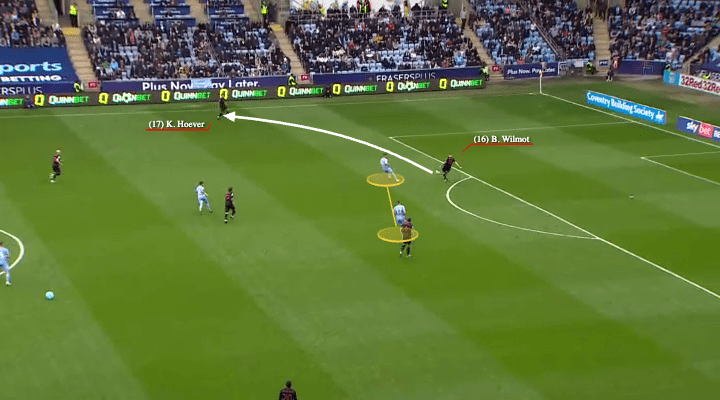
As the wing back gets the ball, he has 10 yards between himself and Wilmot, and a massive space to drive into with the ball. There’s a 4v4 on Stoke’s back line, and a huge gap in front of them to the recovering Seko and Manhoef.

Telestration: Metrica Play

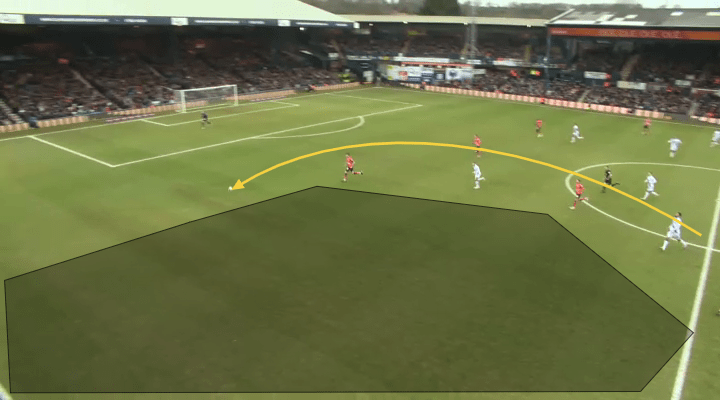
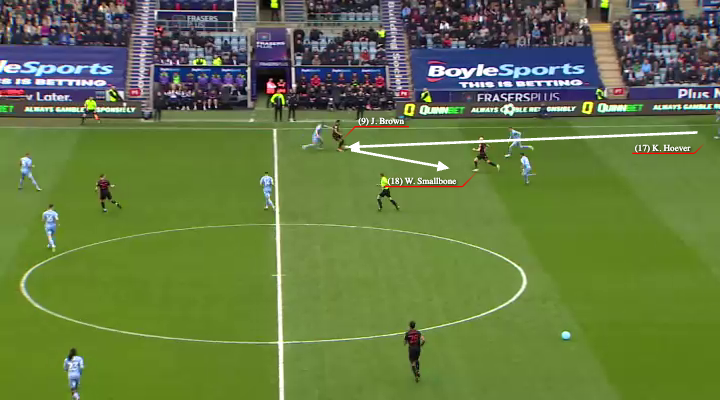
In the end, the wing back has a very easy time driving into the Stoke box, and as Stoke’s defence recover well to defend the 6 yard box (more on this later), passes to the late arrivers into the area are free, and in the end Johansson’s save keeps the score at 0-0.

With 2 simple passes, Cardiff went from 20 yards in their own half with all 11 Stoke players behind the ball, to a shot from 6 yards inside Stoke’s penalty area from a cutback.
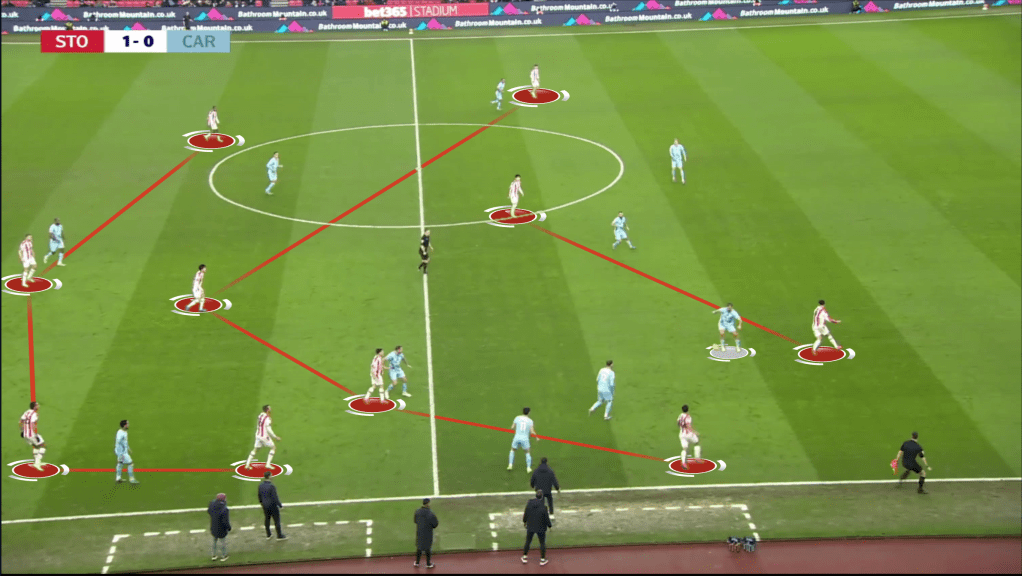
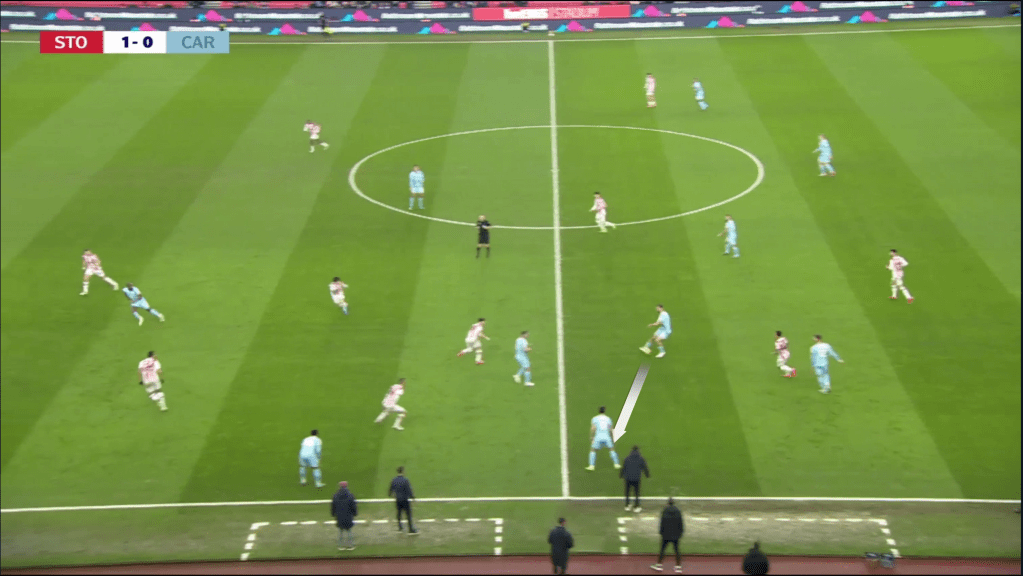
Here we have the build up to Cardiff’s equaliser. Wilmot plays a loose pass to try and slot Cannon through, thinking he’d drop into receive to feet (lol). But as Cardiff win the ball back, Stoke have every player behind the ball apart from Cannon, and all but 2 players on the right hand side of the pitch.

But, as has become common for Stoke this season, the spaces occupied in the defensive shape higher up the pitch are far too easy to get through. Look at the two pictures above, and as the Cardiff player takes the ball forward, he misses a pass inside to the completely free players between Tchamadeu and Junho.

He plays a simple pass wide, which Stoke are in a good position to close out and prevent danger.

But the recognition of where to press, and the ability to press while cutting out passing options, is so poor again.

Wilmot presses aggressively on his own, but the direction of his run blocks off neither the pass down the line nor the pass inside. Moran has, almost inexplicably, dropped off the midfielder to mark an area of space that Seko is already sort-of covering (although he’s also switched left to right about 4 times by this point).

The lack of pressure on the ball, and fundamentally the inability to recognise which spaces are dangerous means Cardiff easily play a pass inside and down the line, and Stoke have turned a 3v3 into a 3v1 in Cardiff’s favour with their positioning.

I believe this focus on defending the spaces leads to confusion in higher areas of the pitch, where players aren’t able to put pressure on the ball and create pressing traps.

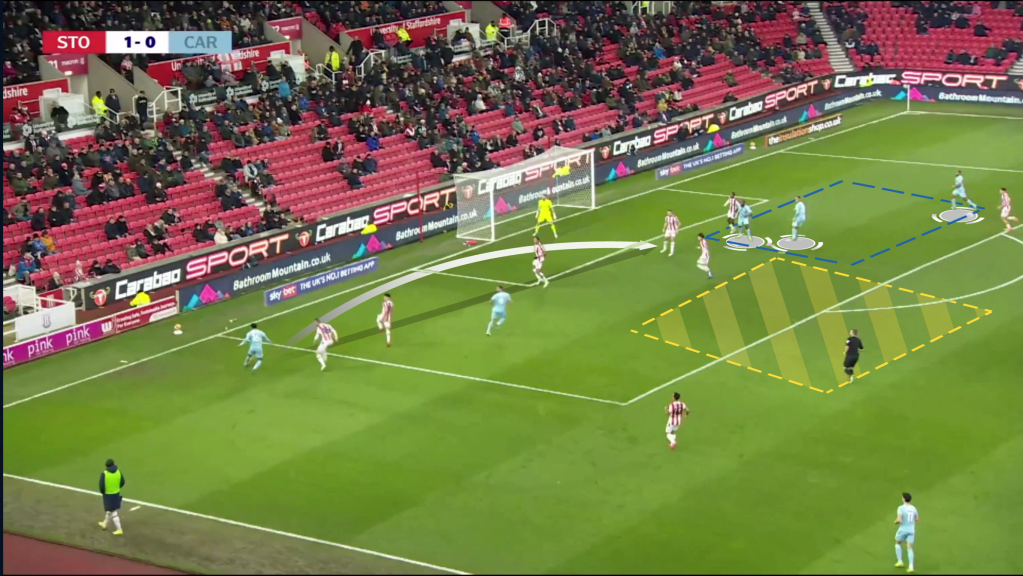
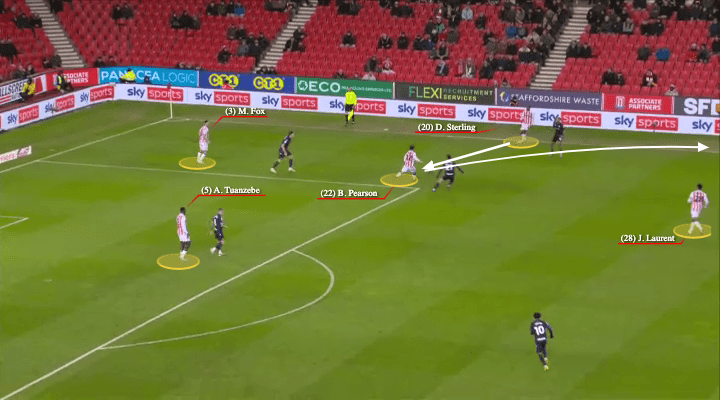
Then, as he makes the run down the line, we see another two issues in Stoke’s defensive structure in the low block phase, as every Stoke player watches the ball and defends the centre of the goal.

In the blue dotted area is a 3v1 on Junior Tchamadeu (and the eventual goal comes from a ball deflected to the back post), and in the yellow zone is something we often see with Stoke’s shape, a massive gap on the edge of the penalty area as everyone defends the 6 yard box.

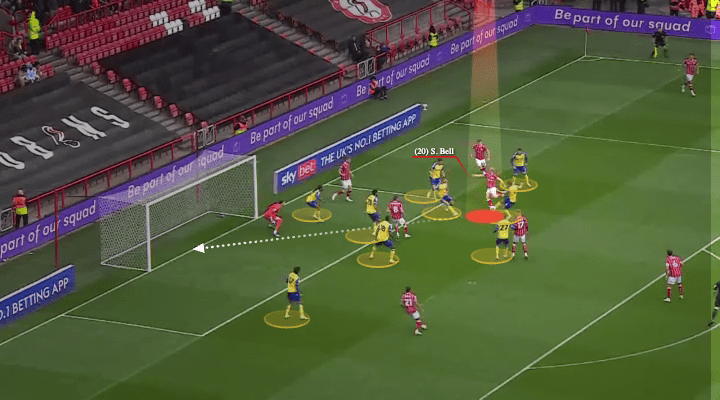
This is the source of the eventual goal, as a cleared header gives someone a free shot 12 yards out. And it happened more than once in the game.

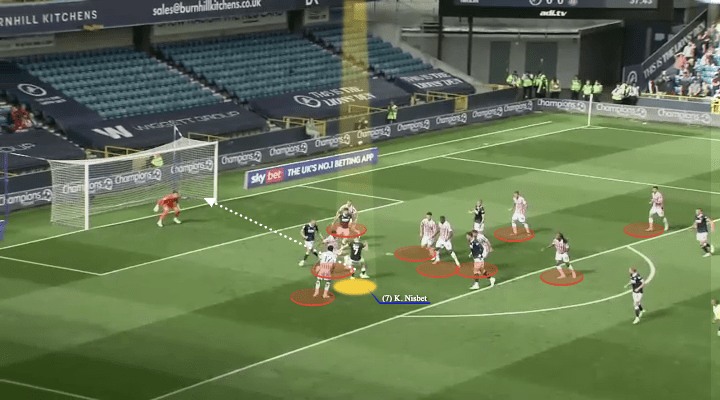
On the left we have the first goal, and on the right we have a similar opportunity that hit the bar. A cross into the box, headed away towards the edge of the box, but every Stoke player is so obsessed with defending the 6 yard box, that they give free shots from 12-18 yards out.

Yes, there are bodies in the way, but I don’t believe these chances – however low value – exist with a more aggressive and less conservative defensive plan in place.

Final 3rd Woes
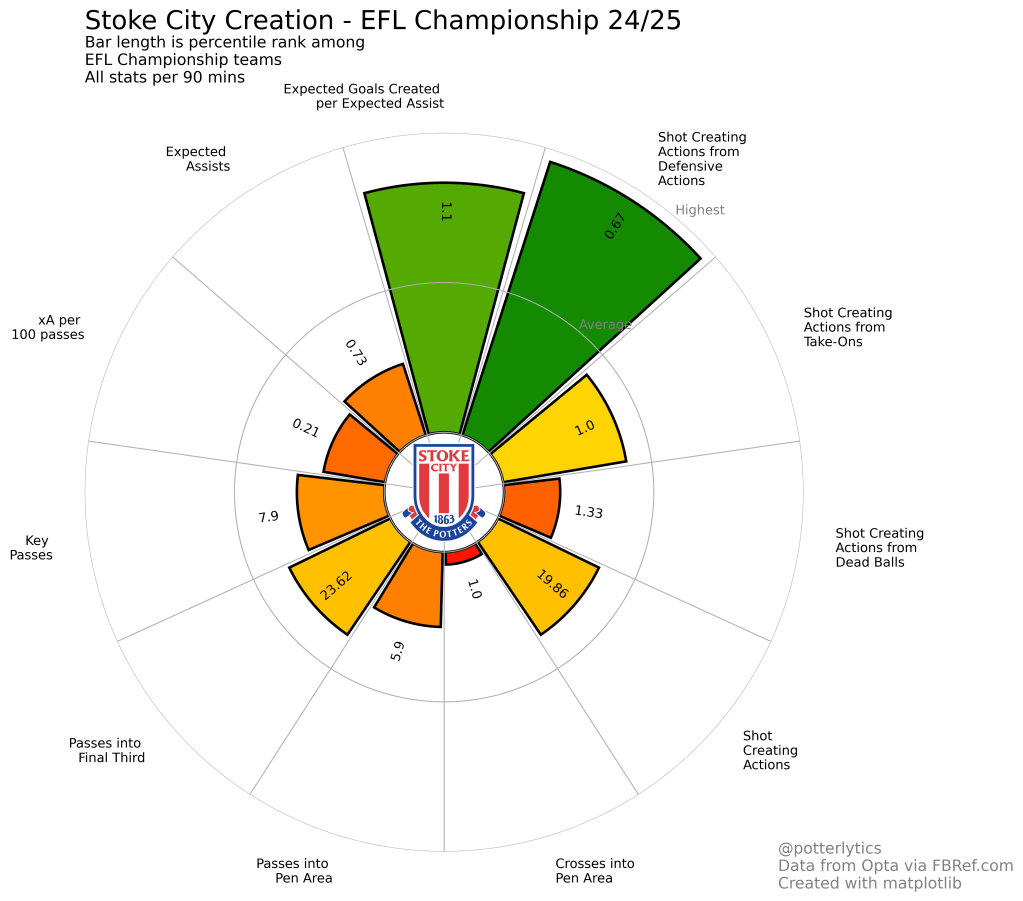
When looking at Stoke’s attacking issues, two big things show up.

Firstly, they’re actually very good at attacking on the break into space. They create the 2nd highest number of shots from defensive actions, and have scored the joint-2nd most goals from fast breaks in the league this season.

But whilst their build up has improved (and I do believe that’s one of few positives from recent performances), the ability to get the ball into the final 3rd and create when they do get it there is so heavily reliant on individual skill, that there are highly variable outcomes.

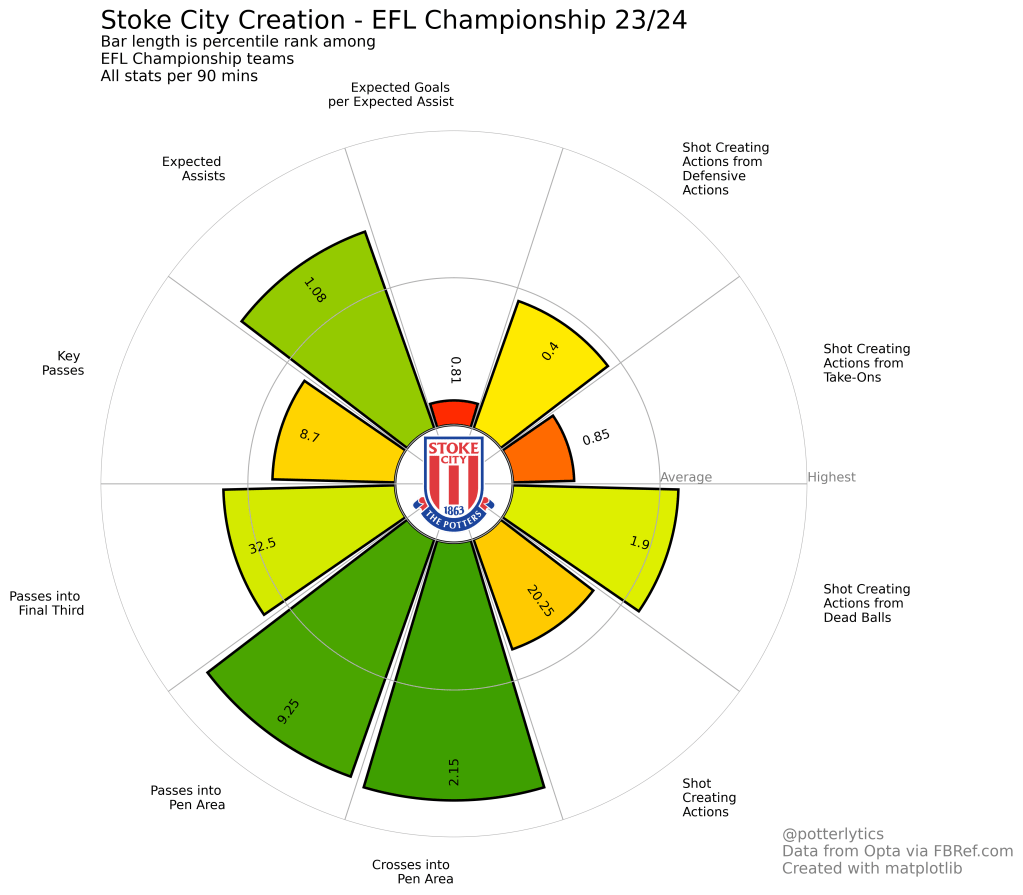
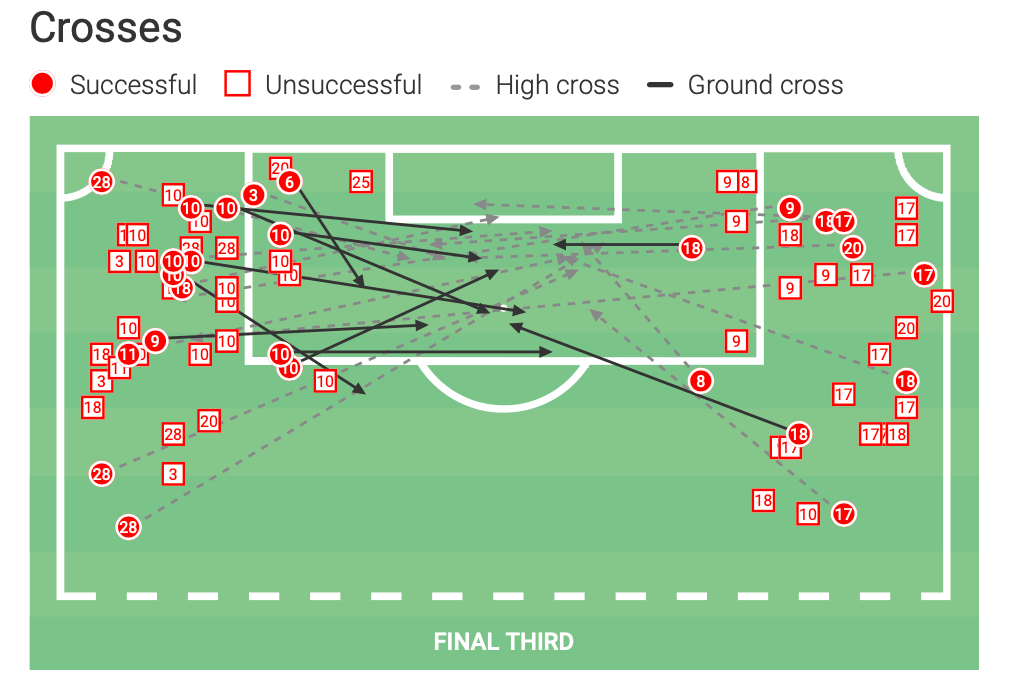
Their ability to create chances is poor, below average in both getting in the final 3rd and in creating chances in all of the above metrics. Only really excelling in creating big chances from low-value passes – an indication of their ability to be aggressive on the break and drive at defenders.

When playing into space and giving their best players the opportunity to attack, Stoke are dangerous. The much-debated Million Manhoef has produced two exceptional passes into space to assist Lewis Koumas vs Sunderland and Tom Cannon vs Luton.

But when the opposition is set in their defensive shape, Stoke narrow the pitch and stop making runs once the first pass doesn’t come.

The lack of structure in the final 3rd when trying to play the final pass has been a big issue for these young players, and as momentum and confidence tails off, it feels difficult to see much improvement on the horizon. Even for what were our clubs ‘stars’ only a few months ago.

It comes to something when I’m pining for something Alex Neil did, but I really do miss that willingness to set pressing traps and play with a bit more risk.

Alongside it being something I enjoy watching personally, I fully believe it suits the attacking talent we have to be trying to win the ball high up the pitch and break quickly in a structured manner

Yes, we may concede big chances and 1v1s against opponents who can play through us, but we’re already conceding almost 2 xG per game on average by sitting in our own box and allowing opponents who shouldn’t be able to get through to waltz to the penalty area.

As an example of that poor press, here’s Cardiff keeping the ball with about 10 minutes to go, as Stoke need a goal.

As a preliminary question, I ask – ‘Where are Stoke trying to force the ball in any of these images, and how do they want to win it back?’

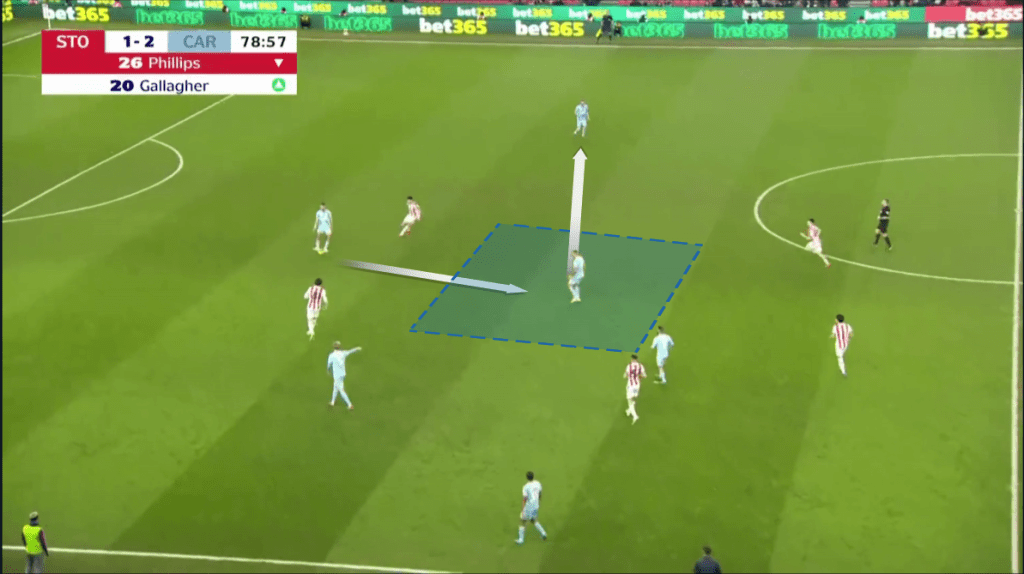
Yes, Stoke are chasing the game a little here, so you might expect it to be more disjointed, but in fact this situation appears across the 90 minutes.

On the left image, Cardiff have the ball with one of their centre halves. The two pivots in midfield are more risky passes because of Gallagher’s press, and the midfielder pushing up onto their line. So the ball is played across to the left.

As it’s played, Tom Cannon presses to force the ball central. A good idea, right? But no, because the midfield is 10 yards off the pivot player who receives the ball.

Not only could he turn easily and try to find a forward pass between the (huge) spaces of Stoke’s midfield, but he can simply play the ball out left to the opposite side, where Stoke have no man within 30 yards.

Whilst they can sit in a compact block well, and prevent easy passes centrally, Stoke struggle so much with actively being able to win the ball back in these higher areas against sides with a bit of composure.

The pass out wide is mishit and poorly-weighted from the Cardiff player, which gives Gooch time to press higher. But as he’s had to run full tilt for 30 yards to press, a simple shift of the ball allows another easy pass into the midfielder at the end of the white arrow, who can turn and attack Stoke’s defence directly, because the midfield have pressed on.

Wilmot (spotlighted) is stuck between marking the central player and the wide player, as Seko (the deeper of the midfielders, is 10 yards off.

Every pressing run from a Stoke player ends up having to screen two possible passes, because there doesn’t appear to be a plan to win the ball back aside from ‘don’t let them play centrally’.

As a result, it becomes really easy to drag the shape around with controlled and composed possession, and with it being so compact and narrow, even poorer sides can play around the shape, as Cardiff did in the first example all those paragraphs ago.

A Final Rant About Structure

To finish this off, I have to talk about the club as a whole.

The situation Narcís Pèlach is currently in feels entirely avoidable, and I have such deep sympathy for him in this position.

Having created a brand new club from scratch 6 times since relegation in 2018, it feels like the new Jon Walters era continues where the previous eras left off.

With 1 manager and 2 head coaches in the past 12 months (or just over), 2 technical directors (or sporting directors now), and 2 managers sacked 5 games into a season in the last 4 years, Stoke are grasping around for anything they can to find the answer.

But to me, therein lies the permanent issue with Stoke City as a football club.

There is no ‘answer’ to football.

There’s no such thing as ‘the right’ way of running a club, ‘the best’ head coach, ‘the best’ sporting director, or ‘the best’ signing to make. Football is such a high-variance sport that you can rarely rely simply on ‘good’ to get you into the best position. You need to produce a process and a plan that you think is right for your club, and stick to it until you feel you need to change. From the top to the bottom.

The issue with Stoke has been that, for far too long, they’re a club playing catch-up. From the ‘it’s what Liverpool do’ technical board of Michael O’Neill that lasted 5 games, to Ricky Martin sacking the manager who brought him in, the ideas have almost never lasted more than one or two bad runs of results.

The entirety of Stoke City’s plan for the club hinges on a Fear of Missing Out.

‘What are the ‘good’ clubs doing? Oh Brighton are doing data scouting, let’s get one of them in, but only for a few months because we’ll have a completely different club structure the following summer.’

There’s no issue with learning from what successful clubs are doing, but it’s never done with a depth of understanding of why those ideas are working at those clubs. Stoke take the most surface level idea from an iceberg of a principle that’s worked for other clubs, and then sack it off when it doesn’t immediately turn them into a top 6 side.

The ‘Sporting Director’ role is another example. The use of a sporting director is to provide accountability to the plans and processes that should already be in place for the whole club. They’re not there to control the club in its entirety, because even they rarely last more than 2 seasons.

I was going to put some examples from previous ‘Pre-Season Q&A’ nights still available on YouTube, just for even more depressing memories, but I’m already way over my word limit. If you’re wanting to see how this has unfolded over time, I highly recommend sitting through the ‘plans’ of the last 6 years explained in those chats.

This obsession Stoke have with finding one emperor figure to take control of everything and make it all suddenly click needs to stop, or I fear even medium term success is beyond them.

Sure, maybe we’ll get lucky and roll a 6 in the manager dice roll game, and win a few. But then what happens when they leave, and we have to restructure again? What happens if Walters leaves, either by choice or worse?

I feel for Narcís, he’s going to likely get a January window to bring in players at a club who have only retained only a few players from their squad 18 months ago, and he’s got to learn on the job very quickly, in an environment that has destroyed much more experienced managers than him, at a club that can’t decide what it wants to be.

It’s been crying out for someone to sit down at the highest level of the club, and plan processes and principles for what type of club Stoke City should be. From Men, Academy, and Women’s teams to the catering at the kids’ games. We can’t keep wanting a revolution every 6 months and expecting the same decisions to suddenly bring success because ‘this time we have the right man, honestly’.

Thanks to any and all readers, and please feel free to comment and follow on Twitter at @potterlytics. If you want to hear myself and Lucas Yeomans discussing each Stoke game alongside some exciting interviews, head over to the Cold Wet Tuesday Night Podcast at BBC Sounds.


George

*Chuckles* I’m In Danger

It hasn’t been the start Stoke would have wanted from their new boss. His first 7 league games in charge have delivered just 6 points, including a thumping victory, and 3 draws with more than a dollop of luck and goalkeeping excellence to thank.

A fantastic 6-1 victory over Portsmouth seemed to signal a bit of a shift in the tide of new manager Narcís Pèlach’s fortunes, and despite some poor underlying numbers, the 3 consecutive draws that followed pointed toward a more resilient and hard-to-beat Stoke side.

Saturday’s 2-0 loss to Sheffield United, who controlled the vast majority of the game, seemed to signal a turn in how fans’ have been viewing the performances, however.

In a vacuum, a poor performance and a 2-0 loss away at a promotion candidate might be a classic ‘oh well, onto the next one’, but in the context of 1 win in 7, and worrying signs defensively, there’s a worrying air of fear around the fanbase.

But just what do those pesky underlying numbers show? Why should you care? And what could it indicate for the future?

And yes, I will include a bit about Southampton.

Disclaimer: None of this should be used as a stick to beat head coaches with. Particularly those who are only 7 games into their first major head coach role.

Nar-sty Numbers

First, and most obviously, we can take a look at Stoke’s ability to create their own chances and prevent opposition chances, with a rolling average of xG created and conceded (xG explainer here).

The blue solid line indicates the average of the previous 7 games’ xG created, with the red solid line showing the average of the previous 7 games’ xG conceded. Each dashed line shows the trend of xG created and conceded for both managers.
The black solid line indicates the transition between managers.

A stark, and somewhat depressing plot.

As simpler stats point towards defensive issues, with Stoke having conceded 39 shots inside their penalty area over the past 2 league games against Sheffield United and Bristol City, the xG data agrees.

Huge caveats with the small sample size, but in Narcís Pèlach’s tenure so far, Stoke’s defensive numbers have fallen off a cliff.

According to Opta, Stoke have conceded > 1.5xG in all bar 2 games so far in Pèlach’s 7 games, including 1.9 xG or more in 4 of those matches.

In fact, at an average of over 1.8 xG per game conceded, this is the worst 7-game spell of league defensive numbers since a 3-0 loss against Wigan, at the very beginning of Gary Rowett’s tenure back in 2018, and even that window was taking into account 3 Premier League games under Paul Lambert.

But of course, stats need context, and much much more in-depth exploration than simply one 12-game set of xG data. So let’s delve into this in a bit more detail.

A Tale Of Two 10s

Despite scoring 10 goals and conceding 10 (+1 own goal) in the league since Pèlach took over, the stats behind those goals continue to tell a worrying story.

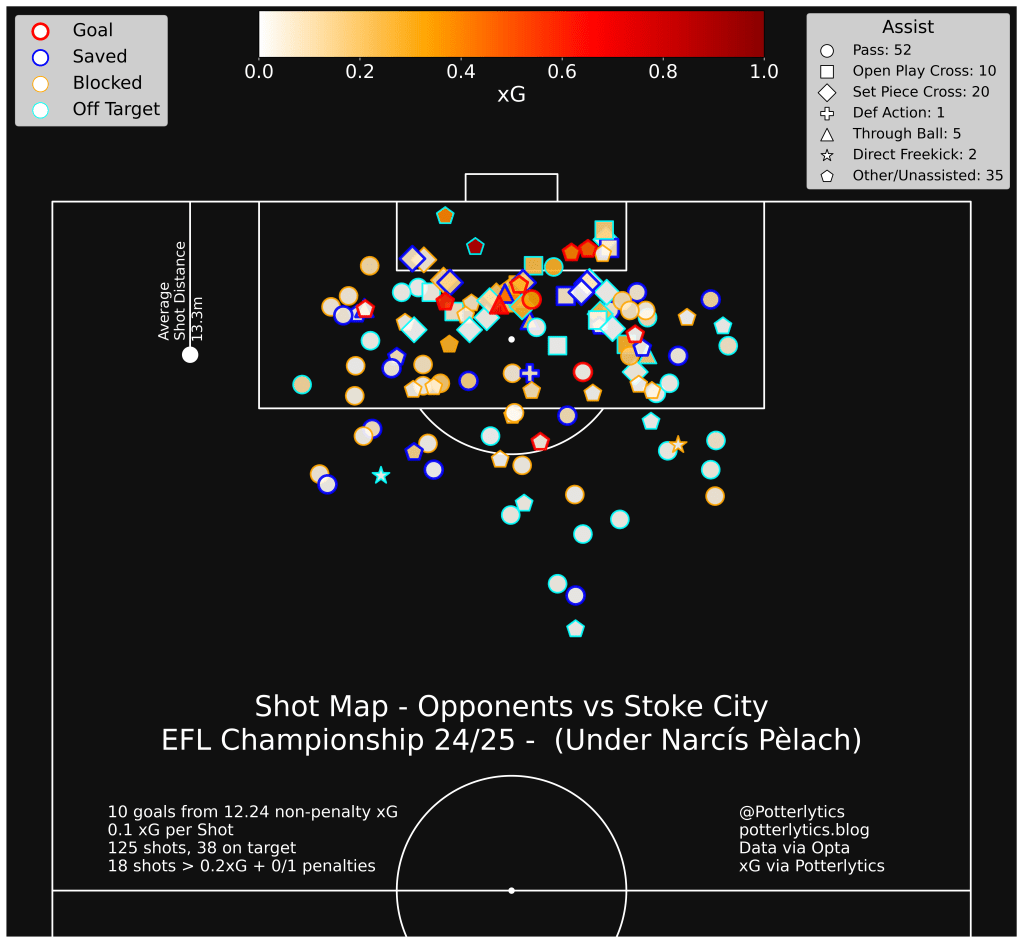
Of the 125 shots Stoke have conceded in that time (almost 46 more shots than they’ve taken themselves), 96 were from inside their own box, at a rate of 13.7 shots in the area per game.

Alongside that, Stoke have created (hugely caveated: according to my xG models) only just over half the xG of their opponents in that time. Over-performing their chances to the tune of almost 3 goals.

Their opponents, on the other hand, are underperforming their xG by 2 goals (excluding the missed penalty which was scored on the rebound by Kasey Palmer).

Having created only 8 ‘big chances’ compared with their opponents 18, 6 of Stoke’s 9 non-penalty goals have come from chances with a low xG (<0.1) compared with 4 of their opponents’ 11 goals.

Alongside that, their opponents have been unlucky with the quality of finishing they’ve shown, having scored 11 goals from a whopping 16.1 Post-shot xG (a measure of how likely a shot is to go in after it’s hit), compared with Stoke’s 9.1 PSxG.

All this points to a significant element of ‘luck’ in Stoke’s recent results, at least in terms of goalscoring for both themselves and the opposition.

Narcís Pèlach mentioned in his pre-Southampton press conference that stats need to be used with caution, reminding Sentinel ace reporter Pete Smith (<3 you Pete) that with conceding shots, you need to take into account the distance, position, and value of these shots. But I’m not sure that even with those caveats Stoke are in a good place.

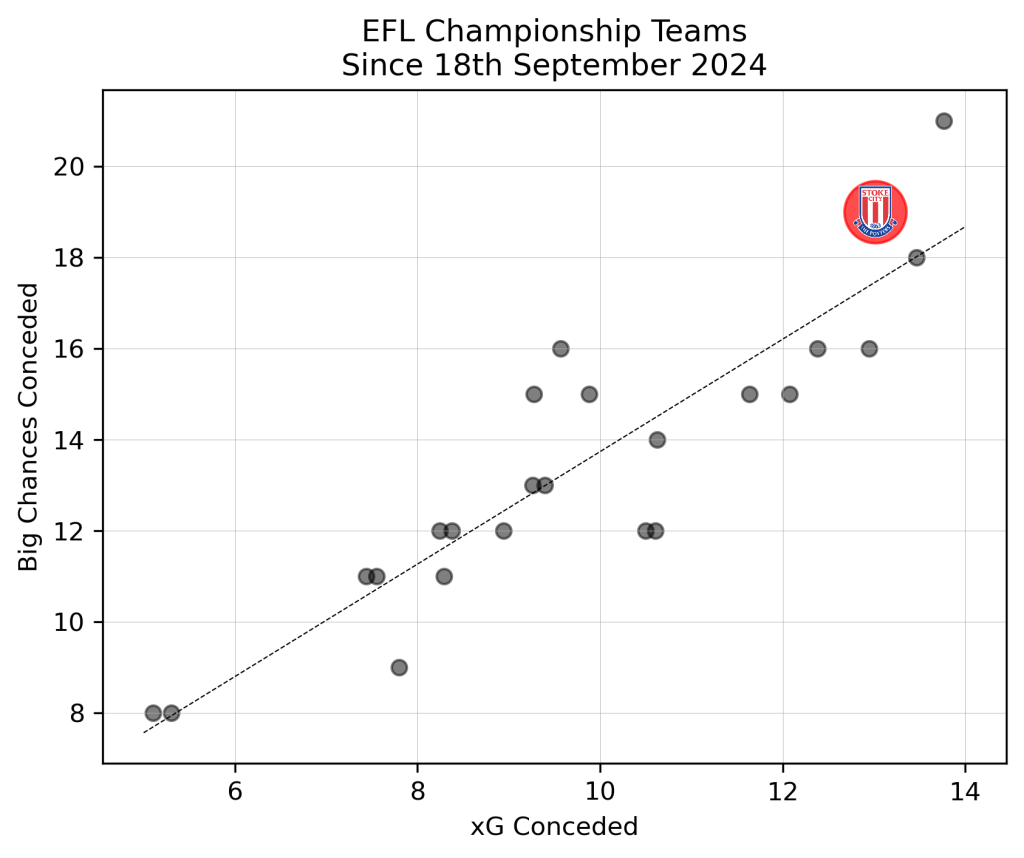
Beyond the eye test of Stoke ‘feeling a bit weak’ defensively, this provides some strong evidence that they’re conceding too many chances, too many high-value chances, and too many chances in their own penalty area.

The number of big chances (xG > 0.2) conceded by Championship teams vs their xG conceded since Pèlach took charge of Stoke. More grim viewing.

Whilst stats in the short term can be largely down to variance, it does indicate a likelihood that, if Stoke don’t arrest their defensive collapse over the last few months, then results will start to follow.

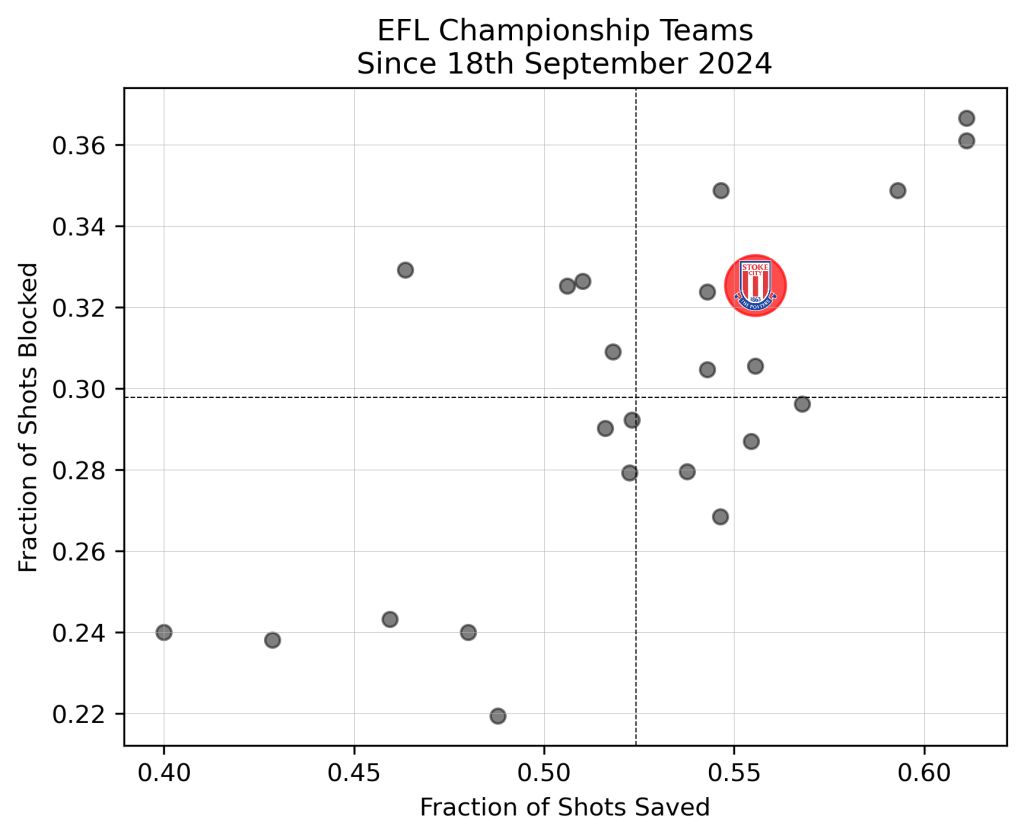
In Pèlach’s defence, there is some evidence that Stoke are improving how they defend the box, and they are above average in the fraction of shots faced that they block. This does indicate that players are more often behind the ball when the opposition take shots, but it’s also the case that Stoke are above average in the fraction of shots saved, which brings us nicely to our glimmer of hope.

A Helping Jo-hand From Vik

Undoubtedly player of the season so far is Viktor Johansson, who has replicated his utterly insane shot-stopping form for Rotherham in recent weeks.

The number of goals below expectation per 90 minutes that goalkeepers are conceding, considering the chances they’ve faced vs. the difficulty of those shots on average. Big Vik is a high flyer.

Replace Viktor Johansson with the ‘average’ historical goalkeeper, and Stoke would be about 7 goals conceded worse off this season, (reductive and way-too-simple stat coming up) winning just 2 games, drawing 1, and losing every other match this season.

Whilst it’s fantastic to have a keeper like Johansson putting up these numbers, it is, again, worrying to be relying so heavily on him for results.

Midfield Muddle

Chief among Stoke’s struggles in recent weeks has been the ineffective nature of their defensive shape.

As Pèlach correctly summised recently, the players are learning a new defensive system, and it will take time for them to get used to that. As it stands, though, the off-the-ball shape of Stoke has only really shown signs of working against a very poor Portsmouth side, and 20-30 minute spells vs Norwich, Hull and Swansea.

And boy does it look poor when it doesn’t work.

The 442 shape out of possession allows for Stoke to challenge with 2 forwards, but the compact shape they employ deeper in the pitch is all-to-easily bypassed.

Initially we saw issues with teams playing around the shape under Schumacher, culminating in some strong criticism of the fullbacks, but now it’s all too easy for teams to play through Stoke’s shape centrally, with the 2 central midfielders consistently unable to block passing lanes and cover ground off the ball.

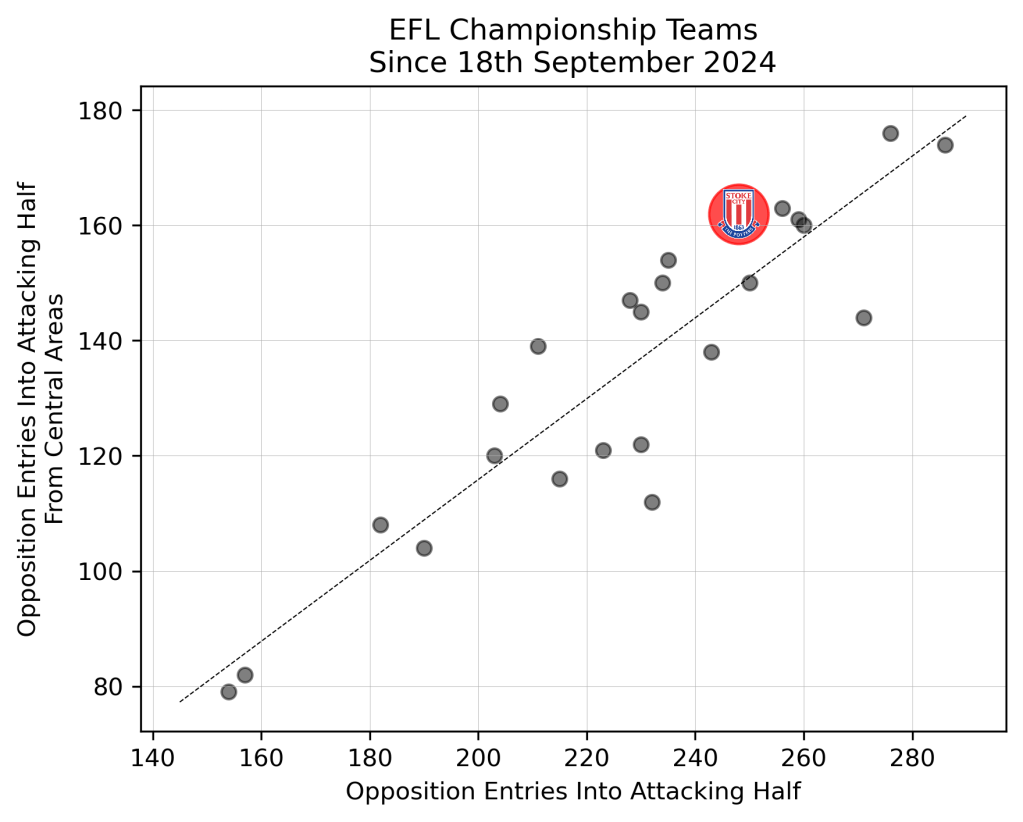
As shown above, Stoke are above average in their last 7 games in allowing the opposition into the final 3rd and the attacking half, but more visibly, they’ve allowed the 2nd most entries into the attacking half in central areas, and the 2nd most entries into the final 3rd from central areas of any team in the league.

Tackles in the deeper 2/3 of the pitch vs defensive actions in central areas from Championship sides since Pèlach took over at Stoke.

And finally, we see just how passive Stoke are in these deeper, central areas. The compact and deep block means they are more likely to allow opponents the chance to deliver the ball into the box, and try to get bodies behind it, leading to the 2nd lowest number of tackles in the defensive 2/3 of the pitch.

And beyond that, the inability to press and block passing lanes centrally leads to their low volume of defensive actions in central areas.

But enough stats, let’s see a few examples:

(I’d like to do more, but thanks to Stoke’s highlights for showing goals and excitement instead of build up shapes for some reason.)

Telestration via Metrica Play

First off, we have a clip from the Bristol City game, in the build up to the 2nd goal.

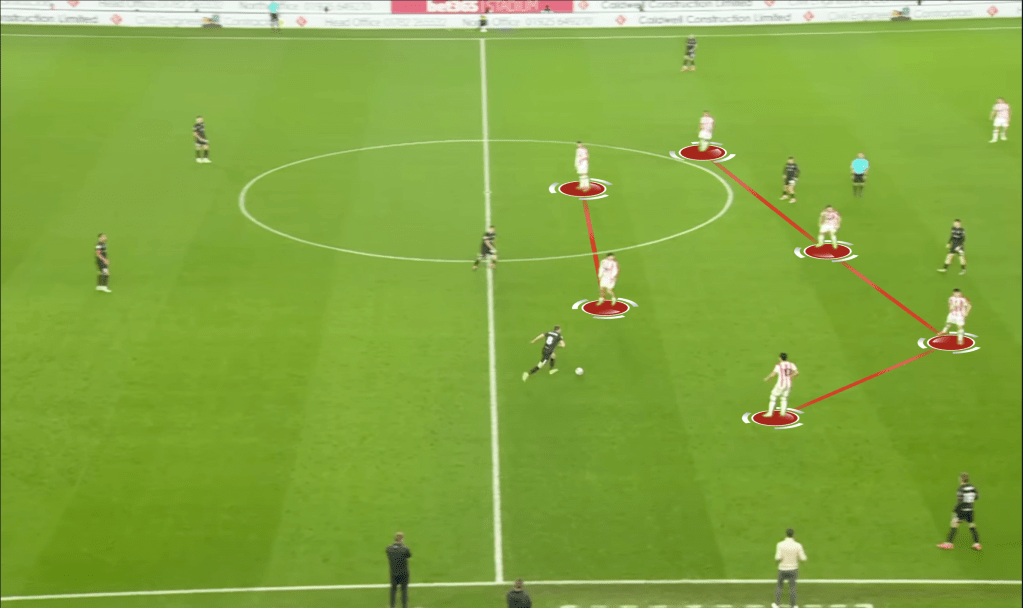
Bristol City have the ball on the half way line with their midfielder, and Stoke are sat in their compact 4-4-2 shape. Immediately we can see the goal of Stoke’s shape, in covering the spaces rather than opposition players and maintaining the defensive shape.

But against strong opposition with intelligent attackers, especially if midfield players are reactive to opposition movement, this can lead to open passes through the lines for opponents, and we can see one of those opening up above.

As the player drives forward, there is very little pressure from the left sided forward, and a simple pass opens up to the forward through the press. He takes the ball on the half turn, plays a pass to his right, and suddenly we see the right hand image.

From a position in front of Stoke’s compact and narrow shape, Bristol City have run forward 5 yards, played 1 low-risk pass through the lines, and are now 4v4 (with wide players available too) against Stoke’s back line.

But although I don’t think this is what Pèlach wants of his players in terms of the ease with which Bristol City play through, there is one positive here, in that Stoke’s defence closes the space well and should clear the ball. An unfortunate clearance and error plays Wells through to score in the end, but the chance was largely squandered before that.

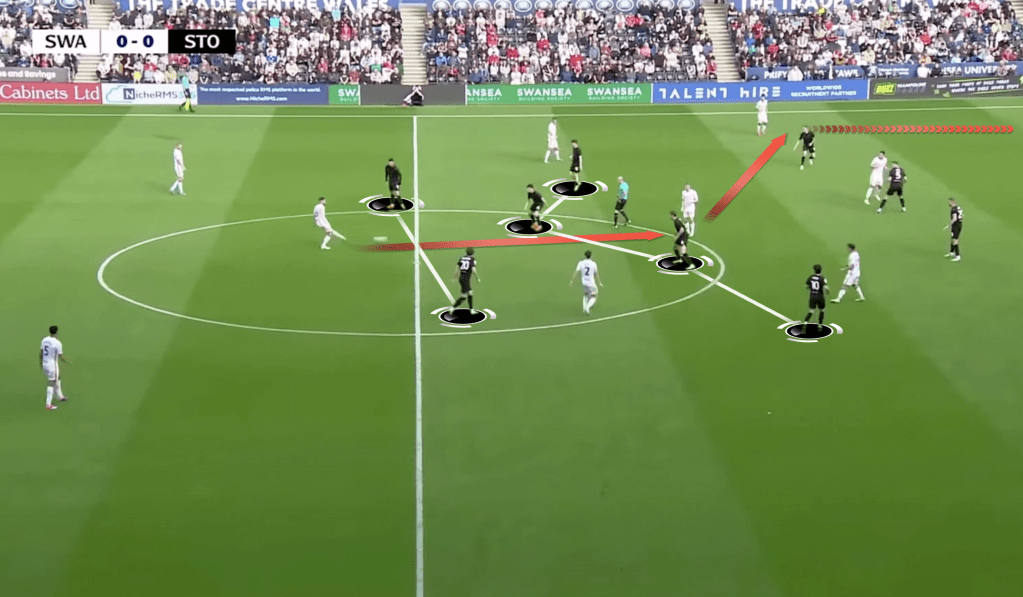
Above we see a similar situation but with a better outcome in the Swansea game.

A simple pass is played through Stoke’s 1st and 2nd pressing lines again, and the ball is played wide.

This reactive press, in which Stoke allow teams to break their lines, has again led to a 2 pass move that goes from the centre circle to inside Stoke’s box in ~8 seconds.

Although this time we do see some positives, and probably the area in which Stoke’s defending has been fairly good in recent times. As the Swansea player arrives in the area, Stoke have 3 of their midfield 4 sitting on the edge of the box to cover pullbacks, and the leftmost 3 of their defence are sat covering the danger areas of within the width of the 6 yard box.

Wilmot presses the player on the ball, forces him wide, and the ensuing cross is easily cleared by Rose.

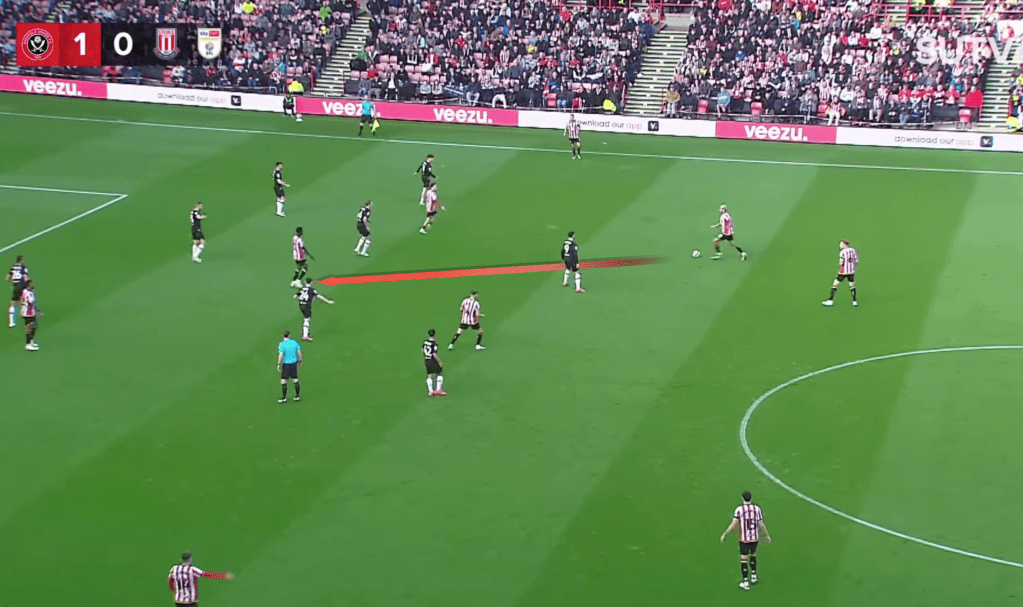
We see a similar issue rear its head above in the game against Sheffield United.

Rak-Sakyi makes a simple movement into the space between Burger and Moran, and a relatively low-risk pass from Souza sees him able to turn and attack Stoke’s defensive line.

After a few body feints, Stoke manage to close the space and squeeze the ball out to Johansson, but again we see a situation where the opposition can run at Stoke’s defence with one or two simple passes through the lines.

Before You Get The Pitchforks Out

But as mentioned above, I don’t think Pèlach is happy with that issue. He’s mentioned, rightly, that Stoke have greatly improved in defending their own area and keeping an opponent out when they sit deep.

But what we haven’t seen is a Stoke side that can get the ball back when the onus is on them to find a more aggressive pressing shape.

Defensive improvement against Southampton was great for momentum and morale, but I don’t think that keeping Russell Martin’s horseshoe-ball at bay with a back 10 is necessarily a tactic that will be indicative of anything in the Championship.

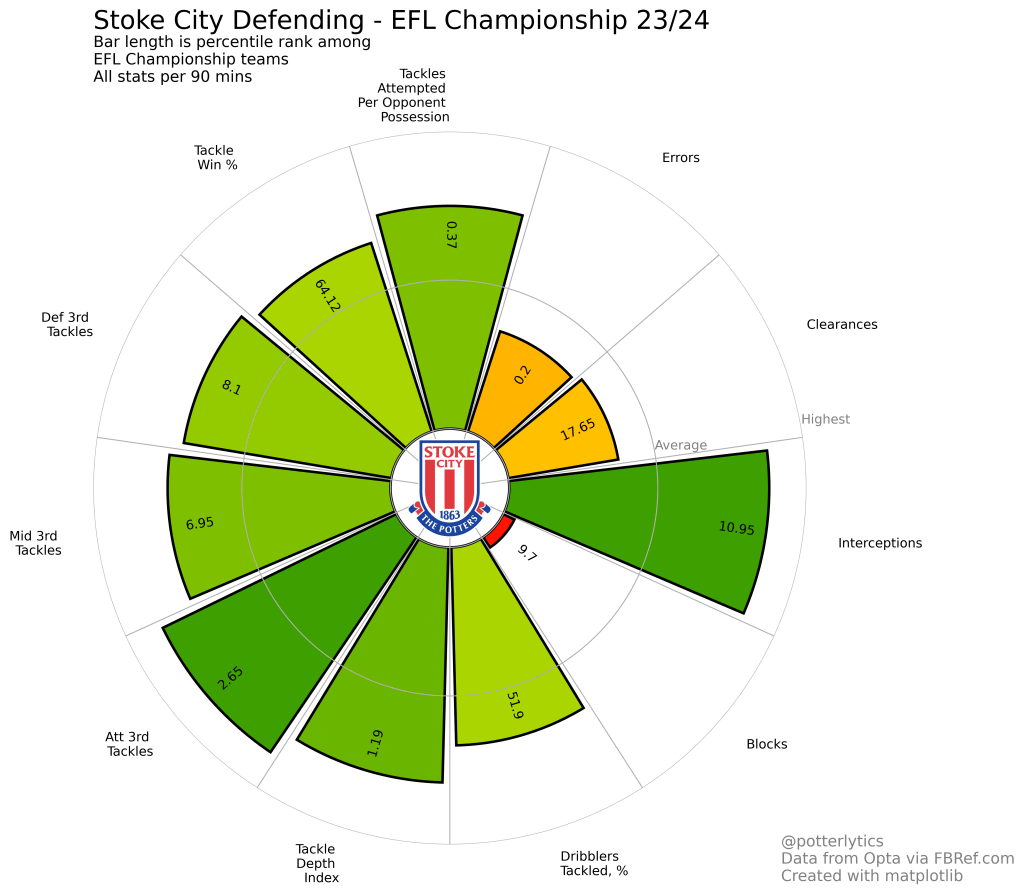
Stoke’s overall defensive numbers show this, with a significant number of tackles in high areas, but one of the lowest numbers of tackles attempted when adjusted for opposition possession.

Stoke’s pressing unit is based heavily on occupying space and frustrating the opposition, with lots of blocks and clearances, and a very high tackle win % suggesting they only attempt to win the ball back when it’s very clearly on.

This hybrid pressing structure, with some aggression high up the pitch, dropping very quickly back into a solid (in theory) shape, had great success against Portsmouth, but I fear it’s too passive to be consistently successful at this level.

Whilst you can look at the goals Stoke have conceded recently and count them unlucky, or down to individual mistakes, I can’t escape the feeling that they’re bringing some of this luck on themselves with such a passive pressing plan.

Allowing the opposition to so easily drop you into a low block may well mean you defend the box better, but you also give them the opportunity to get lucky in very dangerous areas, and your defenders the opportunity to make mistakes in dangerous areas too.

I think immediately of examples such as that Wells goal above, Norwich’s goal, and Campbell’s goal for Sheffield United.

The hope has to be that as the players improve in the low block phase, which I do think is happening, they’ll start to find their feet in the middle and final 3rd, and especially important is that we see an improvement in what they do in possession too.

The best way to defend is to have the ball, and that hasn’t been a strength of Stoke’s either in recent weeks.

But, at 2200 words in, I can’t start an in-possession section now, even if I want to.

While Pèlach has been put under such massive pressure by the circumstances of his hiring, and a strange confidence from some that this side should be pushing for the play-offs despite being relegation candidates not 6 months ago, this article shouldn’t be take as a criticism of him.

There are issues, sure, but he’s a brand new manager at a club that has taken down far more experienced bosses than him.

Today’s game (sorry if you read this late) is massive, though, and as a side looking to improve, you’d think this would be a great opportunity to show what they’re learning.

Thanks to any and all readers, and please feel free to comment and follow on Twitter at @potterlytics. If you want to hear myself and Lucas Yeomans discussing each Stoke game alongside some exciting interviews, head over to the Cold Wet Tuesday Night Podcast at BBC Sounds.

Should you wish to donate to help with the running costs of the site, and the data subscriptions we use, please feel free to visit our donations page here or subscribe to the Patreon linked above. Any and all help is very much appreciated!

George

Excited Stress — My View On the Schumacher – Pèlach Transition

The Stoke City Era Continues

Well, what the hell has just happened?

It wouldn’t be a heavy week of Stoke news without everyone having a taketm, and I wouldn’t be a content creator (am I that? ew), if I didn’t do my best to add my own to the pile of dirge that has come out since 9.05am on Monday morning.

I’m writing this prior to the game against Hull, so be aware that the stats and data below don’t include that game. (I’m writing this after the Hull game, a lot of the data basically maps perfectly onto what happened in the 3-1 loss, but more on that in the coming days)

So, without further ado, here’s my measured response to the latest Stoke City hiring-and-firing saga.

St-even I Didn’t Expect That

It was one hell of a bombshell from Jon Walters, and it appeared that a large bulk of the fanbase neither expected, nor particularly agreed with, the sacking.

I have to admit, my own reaction was initially of confusion, disappointment, and more than a hint of frustration at the timing and justification for Schumacher’s removal as Head Coach.

But, aside from speculation of Walters’ and Schumacher’s relationship, which I’m absolutely not going to be a part of, is there any performance-related justification? Let’s take a brief look at the data to find out.

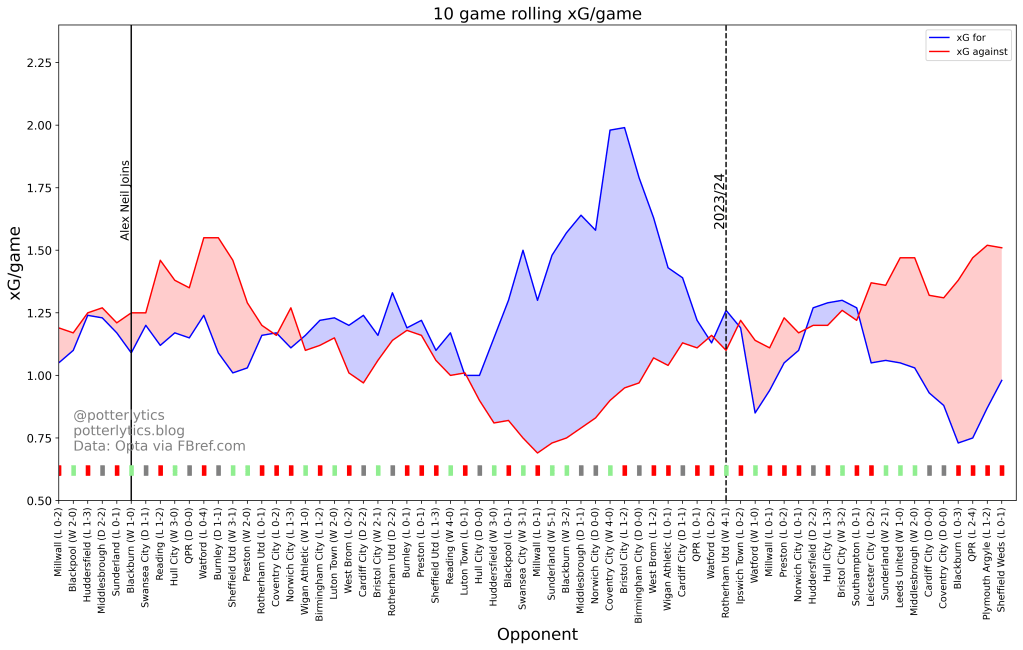
Rolling mean xG per game from previous 7 games since Alex Neil’s sacking in 2023. Blue shaded regions indicate Stoke are creating more than their opponents on average, and red shaded regions indicate the opposite. xG from fbref.com via Opta

Nothing too worrying to look at, on the face of it. After a poor period between the loss at home to Birmingham and the win away at Preston, performances seemed to settle down into what would probably be considered par for the course with Stoke’s squad.

Aside from an absolutely mad performance away in Swansea and a poor effort at Norwich, Stoke actually ended last season in fantastic form, with 5 wins and 3 draws from the last 10 games.

Two very positive performances this season vs Coventry and Plymouth bookended a lacklustre game away at Watford, and a tough loss at home to West Brom in which Koumas twice hit the post when 1v1 with the goalkeeper.

To my view, watching Stoke’s games this season, the key word has been ‘moments’. Setting aside Oxford for the moment, although I do think it followed a similar pattern to many of the other games until the goal, the other 4 league games have been settled largely by one or two key moments either in Stoke’s favour (Baker & Manhoef’s goals) or against them (Koumas misses vs WBA & Johansson’s poor keeping vs Watford).

Erm, well, actually, I think you’ll find’ I hear you say in a nasally voice, pushing your glasses up the bridge of your nose. Yes, don’t worry, I’m not going to pretend everything was simply down to luck, even if I do think the performances were around on-par for what you’d expect with our squad.

Some Kind Of Pun About Schumacher Not Settling Tactically Yet This Season

I’m focusing on league fixtures from this season, but just as a word on the cup games, I think they’ve followed a similar pattern, and I think in particular the Plymouth game was a mirror of Middlesbrough away, with the halves flipped.

But returning to the league, there have been 2 noticeable issues – in my opinion – in how Stoke have performed in their 5 games so far.

As always, this is massively caveated by there only being 5 games, and particularly by huge rotation in the squad with the transfer window only having closed the day prior to the 4th league fixture. I’ll explain later in the piece whether I feel these are issues large enough to justify a sacking, but I bet you can guess my views.

Goals, Yet Again.

The obvious one to start. Stoke have only scored 3 league goals in 5 games. The benefit of Schumacher’s open style, although not quite fully let loose yet, is that freedom in the final 3rd allows your best players to solve their own problems, and generate chances with their individual quality.

But in only 2 games have generated more than 1 expected goals, the 2-1 loss to WBA and the 1-0 win at Home Park. It’s clear from the underlying numbers, and the eye test, that Stoke aren’t a top 6 side right now, but where exactly are they stacking up?

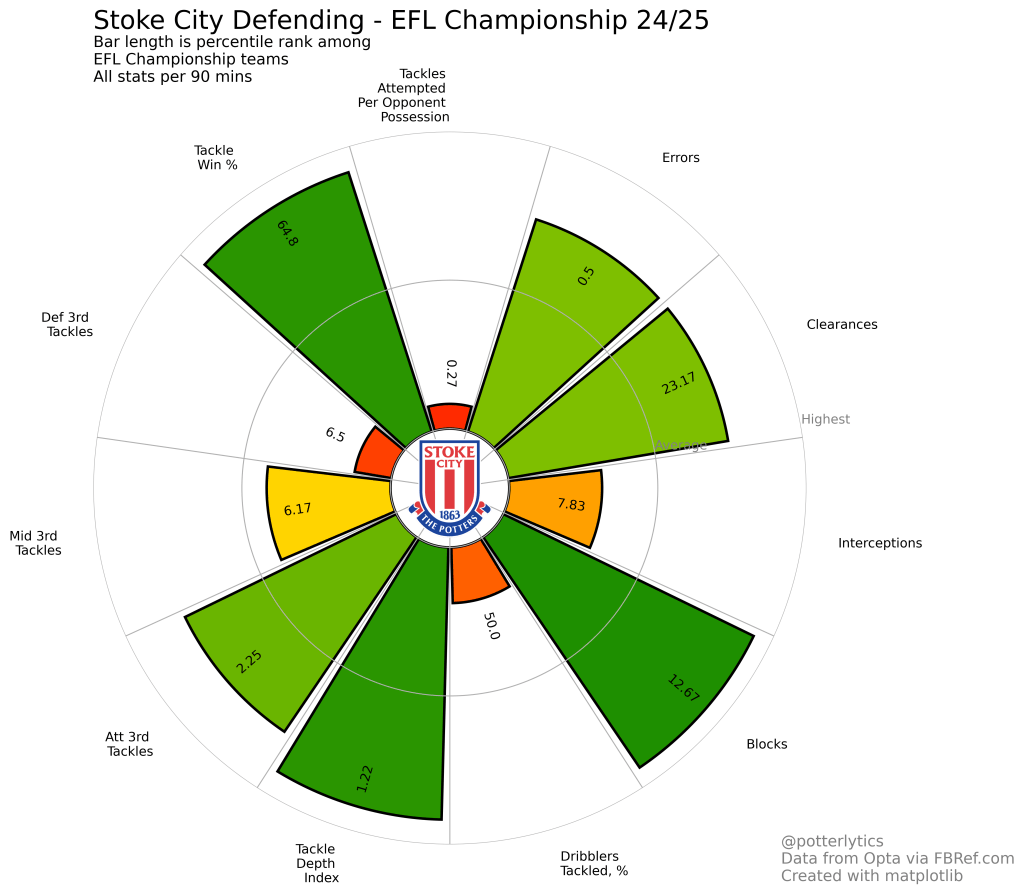
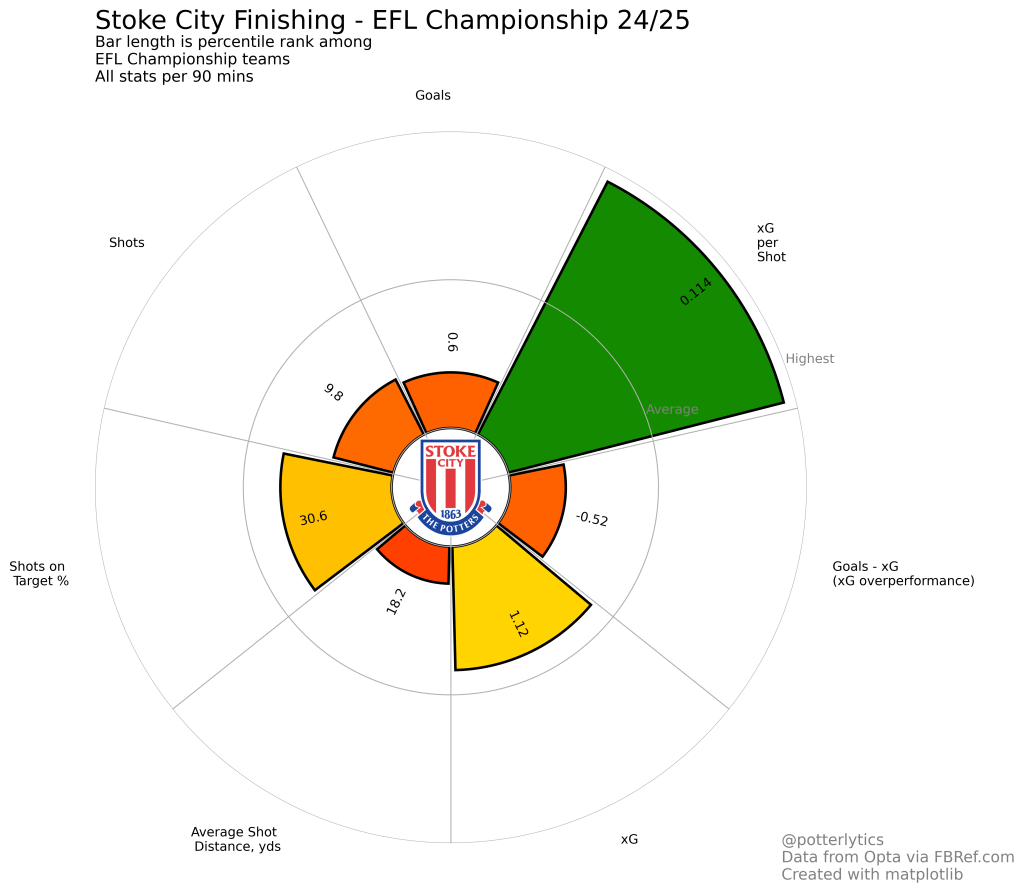
Above we see some ranking radars from their games so far in the league. Again, only 5 games, please take this with a huge bucket of salt.

Glaringly obvious in the right hand plot is the fact Stoke are generating chances at the level of a mid-table side, but doing so from very few shots. This leads to the 2nd highest average chance quality in the league, and the 3rd lowest average distance from goal.

This leads to our 2 major issues in Stoke’s chance creation so far: finishing, and volume.

Firstly, looking into their finishing, Stoke have been underperforming their xG by a huge 0.5xG per game, indicating that the ‘average’ side would have scored 2.5 more goals than Stoke at this point in the season. The bulk of the contributions to this are from chances like those missed against WBA, and often in 1v1 situations.

One might expect that with a young forward line, particularly in Lewis Koumas, who has missed some big opportunities in his exciting start to life at Stoke, this will improve as the season goes on, and the quality of chances Stoke have been able to create is a good sign for the potential of their new forward line.

Secondly, and more of an issue in my opinion, is the volume of chances. 60% of Stoke’s xG has come in the Plymouth and WBA matches, and they’ve created the 5th lowest number of shots in the league.

This doesn’t appear to simply be due to not finding the space to shoot in good positions, although Stoke have had more shots blocked than all but one other team this season in the Championship. The left hand radar above shows that Stoke aren’t managing to get the ball into those dangerous positions (i.e. the final 3rd and the penalty area) at the rate of other sides in the league.

Most glaringly, across all 5 games, Stoke have completed just 2 crosses into the penalty area from open play, both on the opening day of the season against Coventry.

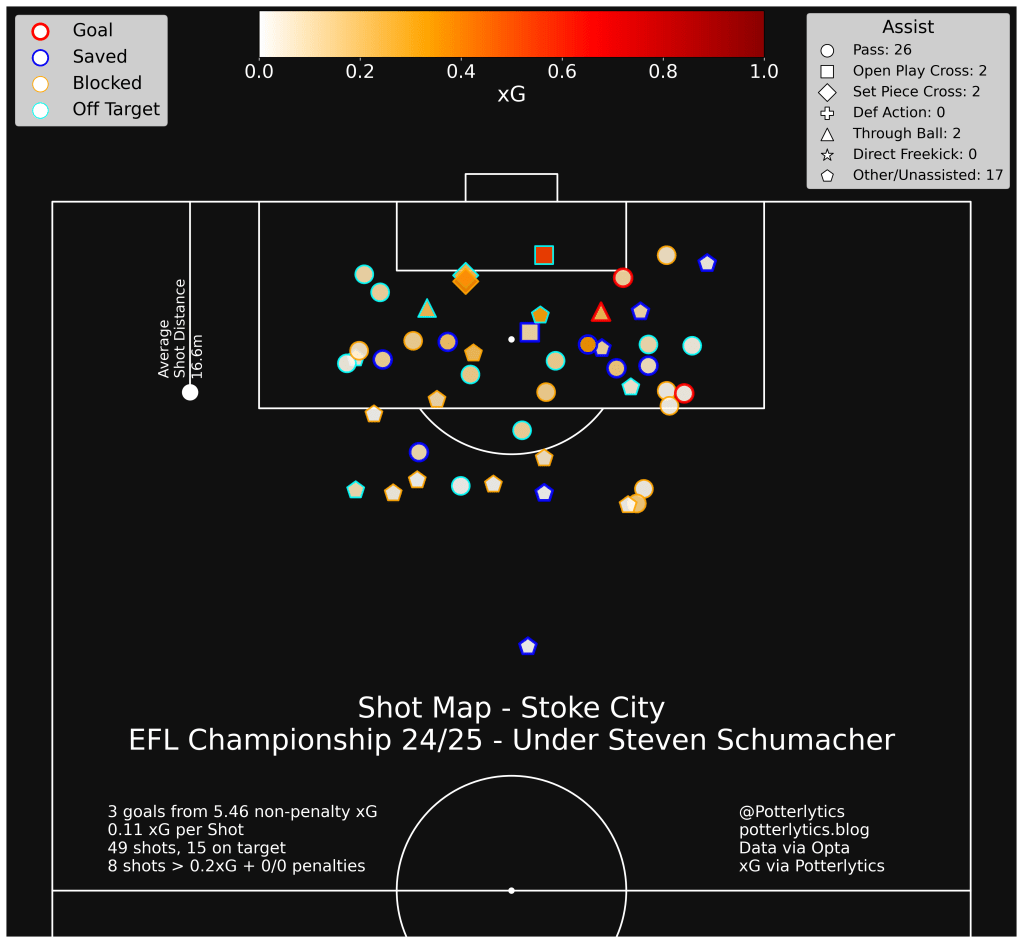
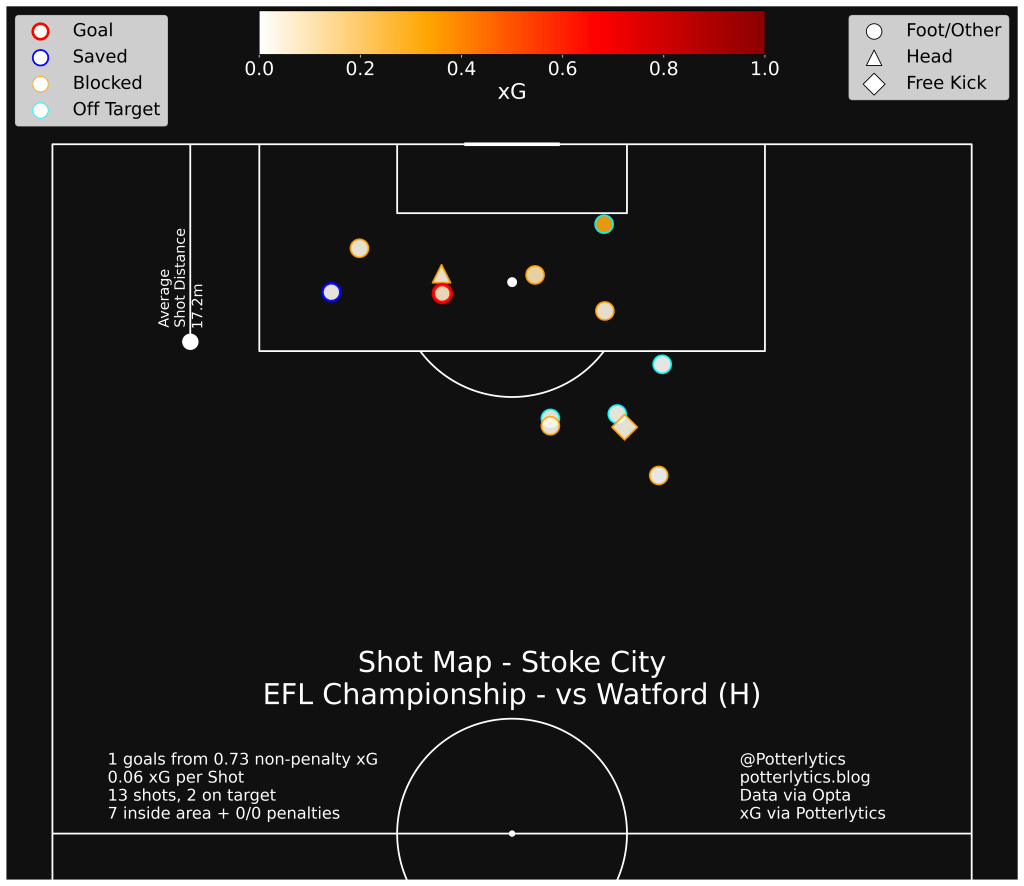
We can see from the above shot map that while stoke have created some high-value chances, they’re pretty sparse in the most dangerous areas, i.e. centrally and ahead of the penalty spot.

The freedom for the front line, alongside their undoubted quality, has led to Stoke creating good chances from the times they do get into good areas (hence the high xG per xA, i.e creating high value chances from each average pass).

This indicates to me that the issue has been much more in getting through an opposition press when the game isn’t so open as it was against WBA and Plymouth, but also that there is one hell of a front line there in terms of chance creation when it does get the ball.

Very Mid (Am I Doing Gen-Z Words Right?)

From my view this season, another issue has been in Stoke’s ability to win the ball back outside of their main pressing/out-of-possession plan.

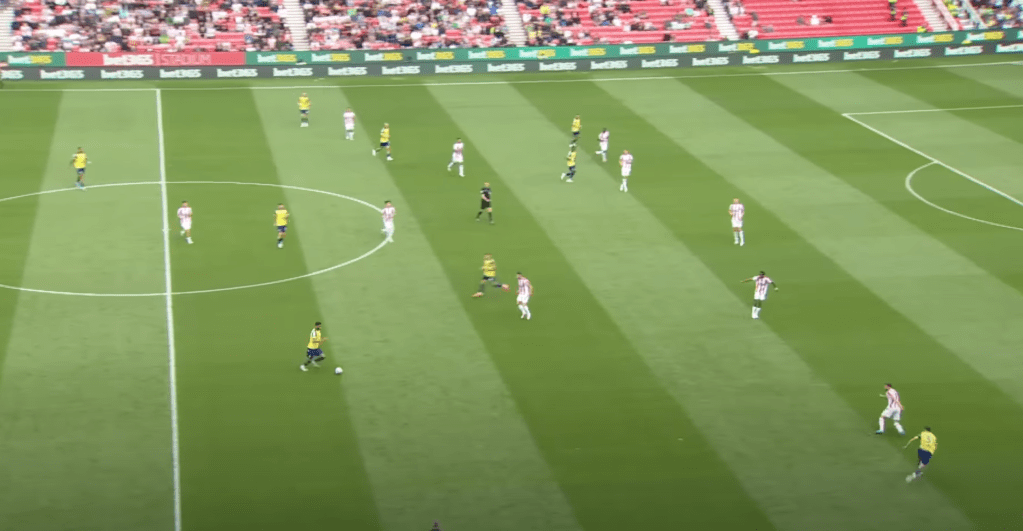
The main plan appeared to be a compact and narrow mid block, as shown by this (blurry, sorry) still from the West Brom game, which resulted in Maja’s goal.

Aside from Lynden Gooch deep on the left hand side of Stoke’s shape, the set-up is essentially how they’ve looked to defend off the ball in every game so far, Plymouth’s double-10/single-pivot aside.

A very narrow back 4, and a compact midfield 3 in front, with the wide players coming inside to make it difficult to play through central areas.

You might wonder why Gooch is dropping into left wing back here, and my read of this is that after a few incursions on the left hand side in the first 30 minutes, Gooch was worried enough to drop in and try to cover the space that winger Fellows was attacking

As an aside, it didn’t work…

But whilst this shape is a good way to protect the centre of the pitch, and Stoke defended their box pretty well when opponents tried to attack the wide areas (possibly Watford aside), something Stoke haven’t managed to do this season is find an out-of-possession plan that wins the ball back when they’re losing.

Particularly in that compact midfield shape of the 4-2-3-1, where the trigger is to push opponents wide and remain combative in the middle, Stoke have struggled to stop the gaps when they have to open up and try to win it back.

Often games have seen midfielders doing their Joe Allen impressions (sorry for the drive-by, Joe) and pressing the ball alone or out of shape, leaving huge spaces for opponents to exploit.

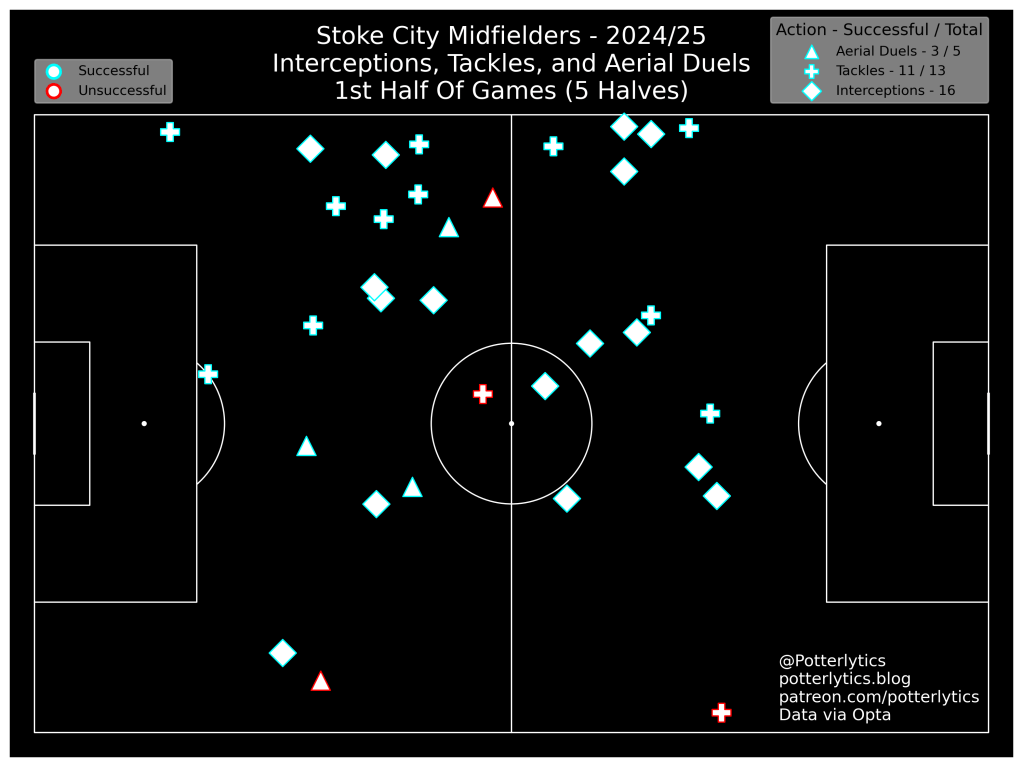
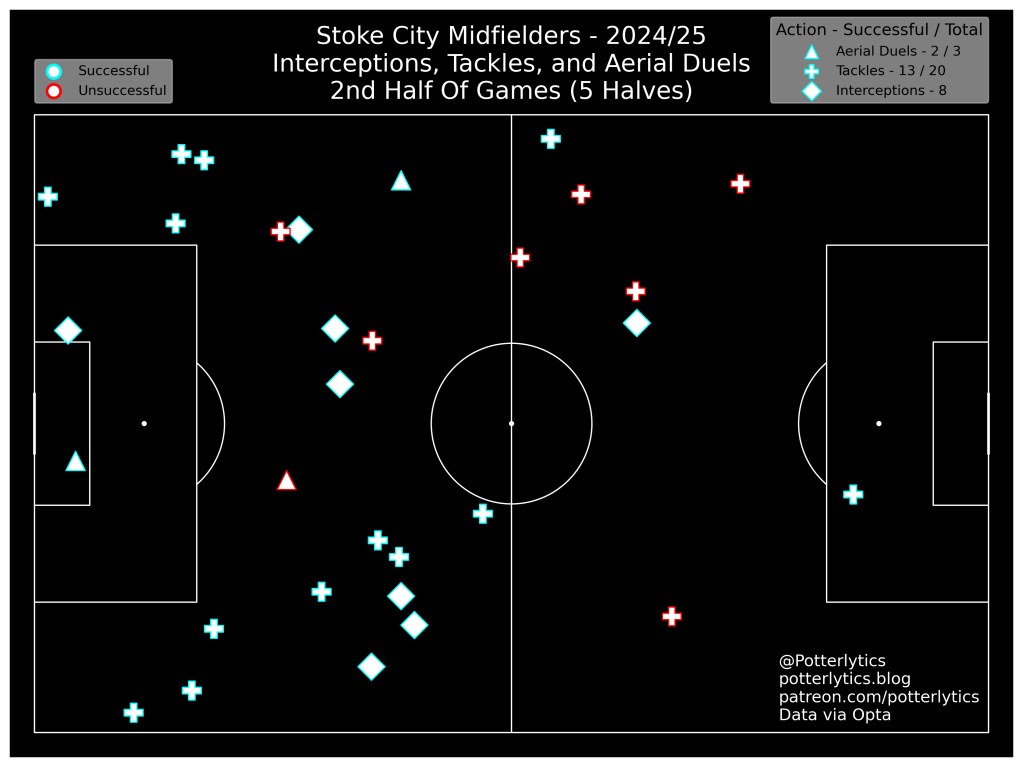
We can see this below in the defensive actions of Stoke’s midfielders from the first half and the second half of games.

The obvious caveat of Stoke defending more in the second half when in the lead are alleviated by the fact Stoke have only actually been in the lead for 20 minutes this season, and in 3 of their 5 games have been behind for either the entire second half or more than 43 minutes of it, whilst they were level in 33 and 35 minutes of the other 2 games respectively.

But what we do see here is that Stoke’s midfielders tended to do two things between the first and second half:

Firstly: Their central midfielders made double the number of interceptions in the first half compared to the second, and their success rate in tackles went from 85% in the first half to 65% in the second, despite making more attempts to tackle their opponents.

Secondly: Although the number of defensive actions was fairly consistent (34 to 31), the number of those actions taking place in the opponents half dropped from 42% to 26% from the first to second half. On top of that, only 3 of those defensive actions in the opponent’s half were successful.

Combining this data with the footage (contextless data is always dangerous, remember!), you see that this is pointing towards exactly the worry above.

Stoke’s midfielders are being stretched as they search for the ball and press out of shape, so we end up with fewer defensive actions in the opposition’s half as they’re played around/through. We also end up a massive decrease in success rates in those actions as more players press on their own, and end up overloaded due to the lack of shape.

Was It Worth It? My Own Daft Conclusions

So the question becomes, after 1800 words of nonsense, was that enough to sack Schumacher, just 9 months in?

In a word, for me, no.

It’s clear this was Jon Walters’ decision, and he’s been keen to put his name to it, emphasising that these are the key decisions that he’s here to make as Sporting Director. ‘Brave’, ‘ballsy’, and many other words have been used to describe this hell of a call from the Stoke fans’ hero.

The issues I described were certainly noticeable in Stoke’s games so far, and not even the most optimistic fan can say they were entirely happy with the performances, but it felt there were signs of improvement, as Schumacher stated in his statement to the LMA: ‘It was clear that my vision of selecting young, hungry and energetic players to represent this great club was beginning to come to fruition’.

So what the hell is going on? I’ve kept you too long already, but let’s consider, briefly, the changes we’re seeing at Stoke, and what they might represent in terms of the long-term plans for the club.

Plus Ça Change

From my point of view, there’s a distinct lack of change on a larger scale with this particular week of excitement, despite constant rallying calls of ‘we’re doing things differently this time’ from the club.

We were (we being me and a set of other nerds who are too excited by ‘the likes of Brentford’) keen to see Stoke shift their manager-led structure into something which better lends itself to longevity and continuity in the modern game. But what Stoke appear to have done is misunderstand the benefits of that, instead simply shifting that power from one person to another, and still refusing to have a club-wide process.

The huge swings in playing style of the first 4 years in the Championship, from cautious controlled possession under Rowett, to blood-and-thunder verticality under Jones, to patient, wide build up under O’Neill, and finally to even more direct, tactically strict play under Neil, were joined by big swings in the backrooms too.

‘Strong and stable’

I can’t escape the feeling that it’s a club without much, if any, identity. Don’t get me wrong, I don’t mean the kind of identity in terms of ‘lump it long and get on the end of it’, but in terms of the processes the club wants to follow, the ethos of how it wants to move forward, and a long-term plan that involves development in all sections of the club; men, women, academy and community.

That doesn’t appear to be happening here at Stoke, or at least, those things seem to change completely at least once a season.

The transition away from a club who gave complete and emperor-like power to a manager, to a club with a Head Coach, focused on coaching and tactical work on the pitch, was something that felt like a positive move, and it certainly is an upgrade on the previous structure.

But Stoke are still a club who relies on a unicorn at the top of the club. Jon Walters may not be the manager of Stoke City, but he is taking up the vast majority of the role that previous bosses have been given, and he has already begun reshaping the club in his image.

I am a huge fan of Jon Walters, and I loved him as a Stoke player, but he is not coming into a club that has a well-defined structure that needs to evolve or tweak its running behind the scenes. He’s a brand new Sporting Director, with very little experience, being given the keys to the entire club and near-unlimited power to set the direction on his own.

This is not expanding on what was done before, this is another revolution in a club that has been ravaged by them for almost a decade now.

I hope beyond hope that this works, but I come back to an excellent article by Tim Keech on alignment within football clubs, and I worry that we still haven’t got this right.

The key focus here is that all segments of the club are aligned, and in alphabetical order. Whilst I’m keen to see Walters’ ideas about the club succeed, there is both a chance that they don’t, and he moves on, or that they do, and he moves on. Either way, he’s not here forever, barring some incredible set of circumstances à la Groundhog Day.

Most importantly, when he does move on, I don’t believe that Stoke have a consistent set of principles that bind everyone from board level downwards, and that will remain beyond his tenure.

My gut instinct, from both this week’s saga and the past 6 years of promised change, is that this is a club and board who are searching to find the ‘right’ or ‘best’ way to run the club, and expect that at some point they’ll find the ‘best’ person to do so, and this will all finally click together.

Whilst it might, particularly with Stoke’s hefty wage budget (even with P&S rules), there are long term issues in having to have a complete revolution whenever one person moves on. Not only that, but not having the commitment to a process through the club, and the obsession with being generically ‘good’, means it’s far too easy to conclude that a set of principles have now failed, and should be discarded for a complete root-and-branch reform, as we’ve seen so many times since 2018.

As Tim says, it is an easy fix. The difference between allowing one person to be emperor of the club, and developing a club-wide plan and process for everyone to get behind isn’t a million miles in reality, especially with the stability of having the owners Stoke have.

For us to have come down, melted our way through so many club structures, club philosophies, and processes, and still only have finished 14th and below, is the worst kind of achievement.

For my pessimistic side, it can feel inevitable that this may end as every other revolution has ended, first with a sacked Head Coach and a new style of play, then with a sacked Sporting Director and promises of a ‘new approach’ and ‘lessons learned’.

But just how many lessons is it possible to learn? How many individual people do we give complete control of the club’s footballing direction before we find success? What even is success for this club, because apparently mid table after 5 games isn’t good enough? If we even do find it, what happens when the right people leave? Do the dice roll again?

I hope beyond hope that Pèlach is given time, and that whoever follows him into the Head Coach role, or Walters into the Sporting Director role, are personnel who can provide a continuity to the club.

As a famous Alan once said:

“I evolve, but I don’t revolve

Thanks to any and all readers, and please feel free to comment and follow on Twitter at @potterlytics. If you want to hear myself and Lucas Yeomans discussing each Stoke game alongside some exciting interviews, head over to the Cold Wet Tuesday Night Podcast at BBC Sounds.

Should you wish to donate to help with the running costs of the site, and the data subscriptions we use, please feel free to visit our donations page here or subscribe to the Patreon linked above. Any and all help is very much appreciated!

George
Everything Is Going To Be Totally Fine Forever – Stoke 1-0 Coventry

Well, that was an unexpectedly lovely Saturday lunchtime out, wasn’t it?

In my customary “I promise I’m going to write more stuff” first piece of the season, let’s take a deep-ish dive into Stoke’s opening day victory against Coventry, and in particular how they solved one of the issues we saw against AZ Alkmaar last week, the build up play.

Risk = Fun

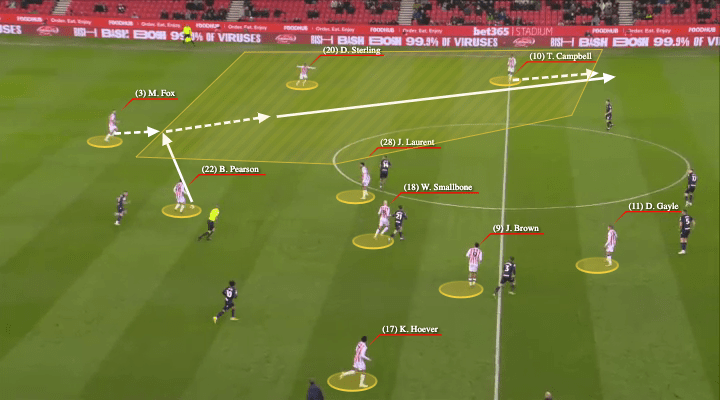
First up, something I’d been critical of in the Alkmaar game was the willingness of Stoke players to take risky passes into the midfield in the build up.

In large part thanks to AZ Alkmaar’s compact and narrow shape, Stoke were forced into playing wide into full backs in the build-up. This meant that Stoke ended up trapped on one side of the pitch as AZ narrowed off towards the ball.

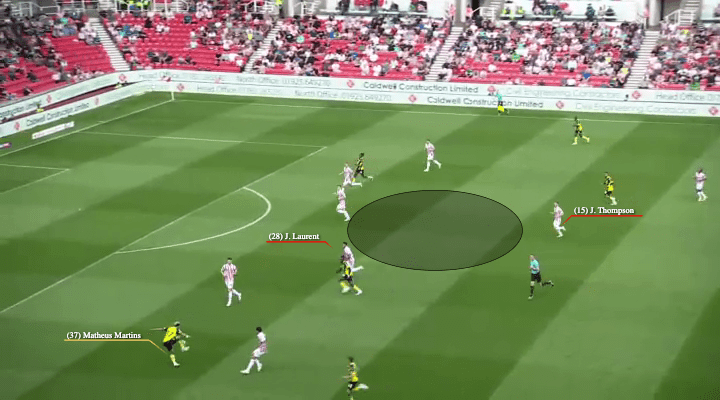
Although the highlights of the game are pretty sparse (thanks Stoke), and so I can’t get a live image of this, here’s a quick example to explain what I mean:

Not being a Europa league opposition aside, Coventry weren’t able to set the same trap for Stoke, particularly in the first half, and we saw a much wider range of options available in the build up.

Alongside more midfield movement and better positioning to find space both between lines and in between centre mids and wide players, we also saw a significant improvement in the willingness to attempt passes through the lines from defence and midfield.

One Step Forwards, Fewer Steps Sideways Or Backwards

Most important, to me, is that these were the first passes our players looked for during the build phase. Wilmot and Gibson in particular were consistently able to pick out players ahead of them when the pass was on, and although recycling possession is still crucial, the balance of finding gaps and keeping the ball was much better through the first half.

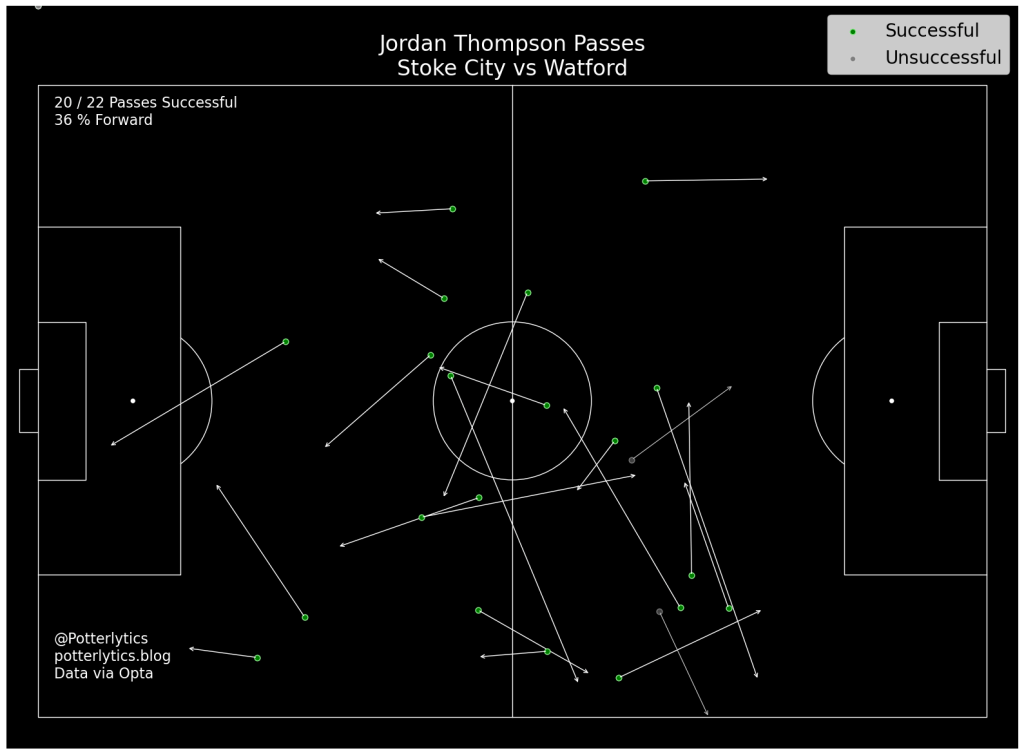
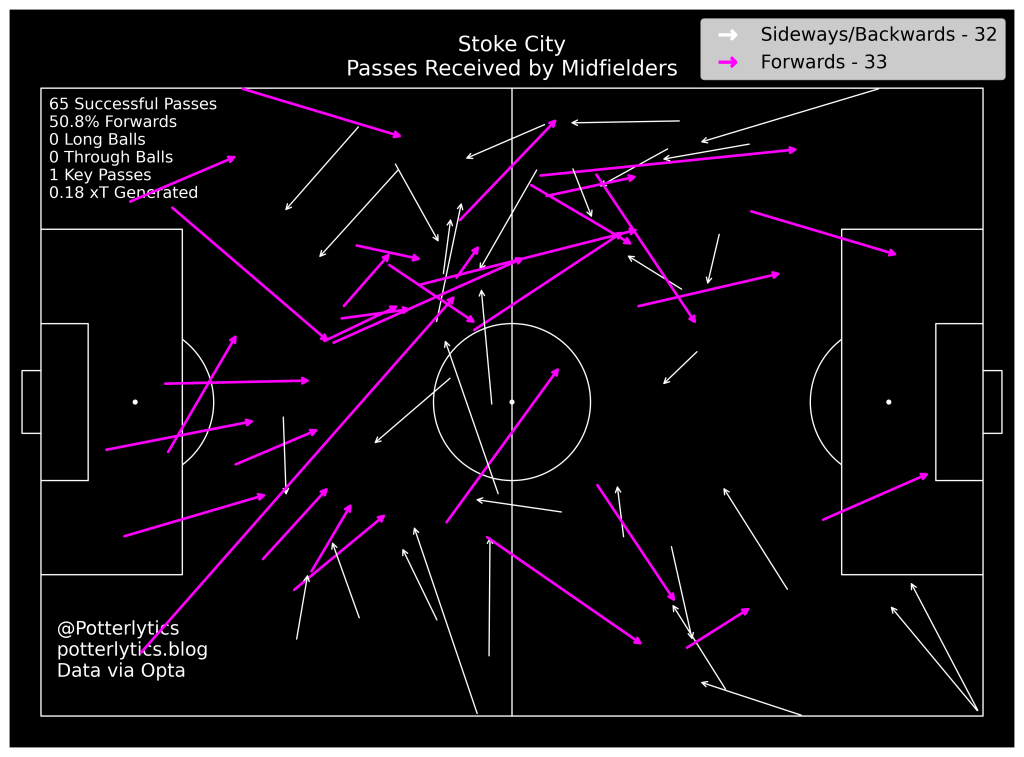
Shown above are the successful passes from centre halves, and received by central midfielders, in the game.

On the left, we can see that over 40% of the passes from centre halves were forward, and we can see that possession recycling was generally either back to the keeper (indicating pressure on the ball), or into wider areas in an attempt to progress.

We also see a significant number of passes into the middle of the pitch, playing inside to midfielders or forwards dropping into half spaces and between the opposition lines. And just a smattering of those oh-so-lovely diagonals from Wilmot out to the wide areas.

On the right we have the other side of the coin. Laurent, Thompson and Burger, all consistently taking up positions to receive the ball from deeper areas, with forward passes making up more than 50% of the successful attempts to get them on the ball.

And as a slight aside, we also see that a large proportion of those passes are made inside the pitch to the centre mids. We didn’t see as much of the centre mids dropping into full back areas as the end of last season, although I think that may be a result of the space that was available between lines in this match in the first half, alongside the lack of control Stoke had in the second half to build a longer possession phase.

What about the actual game?

But who cares about graphs and plots, right? (Me, I do) Let’s take a look at some much more fun examples of this impressive line breaking through the game.

Click on the images to zoom in.

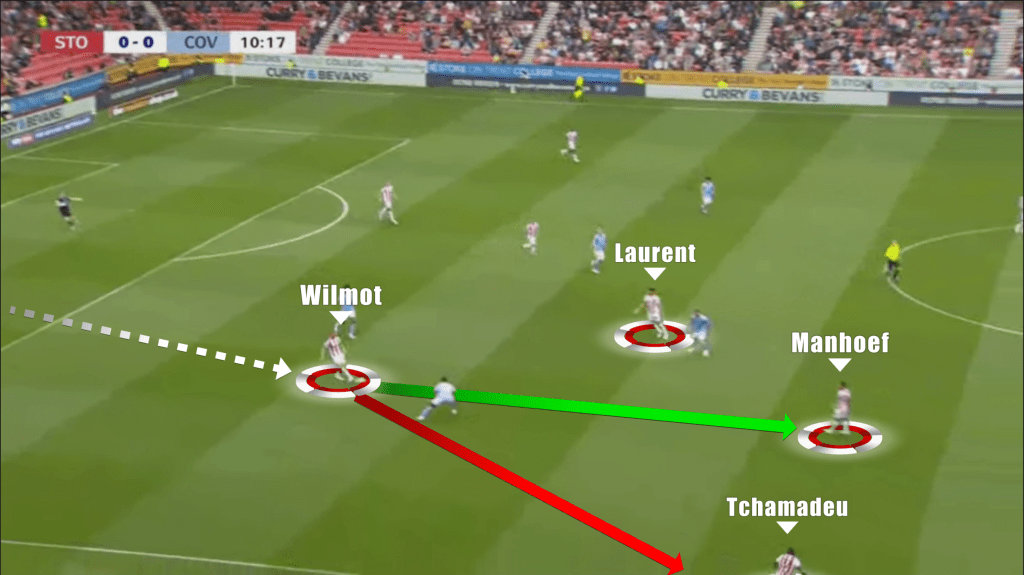
Here we have an early goal kick from the Potters. Gibson plays it short to Johansson, who plays it into Wilmot just ahead of the 6 yard box. As Coventry sit off the defender, largely aiming to cut off passes between centre backs in the same manner as Troy Parrot for AZ Alkmaar, Wilmot takes the chance to drive forward with the ball into the space.

Several times through pre-season, the player on the ball would see that Laurent is marked, and Manhoef would be on the front line, unable to receive the pass. In that case, Wilmot would’ve played the red arrow pass out to Tchamadeu, where he may have been trapped in the wide area with only a marked Manhoef ahead.

Instead, we see Manhoef drop between the lines as the Coventry wide player presses Wilmot. This means Tchamadeu can bomb on down the wing, occupying the opposing full back. As Wilmot plays the pass into Manhoef, the first line of the press is broken, and he can turn with the ball, driving into the opposition half.

Fan-Tez-Stick (Sorry)

And it wasn’t solely the midfield dropping in to make this possible. We also saw the introduction of 18 year old Emre Tezgel in his first league start for Stoke, and although he had just the one major chance (two if Manhoef hadn’t been so determined to get a shot away when Tezgel arguably had the better positioning), he showed maturity and a reading of the game that puts him well in contention to start next Saturday’s game.

Emre Tezgel’s actions vs Coventry.

Although it may seem like he wasn’t hugely involved, he did create a big chance from the header, and set up a shot for Manhoef with some battling play down the wing. Alongside that, those actions in deeper areas were a show of his quality with back to goal, and his ability to drop into space to receive, another helping hand in that build up.

Click on the images to zoom in.

Here we see Stoke work a ball out to the full back, but in a very different manner to the Alkmaar game, and with a much more positive outcome.

Simms continues to try and stop the pass between centre halves, with the midfield behind him in a compact block on the ball side of the pitch. The pass into the 6 (Thompson in this case) isn’t on, but movement on the forward line from Tezgel, dropping in from a high position, allows Gibson to play a pass through the block.

Tezgel lays off a lovely ball back to Laurent, who can now find Tchamadeu on the other side of the pitch, in significant space, where he can drive forward and lay in Manhoef behind the Coventry defence.

We saw in that first half, a significant improvement in how Stoke switch the ball from one side to the other, shifting Coventry’s block from side to side quickly in order to find space.

Not only that, but there was even more variation in how they managed to do it.

Ben’s Back, Baby

And then, finally, we saw the return of the lovely diagonals.

Click on the images to zoom in.

Here we see a slightly different variation, but the principles of playing forward remain. Initially, Johansson plays the pass into Laurent in the holding role, instead of the usual ball into wider centre backs.

Coventry dropped off and allowed Stoke to keep it in these areas (something they shifted after half time, which led to the change in momentum). As Laurent turns, he has a compact block of Coventry players in front of him, so now plays the wide pass into Wilmot, who drives again towards halfway.

Again, the pass to Tchamadeu would be on, but Wilmot attempts the riskier, more fun option of the raking switch across to Gooch, who can run at the opposing full back as they shift across.

In that last frame we can see another aspect of the build, with Burger and Tezgel both occupying defenders on the last line, trying to pin the Coventry defensive line deeper in the pitch.

I’m well aware the principles of playing forward and trying to break lines are almost universal, but I am still delighted to see Stoke take those risks in games consistently, particularly after the AZ Alkmaar friendly.

Long may it continue, onto Tuesday!

Thanks to any and all readers, and please feel free to comment and follow on Twitter at @potterlytics or watch out for the new long-form video content at Patreon.com/potterlytics. If you want to hear myself and Lucas Yeomans discussing each Stoke game alongside some exciting interviews, head over to the new Cold Wet Tuesday Night Podcast at BBC Sounds.

Should you wish to donate to help with the running costs of the site, and the data subscriptions we use, please feel free to visit our donations page here or subscribe to the Patreon linked above. Any and all help is very much appreciated!

George
‘Ambitious Plans’ – Life in the 3rd Tier of Women’s Football

Credit: Jayde Chamberlain @jaydecphotos

It’s a midweek evening in September. Stoke City Women are looking to follow up their cup victory at Northampton Town, and a 4-0 victory over Huddersfield with another win against one of the Women’s National League’s most intriguing underdog stories, Liverpool Feds.

Feds have been a revelation in recent years, following up their promotion campaign in 2021/22 with a fantastically fought relegation battle in 2022/23, eventually staying up by a huge 8 point gap between themselves and the bottom 2.

They are one of only 3 sides in the 3rd tier that are not affiliated with a fully professional men’s team, but what they lack in financial resources and infrastructure, they make up for with tactical nous and fighting spirit.

Stoke have been through somewhat of a rebuild since the summer break, with their first ever full time Head Coach, Marie Hourihan, bringing in a new batch of 13 signings at the start of the season (although one of those signings has since left the club for a rival 3rd tier side, with another leaving on loan), and 2 more had been added by the evening of the Feds match. The previous home game, the aforementioned 4-0 victory, was played on the show pitch at Clayton Wood training ground, as a nod to the intended improvements to the infrastructure used by the women’s team this season.

The much-touted move to semi-pro, announced on International Women’s Day in 2023, signified progress in the way the club views the women’s side of Stoke City. It was an objectively positive and exciting move, although the semi-pro nature had effectively been in place since the start of the 2022/23 season, and is more common in both the Northern and Southern WNL Premier Divisions than the press release and media coverage made out.

On this particular evening, however, Stoke’s Women are back at their traditional home ground at Norton. A week before the semi-pro announcement, Norton was subject to Twitter furore as opposition players complained at the state of the changing rooms, with damp and mould adorning the walls and large parts of the stadium packed with construction detritus. These issues were fixed within a month or so, and the ground is still the most frequented home of the women’s team.

On their return for pre-season training in the Summer, Stoke players attended a meeting in which upper management declared that they’d be playing ‘the majority of their games’ away from Norton this season. Despite the certainty of this meeting, at time of writing only 2 of their 9 scheduled home games have been at one of their other two homes, Clayton Wood and the bet365 stadium.

At this point in the story of our article, I am still working as an analyst for Stoke’s Women’s team, and as I arrive at Norton I notice that the Head Coach is waiting outside the front gates to the ground. I lug some bags of kit out of my car boot onto the ground next to the footballs and home kits that the Head Coach drove in. We’ve no team bus for home games, nor a kit manager, so staff tend to split the gear between their cars after the last training session. This time I’ve got away with a couple of bags of away kits and bibs, the real short straw has fallen to our Physio, who has about 80 litres of water on his back seat in plastic bottles.

As I finish piling the kit bags up, the Head Coach puts the phone down and tells me that the staff at Norton, and the ground’s security guard, didn’t know we had a game tonight. An omen that doesn’t bode well for the match ahead but doesn’t really surprise either of us.

The other staff members arrive with the rest of the kit in their cars. There are 5 of us for today’s match: the Head Coach, myself as the Analyst, the Physio, the Goalkeeper Coach, and the General Manager. This is a pretty good turnout, we’re only missing the S&C Coach and the First Team Coach from the full staff list of the time.

Luckily, by 6pm, about 10 minutes before the time we’d asked players to arrive, the ground has decided to allow us to play, and we’ve been let in to set up. Myself and 3 other staff set up the dressing room, placing kit on hooks and sellotaping A4 print-outs of various bits of pre-match analysis to the doors by the toilets, while the Head Coach sets up cones and footballs for the warm-up.

As Feds walk into their dressing room, there are remarks claiming that some Stoke players are only at the club for the money. A comment which irks many of our players, as a good portion of them still hadn’t actually been paid at this point, and the wages they do get are far from the highest paid in the division.

The walk out onto the pitch for the warm up provides a stark contrast to the previous match’s carpeted pitch at Clayton Wood. ‘F*cking hell is this where their money’s going?’ says one opposition player, as they jog out on the Norton pitch.

It’s hard to argue. Half-inch holes are spread across the entire pitch for aeration, the rock hard ground makes even moulded football boots feel like walking on a nail board, and a plume of sand flies into the air with every kick of the ball.

The dugout roof sags in the middle, sitting at a height just tall enough to fit most players, but anyone over 6 feet tall has to sit towards the sides in order to fit. A miscued pass flies over the dugout and into a neighbouring garden, unfortunately that’s the end of that, I hope it wasn’t a match ball.

Throughout this, myself and the physio are aiding with the warmup, occasionally feeding passes into a possession game, and occasionally rounding up the loose passes towards the goal or halfway line. With the last session of the warm up, we get our call to action. As the Head Coach and Goalkeeping Coach play a game of keep-away with the starting back 4, we’re are called in to take the finishing session.

I think this is probably the overriding image of women’s football at this level for me. People have to muck in and help in any way they can, or things simply don’t get done. It’s so at odds with the image I had of a big, rich, professional club in Stoke City that it sticks in my mind. With only 4 or 5 members of staff at each game, the sight of an analyst and a physio pressuring semi-professional footballers as they turn and take a shot was always a strange one for me, but it was necessary given our lack of options.

I’ve no doubt we’re not the only team where this kind of thing happens, and although I feel our team was smaller than many, staffing is generally sparse at games for most sides, besides the dozens-large entourage of teams like Wolves and Newcastle.

Just before the game begins, I take out my phone and set up the Veo camera, an automated 180 degree camera system that uses AI to follow the action, and used by almost all teams at this level to record games in lieu of an analysis department or dedicated camera operator. As far as I have seen, only Newcastle, Wolves and Huddersfield have any other form of video recording. The referee blows the whistle and the sand begins to fly as we kick off.

Stoke captain Ellie Leek in action against Feds. Credit: Jayde Chamberlain @jaydecphotos

About 100 people have turned up to watch. It always struck me as a great shame that so few could make it to these matches. Tickets are free for season ticket holders of the men’s team, but despite talk from the club of improving the connection between fans and the women’s team, there’s often very little in the way of promotion or advertisement of games, and almost no earnest attempt to create a buzz around the team aside from the grand PR gestures like the semi-pro announcement.

Prior to the most recent few weekends, the social media was often left in the hands of match day staff. Lineups, live tweeting, and any other content was often produced by people with no media qualifications or experience, who should have been working on the game in front of them or organising other parts of the match day rather than having to deal with posting on social media.

Three weekends ago at time of writing, Stoke City Women took on title contenders Nottingham Forest at the bet365, their big return to the club’s stadium, and a huge occasion worthy of fanfare and excitement. The advertising for this over the preceding month, (admittedly only as I saw, although I am a fairly avid follower of all Stoke accounts) consisted of 4 tweets from the women’s twitter account, 2 from the club’s main twitter account, all of the same photo and press release link combination, a pre-match video interview with the Head Coach, and a video interview with 2 players.

Contrast this with the accounts of other teams at a similar or lower level. Consistent social media presence with players taking part in quizzes, games, and developing a relationship with the fans creates a feeling that fans know who they are watching. Just in the last week as I’m writing this, Twitter saw Christmas tree decoration with Wrexham players, Liverpool Feds having a fun little poll for the best Christmas creation made of football gear by their players at training, Derby County Women advertising their player’s appearance on local radio, and the final in a short series of Vodcast-style episodes chatting to players from the team, and simple, but positive and engaging tweets showing player celebrations from 4th-tier Peterborough United Women.

All of Stoke’s tweets from the previous 7 days at time of writing are shown below.

Interestingly I can’t find any evidence on Stoke’s twitter, website, or even the FA FullTime site saying that this County Cup match was happening before it was called off.

The connection between team and fans, aside from a hardcore few who follow regularly of their own accord (big shout out to the lovely family with the fantastically decorated cardboard sign who follow most games), is barely given space or reason to develop at all.

I would like to emphasise that this issue is not something to blame the media team for, as we’ve seen this season that they do brilliant work with the men’s side and academy, greatly improving the offering to fans looking for online content. The issue here is the club rarely making use of these great resources for the women’s team, and not finding room for new resources despite the big budget they touted in the press. These are common themes throughout this article.

Maybe you see this as harsh on the club and maybe even ungrateful, but I ask, how many of the fans who attend the men’s game against Millwall this Saturday could name a single player for the women’s team? How many could name the Head Coach? How many could tell you what league the women are in or give a vague idea of their position in that league? I have a feeling that the answer to all of those questions is not a huge number. To build a relationship with the fanbase, you have to show people what, and who, they’re being asked to support. Those who do see it on matchdays get an insight into a fantastic group of people that I’m proud to have play for the club I support.

On the day of the women’s bet365 return, snow and cold weather made the stadium a tough place to get to for many, and no doubt that affected attendances. Despite that, I’m certain that should you ask the Stoke fans attending the men’s game in the week preceding or following that match vs Nottingham Forest, a very large fraction of them would have no idea that it even took place.

I have often seen arguments that funding Stoke’s women’s team is pointless because it gets low attendances, but how are attendances meant to improve if there is no improvement in the coverage and promotion of the team? There’s plenty of heart, skill, desire and quality in that team for anyone to get behind, if they only were given the hype and promotion they deserve.

It’s hard to find any member of the Women’s team who truly believes that the ‘One Club, One Stoke’ motto put in place this season has any real meaning.

‘One Club. One Stoke.’ Players’ match shorts hadn’t arrived at this point so they were photographed half wearing training kit. Credit: Stoke City FC

We return to the game at hand against Feds, as Stoke make a positive start with two shots saved from new signings Puddefoot and Stamps.

The dugouts of the women’s third tier are an interesting place. Just the week before, the opposition dugout had been shouting abuse at a Stoke coach for passing the ball back slowly.

‘Give the f*cking ball back, n*bhead’ spouts the opponent

‘F*ck off mate, I’ve just passed it back to her’ replies our coach.

‘Gentlemen, will you stop with the f*cking foul language’ says the linesman on our side.

This time the referee is under fire. He calls a player over and tells her to shut up while making a ‘zip it’ motion with his hands. Neither bench thinks that is acceptable, but the ref’s word goes, and the 10 minute sin-bin for dissent makes it difficult to argue.

The linesman agrees with his refereeing colleague, and points an incredible comment at our coach.

‘If you think that’s a foul then I’m sorry, but you just don’t understand football, mate.’

Iconic.

A week later, the professionalism sheen would be peeled back again by a referee, as 12 minutes into the game against Wolves a timeout is called. The ref has just noticed that there are no corner flags on the corners. The laughter in the dugout is half out of genuine humour and half out of embarrassment.

The game against Feds is a tough fight. A scrappy match where the difficult pitch played into the battling nature of the away side. Their keeper had been injured in the warm-up, and the cost and effort of travelling means that they’ll have to make do with their centre half going in net for the game. Only having 5 subs makes bringing an extra keeper even less worthwhile.

She’s done admirably so far, at one point trapping a shot under her foot as if it were a pass, a move that draws a reaction of disbelief and embarrassment from those of us on the Stoke coaching staff. It’s mentioned at half time as a point of improvement, and we move onto the second half with 4 immediate substitutions.

Feds end up having the best of the battle, and despite a quality free kick from Shannon Stamps and two more goals for the on-fire Heidi Logan, they take the 3 points back to Merseyside with a 5-3 win.

Stoke City forward and top scorer Heidi Logan, on loan from Charlton Athletic, in action for the Potters. Credit: Jayde Chamberlain @jaydecphotos

The tough night doesn’t end there, however. After an air clear in the dressing room, the food comes out. As whoever was organising the food at the club had messed up, the General Manager has had to rush and buy 50 wraps from Tesco so that everyone has enough to eat.

A lot of it gets left behind as players are desperate to get back home and sleep off their anger and disappointment before work tomorrow. A 10pm full-time finish means getting home at midnight at best for most of the players, and the adrenaline of playing football, alongside the gruelling effort they’ve put in for up to 90 minutes, leads to many saying they barely sleep at all.

When you’re a part time footballer who works elsewhere for their living, these nights are tough work.

The staff stay behind and pack up the kit, footballs, and bibs into our cars again, ready to be returned to the training ground before the next training session, and stand by our cars for a chat about how to put right the wrongs of the game. Formation changes, personnel changes, bemoaning issues with logistics and planning the week ahead are common conversations in these post-match chats.

The outward lines will be the same, ‘we’re working hard to push this club as high as it can go’, and the people on the ground really are doing that. The players come from around the country, some from as far as London and Essex, to train 3 times a week and play up to twice a week, despite having full time jobs in the day. They sit through analysis, power through gym work, and work through on-pitch training sessions before driving home again and going back to their normal lives.

The majority of staff work alongside full-time jobs too, with many working in the Academy set-up, including the Head Coach, and others with the club as interns for their full-time studies. There is always a new cliff for members of the women’s team to jump off, and barely enough materials to build the wings as they fall.

One Team. Credit: Johnathan Stack

I’m trying my best to avoid this seeming like any kind of sob story or being a particular criticism of any individual. That would be neither fair nor truthful of me. I’m aware that there’s an obvious move in calling this whole article sour grapes given my connection to the club, but in my mind this is simply to show people what work is like for people at this level of women’s football.

To make known the contradiction between the perceived glamour and riches of arguably the best-funded club in the EFL Championship, the resources and ‘progress’ promised in PR campaigns planned in meeting rooms of suited higher-ups, and the day-to-day efforts of the people actually trying to make that progress happen.

I implore everyone reading this who can do so, to get themselves down to the next women’s game they can attend. The players put their heart and soul into every game, it kills them when they lose, and it feels like relief beyond imagination when they win. The staff are consistently working over their hours, for wages well below that deserved by their qualifications and efforts, lugging kit to games and spinning plates just to keep things above water.

Go and celebrate their victories, support them in their defeats, and try to force the club into recognising the opportunity they have in front of them to develop this side. Fill that gap the club has been leaving. I get the distinct feeling that the real, tangible progress won’t come easily without fans making a noise.

Thanks to any and all readers, and please feel free to comment and follow on Twitter at @potterlytics or watch out for the new long-form video content at Patreon.com/potterlytics.

Should you wish to donate to help with the running costs of the site, and the data subscriptions we use, please feel free to visit our donations page here. Any and all help is very much appreciated!

George
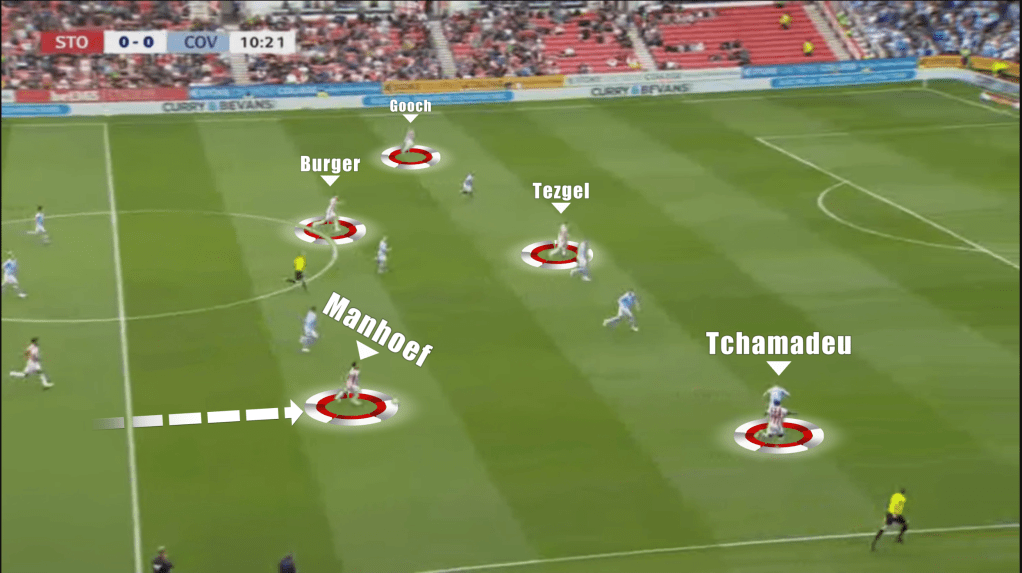
The Brief Rise and Rapid Fall of Alex Neil – What Happened?

So, there we have it. A 1-0 loss to bottom-of-the-table Sheffield Wednesday the final nail in Alex Neil’s 16 month tenure at Stoke City, and we’re in the market for a manager for the 5th time since relegation.

If you would like a reminder, please do go back and check out the xG article from last year.

After a shaky start, Neil looked to have turned things around with an incredible run of 12 games or so from February to April 2023. 21 points from a possible 36, including huge wins over Sunderland and Coventry, gave fans hope that things may finally be coming together.

The run was everything Neil had promised. Front-foot, aggressive football, intelligent high pressing, creativity and directness in attack, and most of all: fun. It was something we hadn’t seen since the COVID-hit end to the 19/20 season, and we didn’t even get to experience that in person.

Those beautiful days of blue shading are long gone. Data: Opta via FBref.com

But the good times had to end, and wow, did they come to a brake-slamming emergency stop. A run of 2 points and just 3 goals from 7 games finished off the 22/23 season as the threadbare squad which could rarely rotate struggled to cope with fatigue. Worse still, a back injury to Player of the Season Ben Wilmot compounded the issue in breaking down a deep block.

This was all fairly reasonable in the minds of most, myself included. It was clear that Neil’s plan (at least as it showed itself in March) was a positive one, and one that had given lots of fans a big reason to buy in to a wave of optimism finally surrounding the club. Yes, the run had petered out with a whimper, but there was now a huge chance in the summer for Neil to bring in his own squad almost from scratch. This was a chance that very few managers get, to mould almost the entire club exactly as he wants it.

This was his chance to show us what he wants his team to be…

*Curb Your Enthusiasm Credits Theme*

The season started full of promise. A 4-1 victory over an admittedly poor Rotherham side was a shot in the arm for the fanbase. The new side consisted of 5 debutants and 2 returning loanees, but it was like they’d been playing together for years.

But very quickly there were worrying signs, and a week later Stoke were taken apart in a 2-0 defeat to Ipswich. The ‘all-action’ pressing approach that led to the halcyon run of Feb-April was clearly something that needed more time to develop among these new players. Ipswich were able to bait the press with ease, and play through Stoke as if they weren’t on the same pitch.

The aptitude of this pressing unit has become a very big issue in the opening 10 games of the season for Stoke, alongside a penchant for allowing attackers to turn in their own box and take a shot. Aside from a battling (and tactically strong) 1-0 win at home to Watford, Stoke were unable to add to their victories column until Gameweek 9, when a late strike from 18 year old Nathan Lowe sealed 3 points away at Bristol City in a very tight, and probably very lucky.

Prior to that game, Stoke were in 20th place, the same position they find themselves 12 games later having removed Neil from office.

Among these starting few games were the seeds of Neil’s destruction, shown best with the following similar goals conceded by Stoke through that period.

In each of the 4 situations above, the opponent highlighted was able to bring the ball down and get a shot away (all 4 resulted in goals) inside the Stoke area, within the width of the 6 yard box. In each of these cases, stoke had a minimum of 5 players in within 6 yards of the ball as the goalscorer received it.

‘Same old Stoke’, right? Well, yes. And this issue seemed to combine with a run of poor injuries to change Neil’s view on how Stoke needed to add points to their tally in the following weeks.

The ‘Good’ Run

A defensively-strong performance against Southampton saw Stoke go down 1-0 to a glorious free kick, despite a stonewall penalty claim being waved away for the Potters. The blueprint was set, as Stoke looked to pack the midfield and create a scrappy game whereby they might release counterattacks from second balls and hope to defeat other teams in small moments (remember this phrase).

Ignoring the Leicester game, with the many injuries and the embarrassing surrender with 2 banks of 4 stood on their own 6 yard box, Stoke stuck with this ‘crowd them out’ mentality in the midfield throughout the next 10 games, and here began the ‘good run’ which convinced many that the tide was turning.

The 2-1 win at Sunderland was a nervy affair, in which neither team particularly dominated, and neither team particularly deserved to win.

Despite scoring 2 goals, Stoke’s attacking woes continued in the underlying numbers, and from the start of October to the end of November, they amassed only 6.5 xG from 9 games. In only one of those 9 did they achieve above 1 xG in a game, the 2nd dominant performance of the season away at Middlesbrough.

In the same period, despite conceding only 11 goals (4 of those in the final game of November vs QPR), Stoke’s opponents managed to create 13.4 xG, over double Stoke’s tally. It became clear that even though they had managed to pull together 3 wins from 5 unbeaten matches in this time, there was no sustainability to this run of form, unlike the highs of March.

The Middlesborough game was a rare joy. A match in which the press worked perfectly, Stoke’s build up was positive and sharp, and the 2-0 victory was well deserved. Leeds at home brought a rare return to the battling victories of old against higher-level opponents, with players throwing their bodies on the line, and a fantastically jammy set piece own goal bringing home the points. But even this joyous win and genuinely battling performance relied on Leeds missing big chances and a penalty.

The strength of battling to save points in those 5 unbeaten matches was marked by a scrappy midfield, a lack of creative freedom, and a consistent lack of bodies willing to run ahead of the ball from midfield or in wide areas. The build-up became slower, more laboured, and consistently longer into forward players. At time of writing, Stoke have attempted more long balls than any other team in the league.

Stoke’s build-up radar. They attempt more long passes p90 than anyone else in the league, and despite having more possession than average, almost 1/3 of their touches are in the attacking 3rd, well above average for the league.

This longer build up was also true of Stoke last season, and reflected the will of Alex Neil to create overloads in the wider areas, which could be hit quickly, either by switches from defence, diagonal passes over the top of fullbacks, or line-breaking passes from centre halves. If all else failed, Jacob Brown (or this season, Mehdi Léris) made a good option for a flick on into a crowded area of the near side midfielder, the full back, and the striker, all ready to win the second ball.

This season, however, the passes into those overloaded areas have been slower to come, less varied, longer, and generally with fewer bodies around the ball.

See the difference between the Rotherham game at home, and the Sheffield Wednesday game from Saturday below.

Against Rotherham we see two clear areas, left and right, where players often interlinked to provide overloads. On the left wing we have Stevens pushed high into the opposition half, with Laurent, Johnson and Vidigal connected closely to support progression of the ball. On the right wing, we see Hoever further forward, with Pearson supporting from slightly further away, and Brown/Mmaee pushed higher to run in behind.

The small arrow to Brown from Travers indicated those longer passes as an emergency outlet. Note that in this game both centre backs played a range of progressive passes into midfield and full backs (Wilmot to Hoever in particular was a huge progression route for Stoke).

Against Sheffield Wednesday we see much less cohesion. Both centre backs contributed less to the build up, and more passes went straight down the line to full backs. Gooch and Léris were in similar average positions, and Bae Junho was almost entirely on his own, relying on straight balls down the line from Stevens.

In fact, throughout the season, midfielders have been receiving the ball in deeper and deeper areas as the games have passed.

Positions of received passes by centre midfielders. The thick white line indicates the median height at which passes were received.

On average, players in central midfield are receiving the ball ~6 yards deeper in the last 10 games than the first 10. The biggest issue here for me is not necessarily that they’re involved in build-up in deeper areas, that can be fine, but that they’re much less involved in higher areas of the pitch.

Last season we regularly saw Smallbone, Laurent, and Baker pop up in higher areas of the pitch to help create and finish off chances. These last 10 games we’ve not seen nearly as much of that. On the plot, this shows up as the squares around the half spaces near the box, which are much less bright in the second image.

Alongside this, centre midfielders added less xT (I know, I’m sorry, it’s a measure of how useful possession is, but for the purposes of this it basically means their average pass didn’t move the ball as close to the goal as it did before) in their passes in the last 10 games.

The end points of successful passes made by Stoke City centre backs. The thick white line indicates the median height at which passes were received.

The same is seen in the passes made by our centre backs. In the second plot, we see that fewer passes make it into half spaces across the halfway line, and far fewer make it into the central areas just inside Stoke’s half. The indication here is that Stoke’s build-up is much less likely to break the initial line of the opposition press by playing into the midfield than it was early in the season.

All this supports the thesis of Neil struggling to fix the defensive issues of the early season, and as such he tried to step away from his centre backs playing into more risky areas, instead preferring to allow centre midfielders to drop deeper than the opposition press, and hoping the real creativity would come from quick breaks or high regains.

‘Front-Foot, Aggressive Football’?

Stoke’s high press has actually been pretty good this season, and they’re still one of the most aggressive pressers in the league. Stoke’s PPDA (how many passes they allow the opponent to make before making a tackle/interception etc) of 8.98 is the lowest (i.e. the most aggressive press) in the league. They make the 5th most attacking 3rd tackles of any side, and have the highest duels, tackles and interceptions per minute of opponent possession.

We can see this in the two radars below.

In the left-hand radar, we see that Stoke make lots of tackles and interceptions, lots of tackles high up the pitch, and a larger-than-average portion of their tackles are high up the pitch.

Similarly, in the right-hand radar, we see that opponents playing against Stoke have few touches in the attacking 3rd, a very low pass completion, and a lower-than-average attacking 3rd touch ratio (number of touches in attacking third/total number of touches).

Stoke are still good at pressing, although their numbers have fallen a little in the last few weeks.

Despite this, Stoke have yet to score a goal from a high turnover all season. From 124 of these occurrences (2nd only to Leeds), 28 have ended in a shot, the 5th highest number in the league. The lack of a true goalscoring threat from this key part of Alex Neil’s ethos has further compounded the attacking woes, and couldn’t cover up the defensive errors as well as they had earlier in the season.

The creativity they do have comes often from throwing the ball into the box and hoping to pick up the resulting pinball. They put far more crosses than average into the box, and pass the ball into the area more than average too. But from this relatively high ‘expected assist’ value (how likely a pass is to result in a goal from 0-1) comes a very low conversion into xG. The xG per xA section of the radar shows that Stoke are among the poorest at the league in turning balls into good areas into high value chances.

There are two possible issues that can cause this, and I think Stoke fall foul of both, but more likely the overriding issue is the latter of the following problems.

Firstly, your shooting players could be poor at getting into those good positions, or poor at turning good passes and crosses into shots. Secondly, but more pertinent for Stoke in my opinion, you can be putting a high volume of low-value balls into the box, inflating your expected assists value but converting very few of these deliveries into good chances. This is supported by the high number of crosses and passes into the box, and an xA value that, despite being above average, is still lower in league rank than the volume of balls into the box.

Crosses are a pretty low-efficiency way of scoring goals, and that becomes even more inefficient when you don’t have lots of bodies in the box as in Stoke’s last 10 games. Compare this to the high value chances created by cut backs in March’s run, and we see a huge difference in the efficiency of Stoke’s attacks.

‘The Malaise Is Deep’

Thanks to John Percy for that turn of phrase. It really does describe the club perfectly.

Although Neil can point to several games where Stoke were on the wrong end of little mistakes, his classic line of ‘we just need to be on top in those moments’ still rings in the ears of every Stoke fan who could stand the post-match press conferences after a loss.

But at some point, you have to look into why so many of these games have been decided by small moments. The Championship is a very scrappy league, with games often decided by tiny margins, but the issue with Alex Neil’s 23/24 Stoke side is that they forced games to be this way in the last 10 weeks or so.

It’s seen perfectly in the Sheffield Wednesday game. Yes, Stoke should’ve scored a (very dubious) penalty. Mmaee and Junho Bae probably should’ve scored big chances too, but Sheffield Wednesday were given a chance to win with Stoke’s lack of control on the ball and unwillingness to play through the lines.

The scrappy nature of the match, enforced by a lack of confidence on the ball, a lack of sharpness in passing, and a midfield 3 tasked with battling their way through the game, was the reason that moment existed for the opposition.

Even the games in which Neil appeared to make attacking changes, namely vs QPR and Plymouth in which a front 4 of Vidigal, Mmaee, Campbell and Junho started, appeared more out of desperation to stop the attacking rot than a true plan.

The front 4 did create more chances against these two defensively weak opponents, despite often appearing to be left to their own devices in terms of how to break down the opposition. But even this relatively conservative attempt to let some technical players do some attacking immediately led the return of defensive woes, with the team conceding 4 (from > 2 xG) to a QPR side that had only scored 12 goals all season by that point.

And So It Begins… Again… Again…

And here you find us again, returning to the managerial market, like an addict trying to find that one hit of dopamine that will make everything great again.

I’ve been clear in my views before about the model of the club, and it will be very interesting to see if the de-facto ‘long term dudes’, in Ricky Martin and Jared Dublin, will survive contact with the next manager who walks through the door. Martin made it clear in the summer that the aim was for Stoke to build with a core ethos of ‘high tempo, aggressive, front-foot football’ in the mould of February to April’s run of form. It was even more clear that there was very little consideration that Alex Neil might not be able to deliver that.

Given the previous willingness of the owners to allow a manager to tear up the foundations of the club as soon as they are announced, any new boss may be likely to have a veto on pretty much anyone in the club. It may depend how much of Ricky Martin’s spiel has been bought into by John Coates, but the dice gets rolled again, and maybe this time we’ll get lucky…

My last post on here ended with a genuine ‘Bravo, Alex’ after the Watford win.

This one will end with a slightly more sarcastic line.

Bravo, John.

xG per game, 20 game rolling average, since Summer 2017.

Thanks to any and all readers, and please feel free to comment and follow on Twitter at @potterlytics.

Should you wish to donate to help with the running costs of the site, and the data subscriptions we use, please feel free to visit our donations page here. Any and all help is very much appreciated!

George

Well, That Certainly Was A Championship Match – Stoke’s 1-0 Battling Victory Over Watford.

It had everything you expect in this league, didn’t it?

Massive diagonals up to a big lad (albeit a Brazilian one), flying sliding tackles, a referee being booed to within an inch of his life, and a scrap that ends with victory for the side who could produce one moment of magic.

And what a moment of magic it was, eh?

A Very Championship Game

Looking at the most basic of metrics, the shots, we see what was a very well-contested game.

One indication of dominance in matches is the positioning and quality of chances within the game.

Generally, a dominant side will create a higher volume and quality of chances inside the now famous ‘V’ as defined by Sean Dyche in his CoachesVoice interview a while ago.

Taking a look at the shot maps for both sides, we see that there aren’t many big chances in good positions for either. Stoke edge the low-xG fight with help from Josh Laurent’s 0.2 xG stretch for the ball from Tymon’s late cross, but neither side really shows dominance here.

And as above, we look therefore for a magical moment to separate the two sides.

A Vidiculous Strike

Who else could we look to but that lovely Portuguese hero?

Let’s start by looking at the scene just as Hoever gets the ball on the wide right.

Image: Wyscout

This is a scene we’ve perhaps wished for from Stoke for a long time.

As Hoever receives the ball, we have 2 pointing into the box for a cross, Laurent dropping off the full back to provide support in the half space, and Johnson attempting to make a late run from midfield to pick up half-cleared crosses and second balls.

Stoke’s most attacking players are running between defenders, into space on the blind side of their markers, and ready to attack the ball.

Image: Wyscout

As Vidigal drops off and the ball comes in, we see why having those 2 central runners makes such a difference. The ball goes past Wesley, who has pushed in to the front post, dragging the defensive player who was covering the area behind towards him.

Now, thanks to some questionable reactions from both the right back, and Livermore in midfield, Vidigal can receive the ball in space, 12 yards from goal.

And then, the magic.

Click each image to zoom in

Firstly, the control. Vidigal doesn’t just cushion the ball to his feet, he extends his chest outwards to push it just beyond the oncoming Livermore, so that he can get the strike off with 2 yards of space between himself and the blocking player.

The strike itself is perfect. Snapshotting on the half-volley as opposed to waiting for the ball to set down fully stops Livermore being able to challenge, and striking cleanly with full extension of this leg generates huge power on the shot (in cricket, we might say he was using those long levers!)

Crucially, though, the quality in keeping his foot through the middle of the ball allows it to stay under the bar despite his 45 degree body position.

Chef’s kiss.

The Question of Ben

But why didn’t Pearson play?

Well, interestingly, I think there could be a tactical reason or two to explain this.

Firstly, we were well aware that Stoke’s threat may come from playing over and around the press of Watford, rather than trying to play through centrally.

Despite some of Thompson’s shortcomings, his passing range is indeed better than that of Pearson, although he didn’t particularly fill that more expansive role on the ball on Saturday.

Secondly, though, and more importantly, Watford very rarely aimed to challenge Stoke through the centre of the pitch. With the back 3 set in the middle, there was a need for more cover in wide areas to challenge players like Sema and Martins.

Laurent and Thompson dropped into wider areas off the ball to combat this, and we can see that most of Stoke’s defensive actions in their own half came in the half spaces and wider, particularly on their wide left.

Stoke City Defensive Actions in their own half.
The end point of Watford passes in the final 3rd.

We can see a good example of this as Watford get the ball on their left hand side below.

Image: Wyscout

As Martins receives the ball, the space in the middle is almost entirely vacated by Watford, with Laurent and Thompson playing as a de-facto double pivot off the ball, ready to press wide or cover 3rd man runs in the half space.

While Pearson certainly can do this role, I can see the reasoning behind Thompson, a more comfortable left sided player with a stronger passing range, to take up the role.

Formations Don’t Matter?

The big change, of course, was the switch to the much-questioned 352.

Alex Neil said in mid-week that he noticed Plymouth’s 0-0 draw last week was in no small part down to their quality in defending their own box.

The addition of eventual Man of the Match Luke McNally was an attempt to mirror this quality, with Stoke conceding 3 crosses into the box of their 4 total conceded goals in previous games this season.

This worked a treat, and we can see this in the maps below.

Both show a huge large of interceptions and clearances in the box, particularly in the central areas of highest dangers.

This includes blocks and clearances from Enda Stevens, Ben Wilmot, Michael Rose, Luke McNally, Jordan Thompson, and Wesley (I know, probably from a corner), showing that the 3 main centre backs were key in keeping the ball out of the box for Stoke.

Comparing this to Watford’s attacking lines (and the pass maps above) also shows that Stoke allowed the ball to come into the box from wide areas, focussing on stopping the receipt rather than cutting out the initial pass or cross.

This is a fairly big shift from the philosophy of previous games, and last season, whereby high pressing and a well-structured and well-timed trigger was pretty consistently utilised.

Against Watford we saw some of this, but I’d expect the lack of cohesion between new signings means the aggressive, well-drilled pressing unit of March 2023 wasn’t a possibility against a positive and high-quality Watford team.

Hence, we circle back round to the initial shot map and see exactly why Watford only have the one (borderline 2) shot(s) in that central 12 yard-box area..

Bravo, Alex.

Thanks to any and all readers, and please feel free to comment and follow on Twitter at @potterlytics.

Should you wish to donate to help with the running costs of the site, and the data subscriptions we use, please feel free to visit our donations page here. Any and all help is very much appreciated!

George
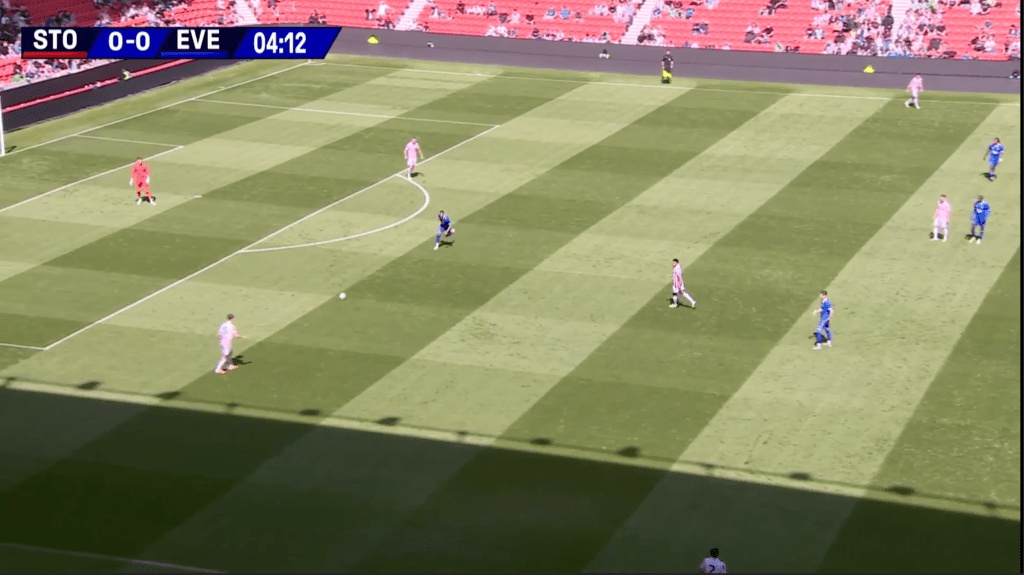
And So It Begins… What To Expect From Stoke

Well, here we are again, fancy seeing you here, et cetera, et cetera, ex chetera.

After a few weeks of nervous terror, Stoke’s transfers fell into place, and an explosion of signings were announced between the Benidorm camp and tomorrow’s fixture.

We’ve seen no fewer than 11 new(ish) faces into the squad at time of writing, with 7 permanent signings, 4 loanees, and even some transfer fees spent!

But how are we expecting to set up? What’s the new blueprint (new-print?) for this season in another revolution at the club? Let’s take a look into those signings, alongside some interesting clips from the Everton pre-season game, to see if there are any indicators to Alex Neil’s 2023/24 Stoke side might approach this incredibly long, exciting, depressing, hopeful, and soul-crushing Championship.

The New Boys

So what does the squad look like in a simplistic idea of the formation we expect them to play? If someone new has signed since this, please don’t shout at me.

It’s a fairly safe assumption that Stoke will be, at least in spirit, playing in a 433 variant. Of course, during games, there will be tweaks to this in and out of possession, but this gives us a basis from which to judge the depth.

In comparison with the squad on our last viewing, shown to the left above, it’s night and day. The majority of first team spots have at least one main option, many of whom fit the mould mentioned in our last article (The Great Rebuild – What’s The Plan?).

My first plan for this article was to go through each signing and position individually, but I think that may be both overkill and boring, so let’s take a look at the big picture of what to expect from tomorrow’s game and beyond.

The Basics – Build-up

One of the exciting parts about these new signings is the quality of passing we have in the back line during build-up.

I mentioned in an article long, long ago, that a key part of Alex Neil’s style (and many managers, in fairness) is to make the pitch as wide as possible when in possession. Last season we often saw Ki-Jana Hoever stood on the right hand touchline during build-up phases, while Tyrese Campbell occupied the left-hand touchline.

Hoever sits wide right during Stoke’s build-up vs Blackburn last season, and Campbell occupied the wide left space. As the ball moves during build-up, Stoke manipulate the first line of press and slide in Campbell in space. Image: Wyscout

Not only does this create space centrally for other players to occupy, and expand the opposition defensive shape, it also allows for quality passers of the ball to use quick, long-range diagonals to get the ball to wide players in space, who are able to square up the opposing full back.

If a defence stays compact out-of-possession against Stoke, they make these diagonals easier to wide areas, and if they expand to mark the wide men, they leave space centrally for Stoke to attack into.

The quality of pass in defence was only generally something Ben Wilmot could provide, but we saw vs. Everton that this role is taken up by Michael Rose, who appears just as adept at progressing the ball through the lines.

In fact, it’s shown in both Rose and his new centre half team-mate Luke McNally’s passing from last season with Coventry.

Both players have consistent forward passing down the near-side wing, and both complete passes (although fewer) across the field to the far wing.

This represents a vast improvement in the build-up passing from the back line from last season, when games often relied on Wilmot to be able to break the first line. If he couldn’t do it, it often meant there were some incredibly frustrating hoofs forward, and passes backwards.

This season, we can hopefully be more confident that we have the quality to vary the build-up passing, and start to break through those presses in ways we couldn’t reliably do last year.

The Shape In Possession

We’ve seen more than one shape trialled over the course of pre-season, which I think is indicative of the variation we’re going to see throughout the year.

Against Notts County, we saw a very attacking back 4, with the 2 centre backs sat deep and spread wide in build-up, with both full-backs (Macari and Tymon) pushed very high up the field.

The addition of Ben Pearson is likely to make this shape more viable in league games, and we did see it used last season. Pearson’s role as a ‘forward sweeper’ just in front of the back 2, cutting out transitions for the opposition and playing as a single pivot, allows Stoke to put men forward without being too terrified of the counter.

Against Everton, we saw a slightly different build-up shape, that utilised a double pivot of Thompson and Laurent.

This gave a little more solidity when dropping deep, but also gave Stoke a ‘box’ from which to build in the first phases of play. In a game where possession was less easy to come by, and the quality of opposition made forward passes into the middle more difficult, this gave Stoke more players in the centre of the pitch to play through the lines should they try to do so.

Build-up in the pre-season game vs Everton. We see that Laurent is dropping off the marker to provide a pivot, with Thompson holding his line to provide options later in the move. Note that both Hoever and Stevens are high up the pitch, level with both sitting midfielders.

It will be interesting to see whether this move to a double pivot is solely to accommodate the lack of Ben Pearson’s defensive ability in this game, or whether we will see a similar move for tough matches against high-level opposition who will dominate possession.

My instinct is that Pearson’s absence was the big factor in this, but with some big teams in the league looking to dominate with quality pressing players, we may see in-game variations to this effect if build-up is not working.

Alex Neil’s Off-Ball Terrors TM

Perhaps the most impressive area of Stoke’s game during last season’s oh-so-brief renaissance was the intensity of the press, and the traps they managed to set even against quality teams.

I don’t expect to see much of a change to what we saw then in the coming season, and despite the high quality opposition, we saw some of that against Everton too.

Gotta Go Fast: A very blurry (sorry) example of the exact same pressing structure as last season vs. Everton.

In the above still frame, we see (I’m so sorry for the picture quality, pre-season makes clipping difficult!) Jacob Brown take up the forward role of providing a curved pressing run to block off passing lanes to one centre back.

Chiquinho and the apparently light-speed Tyrese Campbell are sat between the full back and centre back on each side, ready to trigger a press once the ball is played to their side.

Finally, we see Daniel Johnson man-marking the number 6, taking Will Smallbone’s role in stopping the central ball through the press.

Behind this line, Stoke are sticking with the same, brave man-to-man marking behind that first press, and the first 20 minutes of the Everton game showed that the goal is to snap into tackles to make sure initial duels are won.

As with last season, Neil trusts his players to win 1v1 duels, and those new players fit the mould of strength, agility, and intelligence needed to time challenges and win that ball.

If you want to read more about the pressing unit of last season, check out the article on it here: Anatomy of a 10-game Revolution (Part 1) – Stoke’s New Blueprint

Creating Chaos

The last part is the most exciting, though.

Neil has said many a time that he’s looking for variation in attack, through both variation in number 9s (the dreaded target man moniker), but also through wide players who are strong on the ball and keen to take their man on 1v1.

Well, it appears this window is a bit of a ‘mission accomplished’ on that front.

Where, in previous seasons, we saw the ball moved wide only to be passed back to Morgan Fox to cross from deep, we now see players on both side squaring up the full back and finding a way past them.

The additions of Chiquinho and Vidigal have meant that Tyrese Campbell no longer has to be the only creative force against deep defences, not only taking pressure away from him, but also giving defences two wings to have to defend against.

Those diagonals and quick switches of play become much more dangerous when both wings are manned by players who excel in 1v1 dribbling and creating chances.

Stoke vs Everton width in the first 30 seconds. Campbell receives at the top of the image, with Chiquinho at the bottom.

We see in the image above that this makes a slight tweak to Stoke’s attacking shape, where in matches last season, Brown would take up his position between the full back and centre back, with Hoever charging forward to fill the wide space behind the full back.

This time, Brown keeps his space, but as a central striker, this allows Chiquinho to push into the wide space, and Johnson to press into the space between the opposite centre half and full back.

A front 5 including two wingers, two 8s, and the centre forward is much more dangerous than relying on full backs to attack opposition defences themselves, especially when you have centre forwards like Brown, Mmaee, and Wesley, with stronger movement in the box than a slightly ageing Gayle.

It also brings the additional benefit that full backs can overlap, underlap, or sit deeper for their wingers, rather than being the width-providers themselves. This versatility means Hoever and Tymon (presumably) should be able to contribute much more effectively to the attack.

A Strike Force?

But, going back to the two centre forwards Stoke have signed, we see more of that variation Neil has mentioned so often.

Ryan Mmaee in particular represents an interesting continuation of Dwight Gayle’s somewhat unexpected role as a deeper striker in 2022/23.

His decreasing pace overall, and specifically lack of quick movement within the box led to him dropping deeper and trying to affect the game more in the build-up, and this seems to be something Mmaee can excel in.

A strong, quick, technical striker who is keen to link the play and create for others alongside scoring himself, Mmaee’s quality on the ball is something Stoke have missed when breaking quickly in transitio.

Add onto that, the ability to pick out sharp final passes has been a big problem in facing the dreaded low block opposition of the Championship.

I definitely recommend this thread from @HCfootball01 on twitter for more info on Mmaee: https://twitter.com/HCfootball01/status/1684511415090937857

But what about those pesky games where we need the ball in the box but we just don’t have the presence to win it?

Step forward, Wesley.

We only have to take a look at his shot map from his opening Premier League season with Aston Villa to see where Wesley’s qualities lie.

Shot map for Wesley’s 2019/20 season with Aston Villa, prior to his injury.

The average distance being as low as 12m from goal, taking as high as 0.21 xG per shot, with only 5 of 34 shots from outside the area, and the majority being between the penalty spot and the 6 yard box show clearly that Wesley is a traditional box threat.

He’s also a strong presence outside the box, holding the ball up and bringing others to play.

I think we’re most likely to see him in games where Stoke need the ball in the box quickly, and where playing through the lines in build-up may not be possible.

Adding the clever movement and engine of Jacob Brown, and even the return of Dwight Gayle from injury to this front line makes for a big part of that variation Neil has so often asked for.

So, are we excited? Absolutely. Will hope kill us again? Maybe. Will we get swept along in it all anyway? Of course.

Thanks to any and all readers, and please feel free to comment and follow on Twitter at @potterlytics.

Should you wish to donate to help with the running costs of the site, and the data subscriptions we use, please feel free to visit our donations page here. Any and all help is very much appreciated!

George

The Great Rebuild – What’s The Plan?

So, apparently another season just ended, but I for one can’t remember any of it.

What I do know is that we’ve lost half a dozen or so loanees, and a significant number of players in the squad have had their contracts expire without renewal.

This leaves Stoke with between 12 and 14 senior players, depending on your definition of senior. A sparsely-populated squad whichever no matter your definitions.

So what’s the plan? Technical Director Ricky Martin said this week “It is well documented that we are looking to execute a significant reset within our squad ahead of the new season”.

Let’s take a look into just how big that reset is, and what kinds of players we might be looking to sign over the Summer.

Please don’t quote this article to me when we sign completely different players and give Bonham the number 1 shirt.

A Fistful Of Players

Looking at the squad we have, and crudely shoving them into single positions in Neil’s (apparently) preferred 433 formation, we see a lot of blank spaces.

Stoke City senior contracted players for 23/24, as of 11/5/23. Green indicates possible first choice starters, yellow and orange indicate possible backups.

Again, taking this all with a pinch of salt, we can pick apart some differences here.

Brown can play either up front or wide right, Campbell can play on either wing, many don’t see Tymon and Brown as starters, there are rumours of both Tymon and Baker leaving the club, and of course there are question marks around what will happen to Edwards, Wright-Phillips, and whether young players like Emre Tezgel might get minutes as backups.

But, ignoring that for a second, we see the big gaps in the squad. At a minimum it appears Stoke need to sign the following:

  • A goalkeeper
  • 2 full backs
  • 2 centre backs
  • A sitting midfielder
  • 2 central midfielders
  • 2 wide players

That makes a minimum (again, in my opinion!) of 10 signings to be made this summer. Using Stoke’s February/March/April style as a blueprint, let’s look into each position to see what kind of players we might be expecting Alex Neil to recruit.

Keep(er) Calm?

Firstly, and very important to Stoke fans given this year’s issues, is a goalkeeper.

22/23 season stats from FBref.com (Opta) put Stoke’s goalkeeping department as the 4th worst in the division for Prevented Goals.

To explain that stat, we need to look again at a metric known as Post-Shot Expected Goals (PSxG, also called Expected Goals on Target xGOT).

PSxG measures the probability of a given shot resulting in a goal, taking into account historical data of power, distance from goal, keeper position, trajectory, and end location of the shot.

This differs from Expected Goals (xG – A Stoke City Explainer) as it is not concerned with the probability of a player scoring a chance, but the probability of an already struck ball ending up as a goal.

As a brief example, Peter Crouch’s wonder volley against Manchester City in 2011/12 was a very low xG chance, as it is very rarely scored, ergo it’s very difficult for a player to score from.

The Post-Shot xG however, was very high, as Crouch struck the volley with power and dip into the top corner of the goal, making it difficult for the keeper to save.

Comparing the number of goals a keeper concedes to the expected amount conceded (our PSxG), we can indicate whether a keeper is under, or over-performing in shot-stopping.

In 2022/23, Stoke had one goalkeeper, of the 3 who played in games, who wasn’t under-performing in this metric.

Matija Šarkić conceded exactly in line with his PSxG, while Bonham and Bursik both underperformed considerably.

We can look at this more intuitively by seeing just how many ‘extra’ goals each keeper conceded through the season compared with PSxG:

PlayerGoals ConcededPSxG AgainstPrevented Goals (GA-PSxG)
Jack Bonham2621.4– 4.6
Josef Bursik2216.4– 5.6
Matija Šarkić66+ 0.0

Unfortunately, it doesn’t read well for Stoke. Over the course of the season they conceded 10 goals more than expected from the shots they faced. This is not a sustainable metric for a promotion chasing side, and can explain some of the differences between xG performance and results in this up-and-down season.

Despite only playing in 7 and a half games, though, Šarkić bucked the trend and seemed to integrate well in the team.

I would not be surprised to see Stoke return to him as the first choice goalkeeper for next season.

The Tymon Our Lives?

As we move into the outfield, though, we come to the more difficult issues.

Personally, I would be happy with the left sided full back remaining as Josh Tymon, but I am also aware that many will see him as surplus.

My own opinion stems from his creative performances (many detailed here in my Josh Tymon piece), and the specifics of how Alex Neil has used one full back (sometimes two) to attack high and wide, with the wide attacker playing in the half-space.

Whilst, this season, those roles were more often on the right hand side in Hoever and Brown, I can see the same applied on the left, with Tymon overlapping and a new left winger playing further inside in attack.

In this basic imagining of in-possession strategy, Tymon pushes high and wide, while the left winger comes inside, and the right full back drops back to make a back 3.

This, however, doesn’t solve the issue when Stoke have only 1 full back.

At time of writing, it appears loanee Dujon Sterling will be signing for Rangers, and Morgan Fox was not offered a contract in the recently-released retained list.

A right back who can sit slightly deeper and defend 1v1, in the mould of Sterling, would be very much on the menu for Stoke in summer, and unless Tom Edwards can be reintegrated into the squad, another 1 or 2 full backs are required alongside a first choice.

He Wil-Mot Be Able To Do It Alone

One possible way to decrease the number of signings needed is to sign versatile players, who can play across a couple of positions.

In the mould of Morgan Fox, it would make sense for Stoke to sign a centre back who can play full back or vice-versa.

But given the system Neil favours, with an aggressive man-to-man marking style behind the front line, often leaving centre backs to keep a striker quiet in 1v1 duels, any new starting centre back has to have some specific traits.

Aggressive, positive, combative defending is a must, as is intelligence in being able to arrive into challenges at the right time. (See my Ben Wilmot piece for examples of a player who does these very well!)

Alongside this, a huge issue in the last half-dozen games of 2022/23 was the scarcity of defensive players able to pick a positive, line-breaking pass. In home games against Wigan, QPR, and Bristol City, this lack of vision in the back line allowed opponents to sit off and cut lanes, preventing Stoke from progressing towards the opposition goal.

Axel Tuanzebe provides an obvious solution to these issues, with strength and intelligence in his duels, and a strong eye for a pass. Wilmot and Tuanzebe were the duo who started the game in Stoke’s most impressive build-up display (in my opinion), in the home game vs Blackburn.

However, we have the one big question mark, his fitness. Having joined on the last day of January, Tuanzebe only started 4 games, playing 329 minutes.

Alex Neil did say in a recent press conference that Stoke cannot be picky with injuries, given the number of signings needed.

“There are going to have to be some educated gambles. There might be a certain quality we can acquire we need to take an element of risk on. If we were to take a hard line on that and say everyone is going to have to have played 90 per cent of games completed or we don’t sign them… I don’t think we’re at that stage yet.”

This indicates something we all knew instinctively anyway, that the market Stoke are shopping in is one of very imperfect players. It does, however, mean there is a definite need for solid backup players.

22/23’s backup of Aden Flint, brought in by Michael O’Neill to cover for Harry Souttar’s recovery, struggled to make an impact, and was dropped pretty quickly into Alex Neil’s reign. Phil Jagielka performed well for a time, but towards the end of the season, his age seemed to catch up to him and the centre-back pairing of him and Morgan Fox was a big problem, both defensively and in build-up.

If Stoke can sign Tuanzebe, it seems there is a fantastic player, but it does mean there is much more importance attached to the signing of further centre backs.

Sit In The Middle With Ben

Holding, sitting, deep-lying, whatever you call the deepest midfielder, it’s been something Stoke fans have wanted for years now. Joe Allen tried hard and was very active, but his technical deficiencies were a root issue in several seasons of struggle for Stoke’s midfield.

Ben Pearson made his way into the squad on loan in January, and appeared to have an immediate impact to the midfield, adding strong tackling, calm passing, and an intelligence that could sniff danger on the break and protect the defence behind him.

As with many, in the last 6 or so games of the season he began to wane, with some silly moments of petulance on the pitch causing problems for the team, and some clumsiness and mistakes ruining generally good performances.

There is a strong case that fatigue and frustration was part of that. Indeed, his defensive strengths may even be worth the problems, and it does seem that Pearson would be possibly the first loanee Alex Neil would like to snap up.

Looking at his overall radar plot it becomes clear where his benefits lie.

As an intelligent defensive midfielder he completes an impressive number of interceptions, and passes impressively into the attacking 3rds of the pitch. The archetypal sitting midfielder.

It also appears that Pearson sits well in Alex Neil’s style of play, as a combative player who is active in his work, he’s strong in man-to-man marking, and in the build-up he played well dropping between the centre backs and allowing others to push forwards.

We see one example in the above video, where Pearson (highlighted) remains deep, allowing centre backs to split and push wide, with both full backs pushing high and wide.

Despite this, Pearson is not out of contract, and it is not a given that Bournemouth’s demands will be within what appears to be a very tight budget at Stoke this summer.

Despite some changing remarks on the Profit & Sustainability situation during and since January, it seems the sale of Harry Souttar was the major factor allowing Stoke to avoid sanctions this year, and as such it’s not clear how much of that reported £15m fee will be available for transfers.

Should Pearson not be available, I would assume Alex Neil’s search parameters for the recruitment team will be ‘get me someone like Ben Pearson’. He alluded to similar strategies in a recent press conference:

“I will give them a profile of player we would look to recruit and this is what we want them to do and they would go out and try to find the best options. Potentially I would give an example of a player to find someone of that ilk if we can’t get that one in particular.”

A Small Piece of History

Presuming Laurent and Baker stay, it appears the other hole in Stoke’s midfield is the more aggressive number 8, taken up this season by loanee Will Smallbone. He’s incredibly keen to return to Southampton and fight for first team football there, so it seems Stoke will be looking elsewhere for the summer.

Looking at his radar plot, we see that Smallbone contributed very strongly in creating chances, well above average in most of the creative attacking metrics, and also very high in the number of defensive duels won.

Most of his creative work comes from transitional play, particularly recovering loose balls in the opposition half, and as a crucial part of the pressing unit Smallbone dealt with opposition pivot players excellently, to force the ball into areas where Stoke could win it back.

There will be an emphasis on being part of that pressing unit for any potential attacking number 8, and links with players like Preston’s Johnson, an aggressive pressing player, show that.

However, Neil has been keen to mention that there is a need for a variety of players within the squad overall, and the (sadly disappointing) signing of Bersant Celina showed that he is also aware that sometimes teams need to have a player more able to create outside of pressing structures and transition.

Think players like Vrančić and, who created goals from nothing with a keen eye for line-breaking passes and creative vision.

Just Winging It

And as a perfect segue, we move to the wide positions. Tyrese Campbell and Jacob Brown are both able to play wide, and I’d expect Campbell to be the main man on the right of the attacking 3, should Neil stick with a 433.

However, there’s a clear dearth of talent on the left hand side of the front 3, and there are two possible types of player I can see Alex Neil approaching.

Firstly, in the second half of 2022/23, Neil used Campbell as a high and wide left-sided player, stretching the width of the pitch and taking on his man on the outside to produce cutbacks for several Stoke goals in the ‘golden era’ of Feb-April.

He has previously mentioned the need for players who can go 1v1 on the outside and get balls into the box when playing against a low block, a situation in which Stoke have lost several games this season.

Secondly, Neil utilised Jacob Brown on the right wing as more of a half-space player, who used his excellent movement to arrive in the box when the ball was wide left, stayed high for the longer out-ball to use his aerial quality, and dropped in the half space to drag the opposition full back inside and leave space for Hoever to overlap (see Hoever’s goals vs Boro and Blackburn).

With Campbell more naturally available on the right, to fit in that half-space, it would seem reasonable that Neil will be looking for a left-sided player, who can create to the same degree as Campbell.

Which of the two (half-space or chalk-booted) winger types he looks at depends largely on the way he wants the full backs to attack, and whether he sees Campbell as more of a wide left player or a wide right player.

As above, there’s further emphasis on creating a variable attack, where different types of player can be called upon in different games. Given the adaptability of both Campbell and Brown, it will be interesting to see what specific types of wide player Neil aims for, but I am confident that high on that list will be dynamism and the ability to beat a player 1v1.

Back(up) The Strike(r)s

Finally, a position I didn’t list at first, but one I know many Stoke fans are keen to see addressed.

I may well have to put my tin hat on here, but I’m actually not so desperate for us to spend big money on a starting striker. *hides*

I, personally, really like Jacob Brown and the qualities he brings as a central striker. His movement in the box is exceptional, he’s very good in the press, he wins the ball well in the air, and he’s both mobile and confident enough to run at players with it at his feet if needs be. He’s also scored 20 goals in his last 2 league seasons, despite being played both wide right and as a wing back in many of those games.

But, before you scoff and click back onto twitter, hear me out.

Strikers are expensive, good strikers are even more expensive, and good strikers in good form are the most expensive.

Stoke have, at most, a £15m budget this Summer to sign what is likely to be at least 10 players, and at least 2 of those will be wide players, also notoriously expensive.

As a result of that, unless there is a bargain or a loan to be picked up from the recruitment team, I am more than happy for a cheaper, backup striker to come in and challenge Brown for the starting spot, rather than spending 7 figures on a bigger, more expensive name.

Looking at the type of play Neil wants, goals are required from all over the team, and spending a large chunk of the budget solely on a striker, when we have one who scored 13 in a season in a 14th placed side as recently as 2021/22, would be a big risk in my opinion.

The links with Barnes and Pukki appear to mirror this, with neither particularly looking like big money starting strikers, but more likely challengers to fight it out for the starting spot throughout the season, with their strengths utilised in varying scenarios as and when Neil sees fit.

But, this of course all depends on free agents. I don’t purport to be in any way ‘in the know’ about transfers, but as Neil again said recently, the free agents need to be snapped up first, and then you can see where you need to fill gaps.

One thing’s for sure, it’s a long, rumour-filled summer ahead. I reckon the transfer thread on the Oatcake might break 10’000 pages.

Thanks to any and all readers, and please feel free to comment and follow on Twitter at @potterlytics.

Should you wish to donate to help with the running costs of the site, and the data subscriptions we use, please feel free to visit our donations page here. Any and all help is very much appreciated!

George

Anatomy of a 10-game Revolution (Part 2) – The On-Ball Boogaloo

Part 2: Chance Creation and Build-up Play

Welcome back, to those of you who just read Part 1, looking at sustainability and off-the-ball work, and to those who didn’t go and check it out here (Anatomy of a 10-game Revolution (Part 1) – Stoke’s New Blueprint)!

You join us as we look into Stoke’s remarkable turnaround since February, and to reiterate the context here, let’s look at a brief table.

First 30 Games – Before Huddersfield – HLast 9 Games – Huddersfield – H – Onwards
xG For per 90 mins1.132.10
xG Against per 90 mins1.130.90
xG Difference per 90 mins+0.00+ 1.20
Data from Opta via FBRef

You might say that this could just be a lucky run of fixtures, but as we mentioned in Part 1, this run includes games against 4 of the top 10 most in-form teams in the league, and Stoke’s 10-game rolling xG difference has been above +0.5 for 8 matches now.

Last time we looked at how Stoke’s work off-the-ball work has contributed to this improvement in the underlying numbers, particularly in winning the ball high up the pitch, stopping opponents in their build-up phase.

This time, we’ll look into how Stoke have ramped up that xG for stat, through their own build-up play, and the way they look to create their chances.

If You Build It…

First up, let’s look into Stoke’s building from the back. In a very strong interview during the Sheffield United away game, Alex Neil said the following:

“I thought first half we wanted to try to play and open the pitch out, and to be honest we did that to Sheffield United’s benefit rather than ours.”

“We got a lifeline before half-time by getting a goal, changed it at half-time by not risking it at the back and getting the ball forward, on the front-foot, up against them and aggressive.” [BBCSport]

It appeared that Stoke’s building phase was over, dead and buried, Rest in Peace (2022-2023).

Sure enough, in the following league game, a 4-0 victory over Reading, Stoke did exactly as said in the previous game. They had only 38.1% possession, and the trend continued against Luton in the next game.

Click each image to zoom in

In this clip, Stoke have a free kick just inside their own half. Baker plays the ball short to Wilmot, and we see the plan for Stoke.

Immediately Sterling and Gayle start to bomb forward, and Wilmot clears the ball long into the channel.

Click each image to zoom in

This clip tells a similar tale. Fox receives the ball 20 yards into the Stoke half. As Tymon drops deep to support, Laurent runs forward in the midfield to get into an area of space.

Fox immediately throws a long pass into the left hand channel, unfortunately this time it ends up in Luton’s possession.

So how has this changed over the past couple of months?

Well, let’s look at the two major build-up plans that I think I’ve been able to pull from Stoke’s recent matches.

…Wins Will Come

Click each image to zoom in

This time we look at a Stoke goal kick in their home game against Blackburn. The two centre backs, Fox and Tuanzebe, set up within the penalty box to provide a pass for Bonham. Pearson is in a deeper role centrally to provide an option during the next phase.

The ball goes to Tuanzebe, who plays it across to Fox. This draws the first line of Blackburn’s press, and two forwards close down the centre backs.

Fox turns and puts the ball wide to Sterling, and Ben Pearson moves deeper and wider to provide support. At this point, Blackburn’s first line of press has been beaten, but they have forced the ball wide, and would probably feel like it’s going okay for them.

Click each image to zoom in

As Pearson drops to support, Sterling plays it across to him, and this is where it gets interesting.

Up to this point, the tempo has been relatively low, Stoke have been playing the ball across calmly and baiting the press forwards.

But Pearson immediately shifts the tempo and puts the ball forward with a high pass towards the halfway line. Note: High pass, aimed towards a specific forward/area where forwards should be, not a hoof like some of the passes we saw vs. Luton.

The switch of tempo and pass beat the press, and Gayle nods the ball back into the path of Tyrese Campbell, into a large space in the centre of the pitch.

The slow tempo passing in the previous two images created this space, by drawing those Blackburn midfielders forward. This is a controlled line-breaking move, known by some as an artificial transition. This allows Stoke to attack a defence that isn’t set, and has spaces available to attack.

At this point, Campbell bombs forward to the opposition box, and plays in Will Smallbone for a high-value chance.

Note how the 2nd image here shows Campbell, Laurent and Smallbone immediately bombing forward as Gayle wins the header. This was a crucial part of Stoke’s build-up in this game.

Interestingly, though, this specific routine isn’t necessarily something Stoke do every match, but as with the press we spoke about in Part 1, the principles remain the same throughout.

Let’s take a look at this build-up from the 0-0 draw at home to Norwich.

Click each image to zoom in

In this game, Norwich dropped into a fairly flat mid block, to prevent Stoke from finding space in between the lines. This is intended to stop the artificial transition mentioned in the last clips, by denying space and forcing Stoke to try to play into areas where Norwich have numerical superiority.

Stoke again play the ball calmly and at a low tempo, with extra space to move into towards the halfway line. Wilmot plays it across to Tuanzebe, who moves wider while Pearson drops into the centre of defence.

This allows Tuanzebe, a very press-resistant centre back, to move forward into space on the right hand side. He exchanges passes with Pearson and moves into that space.

Click each image to zoom in

Tuanzebe moves into that space, and we see the compact mid-block shape of Norwich in the first frame.

He waits until the attacker presses the ball, and then plays a pass forwards into makeshift-winger Hoever. Note the movement of Brown, ready to get into position for the next pass in the move. This forward thinking is crucial to breaking down a tough block of compact players.

We also see that Stoke are very wide in possession. Pearson dropping into the quarterback role allows other players to spread out, and we see that despite the ball being on the near touchline, Fox and Campbell are still very wide on the opposite side of the pitch.

Hoever receives the ball and plays it down the line into Brown’s path. Again, We see Smallbone and Campbell running into positions again to receive the next pass or cross.

Again, we follow the same principles as before, drawing the first line of pressure as much as possible with lower-tempo play, then switching quickly to higher-tempo passing, forwards into the midfield or frontline, followed by runners consistently supporting the ball, thinking one or two passes ahead to get into position to receive.

Now in the Coventry game we saw more evidence of another build-up plan, in which Stoke get the ball forward much more quickly into areas of the pitch where they can win first and second duels. This takes advantage of the combative nature of Stoke’s starting XI.

We can see in the plot below that all of Stoke’s forward players are above average in at least one of ‘offensive duels per 90’ or ‘aerial duels per 90’.

Reminder that this is just one indicator, check out our player radars to find out other stats such as success rates! (Player Stats)

In this case, Stoke are looking to a much more simple plan, but still sticking by the same philosophy.

Getting the ball forward into aerially-strong players like Brown and Powell allows Stoke to crowd an area of the ball, where strong, combative players like Smallbone, Hoever and Laurent can win the second ball, again forcing a transition-like phase of play.

This again means Stoke can attack a defence that isn’t set, and aided by quality, high tempo passing alongside quick attackers, they can exploit the extra space available.

We come to the 3 main principles of Stoke’s build-up:

  • Lower the tempo to tempt the opponent to press if possible.
  • Quickly change the tempo to expose spaces in the opponent’s lines, either with line-breaking passes or balls to strong aerial threats.
  • Get bodies into good positions to receive the next passes.

And while build-up is great, there’s no reason to do any of it unless you can create chances! So how do Stoke go about doing the hardest thing in football – scoring goals?

Now For The Fun Bit

We see these principles merge into Stoke’s chance creation, particularly in the specific (if vague) philosophy of exposing spaces.

But, when Stoke do manage to generate either a true transition, by winning the ball high up the pitch, or an artificial transition through build-up as above, we do see some specific areas that the team look to exploit more often.

Most interestingly in my view, I want to speak a little (a lot) about the xG-geek’s favourite – the cut back.

You may have seen Arsenal and Man City utilise this type of chance a lot over the cause of this season, and there is a specific reason teams target this kind of chance.

Most important of these is that shots from this area are very high-value, in terms of xG. Cut-backs are also ground passes, and tend to be taken first time, both of which are factors which increase the historical likelihood of scoring.

An xG model based entirely on location of the shot, we see that central, close shots are of the highest values. Credit: https://www.datofutbol.cl/xg-model/

It was incredibly surprising watching footage back of recent Stoke games, just how many of Stoke’s recent flurry of opportunities have come either from traditional cut-backs, or similar ground-crosses to the area around the penalty spot. For the rest of this piece, I will refer to both types of chances as ‘cut-backs’ for ease.

Using the 1v1 skill and quality in creation of left-winger Tyrese Campbell, Stoke look to expose the right hand side of opposition defences. The ability of Campbell to go either inside or outside a defender means that 2 chances can be created by getting him on the ball wide of the box.

First off, we see the specialism of Campbell, the cut in and shoot to the far post (see the work on the Ty-phone Zone here). But more recently we’ve seen that he has been focused on moving outside, down the line, and cutting the ball back towards the penalty spot.

But there are issues. Cut-backs move the ball into areas that teams work very hard to defend, so there are likely to be lots of defensive bodies pressuring the shooter, decreasing the likelihood of scoring.

Stoke have a very interesting way of helping increase their chances despite this, and it involves the impressive rise of Will Smallbone and Josh Laurent.

Let’s look into the second goal away at Swansea, a clip also analysed in our Josh Laurent Profile.

Click each image to zoom in

Campbell has the ball at the top of the screen, on the corner of the Swansea box.

He stands up the right back, and we see movement from Smallbone, Brown and Gayle, the 3 forwards, into the 6 yard box. These runs are crucial as the Swansea players are forced to track deeper towards their own goal to mark.

As Campbell beats his man on the outside, these runs into the 6 yard box open up space behind the front line, where Josh Laurent is waiting. The cut back comes, and Laurent powers the ball into the net.

The forward players drag the defenders deeper, opening up space. This is one reason we’ve seen an increase in the number of shots (and goals) from Smallbone and Laurent in recent weeks.

The same happened for Laurent’s finish against Sunderland, as below.

Image: Wyscout

Stoke break forward down the right hand side quickly after a drop ball in their own box.

As Smallbone gets the ball, Gayle has moved onto the edge of the six yard box, taking the defender with him. The quick break forward means Sunderland’s back line is out of shape, leaving space for Laurent to arrive late and finish the move with a goal.

Finally, we can see the move for the 2nd goal at home to Huddersfield, at the start of the run of form.

Click on each image to zoom in

Campbell again has the ball on the corner of the box, but this time Stoke are facing a very set defence, having just taken a corner. In the box there is a 6v4 in Huddersfield’s favour.

Notice that as Campbell starts his run down the line, to create the cutback opportunity, Dwight Gayle and Jacob Brown immediately sprint to get into position in the six yard back to drag those defenders back and make space.

Click each image to zoom in

As Campbell gets into position to play the pass into the box we again see the space created by Gayle and Brown pushing the defenders into the six yard box. This time the pullback comes to Brown, who cleverly drops off the defenders.

After a short scramble and a good save, Brown finishes the move to put Stoke 2-0 up.

We see, looking at the last 5 games of Stoke’s crosses, a big clump of left-sides ground crosses. Most of these are from Tyrese Campbell.

Data from Wyscout

In the last 5 games, Stoke have amassed over 2.1 xG just from crossing, according to Wyscout.

In the most recent game, away at Coventry, we saw yet another chance from the same type of cutback.

I won’t explain each bit frame-by-frame again, but here’s Smallbone’s 0.4 xG (Infogol) chance in the first half. Created by winning the ball just inside the opposition half, Laurent plays the ball to Campbell, and the magic commences.

Click each image to zoom in

Now I’m not joking when I say I can find at least another dozen examples of this exact move in the last 5 games. There is a really specific drive to create this type of chance from Stoke.

But that’s not all Stoke do! This specific tactic is one among many, but all follow those basic principles we spoke about earlier. Trying to unsettle and attack a disorganised defence is paramount, and we can see some examples of this in other big chances Stoke have created recently.

Central Perks

We’ve focused on Stoke’s attacking through wide areas, but the propensity to create transitional attacks against disorganised defences, alongside excellent passing quality in the midfield and forward lines, can also lead to Stoke playing large numbers of line-breaking passes through or from the middle of the pitch.

Let’s take a look at a few examples.

Click each image to zoom in

Stealing again from the excellent, informative Josh Laurent profile posted here last week, we go back to the Middlesbrough away game, where Stoke pick up the ball in Middlesbrough’s half, and Hoever bombs forward into space.

Laurent’s quick thinking and quality in pass allow him to deliver a raking ball over the top of the Boro defender, and Hoever goes on to score.

Again we see the same principles that I’ve exhaustively told you about. Quick transition, bodies forward, play the dangerous ball at high tempo to expose uncertain defences.

Click each image to zoom in

This time we join the Sunderland match towards the end (as you can tell from the stands).

Tymon wins a loose ball back after some nice play from Stoke, and twists past one player to come inside.

He plays a reverse ball through for Gayle who now has a good chance. The keeper makes a save but this is a positive attacking move from Stoke, even late in the game.

Finally, let’s see the whole process of building through artificial transition, surpassing a press, and scoring a goal, come together in this clip of the first goal vs Coventry.

Click each image to zoom in

Initially we see a similar start to the examples above in the blog. Stoke calmly pass the ball about in the back line, drawing the two Coventry strikers forward. As the space opens up, the ball moves wide to Hoever, who plays a powerful ground pass down the line to Brown.

Image: Wyscout

Brown pins the defender behind him, and lays off a pass into the path of the oncoming Smallbone. Now Stoke have exposed some of the space we spoke about above, and are in a position to attack a disorganised defence.

Click each image to zoom in

The ball moves wide to Campbell, a little later in the move, and here we see another pillar of the Stoke philosophy, clever movement from lots of bodies into the box. Brown points out where he wants the ball, makes an exceptional run in between the disorganised full back and centre back, and Campbell curls the ball perfectly into his path.

Again, the speed and quality of the move, abruptly coming from the slow, low tempo start, catches Coventry unawares, and Stoke take the lead.

So we can make our final conclusions about the major philosophies behind Stoke’s on-the-ball plan:

1 – When building from the back, use rapid changes from low to high-tempo play to bait the press.

2 – Play progressive passes with quality at high tempo through the pressing lines to exploit the space created by baiting the press.

3 – If necessary, or when building more quickly through longer passes, crowd 50/50 duels with combative players in order to win the second ball.

4 – Attack the space in front of the disorganised defence with large numbers.

5 – Work the ball wide, use dummy runners to drag the defence into the six yard box, and cut the ball back to late midfield runners near the penalty spot.

Of course, there are more specifics than this, and we saw in the second goal against Coventry that sometimes the plan is just to run fast and kick it long!

But, what I see here is evidence of Stoke targeting clear, data-backed tactical principles, and a few very specific moves that have led to fantastic results on the pitch.

The next few games will be a great benchmark for Stoke, facing teams who are far more likely to sit back in a low block and deny Stoke the chance to create those transitional moments.

It’s been something Stoke have struggled with all season, and despite improvements, they are still underperforming their xG. Given the number of games Stoke have lost while having a strongly positive xGD, we all want to see this issue dispelled in the next weeks.

But there is some really good evidence that Stoke may well have the most impressive side since relegation, possibly even since early 2016.

Thanks to any and all readers, and please feel free to comment and follow on Twitter at @potterlytics.

Should you wish to donate to help with the running costs of the site, and the data subscriptions we use, please feel free to visit our donations page here. Any and all help is very much appreciated!

George