

It hasn’t been the start Stoke would have wanted from their new boss. His first 7 league games in charge have delivered just 6 points, including a thumping victory, and 3 draws with more than a dollop of luck and goalkeeping excellence to thank.
A fantastic 6-1 victory over Portsmouth seemed to signal a bit of a shift in the tide of new manager Narcís Pèlach’s fortunes, and despite some poor underlying numbers, the 3 consecutive draws that followed pointed toward a more resilient and hard-to-beat Stoke side.
Saturday’s 2-0 loss to Sheffield United, who controlled the vast majority of the game, seemed to signal a turn in how fans’ have been viewing the performances, however.
In a vacuum, a poor performance and a 2-0 loss away at a promotion candidate might be a classic ‘oh well, onto the next one’, but in the context of 1 win in 7, and worrying signs defensively, there’s a worrying air of fear around the fanbase.
But just what do those pesky underlying numbers show? Why should you care? And what could it indicate for the future?
And yes, I will include a bit about Southampton.
Disclaimer: None of this should be used as a stick to beat head coaches with. Particularly those who are only 7 games into their first major head coach role.
Nar-sty Numbers
First, and most obviously, we can take a look at Stoke’s ability to create their own chances and prevent opposition chances, with a rolling average of xG created and conceded (xG explainer here).

The black solid line indicates the transition between managers.
A stark, and somewhat depressing plot.
As simpler stats point towards defensive issues, with Stoke having conceded 39 shots inside their penalty area over the past 2 league games against Sheffield United and Bristol City, the xG data agrees.
Huge caveats with the small sample size, but in Narcís Pèlach’s tenure so far, Stoke’s defensive numbers have fallen off a cliff.
According to Opta, Stoke have conceded > 1.5xG in all bar 2 games so far in Pèlach’s 7 games, including 1.9 xG or more in 4 of those matches.
In fact, at an average of over 1.8 xG per game conceded, this is the worst 7-game spell of league defensive numbers since a 3-0 loss against Wigan, at the very beginning of Gary Rowett’s tenure back in 2018, and even that window was taking into account 3 Premier League games under Paul Lambert.
But of course, stats need context, and much much more in-depth exploration than simply one 12-game set of xG data. So let’s delve into this in a bit more detail.
A Tale Of Two 10s

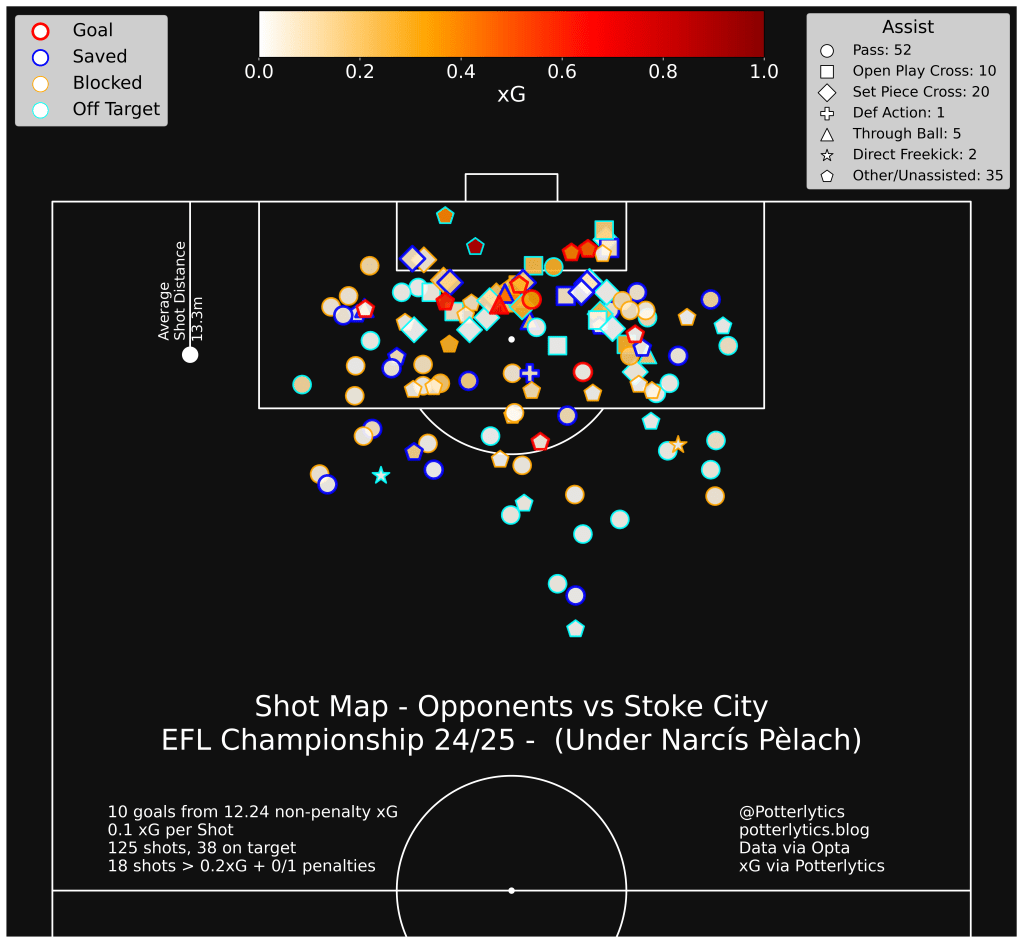
Despite scoring 10 goals and conceding 10 (+1 own goal) in the league since Pèlach took over, the stats behind those goals continue to tell a worrying story.
Of the 125 shots Stoke have conceded in that time (almost 46 more shots than they’ve taken themselves), 96 were from inside their own box, at a rate of 13.7 shots in the area per game.
Alongside that, Stoke have created (hugely caveated: according to my xG models) only just over half the xG of their opponents in that time. Over-performing their chances to the tune of almost 3 goals.
Their opponents, on the other hand, are underperforming their xG by 2 goals (excluding the missed penalty which was scored on the rebound by Kasey Palmer).
Having created only 8 ‘big chances’ compared with their opponents 18, 6 of Stoke’s 9 non-penalty goals have come from chances with a low xG (<0.1) compared with 4 of their opponents’ 11 goals.
Alongside that, their opponents have been unlucky with the quality of finishing they’ve shown, having scored 11 goals from a whopping 16.1 Post-shot xG (a measure of how likely a shot is to go in after it’s hit), compared with Stoke’s 9.1 PSxG.
All this points to a significant element of ‘luck’ in Stoke’s recent results, at least in terms of goalscoring for both themselves and the opposition.
Narcís Pèlach mentioned in his pre-Southampton press conference that stats need to be used with caution, reminding Sentinel ace reporter Pete Smith (<3 you Pete) that with conceding shots, you need to take into account the distance, position, and value of these shots. But I’m not sure that even with those caveats Stoke are in a good place.
Beyond the eye test of Stoke ‘feeling a bit weak’ defensively, this provides some strong evidence that they’re conceding too many chances, too many high-value chances, and too many chances in their own penalty area.
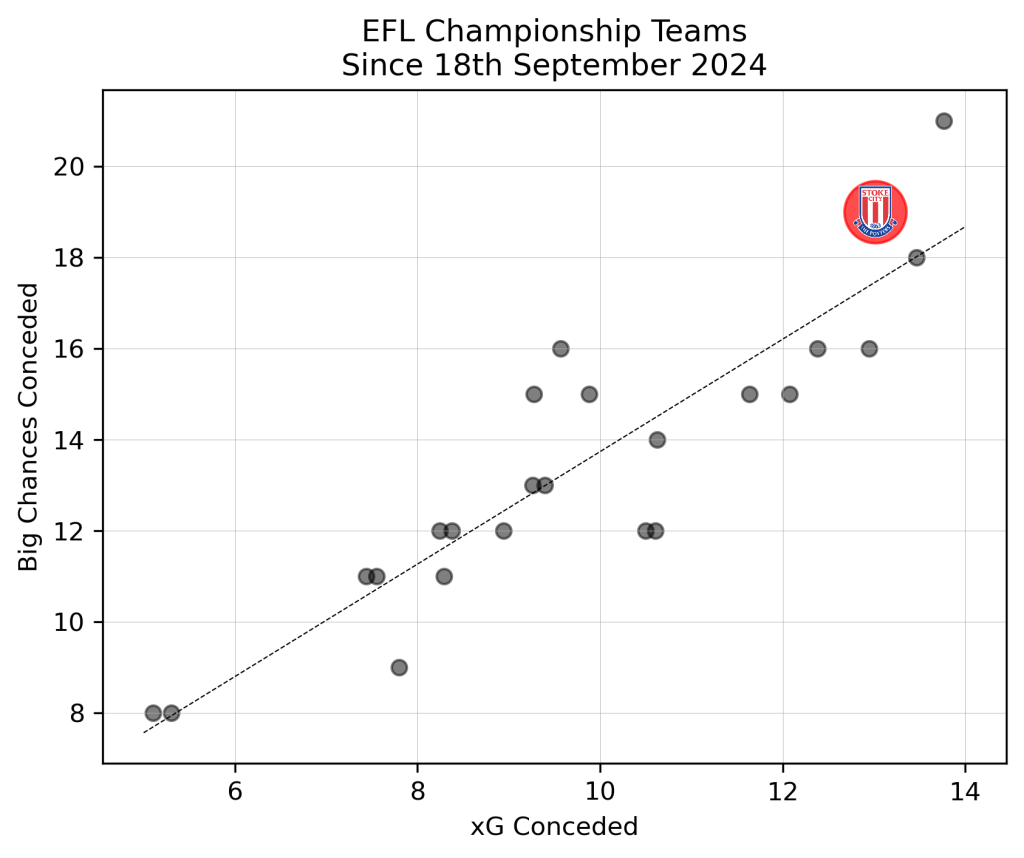
Whilst stats in the short term can be largely down to variance, it does indicate a likelihood that, if Stoke don’t arrest their defensive collapse over the last few months, then results will start to follow.
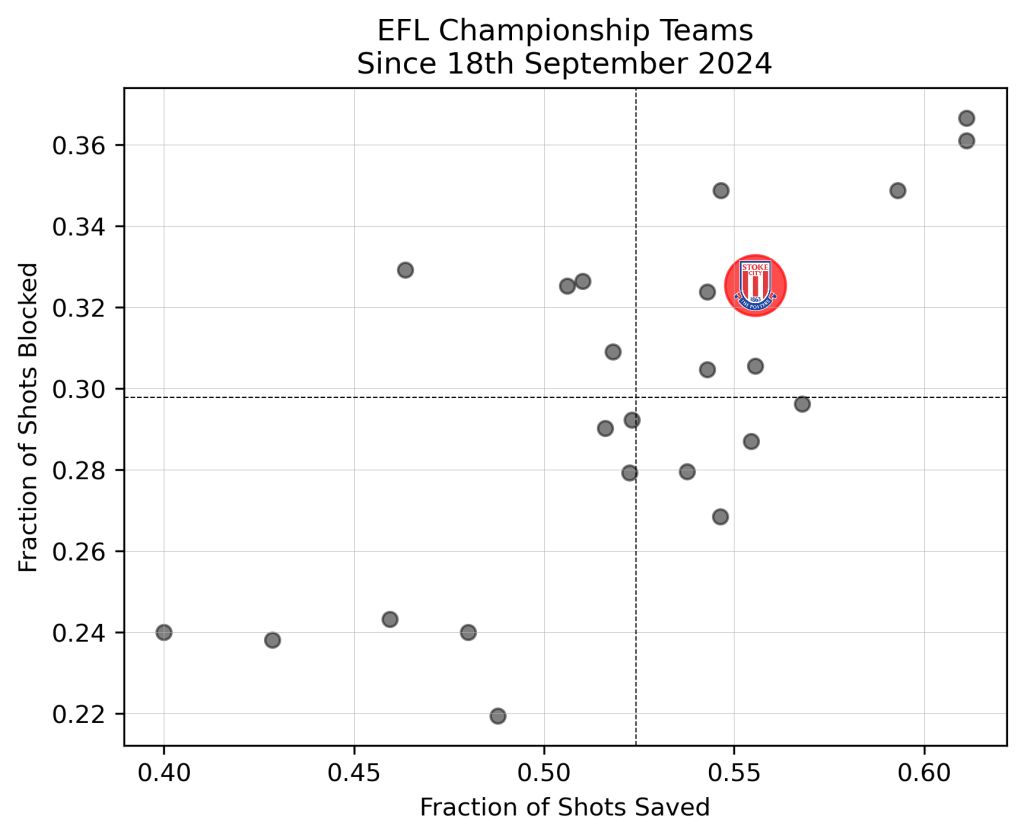
In Pèlach’s defence, there is some evidence that Stoke are improving how they defend the box, and they are above average in the fraction of shots faced that they block. This does indicate that players are more often behind the ball when the opposition take shots, but it’s also the case that Stoke are above average in the fraction of shots saved, which brings us nicely to our glimmer of hope.
A Helping Jo-hand From Vik
Undoubtedly player of the season so far is Viktor Johansson, who has replicated his utterly insane shot-stopping form for Rotherham in recent weeks.

Replace Viktor Johansson with the ‘average’ historical goalkeeper, and Stoke would be about 7 goals conceded worse off this season, (reductive and way-too-simple stat coming up) winning just 2 games, drawing 1, and losing every other match this season.
Whilst it’s fantastic to have a keeper like Johansson putting up these numbers, it is, again, worrying to be relying so heavily on him for results.
Midfield Muddle
Chief among Stoke’s struggles in recent weeks has been the ineffective nature of their defensive shape.
As Pèlach correctly summised recently, the players are learning a new defensive system, and it will take time for them to get used to that. As it stands, though, the off-the-ball shape of Stoke has only really shown signs of working against a very poor Portsmouth side, and 20-30 minute spells vs Norwich, Hull and Swansea.
And boy does it look poor when it doesn’t work.
The 442 shape out of possession allows for Stoke to challenge with 2 forwards, but the compact shape they employ deeper in the pitch is all-to-easily bypassed.
Initially we saw issues with teams playing around the shape under Schumacher, culminating in some strong criticism of the fullbacks, but now it’s all too easy for teams to play through Stoke’s shape centrally, with the 2 central midfielders consistently unable to block passing lanes and cover ground off the ball.
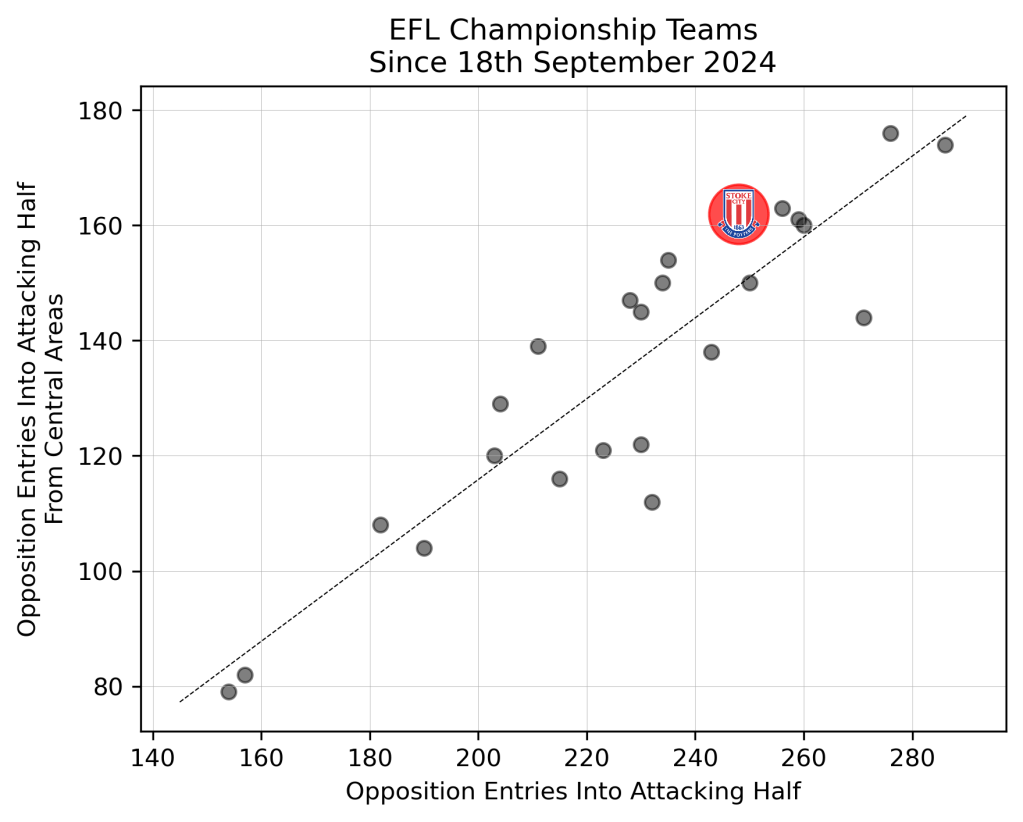

As shown above, Stoke are above average in their last 7 games in allowing the opposition into the final 3rd and the attacking half, but more visibly, they’ve allowed the 2nd most entries into the attacking half in central areas, and the 2nd most entries into the final 3rd from central areas of any team in the league.

And finally, we see just how passive Stoke are in these deeper, central areas. The compact and deep block means they are more likely to allow opponents the chance to deliver the ball into the box, and try to get bodies behind it, leading to the 2nd lowest number of tackles in the defensive 2/3 of the pitch.
And beyond that, the inability to press and block passing lanes centrally leads to their low volume of defensive actions in central areas.
But enough stats, let’s see a few examples:
(I’d like to do more, but thanks to Stoke’s highlights for showing goals and excitement instead of build up shapes for some reason.)
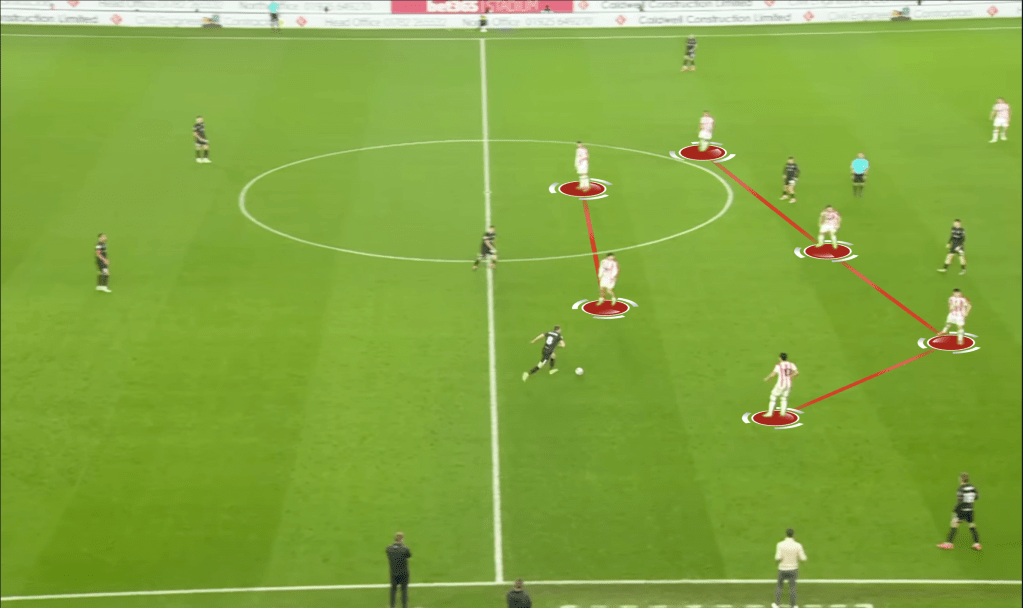
First off, we have a clip from the Bristol City game, in the build up to the 2nd goal.
Bristol City have the ball on the half way line with their midfielder, and Stoke are sat in their compact 4-4-2 shape. Immediately we can see the goal of Stoke’s shape, in covering the spaces rather than opposition players and maintaining the defensive shape.
But against strong opposition with intelligent attackers, especially if midfield players are reactive to opposition movement, this can lead to open passes through the lines for opponents, and we can see one of those opening up above.
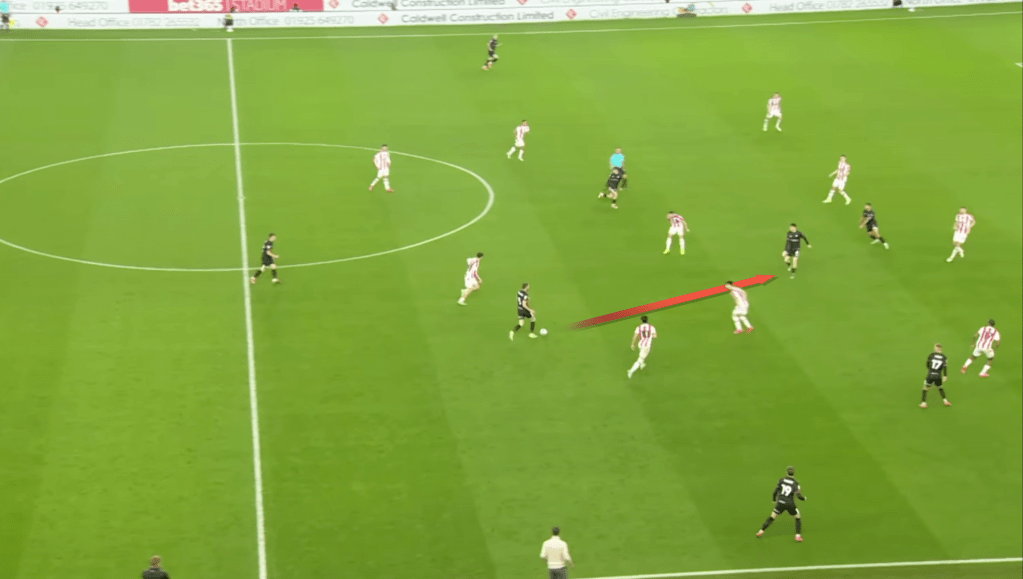
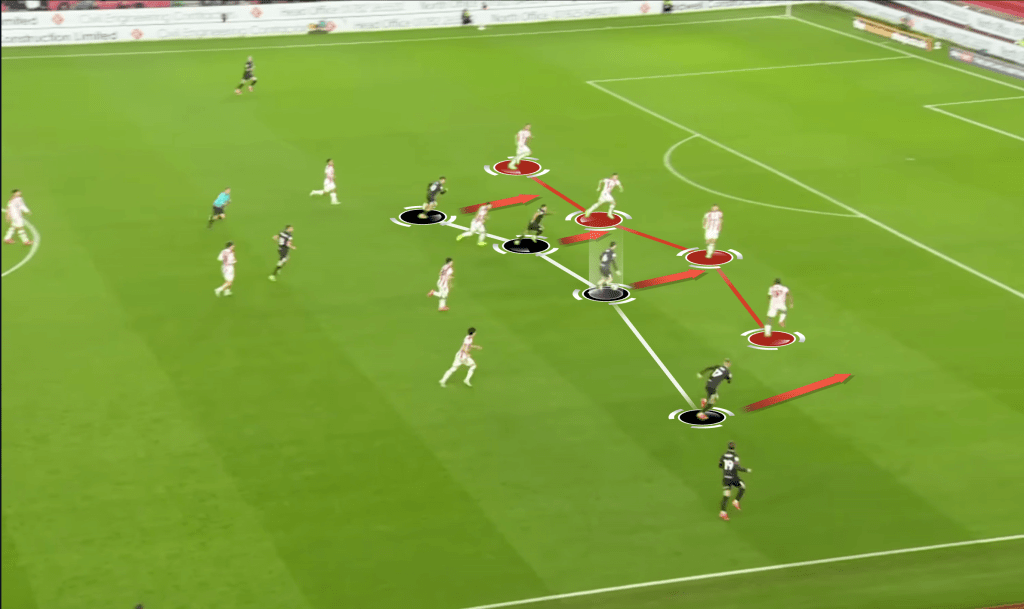
As the player drives forward, there is very little pressure from the left sided forward, and a simple pass opens up to the forward through the press. He takes the ball on the half turn, plays a pass to his right, and suddenly we see the right hand image.
From a position in front of Stoke’s compact and narrow shape, Bristol City have run forward 5 yards, played 1 low-risk pass through the lines, and are now 4v4 (with wide players available too) against Stoke’s back line.
But although I don’t think this is what Pèlach wants of his players in terms of the ease with which Bristol City play through, there is one positive here, in that Stoke’s defence closes the space well and should clear the ball. An unfortunate clearance and error plays Wells through to score in the end, but the chance was largely squandered before that.
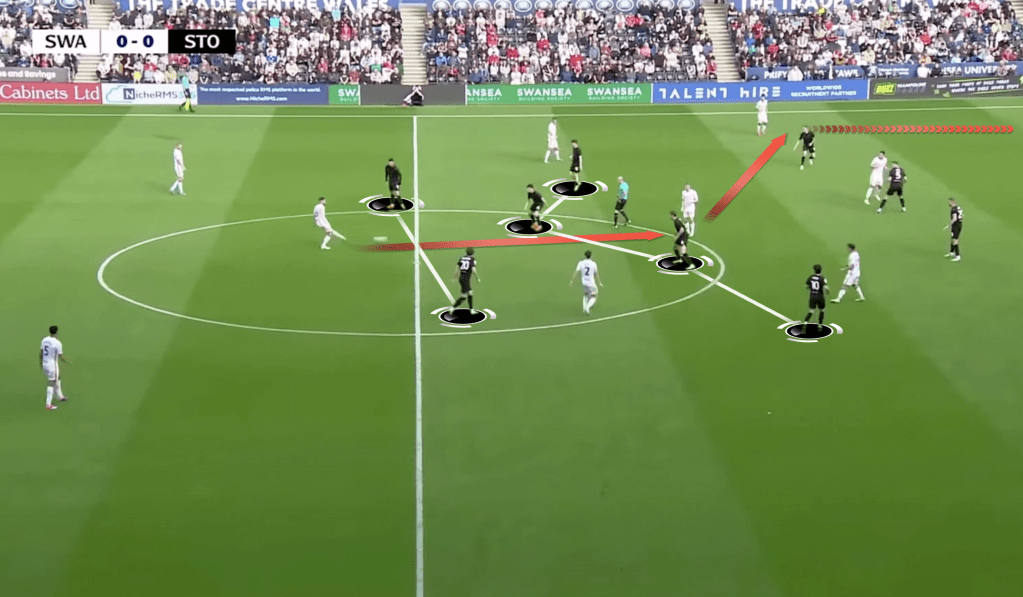

Above we see a similar situation but with a better outcome in the Swansea game.
A simple pass is played through Stoke’s 1st and 2nd pressing lines again, and the ball is played wide.
This reactive press, in which Stoke allow teams to break their lines, has again led to a 2 pass move that goes from the centre circle to inside Stoke’s box in ~8 seconds.
Although this time we do see some positives, and probably the area in which Stoke’s defending has been fairly good in recent times. As the Swansea player arrives in the area, Stoke have 3 of their midfield 4 sitting on the edge of the box to cover pullbacks, and the leftmost 3 of their defence are sat covering the danger areas of within the width of the 6 yard box.
Wilmot presses the player on the ball, forces him wide, and the ensuing cross is easily cleared by Rose.
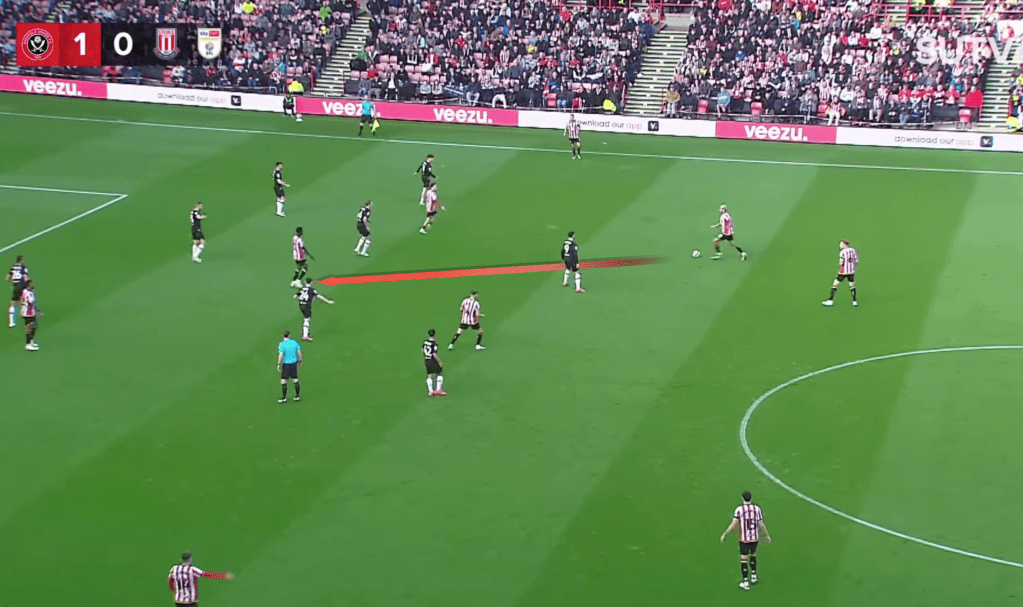

We see a similar issue rear its head above in the game against Sheffield United.
Rak-Sakyi makes a simple movement into the space between Burger and Moran, and a relatively low-risk pass from Souza sees him able to turn and attack Stoke’s defensive line.
After a few body feints, Stoke manage to close the space and squeeze the ball out to Johansson, but again we see a situation where the opposition can run at Stoke’s defence with one or two simple passes through the lines.
Before You Get The Pitchforks Out
But as mentioned above, I don’t think Pèlach is happy with that issue. He’s mentioned, rightly, that Stoke have greatly improved in defending their own area and keeping an opponent out when they sit deep.
But what we haven’t seen is a Stoke side that can get the ball back when the onus is on them to find a more aggressive pressing shape.
Defensive improvement against Southampton was great for momentum and morale, but I don’t think that keeping Russell Martin’s horseshoe-ball at bay with a back 10 is necessarily a tactic that will be indicative of anything in the Championship.
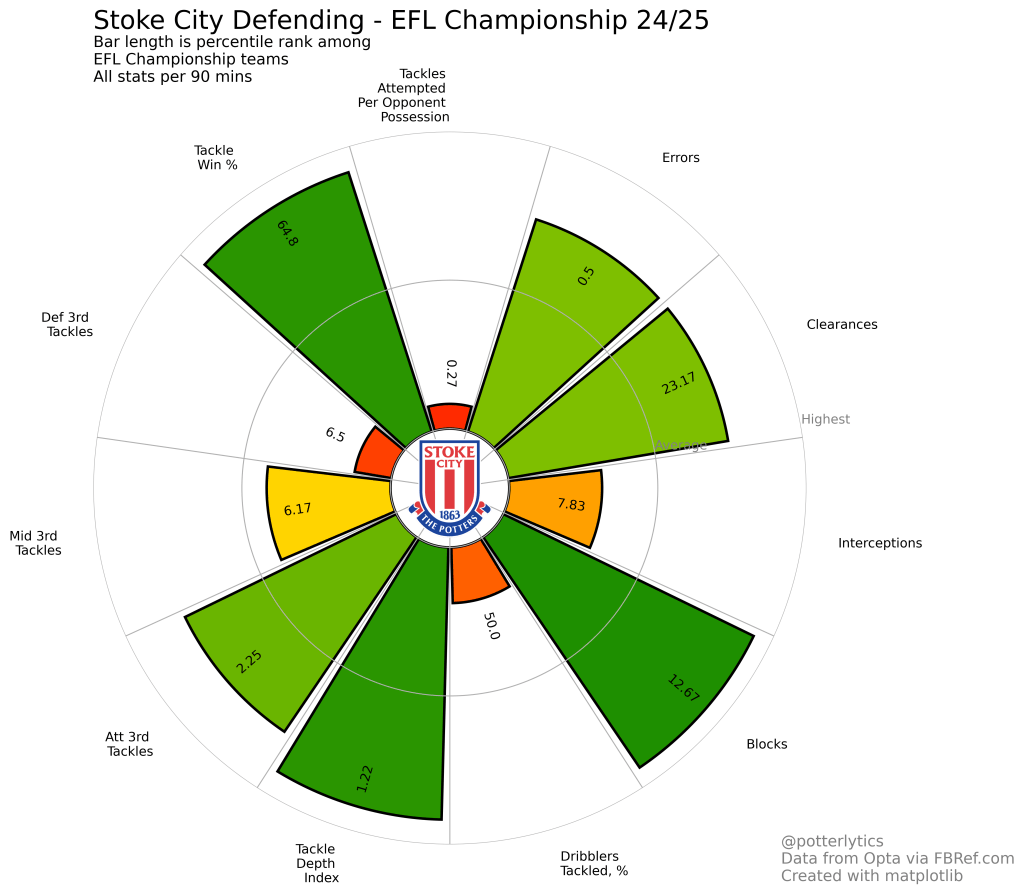
Stoke’s overall defensive numbers show this, with a significant number of tackles in high areas, but one of the lowest numbers of tackles attempted when adjusted for opposition possession.
Stoke’s pressing unit is based heavily on occupying space and frustrating the opposition, with lots of blocks and clearances, and a very high tackle win % suggesting they only attempt to win the ball back when it’s very clearly on.
This hybrid pressing structure, with some aggression high up the pitch, dropping very quickly back into a solid (in theory) shape, had great success against Portsmouth, but I fear it’s too passive to be consistently successful at this level.
Whilst you can look at the goals Stoke have conceded recently and count them unlucky, or down to individual mistakes, I can’t escape the feeling that they’re bringing some of this luck on themselves with such a passive pressing plan.
Allowing the opposition to so easily drop you into a low block may well mean you defend the box better, but you also give them the opportunity to get lucky in very dangerous areas, and your defenders the opportunity to make mistakes in dangerous areas too.
I think immediately of examples such as that Wells goal above, Norwich’s goal, and Campbell’s goal for Sheffield United.
The hope has to be that as the players improve in the low block phase, which I do think is happening, they’ll start to find their feet in the middle and final 3rd, and especially important is that we see an improvement in what they do in possession too.
The best way to defend is to have the ball, and that hasn’t been a strength of Stoke’s either in recent weeks.
But, at 2200 words in, I can’t start an in-possession section now, even if I want to.
While Pèlach has been put under such massive pressure by the circumstances of his hiring, and a strange confidence from some that this side should be pushing for the play-offs despite being relegation candidates not 6 months ago, this article shouldn’t be take as a criticism of him.
There are issues, sure, but he’s a brand new manager at a club that has taken down far more experienced bosses than him.
Today’s game (sorry if you read this late) is massive, though, and as a side looking to improve, you’d think this would be a great opportunity to show what they’re learning.
Thanks to any and all readers, and please feel free to comment and follow on Twitter at @potterlytics. If you want to hear myself and Lucas Yeomans discussing each Stoke game alongside some exciting interviews, head over to the Cold Wet Tuesday Night Podcast at BBC Sounds.
Should you wish to donate to help with the running costs of the site, and the data subscriptions we use, please feel free to visit our donations page here or subscribe to the Patreon linked above. Any and all help is very much appreciated!
George
 Potterlytics