
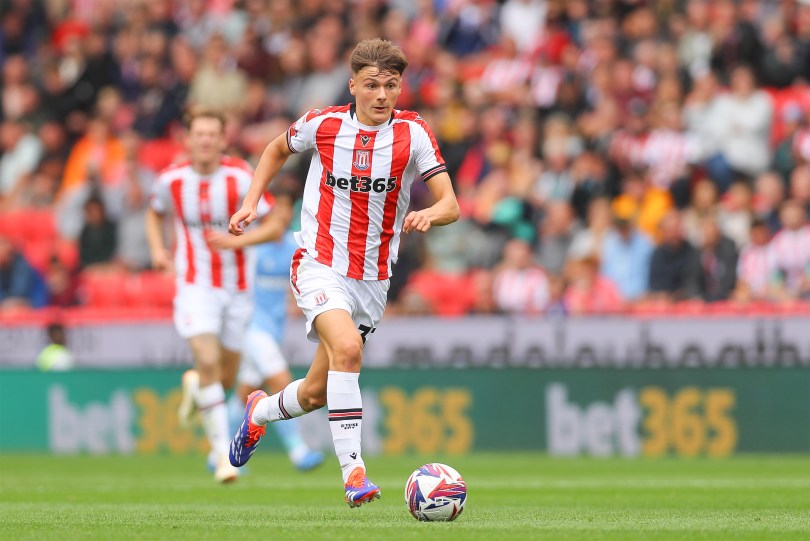
Well, that was an unexpectedly lovely Saturday lunchtime out, wasn’t it?
In my customary “I promise I’m going to write more stuff” first piece of the season, let’s take a deep-ish dive into Stoke’s opening day victory against Coventry, and in particular how they solved one of the issues we saw against AZ Alkmaar last week, the build up play.
Risk = Fun
First up, something I’d been critical of in the Alkmaar game was the willingness of Stoke players to take risky passes into the midfield in the build up.
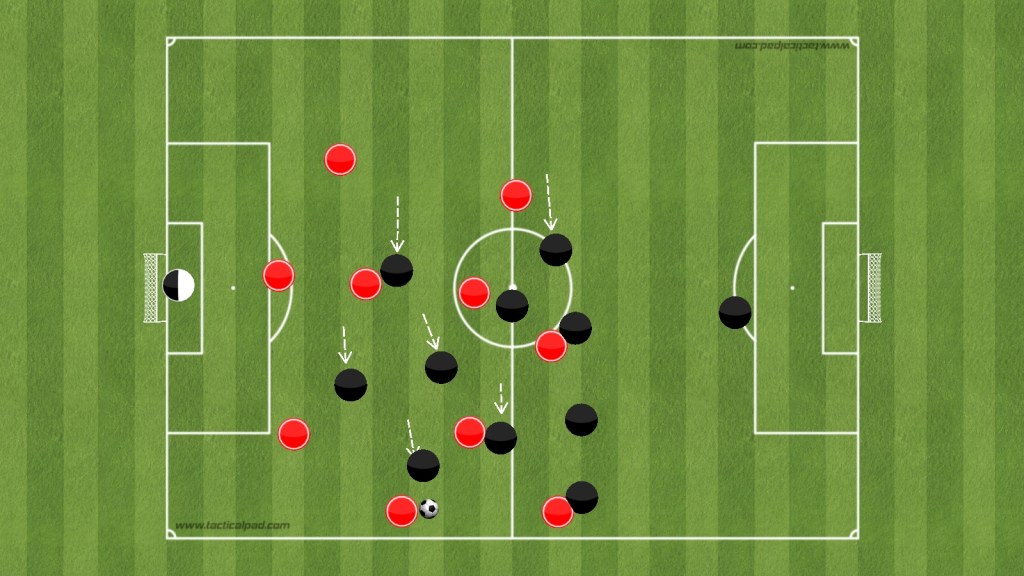
In large part thanks to AZ Alkmaar’s compact and narrow shape, Stoke were forced into playing wide into full backs in the build-up. This meant that Stoke ended up trapped on one side of the pitch as AZ narrowed off towards the ball.
Although the highlights of the game are pretty sparse (thanks Stoke), and so I can’t get a live image of this, here’s a quick example to explain what I mean:

Not being a Europa league opposition aside, Coventry weren’t able to set the same trap for Stoke, particularly in the first half, and we saw a much wider range of options available in the build up.
Alongside more midfield movement and better positioning to find space both between lines and in between centre mids and wide players, we also saw a significant improvement in the willingness to attempt passes through the lines from defence and midfield.
One Step Forwards, Fewer Steps Sideways Or Backwards
Most important, to me, is that these were the first passes our players looked for during the build phase. Wilmot and Gibson in particular were consistently able to pick out players ahead of them when the pass was on, and although recycling possession is still crucial, the balance of finding gaps and keeping the ball was much better through the first half.

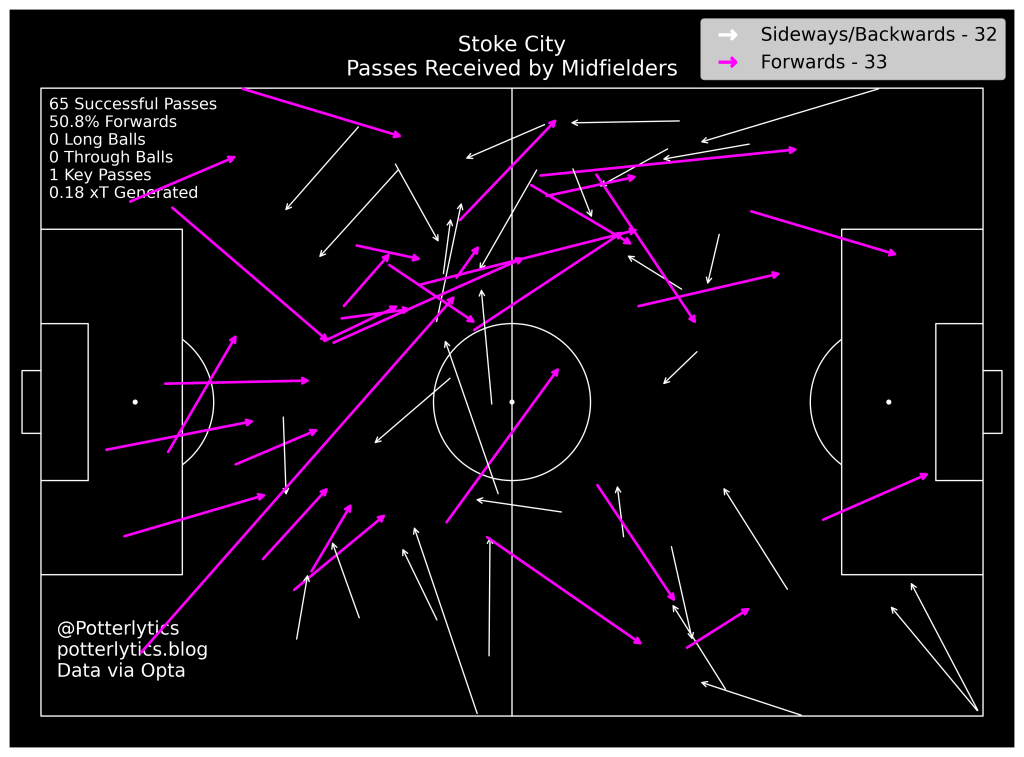
Shown above are the successful passes from centre halves, and received by central midfielders, in the game.
On the left, we can see that over 40% of the passes from centre halves were forward, and we can see that possession recycling was generally either back to the keeper (indicating pressure on the ball), or into wider areas in an attempt to progress.
We also see a significant number of passes into the middle of the pitch, playing inside to midfielders or forwards dropping into half spaces and between the opposition lines. And just a smattering of those oh-so-lovely diagonals from Wilmot out to the wide areas.
On the right we have the other side of the coin. Laurent, Thompson and Burger, all consistently taking up positions to receive the ball from deeper areas, with forward passes making up more than 50% of the successful attempts to get them on the ball.
And as a slight aside, we also see that a large proportion of those passes are made inside the pitch to the centre mids. We didn’t see as much of the centre mids dropping into full back areas as the end of last season, although I think that may be a result of the space that was available between lines in this match in the first half, alongside the lack of control Stoke had in the second half to build a longer possession phase.
What about the actual game?
But who cares about graphs and plots, right? (Me, I do) Let’s take a look at some much more fun examples of this impressive line breaking through the game.
Click on the images to zoom in.
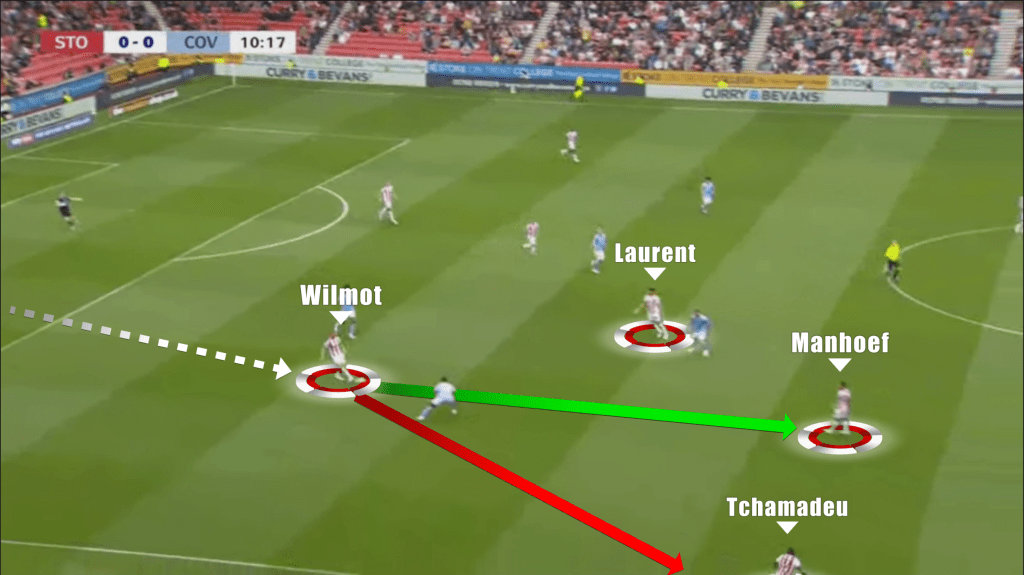
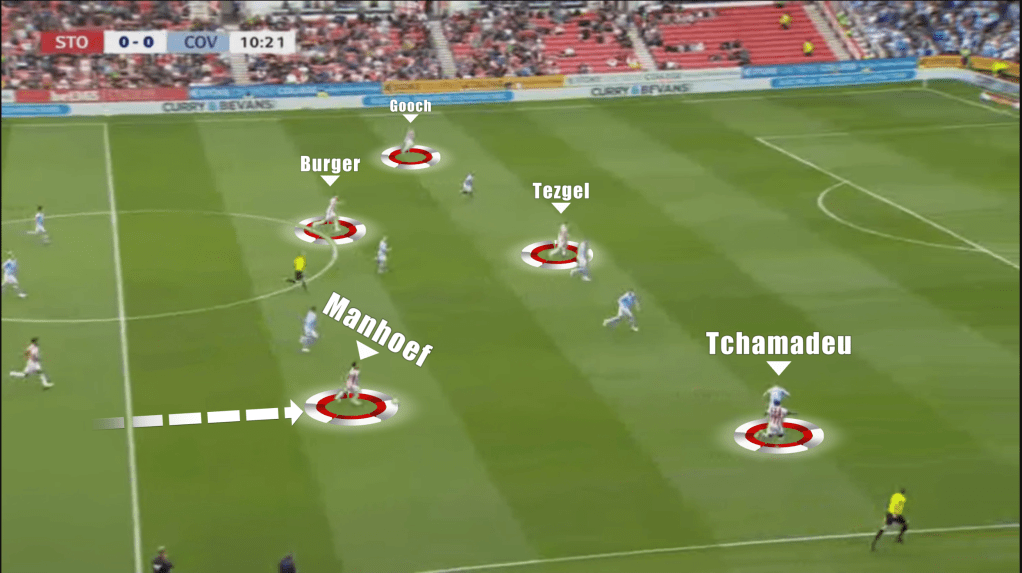
Here we have an early goal kick from the Potters. Gibson plays it short to Johansson, who plays it into Wilmot just ahead of the 6 yard box. As Coventry sit off the defender, largely aiming to cut off passes between centre backs in the same manner as Troy Parrot for AZ Alkmaar, Wilmot takes the chance to drive forward with the ball into the space.
Several times through pre-season, the player on the ball would see that Laurent is marked, and Manhoef would be on the front line, unable to receive the pass. In that case, Wilmot would’ve played the red arrow pass out to Tchamadeu, where he may have been trapped in the wide area with only a marked Manhoef ahead.
Instead, we see Manhoef drop between the lines as the Coventry wide player presses Wilmot. This means Tchamadeu can bomb on down the wing, occupying the opposing full back. As Wilmot plays the pass into Manhoef, the first line of the press is broken, and he can turn with the ball, driving into the opposition half.
Fan-Tez-Stick (Sorry)
And it wasn’t solely the midfield dropping in to make this possible. We also saw the introduction of 18 year old Emre Tezgel in his first league start for Stoke, and although he had just the one major chance (two if Manhoef hadn’t been so determined to get a shot away when Tezgel arguably had the better positioning), he showed maturity and a reading of the game that puts him well in contention to start next Saturday’s game.

Although it may seem like he wasn’t hugely involved, he did create a big chance from the header, and set up a shot for Manhoef with some battling play down the wing. Alongside that, those actions in deeper areas were a show of his quality with back to goal, and his ability to drop into space to receive, another helping hand in that build up.
Click on the images to zoom in.


Here we see Stoke work a ball out to the full back, but in a very different manner to the Alkmaar game, and with a much more positive outcome.
Simms continues to try and stop the pass between centre halves, with the midfield behind him in a compact block on the ball side of the pitch. The pass into the 6 (Thompson in this case) isn’t on, but movement on the forward line from Tezgel, dropping in from a high position, allows Gibson to play a pass through the block.
Tezgel lays off a lovely ball back to Laurent, who can now find Tchamadeu on the other side of the pitch, in significant space, where he can drive forward and lay in Manhoef behind the Coventry defence.
We saw in that first half, a significant improvement in how Stoke switch the ball from one side to the other, shifting Coventry’s block from side to side quickly in order to find space.
Not only that, but there was even more variation in how they managed to do it.
Ben’s Back, Baby
And then, finally, we saw the return of the lovely diagonals.
Click on the images to zoom in.


Here we see a slightly different variation, but the principles of playing forward remain. Initially, Johansson plays the pass into Laurent in the holding role, instead of the usual ball into wider centre backs.
Coventry dropped off and allowed Stoke to keep it in these areas (something they shifted after half time, which led to the change in momentum). As Laurent turns, he has a compact block of Coventry players in front of him, so now plays the wide pass into Wilmot, who drives again towards halfway.
Again, the pass to Tchamadeu would be on, but Wilmot attempts the riskier, more fun option of the raking switch across to Gooch, who can run at the opposing full back as they shift across.
In that last frame we can see another aspect of the build, with Burger and Tezgel both occupying defenders on the last line, trying to pin the Coventry defensive line deeper in the pitch.
I’m well aware the principles of playing forward and trying to break lines are almost universal, but I am still delighted to see Stoke take those risks in games consistently, particularly after the AZ Alkmaar friendly.
Long may it continue, onto Tuesday!
Thanks to any and all readers, and please feel free to comment and follow on Twitter at @potterlytics or watch out for the new long-form video content at Patreon.com/potterlytics. If you want to hear myself and Lucas Yeomans discussing each Stoke game alongside some exciting interviews, head over to the new Cold Wet Tuesday Night Podcast at BBC Sounds.
Should you wish to donate to help with the running costs of the site, and the data subscriptions we use, please feel free to visit our donations page here or subscribe to the Patreon linked above. Any and all help is very much appreciated!
George
 Potterlytics