
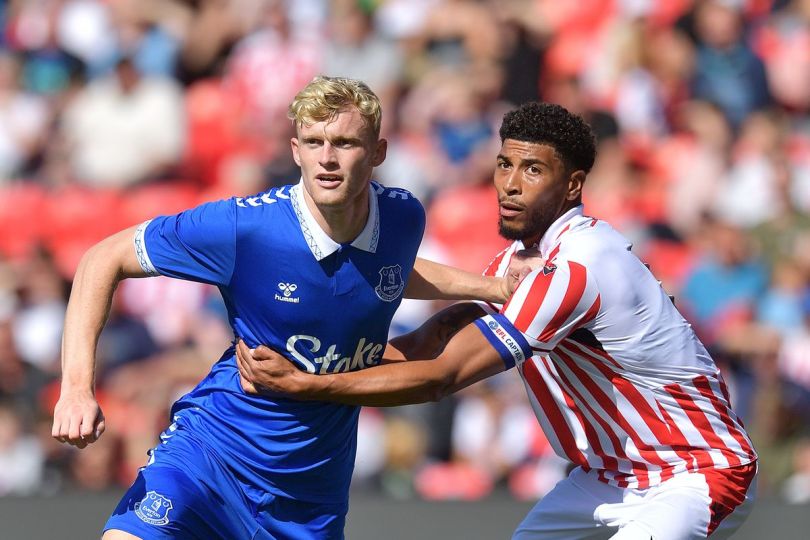
Well, here we are again, fancy seeing you here, et cetera, et cetera, ex chetera.
After a few weeks of nervous terror, Stoke’s transfers fell into place, and an explosion of signings were announced between the Benidorm camp and tomorrow’s fixture.
We’ve seen no fewer than 11 new(ish) faces into the squad at time of writing, with 7 permanent signings, 4 loanees, and even some transfer fees spent!
But how are we expecting to set up? What’s the new blueprint (new-print?) for this season in another revolution at the club? Let’s take a look into those signings, alongside some interesting clips from the Everton pre-season game, to see if there are any indicators to Alex Neil’s 2023/24 Stoke side might approach this incredibly long, exciting, depressing, hopeful, and soul-crushing Championship.
The New Boys
So what does the squad look like in a simplistic idea of the formation we expect them to play? If someone new has signed since this, please don’t shout at me.


Josh Onomah is marked (T) as he has not yet signed permanently. Campbell/Brown are marked in grey on the right wing, as they can both cover there if needed.
It’s a fairly safe assumption that Stoke will be, at least in spirit, playing in a 433 variant. Of course, during games, there will be tweaks to this in and out of possession, but this gives us a basis from which to judge the depth.
In comparison with the squad on our last viewing, shown to the left above, it’s night and day. The majority of first team spots have at least one main option, many of whom fit the mould mentioned in our last article (The Great Rebuild – What’s The Plan?).
My first plan for this article was to go through each signing and position individually, but I think that may be both overkill and boring, so let’s take a look at the big picture of what to expect from tomorrow’s game and beyond.
The Basics – Build-up
One of the exciting parts about these new signings is the quality of passing we have in the back line during build-up.
I mentioned in an article long, long ago, that a key part of Alex Neil’s style (and many managers, in fairness) is to make the pitch as wide as possible when in possession. Last season we often saw Ki-Jana Hoever stood on the right hand touchline during build-up phases, while Tyrese Campbell occupied the left-hand touchline.
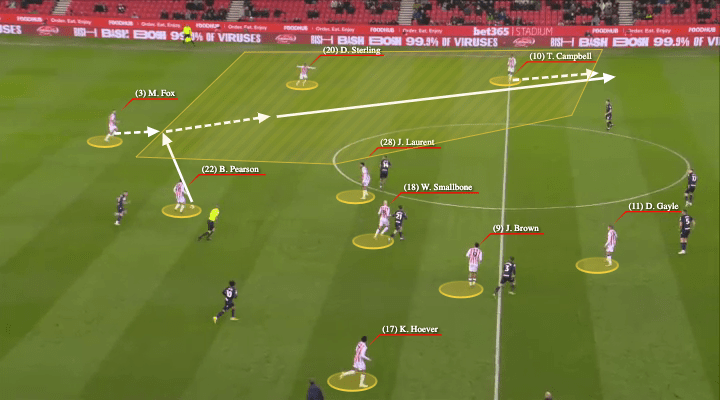
Not only does this create space centrally for other players to occupy, and expand the opposition defensive shape, it also allows for quality passers of the ball to use quick, long-range diagonals to get the ball to wide players in space, who are able to square up the opposing full back.
If a defence stays compact out-of-possession against Stoke, they make these diagonals easier to wide areas, and if they expand to mark the wide men, they leave space centrally for Stoke to attack into.
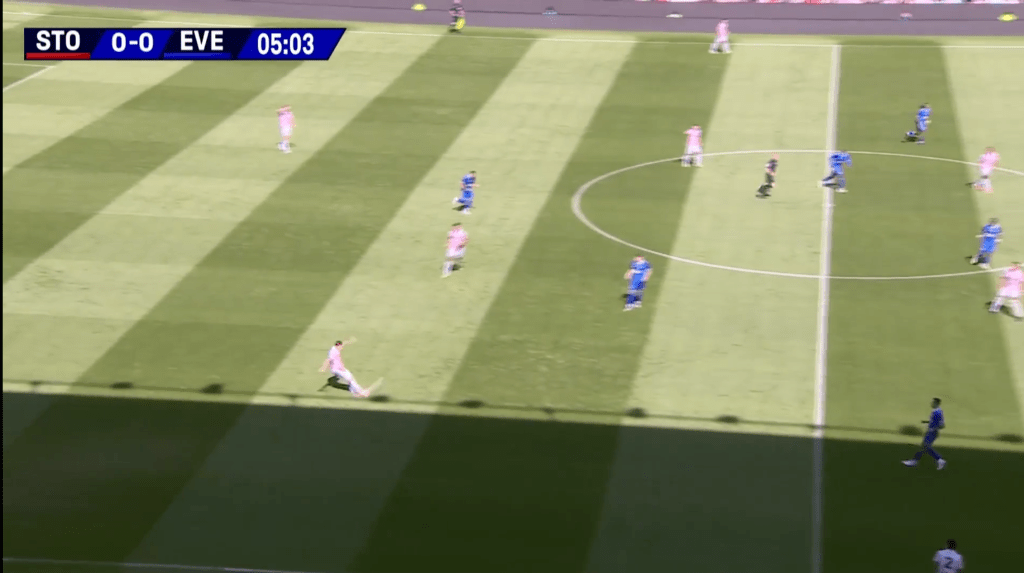
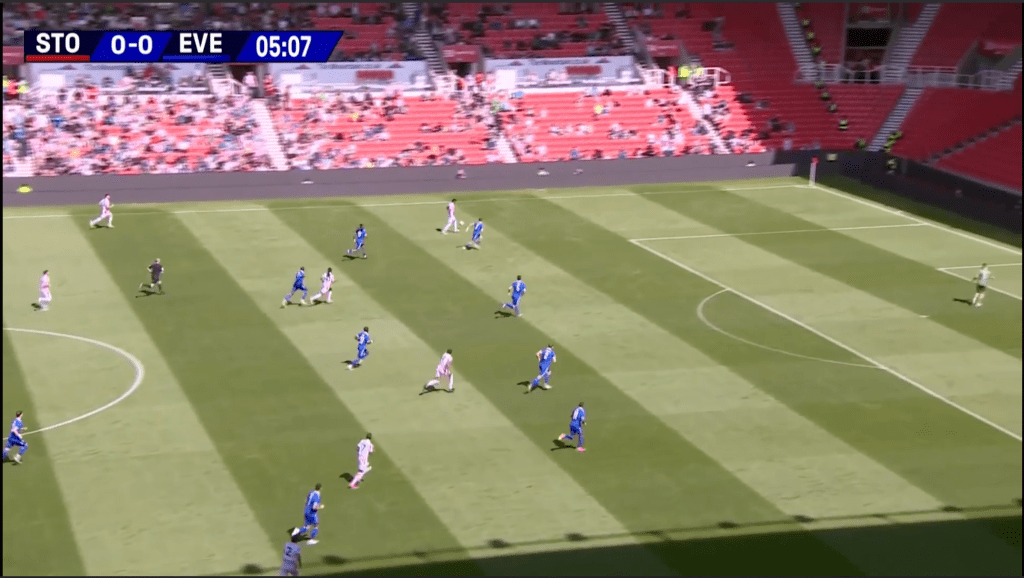
The quality of pass in defence was only generally something Ben Wilmot could provide, but we saw vs. Everton that this role is taken up by Michael Rose, who appears just as adept at progressing the ball through the lines.
In fact, it’s shown in both Rose and his new centre half team-mate Luke McNally’s passing from last season with Coventry.




Both players have consistent forward passing down the near-side wing, and both complete passes (although fewer) across the field to the far wing.
This represents a vast improvement in the build-up passing from the back line from last season, when games often relied on Wilmot to be able to break the first line. If he couldn’t do it, it often meant there were some incredibly frustrating hoofs forward, and passes backwards.
This season, we can hopefully be more confident that we have the quality to vary the build-up passing, and start to break through those presses in ways we couldn’t reliably do last year.
The Shape In Possession
We’ve seen more than one shape trialled over the course of pre-season, which I think is indicative of the variation we’re going to see throughout the year.
Against Notts County, we saw a very attacking back 4, with the 2 centre backs sat deep and spread wide in build-up, with both full-backs (Macari and Tymon) pushed very high up the field.
The addition of Ben Pearson is likely to make this shape more viable in league games, and we did see it used last season. Pearson’s role as a ‘forward sweeper’ just in front of the back 2, cutting out transitions for the opposition and playing as a single pivot, allows Stoke to put men forward without being too terrified of the counter.
Against Everton, we saw a slightly different build-up shape, that utilised a double pivot of Thompson and Laurent.
This gave a little more solidity when dropping deep, but also gave Stoke a ‘box’ from which to build in the first phases of play. In a game where possession was less easy to come by, and the quality of opposition made forward passes into the middle more difficult, this gave Stoke more players in the centre of the pitch to play through the lines should they try to do so.
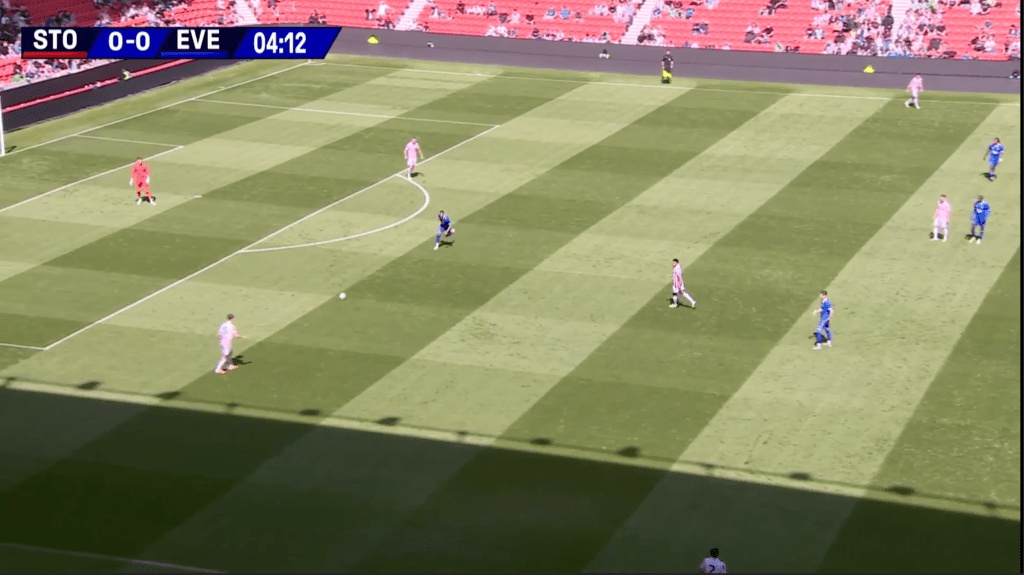
It will be interesting to see whether this move to a double pivot is solely to accommodate the lack of Ben Pearson’s defensive ability in this game, or whether we will see a similar move for tough matches against high-level opposition who will dominate possession.
My instinct is that Pearson’s absence was the big factor in this, but with some big teams in the league looking to dominate with quality pressing players, we may see in-game variations to this effect if build-up is not working.
Alex Neil’s Off-Ball Terrors TM
Perhaps the most impressive area of Stoke’s game during last season’s oh-so-brief renaissance was the intensity of the press, and the traps they managed to set even against quality teams.
I don’t expect to see much of a change to what we saw then in the coming season, and despite the high quality opposition, we saw some of that against Everton too.

In the above still frame, we see (I’m so sorry for the picture quality, pre-season makes clipping difficult!) Jacob Brown take up the forward role of providing a curved pressing run to block off passing lanes to one centre back.
Chiquinho and the apparently light-speed Tyrese Campbell are sat between the full back and centre back on each side, ready to trigger a press once the ball is played to their side.
Finally, we see Daniel Johnson man-marking the number 6, taking Will Smallbone’s role in stopping the central ball through the press.
Behind this line, Stoke are sticking with the same, brave man-to-man marking behind that first press, and the first 20 minutes of the Everton game showed that the goal is to snap into tackles to make sure initial duels are won.
As with last season, Neil trusts his players to win 1v1 duels, and those new players fit the mould of strength, agility, and intelligence needed to time challenges and win that ball.
If you want to read more about the pressing unit of last season, check out the article on it here: Anatomy of a 10-game Revolution (Part 1) – Stoke’s New Blueprint
Creating Chaos
The last part is the most exciting, though.
Neil has said many a time that he’s looking for variation in attack, through both variation in number 9s (the dreaded target man moniker), but also through wide players who are strong on the ball and keen to take their man on 1v1.
Well, it appears this window is a bit of a ‘mission accomplished’ on that front.
Where, in previous seasons, we saw the ball moved wide only to be passed back to Morgan Fox to cross from deep, we now see players on both side squaring up the full back and finding a way past them.
The additions of Chiquinho and Vidigal have meant that Tyrese Campbell no longer has to be the only creative force against deep defences, not only taking pressure away from him, but also giving defences two wings to have to defend against.
Those diagonals and quick switches of play become much more dangerous when both wings are manned by players who excel in 1v1 dribbling and creating chances.

We see in the image above that this makes a slight tweak to Stoke’s attacking shape, where in matches last season, Brown would take up his position between the full back and centre back, with Hoever charging forward to fill the wide space behind the full back.
This time, Brown keeps his space, but as a central striker, this allows Chiquinho to push into the wide space, and Johnson to press into the space between the opposite centre half and full back.
A front 5 including two wingers, two 8s, and the centre forward is much more dangerous than relying on full backs to attack opposition defences themselves, especially when you have centre forwards like Brown, Mmaee, and Wesley, with stronger movement in the box than a slightly ageing Gayle.
It also brings the additional benefit that full backs can overlap, underlap, or sit deeper for their wingers, rather than being the width-providers themselves. This versatility means Hoever and Tymon (presumably) should be able to contribute much more effectively to the attack.
A Strike Force?
But, going back to the two centre forwards Stoke have signed, we see more of that variation Neil has mentioned so often.
Ryan Mmaee in particular represents an interesting continuation of Dwight Gayle’s somewhat unexpected role as a deeper striker in 2022/23.
His decreasing pace overall, and specifically lack of quick movement within the box led to him dropping deeper and trying to affect the game more in the build-up, and this seems to be something Mmaee can excel in.
A strong, quick, technical striker who is keen to link the play and create for others alongside scoring himself, Mmaee’s quality on the ball is something Stoke have missed when breaking quickly in transitio.
Add onto that, the ability to pick out sharp final passes has been a big problem in facing the dreaded low block opposition of the Championship.
I definitely recommend this thread from @HCfootball01 on twitter for more info on Mmaee: https://twitter.com/HCfootball01/status/1684511415090937857
But what about those pesky games where we need the ball in the box but we just don’t have the presence to win it?
Step forward, Wesley.
We only have to take a look at his shot map from his opening Premier League season with Aston Villa to see where Wesley’s qualities lie.
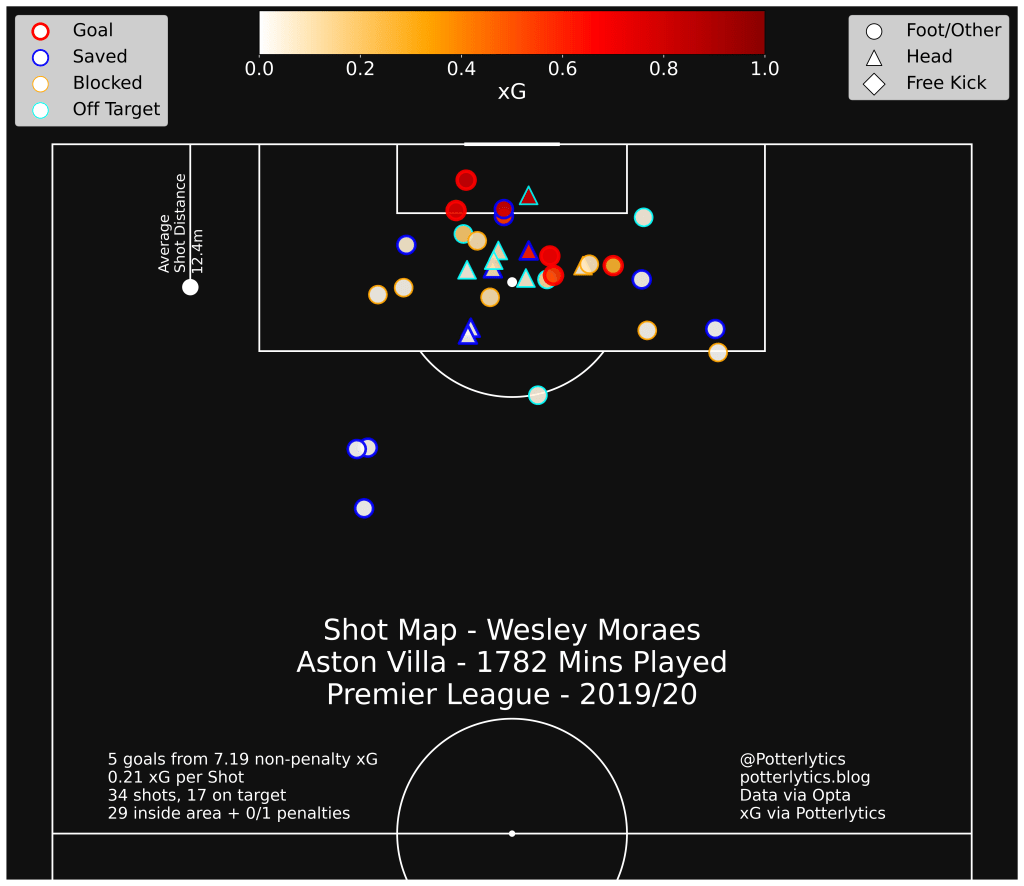
The average distance being as low as 12m from goal, taking as high as 0.21 xG per shot, with only 5 of 34 shots from outside the area, and the majority being between the penalty spot and the 6 yard box show clearly that Wesley is a traditional box threat.
He’s also a strong presence outside the box, holding the ball up and bringing others to play.
I think we’re most likely to see him in games where Stoke need the ball in the box quickly, and where playing through the lines in build-up may not be possible.
Adding the clever movement and engine of Jacob Brown, and even the return of Dwight Gayle from injury to this front line makes for a big part of that variation Neil has so often asked for.
So, are we excited? Absolutely. Will hope kill us again? Maybe. Will we get swept along in it all anyway? Of course.
Thanks to any and all readers, and please feel free to comment and follow on Twitter at @potterlytics.
Should you wish to donate to help with the running costs of the site, and the data subscriptions we use, please feel free to visit our donations page here. Any and all help is very much appreciated!
George
 Potterlytics