

Hello and welcome to the inaugural Potterlytics award post!
I’ve probably slightly ruined the surprise with the title, but I’m not the type to leave my audience (both of you) on a cliffhanger.
Now a post that just says who the award is going to would be boring, and as you’re all well aware, a post under 2000 words would be a big shift from the norm for this blog.
As a result, this is not only an announcement of the award, but we’re also going to go into the trademark Potterlytics depth to show our working.
In this post we’ll be looking, both statistically and with analysis of clips, at just why I believe Ben Wilmot deserves this most coveted of awards.
So, huge congratulations go out from all one of us here at Potterlytics to Ben Wilmot, the first ever Potterlytics Potter of the Season!

Big Ben
So, why Ben? Well as always here at Potterlytics I like to dive deep into excruciating detail to explain my opinions and analysis.
Let’s start off simply by looking at a few of the metrics Wilmot ranks most highly in.

We can see that he excels at ball recovery, tackles and interceptions, and attacking 3rd tackles, alongside his ball progression through carrying, passing, switching, and shot-creating actions (the two offensive actions leading directly to a shot).
The picture this paints is one we are familiar with, and for me this passes the eye test.
Wilmot appears to be a centre back who is strong at recovering the ball and winning defensive duels, and a ball-player who is very keen to progress through the lines, and carry the ball forward.
Let’s delve a bit deeper into these two sides of our Potter of the Season.
He Wil Mot Let You Down
Now, we all know that defenders have to be able to defend. Stoke are not a side who are going to keep the ball for 90 minutes and avoid all defensive work altogether.
In fact, even Man City, as we’ve seen in recent weeks in particular, are starting to evolve into a side capable of sitting off the opposition and absorbing pressure. They’ve arguably become an even better side as a result, and are in with a chance of a treble at time of writing.
Centre back quality is notoriously difficult to measure, and there are constant arguments and debates among stats-nerds about which metrics accurately measure whether a centre back is doing their job correctly.
You might say ‘oh come off it, tackles and interceptions, easy’. Well, my dear sweet little lamb, welcome to the world of football being more complex than you ever wanted it to be.
Tackles and interceptions can be a good measure, but they can also be skewed, especially when not adjusted for possession, team style, and defensive role.
For example, John Stones is only in the 34th percentile for tackles, and in the bottom 6% of players for interceptions. He is clearly an excellent defender, but the side he plays for skews the numbers greatly.
That being said, for Wilmot, we are looking at a player in a middling side, with just over 52% possession on average. We can, therefore, use some of these metrics to build a picture.
As always, it’s never a complete explanation, but we’ll use clips and context to build up a profile. Let’s start with our trusty radial bar chart to get some basic defensive statistics in comparison with other Championship centre backs.
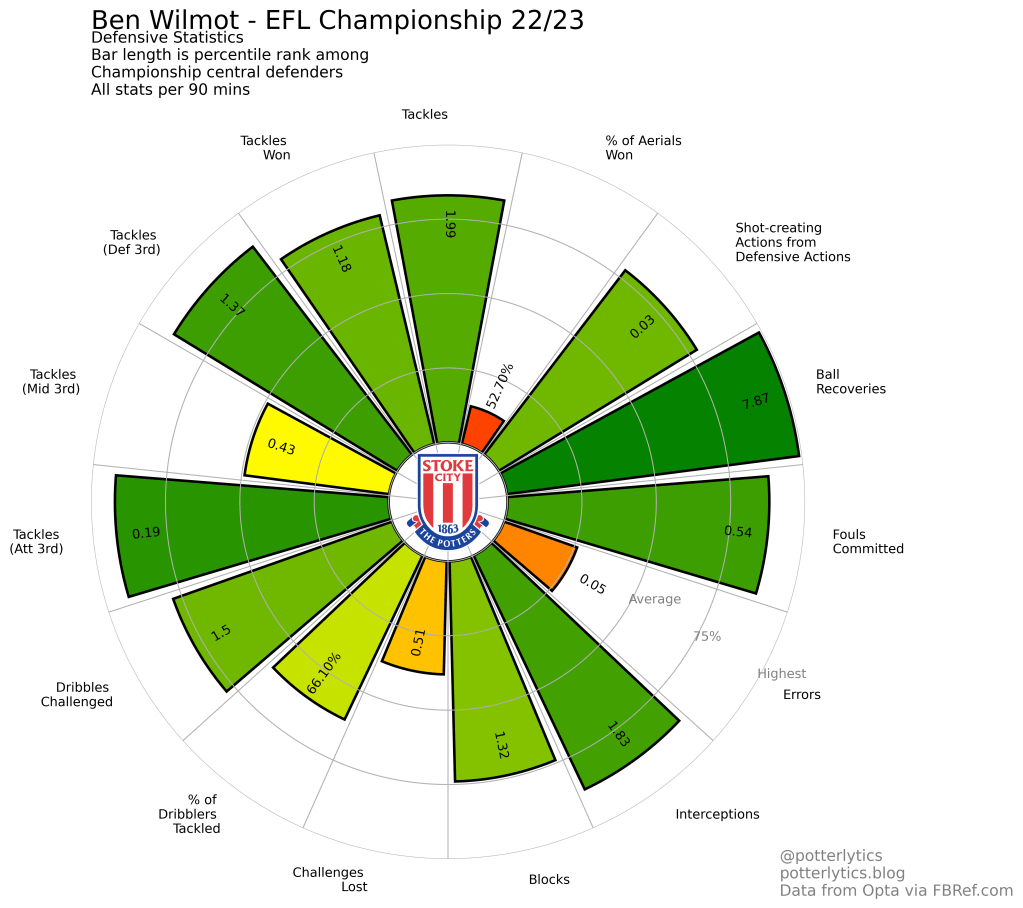
At first it might seem like a garbled mess of colours, but it looks nice, and we can take a closer look and gain some crucial insights into Wilmot’s defensive work here.
Firstly, we see that recoveries, interceptions, and tackles in the defensive and attacking 3rds are well above the 75th percentile. This group of metrics indicate 2 things.
1 – Wilmot’s ability to read the game defensively is a strength.
2 – Wilmot is an active defender who wins the ball back often.
Although numbers are fun, clips are even more fun, so let’s see some examples of that in game scenarios!
Click each image to zoom in

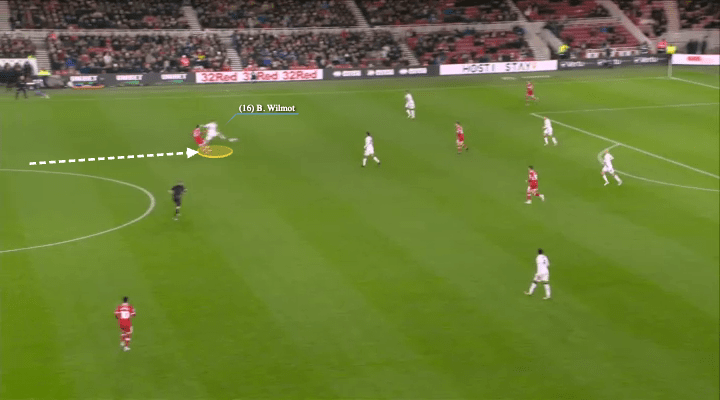
First off we have a quick clip from the recent away game at Middlesbrough. Stefan takes a lofted goal kick towards the Middlesbrough forward to bypass Stoke’s front 2 lines of press, visible in the first image.
The pass is accurate to the forward, but in comes our active defender, timing his run perfectly to arrive with the ball and intercept, leading to a Stoke attack high up the pitch in transition.
Click each image to zoom in
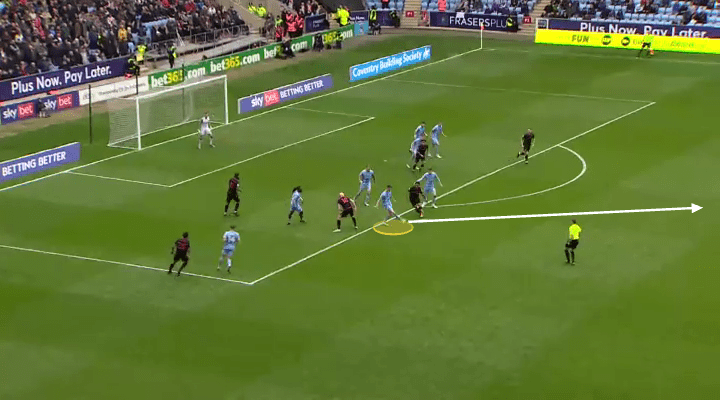
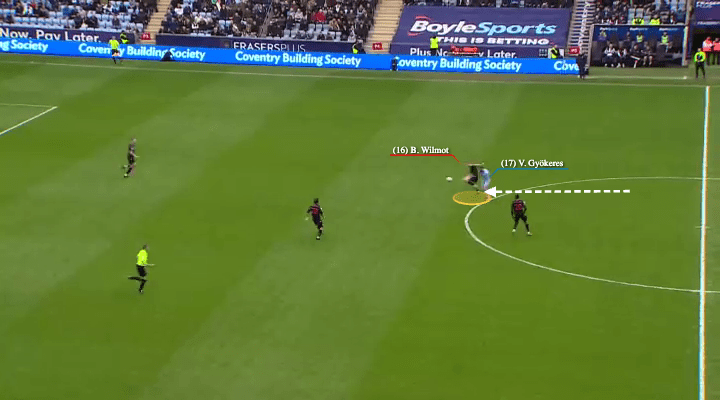
A similar scenario happens in this clip from the Coventry away game.
Coventry, who were relying on hold-up play from Gyökeres to progress up the pitch, play the ball forward towards the halfway line.
Again the pass is accurate towards Gyökeres, but Wilmot times his run perfectly to arrive with the ball and win possession back for Stoke high up the pitch. This is brave defending, facilitated by an excellent tactical and technical understanding of when to arrive at the challenge.
Click each image to zoom in
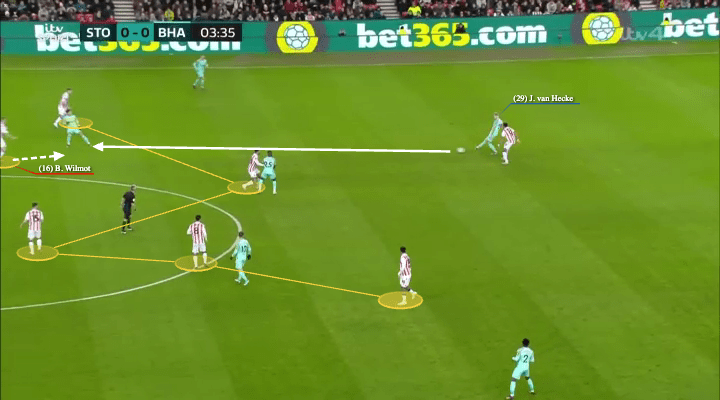

Looking at a much higher level of opposition, in the game against Brighton in the FA Cup, Wilmot is again the active defender.
The ball gets played from Van Hecke through Stoke’s midfield line, and Wilmot takes on the ‘forward sweeper’ role to again arrive at the right time to take possession.
Now Stoke have an opportunity in transition to attack Brighton’s back line directly.
But Wilmot isn’t only useful in this active role, his defensive positioning is also strong in a block, and despite his weaknesses in aerial duels, he is still able to perform well in deeper positions.
Click each image to zoom in


Here we take a clip from the Swansea away game, with Piroe receiving a pass on the turn, 20 yards or so from goal.
Wilmot is the closest defender to Piroe, and so drops to pressure the ball. The main goal here is to avoid Piroe carrying or passing the ball into the shaded area in the second image.
Wilmot stands up, consistently covers the cut inside, and keeps close enough to Piroe to stop him finding space, while staying far enough away to avoid being turned. Piroe is forced wide, away from goal.
By the third image, Piroe is forced to turn around and move to the edge of the box, passing the ball backwards with Stoke’s defence well set in a block.
Click each image to zoom in
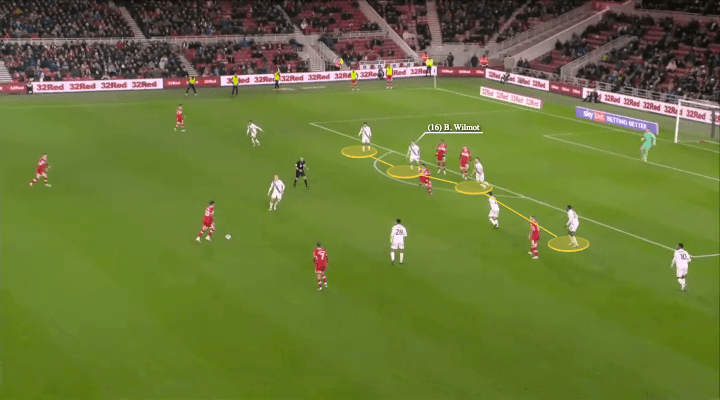
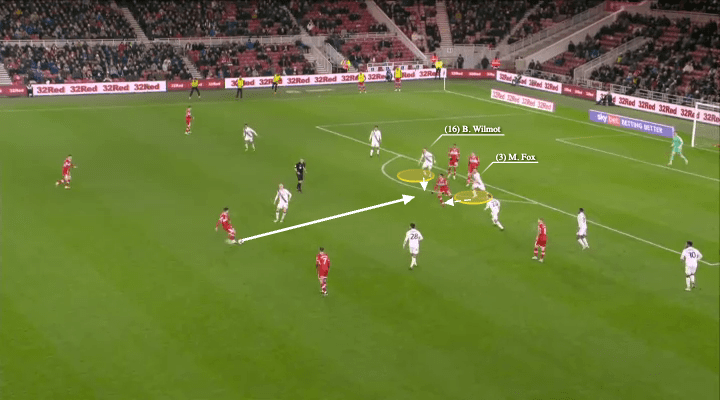

This time, in the Middlesbrough away game, Stoke are set up in a compact block at the edge of their own box. Wilmot is at right centre back in the first image.
Fox, the other centre back, pushes forwards as the Middlesbrough midfielder shapes to play a pass in to the front line. As he does this, Wilmot moves slightly to the left to cover the pass into the two players on the shoulder.
The ball, sure enough, comes into that space, and Wilmot’s intelligence has led to him being able to clear the ball into safety.
It hasn’t all been rosy this season though, and a few errors and misplaced tackles/passes in earlier games did cost Stoke, but as a 23-year-old, Wilmot shows strong tactical intelligence as a defender, a good knowledge of his own ability in when to press and tackle, and a confidence that allows him to step out of defence and be an active part of the forward pressing unit.
If Ben Builds Up, Goals ‘Wil’ Come
But what about the other side of his game? Defenders have to defend, but in a side hoping to win enough games to get promoted, they also have to contribute in the build-up phase.
We’ll stick with the radar plot, and take a look at some of the in-possession work Wilmot has done this season.

Immediately we’re struck again by how active Wilmot is as a centre back. Within the top 25% for touches in the middle 3rd, passes, switches, and crucially, ball progression.
A key part of the build-up play is how a team can break through the opponent’s lines, and we’ve seen in recent weeks that possession without breaking lines doesn’t tend to lead to good performances or results.
Wilmot is particularly adept at playing these line-breaking passes to help break the lines, evidenced by his high ranking in ‘progressive passes’, defined as ‘completed passes (excluding those from the defending 40% of the pitch) that move the ball towards the opponent’s goal line at least 10 yards from its furthest point in the last six passes, or any completed pass into the penalty area’. [fbref.com]
Alongside this, Wilmot is very highly ranked among league centre backs in passes into the final third and passes into the penalty area, with just under 8.5% of his passes fulfilling the ‘progressive pass’ definition above.
He’s also among the highest ranked in carrying the ball forward too, and this quality in being able to break pressing lines through both pass and carry is crucial for top defenders.
This provides Stoke with the necessary penetration to break through pressing lines, and having centre backs who can bypass the first press with a pass is crucial to ensuring that attacks can take place against out-of-shape defensive lines, instead of trying to attack against a full 10-man block.
And even better, this explains the lower-ranked metrics in pass completion and short passes!
Click each image to zoom in

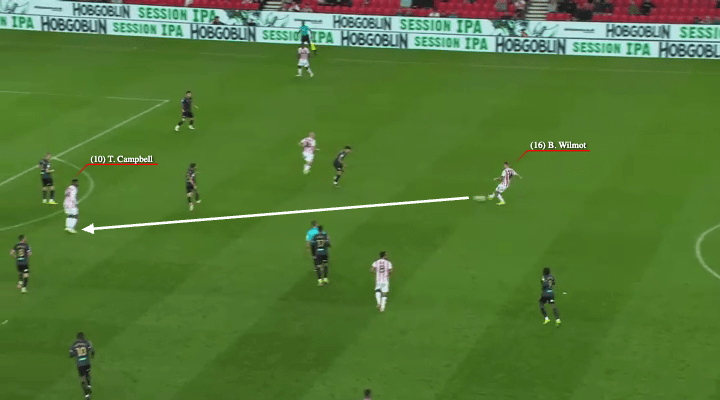
First up we see this fairly straightforward example of Wilmot picking good passes that break the lines instead of playing a simple ball.
The pass should be, as much as possible, always to the player in the most dangerous position possible, with the passing risk as a factor. The amount of risk you accept may vary from manager to manager, but the principle remains the same.
In this case, rather than pick a pass wide, to a player in a fairly non-dangerous position, with no support and a fullback looking to support, Wilmot plays a threaded pass through the midfield line into Tyrese Campbell.
Click each image to zoom in


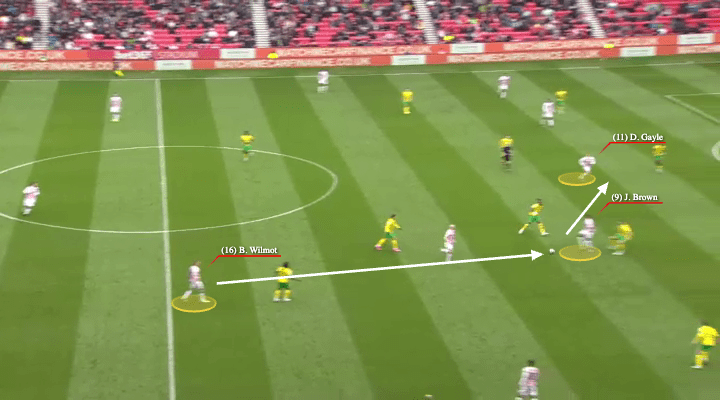
In this situation, we see a similar pass. During build-up, Wilmot receives the ball in his regular spot wide of the centre circle.
He looks up, sees two lines of pressure from West Brom, and picks an excellent threaded ball through to Brown, who flicks into Gayle, and Stoke are immediately attacking the back line of WBA.
The line-breaking passes allow Stoke to switch the tempo from low to high, and to attack those defensive lines directly.
This is a crucial part of the plan for Stoke, particularly when building against sides who are sitting in mid or low blocks. We’ve also seen similar against high presses, in games like Swansea away.
And our final example is a peach, although I apologise for the slightly blurry freeze-frames and the low contrast, blame Sky unfortunately!
Click each image to zoom in

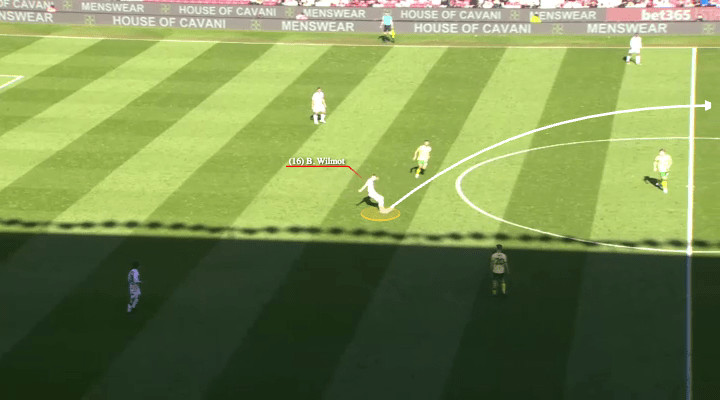
This time we’re at the game at home to Bristol City, and Wilmot picks up the ball in front of the pressing line, which was a very solid and compact mid block.
He carries it forwards to draw the pressing player out, and wait for a space to play the ball into.
As he does so, he spots Tyrese Campbell, hugging the touchline high up the pitch (Hoever was doing similar on the other wing, too) to stretch the play and find space.
Wilmot takes a touch forwards and plays the ball straight into Tyrese.
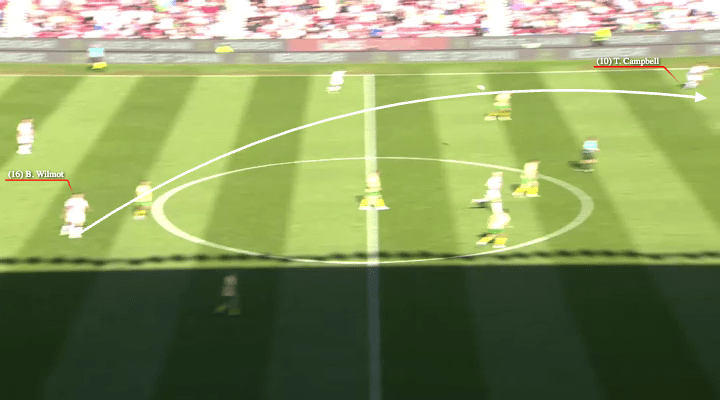
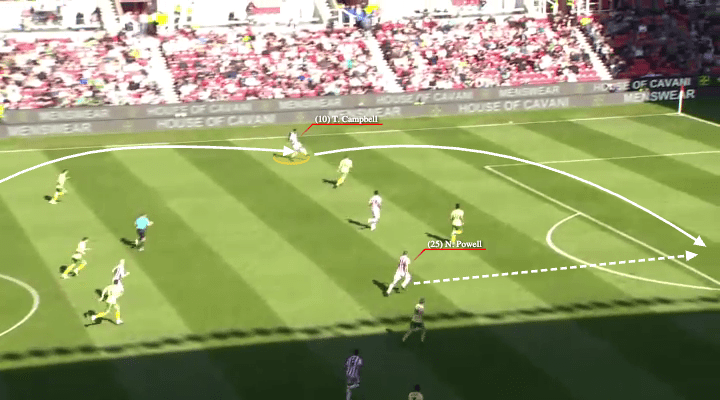
He plays a perfect ball over the top of two pressing lines, that provides Campbell with a great opportunity to attack the defensive line directly.
As the defence isn’t set for this pass, he can swing the ball in to Powell, who finishes into the bottom corner. The tempo switched from calm, possession play in Stoke’s half to a high tempo, line-breaking move with just that one high quality pass from Wilmot.
Get Well Soon, Please
So there it is! A full explanation and a brief profile of the first ever Potterlytics Potter of the Season.
Get well soon, Ben, we want you back in to win it again next season!
Thanks to any and all readers, and please feel free to comment and follow on Twitter at @potterlytics.
Should you wish to donate to help with the running costs of the site, and the data subscriptions we use, please feel free to visit our donations page here. Any and all help is very much appreciated!
George
 Potterlytics