

Part 2: Chance Creation and Build-up Play
Welcome back, to those of you who just read Part 1, looking at sustainability and off-the-ball work, and to those who didn’t go and check it out here (Anatomy of a 10-game Revolution (Part 1) – Stoke’s New Blueprint)!
You join us as we look into Stoke’s remarkable turnaround since February, and to reiterate the context here, let’s look at a brief table.
| First 30 Games – Before Huddersfield – H | Last 9 Games – Huddersfield – H – Onwards | |
| xG For per 90 mins | 1.13 | 2.10 |
| xG Against per 90 mins | 1.13 | 0.90 |
| xG Difference per 90 mins | +0.00 | + 1.20 |
You might say that this could just be a lucky run of fixtures, but as we mentioned in Part 1, this run includes games against 4 of the top 10 most in-form teams in the league, and Stoke’s 10-game rolling xG difference has been above +0.5 for 8 matches now.
Last time we looked at how Stoke’s work off-the-ball work has contributed to this improvement in the underlying numbers, particularly in winning the ball high up the pitch, stopping opponents in their build-up phase.
This time, we’ll look into how Stoke have ramped up that xG for stat, through their own build-up play, and the way they look to create their chances.
If You Build It…
First up, let’s look into Stoke’s building from the back. In a very strong interview during the Sheffield United away game, Alex Neil said the following:
“I thought first half we wanted to try to play and open the pitch out, and to be honest we did that to Sheffield United’s benefit rather than ours.”
“We got a lifeline before half-time by getting a goal, changed it at half-time by not risking it at the back and getting the ball forward, on the front-foot, up against them and aggressive.” [BBCSport]
It appeared that Stoke’s building phase was over, dead and buried, Rest in Peace (2022-2023).
Sure enough, in the following league game, a 4-0 victory over Reading, Stoke did exactly as said in the previous game. They had only 38.1% possession, and the trend continued against Luton in the next game.
Click each image to zoom in

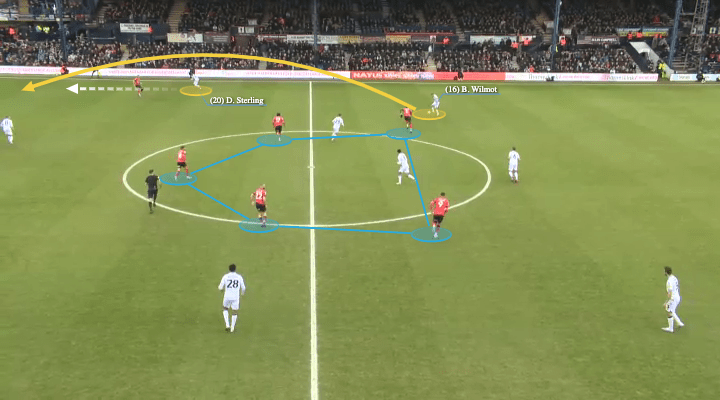
In this clip, Stoke have a free kick just inside their own half. Baker plays the ball short to Wilmot, and we see the plan for Stoke.
Immediately Sterling and Gayle start to bomb forward, and Wilmot clears the ball long into the channel.
Click each image to zoom in
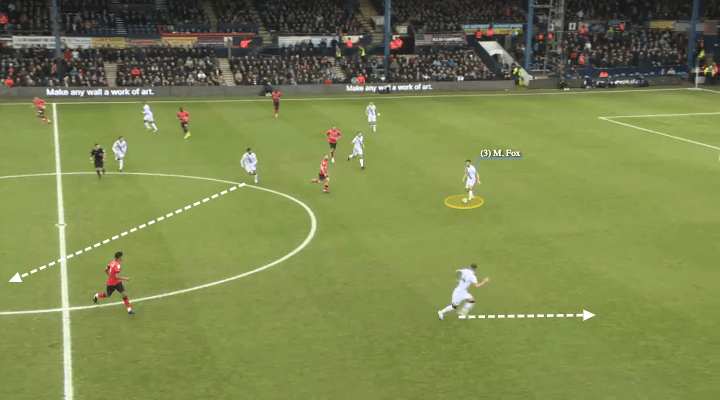

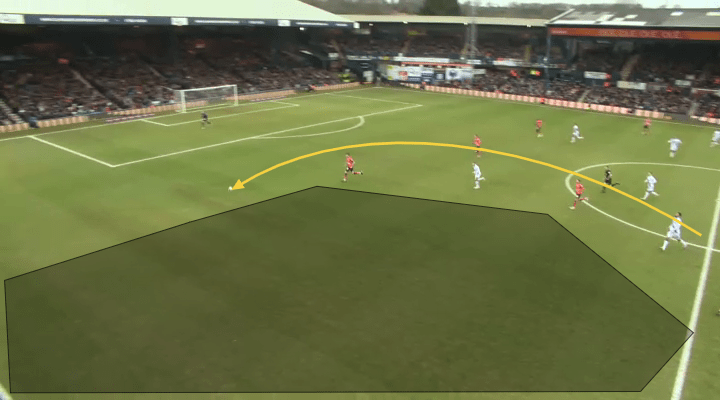
This clip tells a similar tale. Fox receives the ball 20 yards into the Stoke half. As Tymon drops deep to support, Laurent runs forward in the midfield to get into an area of space.
Fox immediately throws a long pass into the left hand channel, unfortunately this time it ends up in Luton’s possession.
So how has this changed over the past couple of months?
Well, let’s look at the two major build-up plans that I think I’ve been able to pull from Stoke’s recent matches.
…Wins Will Come
Click each image to zoom in


This time we look at a Stoke goal kick in their home game against Blackburn. The two centre backs, Fox and Tuanzebe, set up within the penalty box to provide a pass for Bonham. Pearson is in a deeper role centrally to provide an option during the next phase.
The ball goes to Tuanzebe, who plays it across to Fox. This draws the first line of Blackburn’s press, and two forwards close down the centre backs.
Fox turns and puts the ball wide to Sterling, and Ben Pearson moves deeper and wider to provide support. At this point, Blackburn’s first line of press has been beaten, but they have forced the ball wide, and would probably feel like it’s going okay for them.
Click each image to zoom in
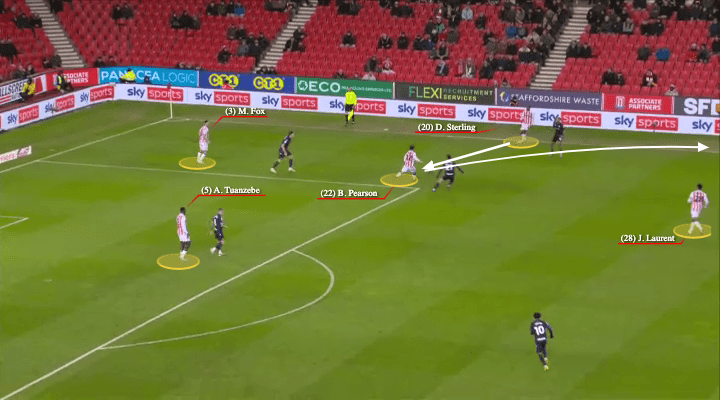
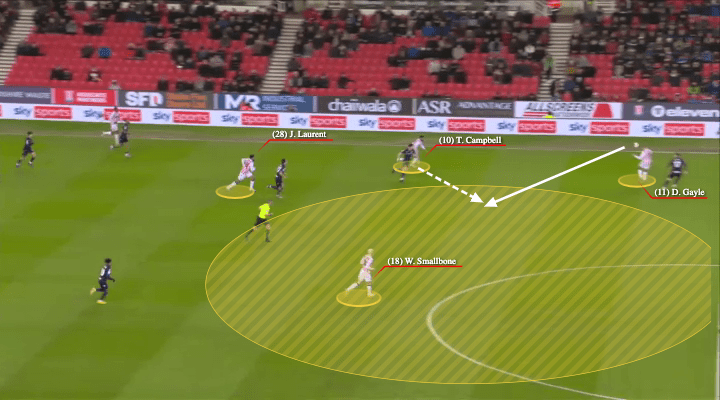

As Pearson drops to support, Sterling plays it across to him, and this is where it gets interesting.
Up to this point, the tempo has been relatively low, Stoke have been playing the ball across calmly and baiting the press forwards.
But Pearson immediately shifts the tempo and puts the ball forward with a high pass towards the halfway line. Note: High pass, aimed towards a specific forward/area where forwards should be, not a hoof like some of the passes we saw vs. Luton.
The switch of tempo and pass beat the press, and Gayle nods the ball back into the path of Tyrese Campbell, into a large space in the centre of the pitch.
The slow tempo passing in the previous two images created this space, by drawing those Blackburn midfielders forward. This is a controlled line-breaking move, known by some as an artificial transition. This allows Stoke to attack a defence that isn’t set, and has spaces available to attack.
At this point, Campbell bombs forward to the opposition box, and plays in Will Smallbone for a high-value chance.
Note how the 2nd image here shows Campbell, Laurent and Smallbone immediately bombing forward as Gayle wins the header. This was a crucial part of Stoke’s build-up in this game.
Interestingly, though, this specific routine isn’t necessarily something Stoke do every match, but as with the press we spoke about in Part 1, the principles remain the same throughout.
Let’s take a look at this build-up from the 0-0 draw at home to Norwich.
Click each image to zoom in
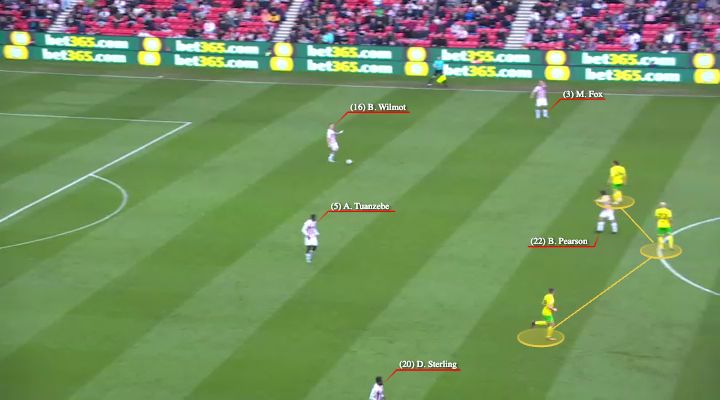
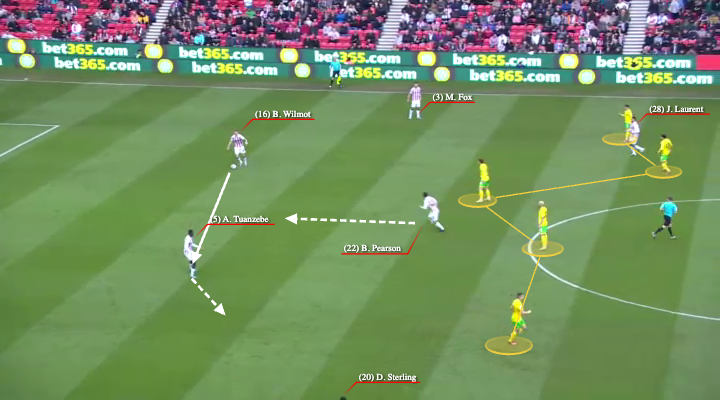

In this game, Norwich dropped into a fairly flat mid block, to prevent Stoke from finding space in between the lines. This is intended to stop the artificial transition mentioned in the last clips, by denying space and forcing Stoke to try to play into areas where Norwich have numerical superiority.
Stoke again play the ball calmly and at a low tempo, with extra space to move into towards the halfway line. Wilmot plays it across to Tuanzebe, who moves wider while Pearson drops into the centre of defence.
This allows Tuanzebe, a very press-resistant centre back, to move forward into space on the right hand side. He exchanges passes with Pearson and moves into that space.
Click each image to zoom in

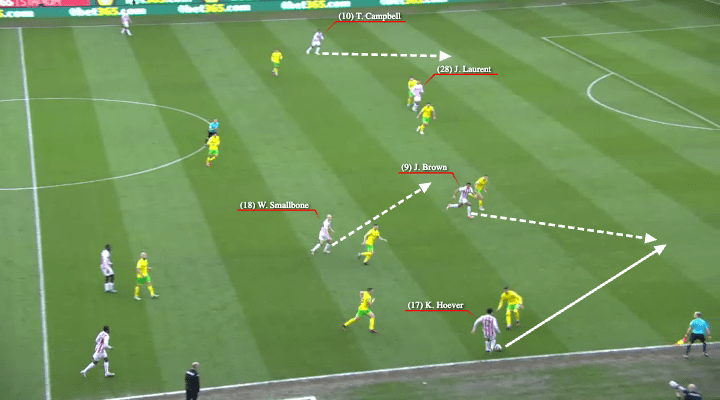
Tuanzebe moves into that space, and we see the compact mid-block shape of Norwich in the first frame.
He waits until the attacker presses the ball, and then plays a pass forwards into makeshift-winger Hoever. Note the movement of Brown, ready to get into position for the next pass in the move. This forward thinking is crucial to breaking down a tough block of compact players.
We also see that Stoke are very wide in possession. Pearson dropping into the quarterback role allows other players to spread out, and we see that despite the ball being on the near touchline, Fox and Campbell are still very wide on the opposite side of the pitch.
Hoever receives the ball and plays it down the line into Brown’s path. Again, We see Smallbone and Campbell running into positions again to receive the next pass or cross.
Again, we follow the same principles as before, drawing the first line of pressure as much as possible with lower-tempo play, then switching quickly to higher-tempo passing, forwards into the midfield or frontline, followed by runners consistently supporting the ball, thinking one or two passes ahead to get into position to receive.
Now in the Coventry game we saw more evidence of another build-up plan, in which Stoke get the ball forward much more quickly into areas of the pitch where they can win first and second duels. This takes advantage of the combative nature of Stoke’s starting XI.
We can see in the plot below that all of Stoke’s forward players are above average in at least one of ‘offensive duels per 90’ or ‘aerial duels per 90’.
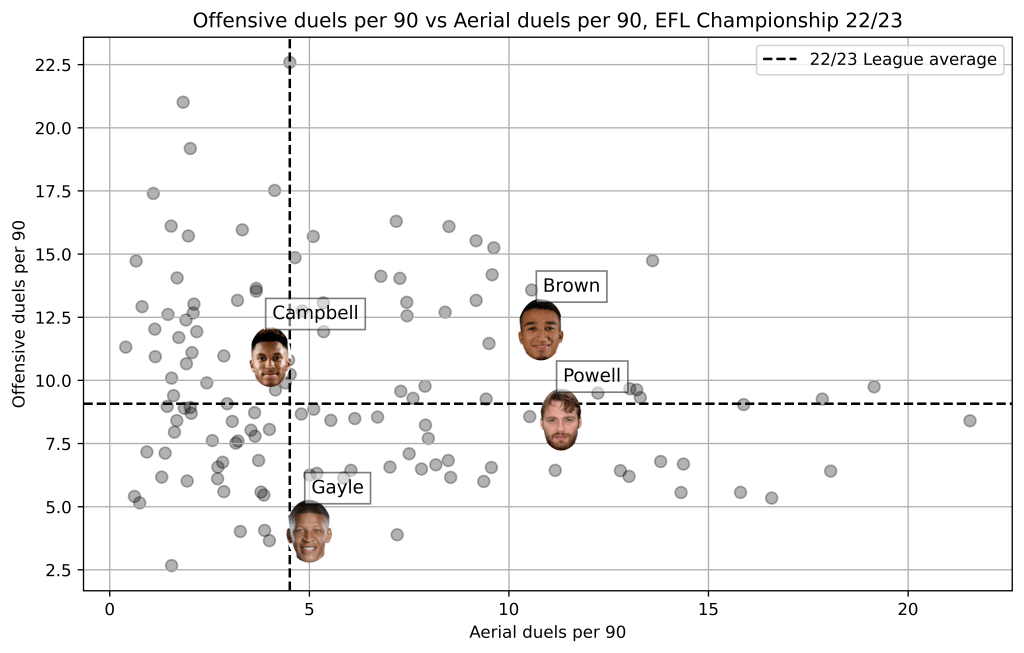
In this case, Stoke are looking to a much more simple plan, but still sticking by the same philosophy.
Getting the ball forward into aerially-strong players like Brown and Powell allows Stoke to crowd an area of the ball, where strong, combative players like Smallbone, Hoever and Laurent can win the second ball, again forcing a transition-like phase of play.
This again means Stoke can attack a defence that isn’t set, and aided by quality, high tempo passing alongside quick attackers, they can exploit the extra space available.
We come to the 3 main principles of Stoke’s build-up:
- Lower the tempo to tempt the opponent to press if possible.
- Quickly change the tempo to expose spaces in the opponent’s lines, either with line-breaking passes or balls to strong aerial threats.
- Get bodies into good positions to receive the next passes.
And while build-up is great, there’s no reason to do any of it unless you can create chances! So how do Stoke go about doing the hardest thing in football – scoring goals?
Now For The Fun Bit
We see these principles merge into Stoke’s chance creation, particularly in the specific (if vague) philosophy of exposing spaces.
But, when Stoke do manage to generate either a true transition, by winning the ball high up the pitch, or an artificial transition through build-up as above, we do see some specific areas that the team look to exploit more often.
Most interestingly in my view, I want to speak a little (a lot) about the xG-geek’s favourite – the cut back.
You may have seen Arsenal and Man City utilise this type of chance a lot over the cause of this season, and there is a specific reason teams target this kind of chance.
Most important of these is that shots from this area are very high-value, in terms of xG. Cut-backs are also ground passes, and tend to be taken first time, both of which are factors which increase the historical likelihood of scoring.
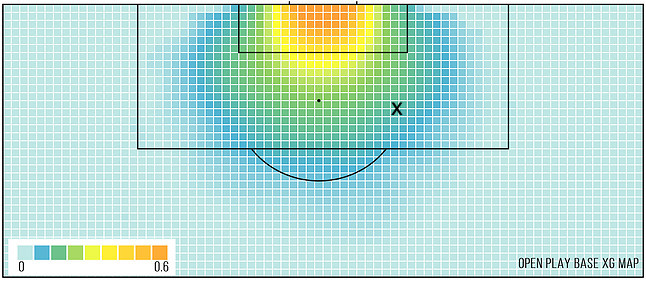
It was incredibly surprising watching footage back of recent Stoke games, just how many of Stoke’s recent flurry of opportunities have come either from traditional cut-backs, or similar ground-crosses to the area around the penalty spot. For the rest of this piece, I will refer to both types of chances as ‘cut-backs’ for ease.
Using the 1v1 skill and quality in creation of left-winger Tyrese Campbell, Stoke look to expose the right hand side of opposition defences. The ability of Campbell to go either inside or outside a defender means that 2 chances can be created by getting him on the ball wide of the box.
First off, we see the specialism of Campbell, the cut in and shoot to the far post (see the work on the Ty-phone Zone here). But more recently we’ve seen that he has been focused on moving outside, down the line, and cutting the ball back towards the penalty spot.
But there are issues. Cut-backs move the ball into areas that teams work very hard to defend, so there are likely to be lots of defensive bodies pressuring the shooter, decreasing the likelihood of scoring.
Stoke have a very interesting way of helping increase their chances despite this, and it involves the impressive rise of Will Smallbone and Josh Laurent.
Let’s look into the second goal away at Swansea, a clip also analysed in our Josh Laurent Profile.
Click each image to zoom in

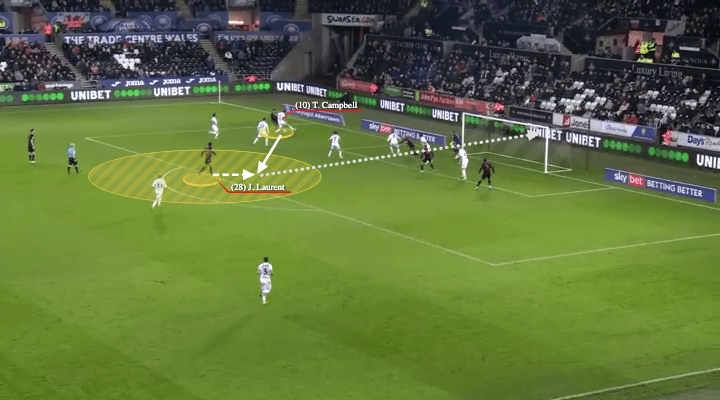
Campbell has the ball at the top of the screen, on the corner of the Swansea box.
He stands up the right back, and we see movement from Smallbone, Brown and Gayle, the 3 forwards, into the 6 yard box. These runs are crucial as the Swansea players are forced to track deeper towards their own goal to mark.
As Campbell beats his man on the outside, these runs into the 6 yard box open up space behind the front line, where Josh Laurent is waiting. The cut back comes, and Laurent powers the ball into the net.
The forward players drag the defenders deeper, opening up space. This is one reason we’ve seen an increase in the number of shots (and goals) from Smallbone and Laurent in recent weeks.
The same happened for Laurent’s finish against Sunderland, as below.

Stoke break forward down the right hand side quickly after a drop ball in their own box.
As Smallbone gets the ball, Gayle has moved onto the edge of the six yard box, taking the defender with him. The quick break forward means Sunderland’s back line is out of shape, leaving space for Laurent to arrive late and finish the move with a goal.
Finally, we can see the move for the 2nd goal at home to Huddersfield, at the start of the run of form.
Click on each image to zoom in

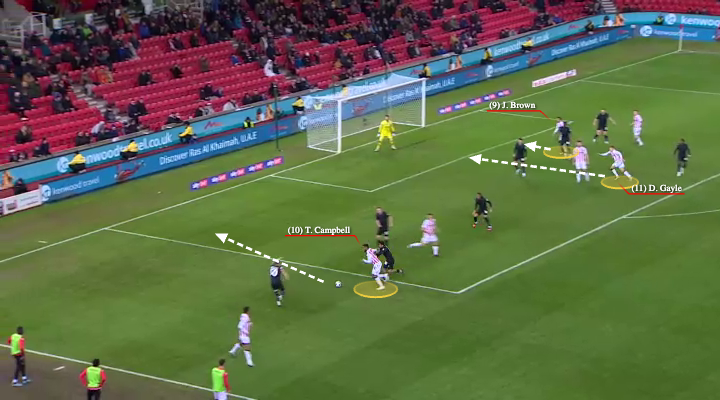
Campbell again has the ball on the corner of the box, but this time Stoke are facing a very set defence, having just taken a corner. In the box there is a 6v4 in Huddersfield’s favour.
Notice that as Campbell starts his run down the line, to create the cutback opportunity, Dwight Gayle and Jacob Brown immediately sprint to get into position in the six yard back to drag those defenders back and make space.
Click each image to zoom in


As Campbell gets into position to play the pass into the box we again see the space created by Gayle and Brown pushing the defenders into the six yard box. This time the pullback comes to Brown, who cleverly drops off the defenders.
After a short scramble and a good save, Brown finishes the move to put Stoke 2-0 up.
We see, looking at the last 5 games of Stoke’s crosses, a big clump of left-sides ground crosses. Most of these are from Tyrese Campbell.
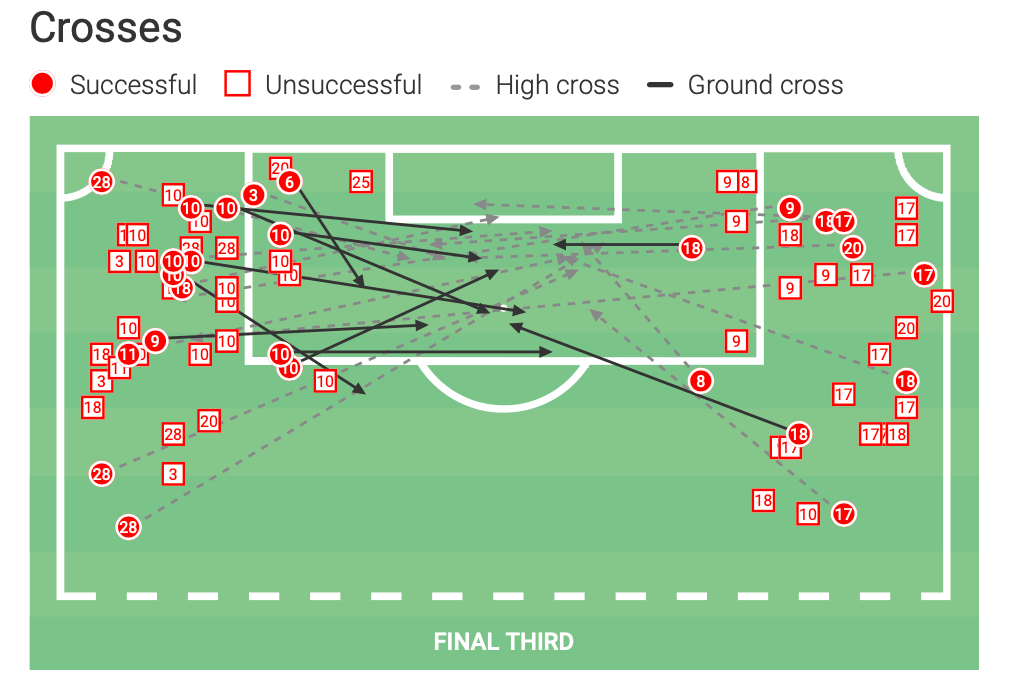
In the last 5 games, Stoke have amassed over 2.1 xG just from crossing, according to Wyscout.
In the most recent game, away at Coventry, we saw yet another chance from the same type of cutback.
I won’t explain each bit frame-by-frame again, but here’s Smallbone’s 0.4 xG (Infogol) chance in the first half. Created by winning the ball just inside the opposition half, Laurent plays the ball to Campbell, and the magic commences.
Click each image to zoom in
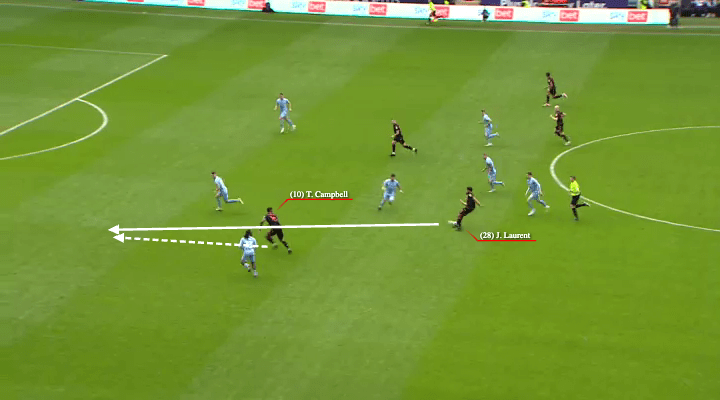

Now I’m not joking when I say I can find at least another dozen examples of this exact move in the last 5 games. There is a really specific drive to create this type of chance from Stoke.
But that’s not all Stoke do! This specific tactic is one among many, but all follow those basic principles we spoke about earlier. Trying to unsettle and attack a disorganised defence is paramount, and we can see some examples of this in other big chances Stoke have created recently.
Central Perks
We’ve focused on Stoke’s attacking through wide areas, but the propensity to create transitional attacks against disorganised defences, alongside excellent passing quality in the midfield and forward lines, can also lead to Stoke playing large numbers of line-breaking passes through or from the middle of the pitch.
Let’s take a look at a few examples.
Click each image to zoom in

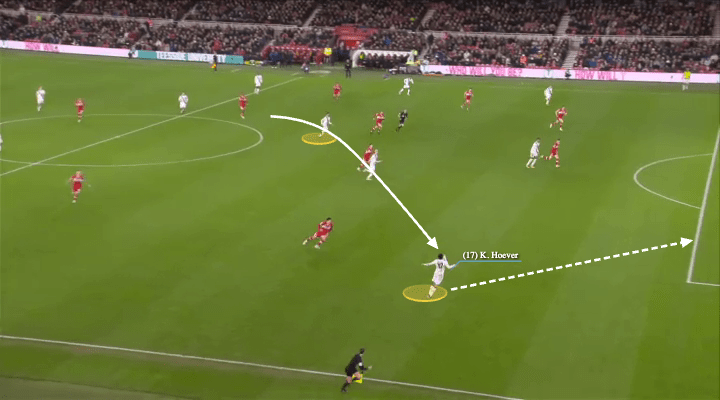
Stealing again from the excellent, informative Josh Laurent profile posted here last week, we go back to the Middlesbrough away game, where Stoke pick up the ball in Middlesbrough’s half, and Hoever bombs forward into space.
Laurent’s quick thinking and quality in pass allow him to deliver a raking ball over the top of the Boro defender, and Hoever goes on to score.
Again we see the same principles that I’ve exhaustively told you about. Quick transition, bodies forward, play the dangerous ball at high tempo to expose uncertain defences.
Click each image to zoom in

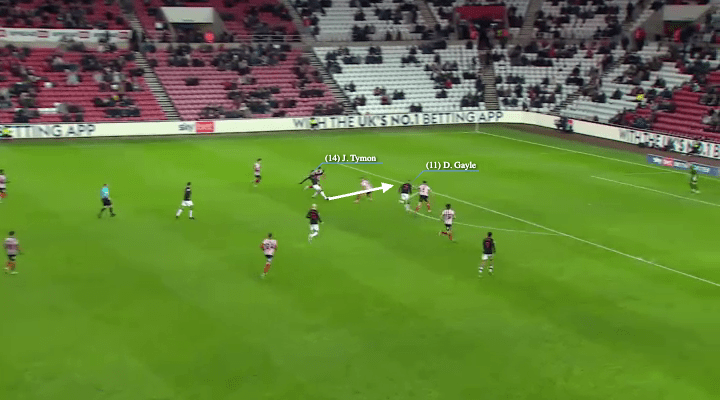

This time we join the Sunderland match towards the end (as you can tell from the stands).
Tymon wins a loose ball back after some nice play from Stoke, and twists past one player to come inside.
He plays a reverse ball through for Gayle who now has a good chance. The keeper makes a save but this is a positive attacking move from Stoke, even late in the game.
Finally, let’s see the whole process of building through artificial transition, surpassing a press, and scoring a goal, come together in this clip of the first goal vs Coventry.
Click each image to zoom in
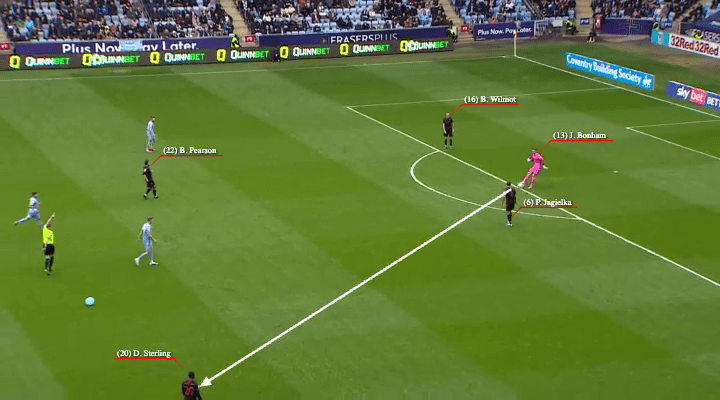
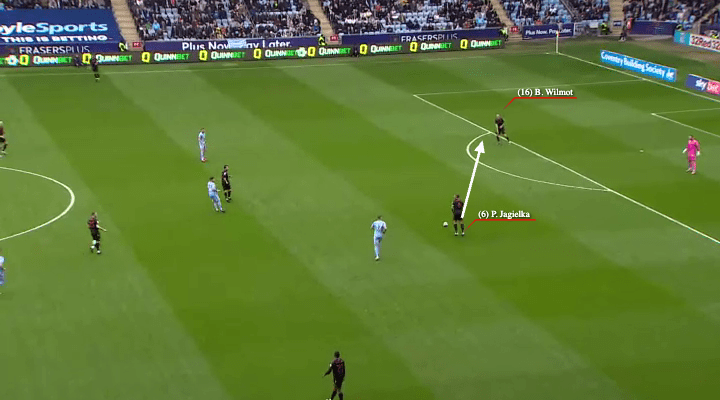
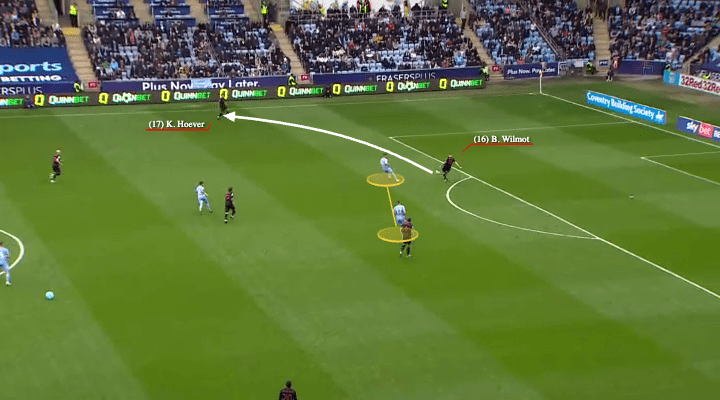
Initially we see a similar start to the examples above in the blog. Stoke calmly pass the ball about in the back line, drawing the two Coventry strikers forward. As the space opens up, the ball moves wide to Hoever, who plays a powerful ground pass down the line to Brown.
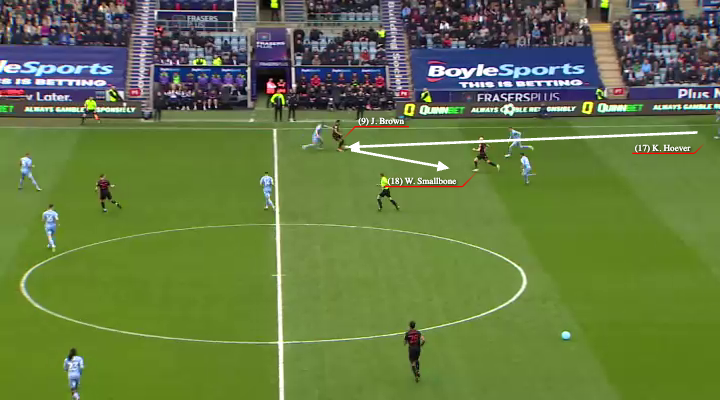
Brown pins the defender behind him, and lays off a pass into the path of the oncoming Smallbone. Now Stoke have exposed some of the space we spoke about above, and are in a position to attack a disorganised defence.
Click each image to zoom in


The ball moves wide to Campbell, a little later in the move, and here we see another pillar of the Stoke philosophy, clever movement from lots of bodies into the box. Brown points out where he wants the ball, makes an exceptional run in between the disorganised full back and centre back, and Campbell curls the ball perfectly into his path.
Again, the speed and quality of the move, abruptly coming from the slow, low tempo start, catches Coventry unawares, and Stoke take the lead.
So we can make our final conclusions about the major philosophies behind Stoke’s on-the-ball plan:
1 – When building from the back, use rapid changes from low to high-tempo play to bait the press.
2 – Play progressive passes with quality at high tempo through the pressing lines to exploit the space created by baiting the press.
3 – If necessary, or when building more quickly through longer passes, crowd 50/50 duels with combative players in order to win the second ball.
4 – Attack the space in front of the disorganised defence with large numbers.
5 – Work the ball wide, use dummy runners to drag the defence into the six yard box, and cut the ball back to late midfield runners near the penalty spot.
Of course, there are more specifics than this, and we saw in the second goal against Coventry that sometimes the plan is just to run fast and kick it long!
But, what I see here is evidence of Stoke targeting clear, data-backed tactical principles, and a few very specific moves that have led to fantastic results on the pitch.
The next few games will be a great benchmark for Stoke, facing teams who are far more likely to sit back in a low block and deny Stoke the chance to create those transitional moments.
It’s been something Stoke have struggled with all season, and despite improvements, they are still underperforming their xG. Given the number of games Stoke have lost while having a strongly positive xGD, we all want to see this issue dispelled in the next weeks.
But there is some really good evidence that Stoke may well have the most impressive side since relegation, possibly even since early 2016.
Thanks to any and all readers, and please feel free to comment and follow on Twitter at @potterlytics.
Should you wish to donate to help with the running costs of the site, and the data subscriptions we use, please feel free to visit our donations page here. Any and all help is very much appreciated!
George
 Potterlytics